Seems I am on the Right Planet After All

I have never been fond of the practice of finishing someone else’s sentences. Memory reminds I am guilty of it but Just beginning 1014less so in later years. Of course, it depends on who’s having the conversation and the nature of their relationship.
Certainly, some topics lend themselves to a cooperative effort in constructing a conversation, sentence by sentence. Consider the combined effort of Pema Chödrön and Oprah Winfrey regarding suffering and impermanence:

Chödrön: “If you’re invested in security and certainty—

Winfrey: “Then you’re on the wrong planet.”*

Yes, indeed.

For me, in this sentence of combined effort is the essence of suffering. We invest in what is no longer possible, seeking a security in what once was. Pain, physical or emotional, comes, goes and will come again only to leave once more.

That we all know pain in our lives is part of the human experience but whether or not we suffer is up to us. In suffering, we hang onto a discontent, staying with a storyline because it is what we know, a trusted buffer.

Such buffers may just as easily blind rather than reveal. In these last two months, I have removed many blinders and buffers, once trusted tools, as I perceive physical pain with a perspective more consistent with the planet on which I live.

The needles of acupuncture, intent in balancing my Qi (energy), present my physical pain to me. Like the crescendo of a wave, the pain intensifies only to even out on the shore that awaits all waves.

These past eight weeks my physical pain has been high as my body awakens, attempting to return to a balance it has not known in decades.  The pain does not stay and it does return but each time the pain is its own new wave, and I, its waiting shore.

It is no longer a battle as I allow my body to do what it does best, repair itself. In fighting my pain I was fighting my body, trapped in the drama of battle, masking my pain as suffering.

on the right planet 1014More and more, I am convinced that all physical pain has an emotional component. It is not that the pain is emotionally created but emotion becomes the storyline of physical pain. Humans tend to respond to stories. We suffer if we stay with them rather than feel the pain.

It is the hardest thing I have ever done, and I don’t know where it will lead. I can tell you where I am right now–living a kind of health that I thought no longer possible. Some days feel like a setback but that is an old storyline of a moment past.

Whatever else, traditional Chinese medicine is affording me an opportunity, challenging as it is. It is not a panacea but hard work. This medicine–herbs, acupuncture and whole food—is helping me remove the ring of fear that surrounds my pain. I just do not suffer as I once did.

It feels as if I am completely rebalancing my life, emotionally and physically. Well, I am, at 62 after nearly four decades of disease. It is balance by moment.  I am definitely on the right planet.

Note: My dear readers, posts may continue to be a bit irregular for a while. To my fellow bloggers, I am quite behind in my reading but I am beginning to catch up. Thanks, everyone.

*Conversation on Super Soul Sunday, aired October 19, 2014.
 

The Eddying of Experiences

Seattle stars 012512

We are stardust—we know that—but as we are dust so are we energy. It is from this energy that we have a momentary experience as a human being, a blade of grass, or an armadillo.

And when we are no longer in this physical dimension, we remain energy, perhaps to know an experience in some other dimension or maybe to return for another physical life, leaving only our dust once again.

Our physical experience is unique to us—each of us has our own vibration—sometimes we’re a wave and other times, a particle.

Since subatomic matter makes up everything we can see and touch and experience in our macro world, then in a sense we—along with everything in our world—are also doing this disappearing act all the time. And so if subatomic particles exist in an infinite number of possible places simultaneously, then in some way so do we.

(You Are the Placebo: Making Your Mind Matter, Dr. Joe Dispenza, p. 183)

The quantum model is staggering with possibility, fascinating and even spellbinding, reality rooted in the pure energy we are. That’s the power of possibility, revealing that magic is real.

KMHuberImage; McCord Park; Tallahassee; Florida

I have always believed in magic, always sensed we had not yet grasped its true nature. For me, the quantum model is a magic carpet ride where the magic is the pure energy of life riding on reality, soaring and swooping, sometimes swirling.

The energy comprising the oneness of reality resembles a whirlpool as it “…fades out and the water passes on, perhaps to be caught again and turned for a moment into another whirlpool,” each its own eddy of experience (Charlotte Joko Beck).

Each whirlpool caught up in its own moment of existence yet ever connected to the energy of coming and going. Sometimes, we’re the  whirlpool, and other times, we’re a drop but always, we are the river.

There are many names and beliefs for the energy animating existence–God, the Universe, the Source. Each expression of this energy—as a human, as a blade of grass, as an armadillo–is a unique experience of life, a momentary whirlpool in the river that runs eternally.

When we learn to move beyond mistaken concepts and see clearly, we no longer solidify reality. We see waves coming and going, arising and passing. We see that life, composed of this mind and body, is in a state of continual, constant transformation and flux. There is always the possibility of radical change. Every moment – not just poetically or figuratively, but literally – every moment we are dying and being reborn, we and all of life.

~ Sharon Salzberg ~

Of Alarms, Animals, and Awakened Hearts

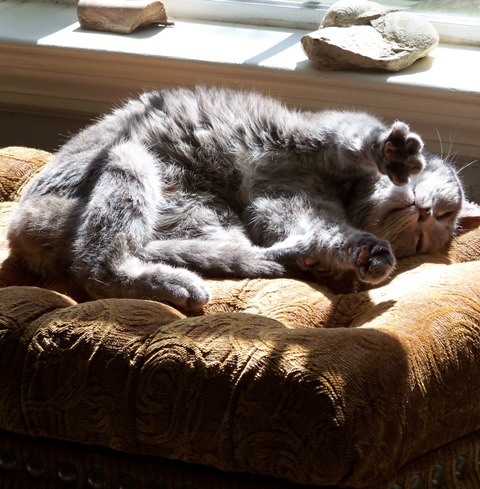
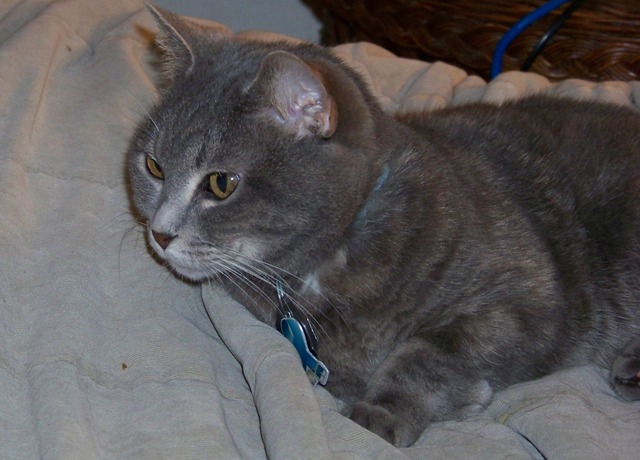
When the fire alarm went off, feline EmmaRose and I seemed sure it had something to do with me. She gave me her usual look of what now? My thought was I had finally succeeded in leaving an empty tea kettle on a hot burner long enough to melt the kettle’s bottom.

Quickly, I realized it was not our smoke detector but the fire alarm for the entire building. It was someone else’s burner/pan/tea kettle. I went outside into the warm, North Florida midnight air as did the rest of the building’s residents.

I did not put EmmaRose in her carrier and take her with me for she has such dread of any interruption of our routine—it upsets her for days—and although she is not fond of the fire alarm, it is not an unknown to her. Was this not yet another human event occurring for no apparent reason?
In her sun 0413

That seemed EmmaRose’s attitude, and she was correct. We never knew who pulled the alarm and probably never will. However, it would take 40 minutes before the alarm was finally silenced. Neither management nor the fire department could locate a key. This was not routine.

Within minutes, I decided the alarm was too much for EmmaRose’s ears. Standing among my neighbors, I heard myself say, “Well, I’m going to go get my cat.” I turned and walked toward my apartment.

Why I said aloud what I was thinking I have no idea but it produced another kind of human alarm.

“WHAT GOOD IS A CAT GOING TO DO??!? HOW WILL THAT HELP US?!?”

My back was to the man who was bellowing. I knew who it was, Carl. He had been talking nonstop to anyone and everyone but no one seemed to want his opinion, especially the firemen.

Still garrulous with my thoughts I shouted, “I think a lot more of animals than I do of people.” His retort was a strong suggestion that I grow up. I offered he might do the same and walked into my apartment.

EmmaRose met me at the door, ready to get into her carrier, and together, we went outside and away from the building but still in the vicinity of Carl’s voice.Eyes Open 0513

“I’ve been on the battlefield! I was in Special Ops! This is nothing! We are all upset!” Then, he stopped and looked around. After a few breaths, he mumbled something to the effect that I was making it worse for everyone.

It seemed more residents were bringing their pets outside. Maybe I had made it worse.

I looked at Carl. “Well, I didn’t think I was but if I have, I apologize.”

“Well, I apologize, too,” he said, adding, “peace?”

“We’re done,” I said.

Both of us remained quiet for the duration of the alarm as did every dog and every cat.

The next morning, Carl and I found ourselves face-to-face, again. We rarely saw each other.

“Good morning,” I said to Carl and meant it.

“So, we’re okay after last night?”

“We’re fine, really.” I extended my hand to him, and he shook it.

“I don’t know why I said that about your cat.”

“The alarm is hard on animals’ hearing,” I said, adding “I didn’t need to say what I said, either.”

“No, that was all right.”

KMHuberImages

At this point, we actually heard each other; our own alarms had finally shut off. For longer than the 40-minutes at midnight, Carl and I acknowledged each other’s value—a traditional Catholic soldier and a Buddhist animal lover—each worthy of respect for the human beings we are, a veteran and a hippie.

Carl is a fine teller of stories and excels at revealing the punch line. We laughed a lot and genuinely. We found common ground in a thoughtful discussion on democracy, in our mutual disdain for both prejudice and the healthcare system.

As he started up the stairs to his apartment and I to my vehicle, I heard the limp in his step, something I had not noticed.

I called out to him. “How do you feel about acupuncture?”

“I believe in it. Why?”

“I know a good one. Would you like her card?”

He says he would. I return to my apartment for the card, and he comes down the stairs to get it.

He thanks me and adds, “When you make a mistake you just have to own up, don’t you?”

“Yes, and then let it go,” I say.

And so we separate with hearts awakened.

The quality of modesty, or humility, comes naturally when we’re attentive. When we see how reactive and unkind we can be, this humbles us considerably.

Instead of causing despair, however, this painful realization can connect us with the tenderness of bodhichitta [or, awakened heart].

Modesty, or humbleness, is the opposite of armoring ourselves: it allows us to be receptive and hear what others have to say.

Pema Chödrön

(No Time to Lose: A Timely Guide to the Way of the Bodhisattva, pp. 134-35)

Sparkling Waverly 1013

Looking Through the Life Lens

Waverly in Fall 0914
Focus is adjusting the aperture of the life lens to reveal the ever-changing depth of field. Sometimes, life requires a wide open lens—the big picture—often, the aperture is small, open only to the current moment. Big or small, clarity creates perspective.

The turning of the life lens is like a kaleidoscope, quick glimpses of what might be, any and all a possibility. Not all choices will be clear, even momentarily, but those chosen find a forever as memories, a clarity all its own.
Almost Focus 0914

These days, my life lens hardly knows where to focus for my aperture is wide open, the depth of field possibilities ever-expanding. I know that infinite possibilities exist in each moment but every once in a while life is so large, it’s hard to decide where to focus first.

Almost daily now, I walk Waverly pond and park for a little focus practice.  Waverly residents are used to me and my aged, Kodak camera. Many of my photographic attempts resemble a quick turn through a kaleidoscope. Later, no amount of digital manipulation provides focus but in memory, focus has soft edges.Losing One's Head 0914

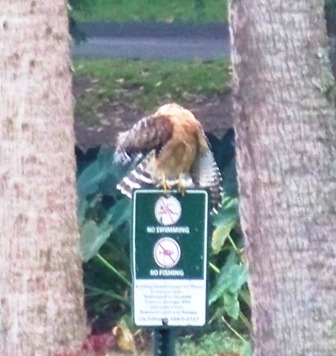
Of late, the resident pair of red-shouldered hawks have been quite fond of perching atop the “no fishing, no swimming” signs that are positioned on opposite sides of the pond.

I have yet to get a focused photo of their perching but I included one in last week’s post, anyway.  From these two vantage sign points, the hawks’ presence on the pond and the surrounding park is a constant and clear reminder to all.

I have learned how close I can get to the hawks, which is usually just out of the depth of field for my Kodak lens. Auto-focus is insufficient so I keep trying different settings.

The hawks balance patiently, providing me one opportunity after another but only my life lens captures the essence of these moments forever.Ghostly Egret 0914

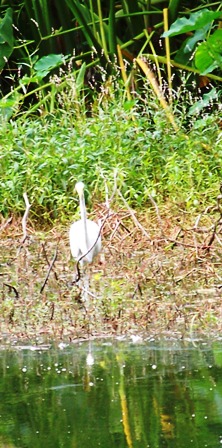
Eventually, I get a clear, sharp picture of the sign sans hawk. This is focus practice after all. Inadvertently, I capture a snowy egret in the background; its image more ghost-like than feather and flesh.

I continue my walk around the pond toward the egret, stopping to lean against a recently pruned ashI see You 0914 tree. I focus the Kodak lens through tree branches and find the egret looking at me so I look back. We stay this way for a bit before the egret returns to fishing, and I, to my walk.

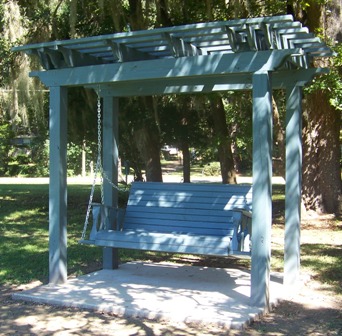
Recently, the neighborhood association added a wooden swing. It is so comfortable that it is rarely unoccupied. From here, the view is as wide open as my life lens aperture can get–timeless focus.

The wooden swing is my last stop. Often, the hawks join me, either alight the light post or perching on the connecting power wire. On overcast, drizzling days, grub from the ground is a favorite.

Sitting on the swing makes focusing the Kodak even more of a challenge. For me, it is a swing in perpetual motion for my feet cannot touch the ground so I sit forward for focus.

The Kodak results resemble turns of a kaleidoscope, with an occasional exception, but my life lens continuously captures Waverly for a lifetime of remembering.
Waverly Swing 1014


Not so Much but Just Enough

The whole harmony of life is a balancing act–not too tight, not too loose. It is not static—this Yin-Yang balance—it is in constant motion, ever impermanent as it shifts and adapts but always it is whole, complete.

The phrase “not too tight, not too loose” is associated with a well-known Buddhist story about a musician—he is a sitar or lute player depending upon the version–who comes to the Buddha for advice on meditating.

No and No 0914The Buddha advises the musician to consider his musical instrument as he asks, “What happens if you turn the strings too tightly?”

“The strings break,” the musician answers.

“And when the strings are not tight enough?”

The musician replies, “They are too loose. A string in tune is neither too tight nor too loose.”

Not too tight, not too loose is the elegant simplicity of balance, whether we are tuning a musical instrument, practicing meditation, or just living our lives day-to-day. Ultimately, imbalance finds balance.

The constant adjusting of imbalance plays out against the backdrop of life ever in motion and always in perfect balance. That is the wholeness of Buddha nature where cacophony finds its way to harmony, ultimately.

The tuning of strings on wood is straightforward but for human beings with so many ways to adjust and adapt what is too much or not enough is not always as obvious.

It is helpful when there is a buddha to ask, although the face of a buddha is not always recognized.

We meet ourselves time and again

in a thousand disguises on the path of life.

Carl Jung

These disguises, or buddhas, are mirrors of well-known behaviors, the “ineffable flux that makes a person a unique being” (Ted Kaptchuk). It is for us to look into each mirror, to seek the unique in the familiar, to open to life as it is revealed. If not, we could miss meeting a buddha.

The uniqueness is the chaos of being alive—the struggle for balance—within the constancy of life, whole in its harmony. Like the strings of the lute, living requires a fine tuning between too much and not enough. And for the sitar, it is how it sings.
No One Way 0914

There is no standard or absolute–what is health for one person may be sickness in another. There is no notion of “normal” Yin-Yang–only the unique challenges and possibilities of each human life.

(Ted Kaptchuk, The Web That Has No Weaver)

As Lao Tzu said, “he who stands on tiptoe is not steady” for the only constancy in Yin-Yang is that it—and us—are ever in flux. There is no one health for all, no normal for anyone. There is only the fine tuning of living—not too tight, not too loose—in attaining balance, momentary as it may be.

Nothing remains; everything passes by.
The only thing that always abides is your witnessing.

That witnessing brings balance.
That witnessing is balance.

~Osho~

Always, there is the passing parade of buddhas, in one disguise after another.

We are all Home

To sit within ourselves is to be at home. Our home is full of emotional energy continuously streaming through our body, the structure we rely on for the experience of being human. All we have to do is sit down.

The more you are willing to just let the world be something you’re aware of, the more it will let you be who you are….

Michael Singer (The Untethered Soul)

Michael Singer introduced me to the “seat of self” as he calls the center of consciousness that is within us all. It is from here that the “great mystery begins once you take that seat deep within” (Singer). We become aware of being aware of the world around us, and we do it from the safety and comfort of home.

Peace is available to us in every moment. We don’t have to go anywhere.

white-heron-110311Some settings may seem more peaceful than others but I find it quite powerful that peace is always available to me if I will just sit down in the seat with my name on it. Everyone has one. We are all home.

A little over twenty years ago, Willie Baronet began his “We Are All Homeless” campaign. He wanted to ease his own discomfort in seeing homeless people. In doing so, he has provided comfort to thousands of others.

Baronet decided to purchase signs from homeless people, offering anywhere from $10-$20 per sign, but that was not what eased his discomfort nor increased his awareness of himself and the world around him.

The purchase was the way to start a conversation with each homeless person who sold him a sign. The conversations continue as his collection of signs grows. It has become a wall of awareness about homelessness and the human story.

Each sign is a line in the story of the multi-dimensional person who created it. Each sign is a single thread in the tapestry of humanity. The stories run the gamut of what it is to be human, sometimes desperate and other times, simply inspirational.

We all are homeless until we come home. Not all who carry signs believe home is a physical shelter as Baronet discovered. Many are home, living in the peace of an open heart. They are always home whether they reside in subtropical peninsulas, high plains deserts or on city streets.

But do not ask me where I am going,

As I travel in this limitless world,

Where every step I take is my home.

Dogen

If we can bring ourselves to sit down in the home we always have—our seat of self—and be comfortable with all that we are and are not, we will find ourselves looking through a lens of equanimity and compassion at the world around us.

Oh the stories we will tell, the stories we will hear.

Weather in weather 0314

Expanding the Cone of Habit

Duff in Outer Space 091414

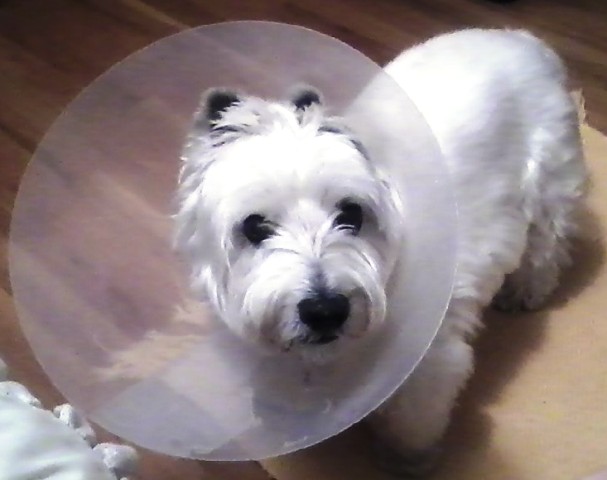
This bright-eyed Westie is a member of my extended family. Formally, he is known as McDuff but to all he loves and to all who love him he is “Duff.” Recently, he had minor surgery on his ears and in order to aid his healing, he wore a cone, a change of habit for him.

Change is how we form habits, forging new neural pathways for our brain to record as a new response to life’s experiences. It is how we physically open up to possibility.

Thanks to impermanence, everything is possible

(Thich Nhat Hanh)

I have been wearing my own cone of habit believing I was open to all healing possibilities. I was unaware that I could not see outside the scope of my cone of habit. It’s easier to do than one may think.

Undoubtedly, there are habits that serve us for as long as we live. Unique to each one of us, we know what they are. It is when we wear our habits as the only way to live that we create a cone, reducing our ability to see alternatives that may even improve our current practice.

Because you are alive, everything is possible

(Thich Nhat Hanh)

Thanks to impermanence, there is always another way. All we have to do is be in the reality we have and adapt like canine Duff. Ultimately, he figured out a way to use his cone to toss his ball, not far, but far enough to create a new way to continue to play ball. He was not confined by his cone.

My health issues also involve mobility. Months ago, I found myself in a situation where I could not walk to my destination and needed a wheelchair. It scared me, and it narrowed my vision regarding my mobility. I gave up walks but continued my daily, gentle yoga flow.

Although I increased my flexibility, the musculoskeletal pain increased and spread up my spine to my neck. Still, I stayed within my cone of comfort. It took a lupus flare-up involving my kidneys to expand my vision.

In opening to the reality I was living rather than being stuck in a moment that may never occur, I expanded my cone of habit and found an alternative health practitioner. Like Duff, I wanted to keep playing.

I did not have to look long or far. There is a licensed physician of Chinese medicine within blocks of my apartment. At my first appointment, I sat stunned as she revealed to me, in astonishing detail, what various teams of medical doctors had taken years to tell me.

Most of my medical history I had not mentioned for I had tried acupuncture previously with no results but I had never met a physician of traditional Chinese medicine.

Her estimation of my prognosis is geared to the life I have. As she reminds me, nothing is 100% but there is relief, and there are alternative ways, if I remain open to them.

After the first acupuncture treatment, I began taking short daily walks, sometimes including a stroll around my beloved Waverly pond. After the second treatment, the searing pain in my right knee significantly diminished and has yet to reach previous pain levels.

With food and some herbs, we are working with the lupus inflammation. There is a lot of hard work ahead but as long as I am alive, I can find a way to play ball, as Duff showed me.

Duff without cone 091414

A Note About Duff: Remarkably handsome, this wise Westie lives in Seattle with my dad and his wife.

Some Awareness This Way Comes

I have developed some issues with my cervical spine so writing and posting are physically as well as cognitively difficult. Like all change, it will not stay but offer alternatives not imagined. Such is the energy in change.

I am reminded of “life is the art of drawing without an eraser” (John W. Gardner). Every moment offers itself to us for the experience that it is without any erasures. Ours is to continue to draw on each moment.

I am grateful for this day

and for every moment I experience

in this physical dimension

as a human being.

May I meet each moment with equanimity,

compassion, loving-kindness, and joy

for all things, in all ways.

These are my lines that outline each day for me, a selection from what others have revealed to me in their writing and in the way they live their lives. I am grateful for these lines that frame my life, a daily awareness that my way comes.

I plan to resume regular posts by September 14th.  As I am able, I will respond to comments. I know I am behind. Yet, do know your thoughtful comments are not only read–always–but carefully considered and quite often are reflected in my posts. Thanks for that.

Oh, and apologies to Ray Bradbury–Something Wicked This Way Comes—the novel and title seemed rather appropriate. As a matter of fact, I just finished listening to it, again, and yes, more awareness my way came.

KMHuberImages


Grace in a Line of Risk

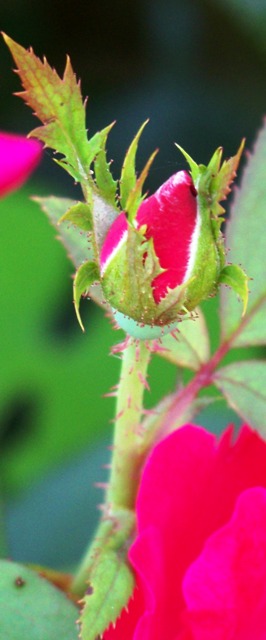
Grace is the bud of a rose in late summer risking the security of self to burst forth as a blossom that cannot close again.

Bud Before the Risk 0814

…and the day came

 when the risk to remain tight,

in a bud,

became more painful

than the risk it took to blossom.

(Elizabeth Appell)

This line has been appearing for around 35 years on journal covers, inside greeting cards, on opening pages of published books and, of course, on the Internet.

The only attribution I had seen was to Anaïs Nin who did not, it seems, write these words. There is a tangential reference to a bud in one of her novels but these words do not seem to appear in any of Nin’s work.

As much maligned as Internet resources are, this misattribution precedes the pervasive use of the worldwide web. I had to reach way back into my memory but I remembered first seeing the quote in the mid 1980s. This time, my memory was accurate.

It seems Elizabeth Appell wrote these words in 1979 when she was known as Lassie Benton, Public Relations Director at John F. Kennedy University (Orinda, CA) and editor of its adult education brochure.

Appell maintains she was “on deadline” when she scribbled those twenty plus words for the opening page of the brochure, perhaps determining their destiny to appear on other opening pages.

As editor, Appell would have not provided any personal attribution. In the ensuing years, the single line would Bud Opening 0814also be offered as a poem with the title “Risk.” Yet, life and truth have a way of revealing their sources, ultimately.

In 2009, the Anaïs Nin Blog received an inquiry about the risk line’s source but it was not until 2013 that Appell decided to offer her story as well as provide a copy of the brochure page that first featured the line.

Appell revealed that she has known of the confusion as far back as the 1980s having read her words in a greeting card. She wrote to the card’s publisher who never responded.

There does seem to be one instance of the poem attributed to Appell as Lassie Benton as well as some anonymous attributions but mostly, the poem is attributed to Anaïs Nin.

It was only when two of Appell’s friends brought her their published books with the quotation attributed to Nin that Appell decided to correct years of misattribution.

And she did so with the grace of the line she wrote. Honored that her hastily scribbled words to meet a deadline have meant much to many, Appell may have taken another risk in her response to a comment on the Anaïs Nin Blog:

I have been writing for a long time. Every now and then I hit a chord, but never like the chord I hit with the “Risk” line. To be in the literary circle of Anaïs Nin is a thrill. I’m proud and grateful.

(Elizabeth Appell)

To me, this story of grace in a line of risk demonstrates the lifetime that unfolds in each moment we experience. Rarely can we know the impact of the series of snapshots that are the moments of our lives. Yet, some snapshots will return revealing their source.

May we have the grace of Elizabeth Appell in the face of risk and blossom.

The Blossom 0814

Bite-by-Bite, a Mindful Remembrance

KMHuberImages

Each August, I remember the day—some four years ago, now–that my gnawing hunger and craving for connection closed the door on the way I lived.

Always, my memory of that pre-dawn, August 12th morning feels crystalline yet memory is the mind’s filter, a selective and often soft light on pain past. Still, the remembrance is sharp enough.

Then, my heart was as empty as my stomach. In all ways, I was perfectly hollow, mindless in my approach to decades of autoimmune disease and related health issues.

I had reached the point where no food satisfied my hunger and almost any food would trigger digestive issues. Thinking 0714My weight just continued to climb no matter what I ate or did not eat. Inflammation was systemic.

My doctors—I had a whole group by this time—increased the variety and type of medication for my stomach and thyroid as well as musculoskeletal pain, more tests for my kidneys, and always more blood work as if to make sure both lupus and Sjogren’s remained rampant.

Mindlessly, I lived, not present for any of it. Rather, I looked to the days when remission would return—as it always had for the thirty years previous—then, I would return to life as I knew it.

There was no remission but there was no organ failure, either. What did happen was a dramatic decrease in my systemic inflammation, my digestive issues are no more, and I have maintained a 68 pound weight loss for 30 of the last 48 months with only gentle yoga for exercise. Musculoskeletal issues, in particular mobility, remain a challenge.

Mine is a life few, if any, would want but it is mine—and I am mindful of it—something I never was in the way I once lived.

Mindfulness is deliberately paying attention, being fully aware of what is happening both inside yourself—in your body, heart, and mind—and outside yourself, in your environment. Mindfulness is awareness without judgment or criticism.

(Mindful Eating, Jan Chozen Bays, M.D., p. 2)

It was the hunger in my stomach that brought me to mindfulness. I had to learn what food my body needed, for each body is unique in its nutritional needs. No two are the same. I had to sort through the food that would satisfy my hunger and ultimately, open my heart.

Eating mindfully is a bite-by-bite experience. Not all foods are equal in nutrients but being mindful of each bite keeps my focus on whether or not the food is satisfying my hunger. I have found I am much more selective in what and how I eat. Why would I eat food that leaves me not only hungry but craving more?

A Gander 0514Am I eliminating my disease process? No, but I am assisting my body by eating nutrient-dense food rather than adding to its burden with empty calories. And yes, it has taken most of these last four years not only to realize the difference between the two but to find food I love to eat.

Grains, even gluten-free, are not something my body processes efficiently but infrequently, I partake. The same is true for any starch or yeast. Sugar brings on “brain fog” and increases my musculoskeletal pain. Dairy and soy I just avoid.

My being present in eating opened me to my life as it actually is, filled with infinite possibilities unique to me. Mindfulness helps me discover them and experience life in ways I never imagined. Every day is fresh, its own possibility.

In creating a physical, compassionate connection with my body, I opened my heart to life as it comes–I connected–this August 12th, I paused to remember. Thanks, regular readers, for walking with me down this memory lane yet another time.