A Festival of Firsts at St. Marks Wildlife Refuge

Gratitude abounds on any visit to St. Marks Wildlife Refuge but on the first Saturday in Festival Crowd St Marks 0214February, the Wildlife Heritage and Outdoors Festival is a celebration that is a refuge for all. The festival is one of many firsts that signal spring.

The afternoon is overcast but warm, almost balmy. Snow, ice, and road closures of the previous week are a mere matter of record. The joy and gratitude of being alive is in the music that is in the air. Hot Tamale is playing.

Hot Tamale 0214Every time I hear Adrian and Craig perform, the music of another century returns–folk, easy listening, country, rock and roll—all songs to which I still know almost all the words.

I sway to the nuance Hot Tamale brings to each cover for Craig and Adrian are also songwriters, sensitive to the music in words. Not surprisingly, their own music is layered in story. Sometimes, it is pure poetry.

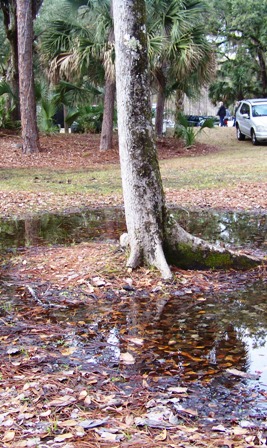
The “natural stage” for Hot Tamale overlooks mini pools of clear water covering golden leaves and amber needles. That is also a festival first as pine and oak trees signal islands of spongy, black dirt tufted like frosting on a cake.

Here and there, boardwalks become bridges to provide passage to and from these “temporary Festival islands 0214 St Marksislands” that offer picnic table seating. Strangers share space, music, and a bit of themselves.
Adrian’s rendition of  “Somebody to Love” echoes Grace Slick and 1971, a year Adrian and I shared similarly, although completely unknown to each other and physically, thousands of miles apart.

In another century, Adrian first sang that song in a gymnasium somewhere on the East Coast, and I, in the Rocky Mountain West, was also singing Grace Slick in a building very like a gymnasium. It is entirely improbable that Adrian and I were singing the same song on the same day for the first time but it is not completely impossible.

The memory moment passes as Hot Tamale turns to calypso–“Day-O…D-a-a-y-O”–there is mention of “The Lion King” and Harry Belafonte but it is the movie that most seem to remember as occupied picnic tables sway in rhythmic response.

A young girl with sunshine blonde, kinky hair whispers to me she has not seen the movie. That is a first. I have never met anyone else who has not seen the movie. I do not ask her about Harry Belafonte. It is enough that we sing along as if we were born to it.

After the performance, Adrian comes over and we hug, saying how good it is to see one another. The young girl wonders whether Adrian and I are sisters, definitely a first. We smile at one another as Adrian responds, “we’re just good friends.”

And then we all talk for a while as friends, new and old, before leaving the picnic table, the makeshift island and the music. I drive on to the St. Marks Lighthouse on Apalachee Bay.

All along the roadside, cars pull over and stop, a wildlife event, as cameras of every size and shape point and shoot, lenses looking East as well as West.
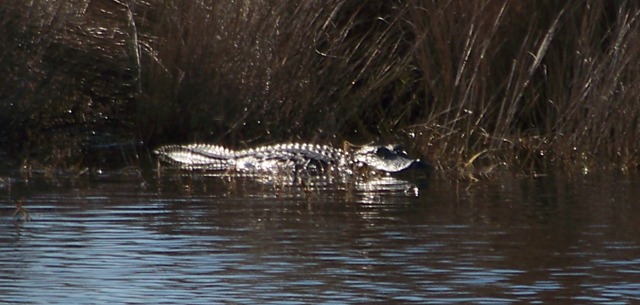
Gator on Festival Day 0214

It is late afternoon now and the warm sun has diminished the clouds, an event welcomed by alligators. In less than three miles, I spot four gators but there are a lot more if the sea of cameras is to be believed.  Waterfowl, mostly cormorants, form a crowd away from the banks of basking gators.

I park near St. Marks River and walk to a point on the bay. It is high tide, a first for me in all the years I have walked the refuge so there is no balancing on old oyster beds. I am content to watch the bay waters lick the sanded shore.

Firsts at the Refuge are a constant whether one visits day by day, year by year, or month by month. The turn of time and tide, the changer and the changed.

High Tide St Marks 0214

When Ice Falls from the Sky in Florida

Snow on unit 012914It is the year it snowed, and the year is yet young–2014 has stuff to strut it seems—already, it impresses. Just the possibility of snow/sleet in Florida is not only newsworthy but requires action.

Whether there will be enough ice from the sky to roll into a snow figure or enough to lie down in to make the wings of an angel are serious considerations.

Snow is an interloper in a subtropical land but the curiosity of experiencing it outweighs its inconvenience.

City thoroughfares and interstates closed, some for over 24 hours, as did I-10 from the Florida border to Georgia and Alabama. Sand is one thing we have plenty of so we spread it about.

I did witness a few flurries that were not bouncing sleet balls of white, although I saw those as well. Decades of Rocky Mountain West wintering renders me a bit of an expert on frozen precipitation. I know my snow.

Whether it was sleet, snow or both, there was ice on trees, rooftops, and even on outside air conditioning/heater units. All are constructed, naturally or otherwise, to withstand hurricane-whipped rain but ice falling from the sky shocks. After all, it has been a quarter of a century since the White Christmas of 1989, and memory does not always serve.

Ice from the sky crossed a boundary because it could or because boundaries are meaningless when it comes to weather. Yet we believe we can predict the temperature and whether or not there will be precipitation.  Whatever we predict, the weather delivers what it has to deliver and moves on.

Watching ice fall from a Florida sky is like watching moments coming into physical existence, not lost in the flurry of a glass, snow orb but one by one, sleet balls bouncing, flakes floating, all completely present and content in their moment of existence, their lives.

Snow on roof 020214

I am reminded of my own moment that is my life. Do I receive each moment as it is given or am I too busy predicting weather that may or may not arrive?  Not opening the gift I am given is a lifelong trait. Perhaps that is why my life span is longer than ice that falls from the sky. I need lots of practice so I have more substance.

The wind cannot shake a mountain.
Neither praise nor blame moves the wise man.
He is like a lake,
Pure and tranquil.
~ Buddha: Dhammapada ~

When I am not the mountain, I am in a winter of discontent, allowing my mind to shake me. Rather than becoming a lake and absorbing all weathers, I am tempest-tossed, neither pure nor tranquil but frozen in flight.

Yet thaw I do, as nature, a force all its own, wends the way it is what with what it has. When I am who I am–unshaken—I am not limited by the weather of the world but open to the weather of its storms.

Ego Pop-Ups: Drama on Demand

If we listen only to our ego, we are never enough and never will be.  The essence of ego is to chatter constantly for that is how it thrives. Ego is not concerned with what choice we make ultimately for as soon as we make a decision, ego considers the choice not chosen and cites consequence after consequence.

The chatter is deafening at times yet it is ego’s duplicity that does it in for at some point, we realize we are caught up in ego’s never ending storyline. Ego is like the pop-ups on our computer screens—drama on demand—our choice is whether to allow or to block.

As humans, our ego pop-up blocker is found in joy, love, gratitude, and compassion where ego dare not tread for within these emotions, we are always enough. There is no need for drama.

Compassion, love, joy and gratitude remind us to be thoughtful in our speech, not to take things personally, to stay present in what we do so we make no assumptions about anyone or anything for when we are mindful, we really are doing the best we can.

Still, some days it seems as if all we ever do is deal with our ego pop-ups. Ego seems to know our vulnerabilities better than we do no matter how hard we try to remain present.  Why is that?
Ego 1113

Michael Singer says that “reality is just too real for most of us, so we temper it with the mind….”  Often, we just avoid those places where ego pop-ups abound or we run rather than facing what is occurring. Other times, rather than blocking the emotional pop-up, we stay with its storyline for it is a drama we know.

It is not for us to cling to our ego drama nor to suppress it. It is for us to acknowledge our ego’s existence:

Like two golden birds perched on the selfsame tree, intimate friends, the ego and the Self dwell in the same body. The former eats the sweet and sour fruits of the tree of life, while the latter looks on in detachment. Mundaka Upanishad

We are not our ego but we are the one who experiences emotions; we are the one who hears constant chatter. When we allow our ego to block us to our true self, we are not enough. Continuously, we surf screen after screen searching for freedom from our ego. Yet, exist with ego we must.

We are partners with our ego, one emotional pop-up after another. If we view our emotions as passing thoughts, momentary screenshots, we ground ourselves in the eternity that is the life force.

Ours is the compassionate response, grateful for the experience of being, of knowing love and joy.  We live as we breathe, inhaling each moment so that we may let it go. We are alive, and it is enough.

Aim for Even: Bringing Zen Into Every Day

This is the beginning of my third year of blogging about bringing Zen, the “meditative state,” into every moment of every day. There is no one way to do this, as I have learned, but Zen is possible in any and every moment.

The meditative state is being engaged in life, immersed in it, actually. “When coming out of sitting, don’t think that you’re coming out of meditation, but that you are changing postures” (Ajahn Chah).

The act of meditating is to sit in stillness while the practice of yoga moves around the body’s fluids. In both, there is the sensation of being alive. Taking a meditative moment at the end of a yoga session allows the fluids to balance within the body. What was in motion is now in balance for the day.

The postures or positions we assume are unique to us as are our everyday responsibilities. We join with one another in many activities, especially in our work, but even our collective effort is comprised of the unique points of light that each one of us is. That is the meditative state, our own Zen, which we bring to life.

Bringing Zen into our every day may mean stops and starts for a river’s flow is not always smooth, choppy or a torrent but rather, it is steady and swirling simultaneously. Making the meditative state integral to our lives is to aim for even, to meet each moment for all that it is without looking ahead or behind.

To aim for even is to “…stop being carried away by our regrets about the past, our anger or despair in the present or our worries about the future” (Thich Nhat Hanh). Aiming for even is to maintain our balance through the rapids of our lives and to float on moments of reflection. One is not more than the other ever.

Aim For Even 1113

To aim for even is to throw off emotional weight past, present or future, to “…see that the emotions themselves arise out of conditions and pass away as the conditions change, like clouds forming and dissolving in the clear open sky” (Joseph Goldstein). Emotions have the substance of a cloud and the energy of the life force, pure and wakeful.

Bringing Zen to the every day is letting the clouds of emotion delight, darken, and dissipate. Emotional balance is more than shrugging off a difficult moment. It is accepting that the dark never stays and neither does the light. Life is impermanent eternally.

“For things to reveal themselves to us, we need to be ready to abandon our views about them” (Thich Nhat Hanh). To aim for even is to forego pre-conceived notions of what or how life should be. To meet each moment is to allow it to reveal itself in all that it is and then respond.

If we allow the meditative state to remind us that silence is always a response, we are able to immerse ourselves in all that comes to us for as long as it may take but not a moment longer for there is so much more to come.

In meditation, we watch thoughts come and go for that is the posture of the practice. In bringing Zen into the everyday, we allow moments to move through us rather than holding onto them.

These past two years of blogging have been rich years. So many of you have revealed to me perspectives I may not have otherwise considered or have ever discovered. Thank you for bringing Zen into my every day, reminding me to aim for even.

The Well of Compassion is Full of Emotion

When we get to the core of any emotion, even anger, we discover a wakeful energy free of drama, unattached to any situation. We have come to the well of compassion into which all emotion empties eventually. No longer do we thirst for we drink what we once found undrinkable.

It is a story we relive all our lives.

Immersed in our own drama, we exhibit behaviors to hide the heart of our anger. It is only when we strip away the story we have told ourselves—perhaps for years—that we discover the core of our anger. Once revealed, we empty ourselves, slaking our thirst with a cup of compassion.
Hawk 3

Not surprisingly, I am thinking of a story about the Buddha and an angry, young man. As the Buddha was walking through a village, he was approached by a young man who screamed at him. He taunted the Buddha, calling him stupid and a fake. The Buddha, the young man declared, had no right to teach anybody anything.

The Buddha quietly considered the young man before asking him a question. “’Tell me, if you buy a gift for someone, and that person does not take it, to whom does the gift belong?’”*

The question was not what the young man expected, and he readily replied, “’It would belong to me, because I bought the gift.’*

“The Buddha smiled and said, `That is correct. And it is exactly the same with your anger. If you become angry with me and I do not get insulted, then the anger falls back on you. You are then the only one who becomes unhappy, not me. All you have done is hurt yourself.’”*

That the Buddha did not react to the young man is anticipated yet in not accepting one gift, the Buddha offered another, the compassionate response: “If you want to stop hurting yourself, you must get rid of your anger and become loving instead. When you hate others, you yourself become unhappy. But when you love others, everyone is happy.”*

The story ends with the young man giving up his anger and deciding to follow the Buddha. Stories are illustrative, sometimes metaphorical, but always they enrich our lives with what is possible. Compassion is always an option, which is not to say it is an easy response. Anger confines, love expands—our choice.

Anger is not easily eschewed either, whether it comes from within or whether it is offered to us. Like love, anger has survived and evolved with us. Chagdud Tulku Rinpoche observed: “Meeting anger with anger is like following a lunatic who jumps off a cliff. Do I have to go likewise? While it’s crazy for him to act the way he does, it’s even crazier for me to do the same.”**

In the 21st century, opportunities abound as daily we crisscross our planet and the paths of others. Each meeting is an opportunity to drink a cup of compassion or to go crazy with the craziness.

*Buddha and the Angry Young Man

**Reacting With Anger

Rather Than Resolutions, Consider Laziness

I am not much on making resolutions for any period of time. My mostly Buddhist self knows that each moment is its own clean slate. Rather than becoming anything or anyone, I just need to meet each moment I am given and aim for even.

Some may consider that laziness, and I accept that label in any year, moment, hour, or nanosecond. As with any feeling or emotion, all we have to do is accept that each emotion has its own drama and demon players. Ours is to experience but not to become.Laziness 010514

Once we have named the emotion—“this is laziness”–we strip away the drama that has kept us from continuing the story that is our life. Laziness is not “…particularly terrible or wonderful…it has a basic living quality that deserves to be experienced just as it is” (Pema Chödrön).

There is no reason to run away or hide from any emotion. Removing the drama reminds us the duty of being alive requires us to experience our emotions, laziness among them.

If we enlarge our sense of what it is to live, we realize events and emotions are mere scenes in a daily drama, each replaced by the next experience. We are moved by the emotion of each experience but sometimes, we get caught.

“Whatever we discover, as we explore it further, we find nothing to hold onto, nothing solid, only groundless, wakeful energy” (Pema Chödrön). Our discovery that we have experienced laziness and that it is no longer worthy of our rapt attention is the dawning of a new day, a new moment or a new year. Transformation occurs when we no longer disguise or repress what our experience is.

“When we stop resisting laziness, our identity as the one who is lazy begins to fall apart completely” (Pema Chödrön). We have named it so that it becomes nameless and no-thing. The ego is revealed for the groundless dramatist that it is.

What remains is the wakeful energy that allows us a fresh look at ourselves and the world around us. We open to the experience of being alive as the drama unfolds yet again. All we need to do is show up and experience.

“Once More to the Lake” for Reflection on the Year

I am a big fan of New Year’s Eve neither for the noise nor for the celebratory streamers but as a day and night of reflection. Over the past two decades, the last day of each year has emerged as a major holiday for me.

Often, E.B. White’s essay, “Once More to the Lake,” comes to mind not because I am ever lakeside on the 31st of December but because this final day of the year has become one of “peace, jollity, and goodness” much like White’s childhood summers spent at a Maine lake in many a late August.

For me, New Year’s Eve is “infinitely precious and worth saving” no matter how I have marked the year. I flip through my memories of months as if I were watching the year as a slide presentation, images catching between ceiling and wall. Memories are often served skewed.

More than anything, remembering a year on its last day helps me “enlarge my sense of things” so that my perspective is not confined like water in a glass but broad and open like the lapping waters of a lake. In other words, I become a lake.

KMHuberImages
KMHuberImages

Remaining a lake is a lifelong process but the idea has intrigued me since I discovered the story of the Hindu master and his apprentice. Every year I re-tell the story on my blog—at least once—this year, the story seemed appropriate as my last blog post of 2013, a way to enlarge my sense of the year past and open myself to 2014.

As the story goes, a Hindu master grew weary of the constant complaints of his apprentice. No matter the day or the place, the apprentice was not satisfied with his life, how it measured up or how it did not.

One day, the master sent the apprentice to purchase salt. Dutiful but doubtful, the apprentice made the purchase and upon his return, the master told the apprentice to put a handful of salt into a glass of water and take a drink. The apprentice complained that the water tasted bitter.

This was a complaint that pleased the master. He then asked the apprentice to bring the rest of the salt and follow him. After some walking, they came to a lake.
Waverly bridge in spring 0413

At water’s edge, the master told the apprentice to throw the remaining salt into the freshwater lake. Then, the master told the apprentice to take a drink from the lake. The apprentice said the water tasted fresh. Again, the master was pleased.

The pain of life is pure salt; no more, no less. The amount of pain remains…exactly the same. But the amount of bitterness we taste depends on the container we put the pain in. Enlarge your sense of things. Stop being a glass. Become a lake.

(Mark Nepo’s Book of Awakening)

The story of the Hindu master and the apprentice frames all my New Year’s Eve reflections. Some years are larger than others, and it is true that as I age, I find life less bitter. Perhaps it is that I drink from life with less expectation and with more curiosity. I like to think so.

I do not have the opportunity to drink from a lake so I sip saltwater from a glass. The sting of the salt reminds me how easy it is to savor only the bitter. It is then that I enlarge my sense of things for the mere experience of life is “infinitely precious and worth saving.”

With Two Wolves is the Wisdom of One

In these days preceding the winter solstice, it is the Cherokee story of the two wolves within that is most on my mind. As the solstice is the darkest day of the year, it is also the solstice sliver of light that reminds us life renews–no matter what. Perhaps on no other day is the nature of fear and fearlessness so apparent.

Facing fear means we sit down with the two wolves that live within us–one light, one dark—and accept that denying either wolf creates a constant battle that cannot be won only continuously fought. Each wolf is the other’s half–left vs. right, good vs. bad, this vs. that—fearlessness seeks the wisdom of the whole.

As far as I know, the Cherokee story is the only version of the two wolves that advises wisdom may be found in both light and dark. Some days feature more of one than the other but insight is born of both. When we admit we are afraid—when we sit with our two wolves–all that is left is fearlessness.

“How you choose to interact with the opposing forces within you will determine your life. Starve one or the other or guide them both” (Beyond the Conflict of Inner Forces, a post at www.awakin.org). That we have a choice is critical to remember for even in the dark of the winter solstice there is light.

Storm Clouds 081913

“Nobody can give you fearlessness. Even if the Buddha were sitting right here next to you, he couldn’t give it to you. You have to practice it and realize it yourself. If you make a habit of mindfulness practice, when difficulties arise, you will already know what to do” (Thich Nhat Hanh).

And yes, no one can give us mindfulness, either—I am beginning to suspect it may be the other half of fearlessness–for being mindful means we meet the dark and light of life without favoring one or the other, only appreciating the wisdom of the whole:

“When we practice inviting all our fears up, we become aware that we are still alive, that we still have many things to treasure and enjoy. If we are not pushing down and managing our fear, we can enjoy the sunshine, the fog, the air, and the water. If you can look deep into your fear and have a clear vision of it, then you really can live a life that is worthwhile” (Thich Nhat Hanh).

The here and now is the only reality we ever have; to meet it fearlessly is to live life as it unfolds in the dark and in the light.

For me, these waning days of 2013 offer more unknown than known—maybe more light than dark or more dark than light—regardless, I sit with my inner wolves, mindful of the promise of the winter solstice and the wisdom of one.

(Regular blog posts will resume by December 29, 2013).

Recognizing What is Going On is a Mere Act of Being

Just the other day I realized I rarely recognize opportunity as it is unfolding.  Not rushing to label opportunity and put it in its box is a lifelong pattern and a beneficial one at that. It may be that not labeling any moment is what allows us to be most mindful and, thus, most present in our lives.

Do not try to become anything. Do not make yourself into anything. Do not be a meditator. Do not become enlightened. When you sit, let it be. When you walk, let it be. Grasp at nothing. Resist nothing.

~ Ajahn Chah~

The mere act of being invigorates us whether the energy we are feeling is familiar or seems a spark, strange and unknown. Regardless, the energy of each moment is unique, unattached, not ever having presented in quite the same way. All we have to do is let go of preconceived notions. That is the nature of being.

The meeting 112113

In the past few weeks I have had a lot of practice with just being. Although I have been more overwhelmed than not, I discovered an underlying energy I was sure I no longer had, a gift bright and shiny but an awakening as well as a remembering. Simultaneously, the energy I am experiencing is new and old so it is not surprising that I lurched a bit, trying to rely on past experience when all I had to do was just be and not be anything.

Regular readers of this blog know I have benefited from a diet of whole foods as well as a regular yoga and meditation practice. Regarding the diet, I am entering my fourth year of low sugar, low starch, lots of leafy, green vegetables and gluten-free grains; for the last year and a half, I have meditated at least six days a week and usually daily; I am approaching the six month mark of a regular yoga practice, which is all but daily.

I am now realizing a steady energy from this combination of diet, meditation, and yoga. However wonderful it is, there is even more. A professional opportunity is within my grasp, one I could not have imagined.

Amazingly, rather than greeting the opportunity mindfully—just being who I am–I relied on well-worn behaviors of the person I was. I fell into old patterns and not surprisingly, I started feeling physically and emotionally drained yet it was not a full lupus or Sjogren’s flare-up. Not at all.

KMHuberImages
KMHuberImages

It was as if I did not trust the person I am now. I knew I was being given more than a chance to contribute substantially to improving lives of animals; I was being given a chance to be a member of a professional team again.

Rather than being invigorated, I held opportunity at bay. I was so afraid of failing and at the same time I was so sure of succeeding. Then, I “recognized what was going on” as Pema Chödrön would say:

When we are distracted by a strong emotion, do we remember that it is part of our path? Can we feel the emotion and breathe it into our hearts for ourselves and everyone else?… And when we can’t practice when distracted but know that we can’t, we are still training well. Never underestimate the power of
compassionately recognizing what’s going on.
(Pema Chodron)

It is early days in adding this professional world to my online writing life but that I am able to venture into that world is one of the greatest opportunities of my later life.  And yes, autumn—my favorite season—overflows with gratitude for this unknown, emerging life. Such is the mere act of being.

The Eternal Now of All Seasons

The holiday season and I have an ambivalent history. Some years, I was unable to let the season go, and other years, I never quite showed up for it. Yet, there is one seasonal constant: tradition says we harvest in fall and give thanks; as winter begins, we give gifts, goodwill among them.

All that is left

to us by tradition

is mere words. It is up to us

to find out what they mean.

~ ibn al-`Arabi~

In the Midst of 112113

Each holiday season, I reconsider its traditions in words well-worn as well as new ones:  “…to be detached from both the past and future [is] to live in the Eternal Now.  For in truth neither past nor future have any existence apart from this Now; by themselves they are illusions” (Alan Watts).

The promise of the Eternal Now is life as a seamless season, gifts available in every moment of eternity. If we embrace this holiday season as the Eternal Now, we open ourselves to a way of life that extends goodwill this day and every day.

Yet, any moment of the holiday season offers us experiences that unwrap us raw. These are gifts that cannot pass quickly enough–or so we think–whether it is the first holiday of loss or just another year that we mark a loss. We remember, as we should.

Like the holiday season, the Eternal Now is not a matter of endurance but a matter of meeting each moment just as we are. We may only manage a breath but that is enough to take us into the next moment. Emptying ourselves into loss opens us to gratitude for having loved at all. In love, we let loss go.

Strolling along 112113
KMHuberImages

For those holidays I could not let go, I was clinging to the bright and shiny rather than experiencing them. I never really opened their gifts. In those years I completely avoided the holidays, I was surrounded by sparkling gifts not only unopened but unnoticed.

In trying to hold onto a moment and make it stay, we cause ourselves to suffer; if we refuse to show up, we are still seeking what is not and we suffer.  Yet, the field of infinite possibilities is always available to us as long as we breathe for we are never out of sync with the Eternal Now, no matter what.

“You may believe yourself out of harmony with life and its Eternal Now; but you cannot be, for you are life and exist Now—otherwise you would not be here” (Alan Watts). We can celebrate our entire lives with the warmth of the holidays if we remember that existence— the Eternal Now — is always in perfect harmony.

My gift to you, and thus to me, is a life lived in the Eternal Now in all seasons.

Regular blog posts will resume December 8, 2013.