Looking into Nature’s Mirror and Finding Grace

Waverly Larch Spring Nubs 0313The cycle of seasons is nature’s mirror, ours for the viewing. Mostly, we celebrate a new season but not always the length of time nature takes to make the change.

We assign spring a date, anticipating an event that may or may not arrive as assigned. Arrival is always a mystery. In a moment of grace, nature unfolds in its own time, in its own way.

“I do not at all understand the mystery of grace—only that it meets us where we are and does not leave us where it found us.” Anne Lamott

I do not understand the mystery, either, but I am content for the experience of it. All I do know is that grace transforms. And like spring, it is its own mystery.

Grace flows with the majesty of a meandering river. Part of its mystery is the gradual eroding of its course, without beginning or end. We do not know the precise moment we are transformed. We only know that we are.

In grace, we do not wallow or stagnate but discover and re-discover the spring of our lives not so much as to re-live but to be reborn in yet another season.

Spring is not a one-time event.

Grace moves us to deeds we once thought impossible. In each spring of our life, we emerge anew. Grace allows us to bare ourselves as we are—to take the risk again—to meet each new spring we are allowed.

We are given only one body to grow but we have the gift of grace to transform, to meet yet another spring. Our seasons cycle within our hearts, bold with the opportunity each affords.

We need not remain wrapped in winter, blanketed in its protective shell. Like nature, ours is not to stagnate or to wallow but to transform from a winter’s day into a spring’s blossom. It is the way of grace.

The bud opens, and life begins anew, yet again. There is grace in this falling away of one season for another, a radical change replete with uncertainty.

As we are revealed so are we seen. Grace unlocks our softness.

A Day in Search of the Theory of Everything

I am at the point in my life where I can appreciate every day of the week as just another day.  I keep plans to a minimum. It keeps me open to just what any day can bring.

Every once in a while, a day does take on a life of its own. Often, when there is a plan involved. So it was with last Monday and my plan to see the movie, The Theory of Everything.

The day began like any other Monday as I perused my WordPress reader for a #MondayMusing post to share on my Twitter feed. The first post I read–Core Spirit–made an indirect reference to the Theory of Everything.

Far and Away 0315

It is a thoughtful essay on consciousness, in particular the differences between the scientific perspective and the spiritual experience. These differences are centuries old.

To me, science confines itself to the natural world, what it can prove/observe.  Those in the spiritual community—poets, philosophers, religions—confine themselves to the experience of just being alive.

In the Core Spirit essay, scientists seek to define the natural world; the spiritual seek “communion” with it. Yet, it is a world we all share. That we have unique and different perspectives should serve to broaden understanding—fuel curiosity—ultimately, it still divides rather than informs.

As for the Theory of Everything explaining all the laws of nature and accounting for all that has ever happened? The essay ends with: “Einstein said that knowing this equation would be reading the mind of God” (Core Spirit).

Closer 0215

To my mind, agreement upon that equation will not come readily but then I am one who immerses herself in the wonder of the moment. Science may  find the equation; some say it already has. For me, science only adds to the awe.

I was pleased at the coincidence of coming across the post on the day I planned to see the movie about the Theory of Everything.

I checked the movie’s show time once more before leaving but paid no attention to the movie theatre location. That, I was sure I knew.

When I arrived at the third movie theatre location, I was told the movie is now out on DVD. The movie theatre employee looked at me askance, of course, but she did have to make a phone call to discover that information. We both learned something.

If I had read the complete movie listing, I would have discovered the fourth location where the movie was, indeed, playing at that specific time, out on DVD or no.

Of course, it was too late to drive to that location. I was not dismayed. There might be a day to see the movie but it was not that day.

Perfect Shell 0514

Once home, I checked my email. Within the last twenty minutes, I had received an email from the Washington Post, asking to re-publish “Learning Zen from a Beagle,” my post about a blind beagle showing me the way.

Had I gone to see The Theory of Everything, I would have missed being available for a back and forth email session with the Post editor. I would have missed this moment in my life. Maybe, I would have missed everything now unfolding.  Maybe not.

As for my next plan to see The Theory of Everything, my name is in the local library queue. On another day, my name will come up. Who knows what will unfold.

 * * *

For a thoughtful and concise post on the equation and the Theory of Everything, here is Matthew Wright’s “How Stephen Hawking Reconciled the Irreconcilable.”

For a considered discussion on consciousness, here is “The Akashic Field and Consciousness.”

If you are interested, here is the link to the Washington Post’s republication of “How My Blind Beagle Taught Me Zen.”

Monarch Meditations on Butterfly Warriors

Rock and Hard place 1014

It is just dark, the morning darkness that precedes every dawn, the stillness before the splash of the sun that becomes the light of day. This is the pause—the moment of stillness—before the stirring begins yet again.

Most mornings I immerse myself into the stillness—my meditative state I call it—for when I do, there is a shimmer to the day that seems to rub off onto me as well.

Yet, there are days upon leaving my sleep state that I am aware of a mind-body consensus considering “what if we just rest today” and not really awaken. Mind knows that skipping meditation means body will not have to stretch itself with yoga.

There is a cascade of memories—perfect in their replaying of such lazy pleasure—of what past days of rest have meant: comfort food, marathon movie watching, binge reading.

It is the escape offered to the day at hand. Almost always, I decline the escape route. But every time I do, there is an acknowledged appreciation for what that escape once meant. It remains an old friend rarely visited.

Instead, I sit and remember the warrior monarch butterfly, a true bodhisattva and a welcome memory on the mornings I hesitate to meditate. The complete metamorphosis of the butterfly reminds me why I meet each day I am given.

It is the butterfly who gives up one way of life after another—each stage fraught with life-ending possibilities—for to fly is to know the freedom of walking on air. From the stillness of the larva the caterpillar stirs to its search for sustenance, consuming one leaf after another.

There is a reward for all this eating, and it is not one of rest but rather it is the spinning of a pupa—the chrysalis—a chamber of life as tissue, limbs, and organs of a body that once crawled become a body that now flies.

No new life emerges until the old is transformed into what is necessary for the life that awaits.

And for the monarch warriors, there is a 2,500-mile migration critical to its survival, a quest that relies not on individual warrior monarchs but on all monarch warriors living their lives to ensure the species.

Safety in Numbers 1014

The monarch warrior moves through one form of life after another without wondering about the ways of existence. Such consideration falls within the realm of the human species.

We yearn to be like the monarchs, warriors working together, not singularly, to ensure our species survival. We might ache for metamorphosis but we do not easily let go of our accumulated experiences, especially those that seem to require so much of us.

“We don’t want to go through that again,” we say, which we won’t, of course, not exactly. Perhaps the monarch warrior does know this.

We want to spread our wings without changing who we are. We are agreeable to making necessary changes—an adjustment of our very being—as long as we are allowed to keep what is most dear.

We may not be as fearless or as selfless as the warrior monarch but we are just as connected to existence. We are born with the capacity for complexity rather than the singularity of purpose of the warrior monarch.

I have to wonder just what the warrior monarch might know for it is my nature to wonder. And so I do. On most mornings in the stillness before the stirring begins yet again.

Releasing the Fragrance of Forgiveness

Lately, I have been writing about transformation, in particular the changes I am experiencing with my health. And this week, there is even better news. For the first time, my acupuncture physician felt all of my pulse points. For me, that is huge—to say it is remarkable is not an exaggeration.

It indicates more movement than stagnation. It is as if a way of life, a mindset, is dissolving, breaking up. There is still some stagnation but the decline is being reversed as my cell structure changes in my body’s attempt to balance itself.

Transformation offers what has never been. If not a new body, literally, then a body and a being “falling in love with life, again” as reader Val Boyko so generously offered in the comments on last week’s post.

That more life is pulsing through me accounts for my increased energy level; also, it seems accurate to say—now–that my pain level is also in decline, albeit a slow one.

Flying Away 0115

Transformation occurs in its own time—patience is essential–but the benefits are life-changing, literally. I find I am more present in each moment. I do not want to miss any of the unfolding of any day so I am less likely to pay attention to mindset. There is so much new to explore.

Still, the mind prefers calling up the tried and true of old, a series of steps followed again and again until they are, well, set, as if in concrete. Mindsets are the known, limited in effect and thus, predictable, perhaps even stagnant.

Yet, I do not believe that a mindset is without its worth. Not at all. Rather, it is our own bank of experience. Mindset makes us who we are.

Mindset is what we bring to the moment we meet transformation. Then, we have a choice: same-old, same-old secure or the unknown of transformation.

“Patience, grasshopper” is a line I have met many times these last months yet sit I did and do still. My impatience is less for I found that in being patient, one finds forgiveness, the ability to let go of the debt that accrues from all regret. It is the way to open one’s heart to all.

KMHuberimage
Not a Violet but a Petal

Not surprisingly, I returned to a favorite quote. Forgiveness is the “fragrance that the violet sheds on the heel that has crushed it.” Though often attributed to Mark Twain (since the 1970s), it seems its present form is a compilation of phrases from centuries past.

No doubt the thought stays with us for forgiveness is such a struggle for humans.

There is a firm delicacy in a violet petal forgiving the heel that crushes the life out of it. Soon, the fragrance dissipates but it lingers just longer than life. That is forgiving the debt.

The fragrance reminds that in forgiveness we are transformed–a mindset shattered for what is yet to come with no regret of what has been.

Transformation requires we accept every step we have ever taken; it requires we acknowledge every action or decision, given or received. None can be undone. All steps are ours to own, to accept, and to release.

As always, forgiveness—a journey deep and often dark—begins within us. We cannot offer to others what we do not give to ourselves. In the moment we accept all that we have been, we release the fragrance of forgiveness.

We focus not on what crushes us but on what releases us.

The Magical Spice of the Gingerbread House

Perhaps the real spice in ginger is its magic, similar to the sparkle more in evidence this time of year than during other seasons. Resembling ginger’s spice, there is a warming of hearts and sometimes, even the healing of them. Of course, that’s where the magic is.

Ginger, and in particular gingerbread, has been associated with Christmas since the 17th century when gingerbread became a popular art form across Europe. It was in the 1800s when the Germans began baking and building gingerbread (lebkuchen) houses.

Hansel 1214The popularity of these houses coincided with the publication of a Grimm’s fairytale about “Hansel and Gretel,” two children who could not resist eating a gingerbread house. Very few people ever have, young or old.

Gingerbread houses are still associated with the holidays, a remembrance of one way the magic is celebrated. After all, gingerbread houses have their own kind of magic, rather like the hearts of children in any season but during Christmas, well….

You can see it in their eyes every day of the season, reflected in the soft glow of colored lights, mirrored in the round, red baubles hanging from the branch of a Christmas tree.

If you are fortunate enough to catch a child’s image in a bulb, you might also look more closely into what the ornament reveals for you. It is not as if the magic excludes.

It is as if we are once again that child in stolen moments wondering just what awaits us. Perhaps wishing for a certain gift or just being dazzled by the sparkle of everywhere we look. The scent of the freshly cut tree, an aroma reserved for one time of year only.

As an adult I may be mostly Buddhist but I delight in remembering the Christmases of holiday seasons past. Also, IGretel 1214 am almost child-like in enjoying the wonders of this giving season, be it gingerbread houses or their creators with their works in progress.

For me, there is no greater love than in the eyes of these two children, my great-niece and great-nephew. In their home, they carry on their family tradition of celebrating Christmas. They share it with me—some 2,000 miles away—courtesy of their grandmother’s love—and her camera.

The Artist 1214Every time I look at these photos, it is Christmas.

And yes, there is my naïve hope that the heart of the giving season—the magic that the heart of a child knows—will stay as the heart of the world this year and not be boxed up with the shiny bulbs and colored lights.

We can hold onto the spirit of the season—there is no need to keep it locked away for another year—its spice will sustain us, heal us like the ginger so necessary for a gingerbread house.

The spirit opens our hearts in ways we find difficult—even impossible–during other seasons. Increasingly, we are weary of the shininess of the season yet we thrill to the glow of colored lights, imagining lives behind windows in gingerbread houses, as if magic only lived in the imagination.

It does not. It lives within our hearts.

Any child can remind us on any day. It is for us to return to a moment in our lives–maybe it’s Christmas or maybe it’s not–when we believed in magic, the spice that heals.

Gingerbread houses 1214


Reading Both Sides of the Label

The giving season 1014
It is the “giving season,” wrapped gifts are tagged to identify who is receiving and who is giving. These labels tell us that we are thought of, sometimes in a way that surprises and, unwittingly, may separate us.

Labels do exclude as well as identify—they play a necessary part in our lives—sometimes, we come to rely on a label as finite when in reality, it is not.

This labeling of life as a known quantity is easy to do. Some labels last a lifetime.

If the doors of perception were cleansed
every thing would appear to man as it is, infinite.
For man has closed himself up, till he sees
all things through narrow chinks of his cavern.

William Blake
(“The Marriage of Heaven and Hell”)

For most of my life, I did not appreciate there are two sides to any label, much like the dark and light wolves that live within us. Just as both wolves require feeding, both sides of any label balance the life experience.

Lone tree 1014It is not merely a matter of turning over the label—that is sleight of hand, yet another illusion—it is in the turning transformation occurs. The unknown emerges as the known fades.

Right now, my health is somewhere in-between what always has been and what has not been. I do not know what the other side of my chronic disease label may reveal.

It seems fair to say it is still a blank. It is also more than fair to say I am a bit befuddled but just as intensely curious. Amazingly, I seem rather patient, something I am not, usually.

Wear a label long enough, and it is how the mind wends its way. If the mind—the head–leads the heart long enough it will grow silent, aware it cannot be heard.

What matters lives,

Hidden or not,

Within us

So that when the right words come

We recognize them as something

We tried to say but did not know how.

Fanny Howe
(The Wedding Dress: Meditations on Word and Life, “White Lines,” P. 70)

Let me give you the right words that came to me as I began to peel back the label of chronic disease: I am no longer waiting to die; I am creating a life new to me.

The choice between no longer waiting to die and creating a life is not an obvious one. There is a chasm, decades deep, between the two sides of this life label. Grief is what bridges them.

I grieve for my life of chronic illness that consumed all of my middle age and most of my youth. I have to grieve soRock and Hard place 1014 I stop trying to regain health that was possible only in the years then but is not in the years I have now.

“People wait until nothing else works,” is what my acupuncture physician told me. Yes, it was only when I believed I had nothing to lose that I was able to lose the label of a lifetime.

Who knows what life will emerge. What I do know is that it has not been nor is it about what I might gain. There is no desire to wrap up this gift and slap a label on it. As it is given, so is it received.

Monarch Moments in a Sunny Land

The Monarch Bush 1014

It is some weeks since I spent a morning among the monarch butterflies at St. Mark’s Wildlife Refuge. On their way to Mexico to overwinter, the monarchs make a multi-generational trek of 3,000 miles in spring and fall.

It is in the sunny lands they survive.

It seems to take at least four generations of butterflies to complete the trek. Only the monarchs know when it is time to go and for that matter, where to go. Some monarchs live as long eight months but others only long enough to mate and to lay eggs—a life of two to six weeks.

Because the trek is multi-generational, how do the butterflies always know? That is the mystery of the monarch migration. Inadvertently, mystery may be the greatest asset the monarchs have as they struggle to survive as a species.

Humans love a mystery. Often, we will take steps to preserve what we “have not yet figured out.” Recently, the monarch migration attracted the attention of the Canadian, American, and Mexican governments.

Perhaps the uniqueness of the monarch migration—its mystery—will hold their attention span long enough to restore butterfly habitat, thereby helping other pollinators as well. Perhaps….

At St. Mark’s Wildlife Refuge, there has been a Monarch Festival for 26 years but in 2014 there was worry as less than a handful had arrived–but the monarchs did not miss their festival—they showed up one day before it began.

Monarchs on the Water 1014

All these thoughts were mine as I sat among the monarchs—and that is almost literally true—for I was the lone human on a bench by the sea, next to bushes of butterflies. Gulf and sky were one shade of blue, shimmering in a sunny land.

Knock on the sky and listen to the sound!
Zen saying

In my moments with the monarchs, there seems no mystery, just a longing for sunny lands whether north or south. Neither the trek nor the distance matters. It is a migration for sunny lands, a yearning for survival, realizing that in order to arrive one must leave.

I watch the monarchs flock to saltbush, goldenrod and dotted horsemint bushes, diligent and methodical, trusting in the sun of this day as they spread their wings. They are on the move, after all.

He who binds to himself a joy

Does the winged life destroy

He who kisses the joy as it flies

Lives in eternity’s sunrise

(Eternity, William Blake)

So it is to knock on the sky and listen.

Postscript:

As I sat among the monarchs that day, the refrain of “Sunnyland,” a Hot Tamale original ballad, played in my mind. On one level, it is a song of the human desire to migrate to sunny lands but like the monarch mystery, it has other levels.

Within a week of my moments with monarchs, Meredith published the succinct, “Milkweed Meditation.” The milkweed is the monarchs’ favorite bush.

Finally, the initial count of monarch butterflies may be up this year, a first in a long time, and the migration mystery remains.

The Eddying of Experiences

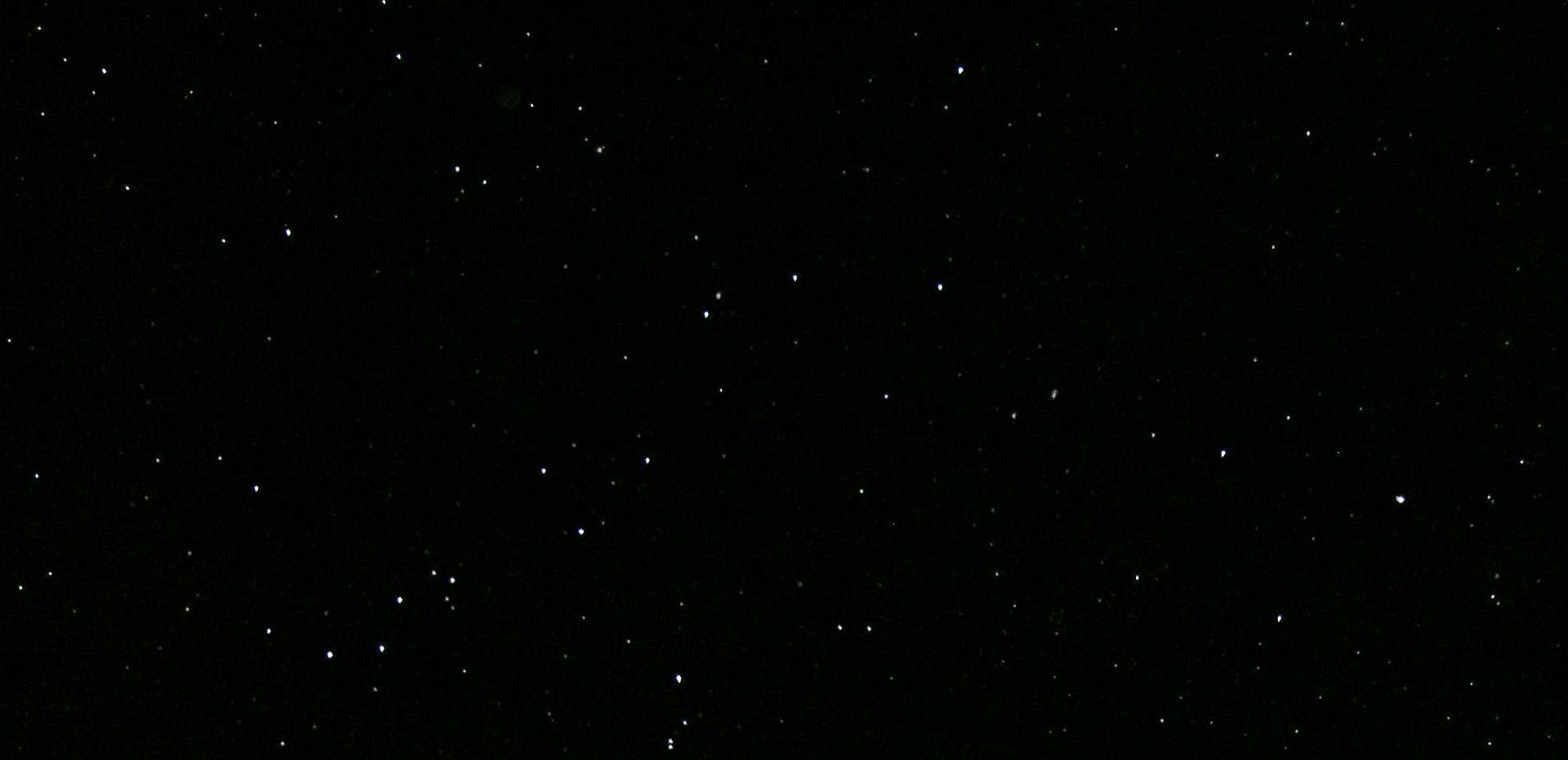
Seattle stars 012512

We are stardust—we know that—but as we are dust so are we energy. It is from this energy that we have a momentary experience as a human being, a blade of grass, or an armadillo.

And when we are no longer in this physical dimension, we remain energy, perhaps to know an experience in some other dimension or maybe to return for another physical life, leaving only our dust once again.

Our physical experience is unique to us—each of us has our own vibration—sometimes we’re a wave and other times, a particle.

Since subatomic matter makes up everything we can see and touch and experience in our macro world, then in a sense we—along with everything in our world—are also doing this disappearing act all the time. And so if subatomic particles exist in an infinite number of possible places simultaneously, then in some way so do we.

(You Are the Placebo: Making Your Mind Matter, Dr. Joe Dispenza, p. 183)

The quantum model is staggering with possibility, fascinating and even spellbinding, reality rooted in the pure energy we are. That’s the power of possibility, revealing that magic is real.

KMHuberImage; McCord Park; Tallahassee; Florida

I have always believed in magic, always sensed we had not yet grasped its true nature. For me, the quantum model is a magic carpet ride where the magic is the pure energy of life riding on reality, soaring and swooping, sometimes swirling.

The energy comprising the oneness of reality resembles a whirlpool as it “…fades out and the water passes on, perhaps to be caught again and turned for a moment into another whirlpool,” each its own eddy of experience (Charlotte Joko Beck).

Each whirlpool caught up in its own moment of existence yet ever connected to the energy of coming and going. Sometimes, we’re the  whirlpool, and other times, we’re a drop but always, we are the river.

There are many names and beliefs for the energy animating existence–God, the Universe, the Source. Each expression of this energy—as a human, as a blade of grass, as an armadillo–is a unique experience of life, a momentary whirlpool in the river that runs eternally.

When we learn to move beyond mistaken concepts and see clearly, we no longer solidify reality. We see waves coming and going, arising and passing. We see that life, composed of this mind and body, is in a state of continual, constant transformation and flux. There is always the possibility of radical change. Every moment – not just poetically or figuratively, but literally – every moment we are dying and being reborn, we and all of life.

~ Sharon Salzberg ~

Looking Through the Life Lens

Waverly in Fall 0914
Focus is adjusting the aperture of the life lens to reveal the ever-changing depth of field. Sometimes, life requires a wide open lens—the big picture—often, the aperture is small, open only to the current moment. Big or small, clarity creates perspective.

The turning of the life lens is like a kaleidoscope, quick glimpses of what might be, any and all a possibility. Not all choices will be clear, even momentarily, but those chosen find a forever as memories, a clarity all its own.
Almost Focus 0914

These days, my life lens hardly knows where to focus for my aperture is wide open, the depth of field possibilities ever-expanding. I know that infinite possibilities exist in each moment but every once in a while life is so large, it’s hard to decide where to focus first.

Almost daily now, I walk Waverly pond and park for a little focus practice.  Waverly residents are used to me and my aged, Kodak camera. Many of my photographic attempts resemble a quick turn through a kaleidoscope. Later, no amount of digital manipulation provides focus but in memory, focus has soft edges.Losing One's Head 0914

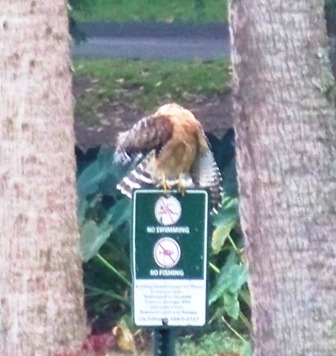
Of late, the resident pair of red-shouldered hawks have been quite fond of perching atop the “no fishing, no swimming” signs that are positioned on opposite sides of the pond.

I have yet to get a focused photo of their perching but I included one in last week’s post, anyway.  From these two vantage sign points, the hawks’ presence on the pond and the surrounding park is a constant and clear reminder to all.

I have learned how close I can get to the hawks, which is usually just out of the depth of field for my Kodak lens. Auto-focus is insufficient so I keep trying different settings.

The hawks balance patiently, providing me one opportunity after another but only my life lens captures the essence of these moments forever.Ghostly Egret 0914

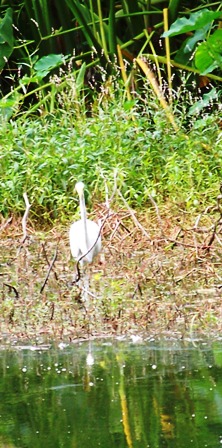
Eventually, I get a clear, sharp picture of the sign sans hawk. This is focus practice after all. Inadvertently, I capture a snowy egret in the background; its image more ghost-like than feather and flesh.

I continue my walk around the pond toward the egret, stopping to lean against a recently pruned ashI see You 0914 tree. I focus the Kodak lens through tree branches and find the egret looking at me so I look back. We stay this way for a bit before the egret returns to fishing, and I, to my walk.

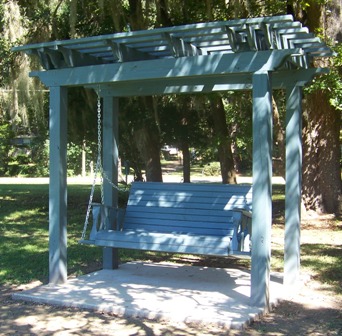
Recently, the neighborhood association added a wooden swing. It is so comfortable that it is rarely unoccupied. From here, the view is as wide open as my life lens aperture can get–timeless focus.

The wooden swing is my last stop. Often, the hawks join me, either alight the light post or perching on the connecting power wire. On overcast, drizzling days, grub from the ground is a favorite.

Sitting on the swing makes focusing the Kodak even more of a challenge. For me, it is a swing in perpetual motion for my feet cannot touch the ground so I sit forward for focus.

The Kodak results resemble turns of a kaleidoscope, with an occasional exception, but my life lens continuously captures Waverly for a lifetime of remembering.
Waverly Swing 1014


Not so Much but Just Enough

The whole harmony of life is a balancing act–not too tight, not too loose. It is not static—this Yin-Yang balance—it is in constant motion, ever impermanent as it shifts and adapts but always it is whole, complete.

The phrase “not too tight, not too loose” is associated with a well-known Buddhist story about a musician—he is a sitar or lute player depending upon the version–who comes to the Buddha for advice on meditating.

No and No 0914The Buddha advises the musician to consider his musical instrument as he asks, “What happens if you turn the strings too tightly?”

“The strings break,” the musician answers.

“And when the strings are not tight enough?”

The musician replies, “They are too loose. A string in tune is neither too tight nor too loose.”

Not too tight, not too loose is the elegant simplicity of balance, whether we are tuning a musical instrument, practicing meditation, or just living our lives day-to-day. Ultimately, imbalance finds balance.

The constant adjusting of imbalance plays out against the backdrop of life ever in motion and always in perfect balance. That is the wholeness of Buddha nature where cacophony finds its way to harmony, ultimately.

The tuning of strings on wood is straightforward but for human beings with so many ways to adjust and adapt what is too much or not enough is not always as obvious.

It is helpful when there is a buddha to ask, although the face of a buddha is not always recognized.

We meet ourselves time and again

in a thousand disguises on the path of life.

Carl Jung

These disguises, or buddhas, are mirrors of well-known behaviors, the “ineffable flux that makes a person a unique being” (Ted Kaptchuk). It is for us to look into each mirror, to seek the unique in the familiar, to open to life as it is revealed. If not, we could miss meeting a buddha.

The uniqueness is the chaos of being alive—the struggle for balance—within the constancy of life, whole in its harmony. Like the strings of the lute, living requires a fine tuning between too much and not enough. And for the sitar, it is how it sings.
No One Way 0914

There is no standard or absolute–what is health for one person may be sickness in another. There is no notion of “normal” Yin-Yang–only the unique challenges and possibilities of each human life.

(Ted Kaptchuk, The Web That Has No Weaver)

As Lao Tzu said, “he who stands on tiptoe is not steady” for the only constancy in Yin-Yang is that it—and us—are ever in flux. There is no one health for all, no normal for anyone. There is only the fine tuning of living—not too tight, not too loose—in attaining balance, momentary as it may be.

Nothing remains; everything passes by.
The only thing that always abides is your witnessing.

That witnessing brings balance.
That witnessing is balance.

~Osho~

Always, there is the passing parade of buddhas, in one disguise after another.