All Posts

The View From Waverly: Bottoms Up!

Curiosity is standing on a moment’s edge, sharp with uncertainty, and deciding the leap is worth the risk. Staying curious closes the door on the known and opens us to the thrill of exploring familiar territory as if it were the first time.

When the “world is too much with me,” I escape to Waverly pond and park—in my mind’s eye ever idyllic—once there, I believe I will regain myself, and I do, but never in the way I anticipate. For when I am at Waverly, curiosity shoves aside all of what I am so certain, and no matter what happens, the view is new.

Life goes on at Waverly, impermanent but not imperfect. It is a distinction well worth remembering for nature does not summon the past to understand or to avoid the present, no matter how daunting or mundane the moment might be.

Nature just is, unfolding in every moment, perfect and precise, providing another perspective, different from the moment previous and unlike the one yet to come. Nature is curiosity sustained.

As I look across the waters of Waverly, there is not a single snowy egret or Canadian goose to be seen but the waters of Waverly are not as I have seen them–ever. Sediment, rust in color and seemingly the texture of sawdust, covers most of the pond.

Among the Muck 0314

Its red clay banks are deeply scarred by what was once roaring rivulets of seed pods and dead grass. Day long rains swept and splintered pine needles into fragments of themselves. Needles, pods and grass—a winter’s barge–now float.

Spring blossoms are sporadic, seemingly uncertain. Most trees stand bare, witnesses to a winter that seems in no hurry to leave. So far, spring is days of rain and weeks of gray. I do not know Waverly in this kind of spring. It is not what I want to see.

In response, my mind’s eye returns to Waverly idyllic, as if to wait out the moment that I have. I actually close my eyes on the nature that is for the nature I seek.

Standing on the edge of such a moment is a first for me at Waverly, and I open my eyes with a start, having heard nothing but having sensed something. It is the wonder of the world, whether at Waverly or wherever, that in the instance of knowing one thing, something entirely new reveals itself.

In this moment, it is the bobbing bottom of a duck amid murky waters, oblivious to winter’s floating barge. The duck rights itself, churning through the old as if it were new.

Almost bobbing ducks 0314

Once again, the duck is bottom up, now joined by yet another duck, also bottom up. For more than a while they are content within the muck, swimming one way and then the next, sometimes in circles, seemingly content in waters that are new yet the same.  Ultimately, they swim beyond winter’s barge to open water.

So often, the unknown is merely a new perspective on an old situation, one that seemed so ripe for escape. Escape takes us only to where we have been as we have been. Staying curious allows us to meet the moment’s edge, perhaps bottom up, completely unsure of what that may mean but confident that these waters offer life in yet another way.

Swimming Away 0314

Good Manners Make Good Neighbors

The pain of loss sometimes divides me between a life I once knew, and the life I have now, a wall not welcome yet one all my own. Most days my mostly Buddhist self says, “Let’s not attach to the pain of loss or we’ll get stuck in its drama.”

But there seem so many days I am too bound to my mind and unwilling to face life as it is now. My lifelong friend is dead, my ability to move through life threatened emotionally as well as physically. A life I knew is no longer but I hold onto it, as if “walling in” a life were possible.

Finally, reality forces me to focus—I have poured coffee into my oatmeal–mindfulness makes me aware of the wall I have so carefully constructed. So often it is the human way to try and still life.

Good Neighbors 0214

“Something there is that does not love a wall” is a line from Robert Frost’s “The Mending Wall,” a poem I once knew by heart some fifty years ago. Now, all I recall is a single line but it seems enough.

In the poem, two Maine landowners perform their spring ritual of reinforcing a rock wall that keeps separate his land from his land. Whether it is nature, the magic of elves, a burrowing animal, or a thoughtless hunter that tear down the wall matters not. “Good fences make good neighbors” is the belief of one neighbor while the other wonders if that is true.

Before I built a wall I’d ask to know
What I was walling in or walling out,
And to whom I was like to give offence.
(Robert Frost, “The Mending Wall”)

When I first wrote about this poem in some grade school or junior high English class, I sided with the neighbor who believed a wall was a sign of respect, a reminder of what was not one’s own, a sign of good manners.

Now, I am older or simply old—a final label—yet still on the life side of the wall between here and whatever comes next–the unknown, the intangible—I am here within the laws of nature.

He is all pine and I am apple orchard.
My apple trees will never get across
And eat the cones under his pines, I tell him.
He only says, ‘Good fences make good neighbours.’
(Frost, “The Mending Wall”)

In my later years, I re-consider what makes good neighbors. It is not good fences or any walling in of loss or walling out of life. It is good manners, a respect for life as it renews on terms not for us to understand immediately but ultimately for us to accept.

Good Neighbors 2 0214

Ours is to extend good manners in our relationship with every form of life. It is ours to mimic the apple orchard and the pine forest, as each respects the other without transgression, as both drop their seeds for a life larger than their own.

Ours is to grieve for those who are no longer here. We respect that they lived and left life with us. It is ours to continue without a wall at all. It is good manners that do not love a wall; it is good manners that make good neighbors.

Reference Notes: For a profound essay on grief, loss, and life, I recommend Francis Weller’s “In Praise of Manners;” also, here is a link to Robert Frost’s “The Mending Wall.”

In the Presence of Coffee and Oatmeal

Each morning, I drop into a reverie that is becoming more routine than not. It occurs after my meditation and yoga practice but before that meditative state settles into my day.

It is a time in-between, this hour between the dog and the wolf, this waking up to the day Bloom of Peace 0613where thoughts define what must be done but being present provides the focus.

Breakfast often serves as a bridge for the meditative state to make its way into my day. A steaming bowl of oatmeal and coffee brewing simultaneously reach a point requiring a similar action, to pour.

The thought of pouring defines what is required but being present focuses the thought, which is either to pour almond milk into a steaming bowl of oatmeal or to pour freshly brewed coffee into a mug. If the general thought of pouring swirls between oatmeal and coffee, what was one or the other might just become another.

Such coffee-in-the-oatmeal mornings bring reality to our attention, courtesy of the meditative state. The realization of what has occurred intensifies our focus on what might happen next. This shape shifting of our lives uncovers us.

Give your real being

a chance

to shape your life.

~ Nisargadatta Maharaj~

Mindfulness does not multi-task but awakens us to where we are, to what we are doing. It is a snapshot, a jolt of opportunity to consider the untried, the untested. When our real being emerges, it is an hour between the dog and the wolf not so much of reverie but of reality.

I have many coffee-in-the-oatmeal mornings and just recently, I watched a writing life I had envisioned evaporate. The writer I was trying to be was not the writer I am. It was just that basic. I was trying so hard to secure a writing life not meant for me that I almost missed living the writing life I have.

I used to think I wrote because there was something I wanted to say. Then I thought, ‘I will continue to write because I have not yet said what I wanted to say’; but I know now I continue to write because I have not yet heard what I have been listening to.

~Mary Ruefle, “On Secrets”~

Footprints 1013

I am not a writer of fiction but for years fiction is what I thought I heard yet no center of any story I wrote ever held.

In my poetry, prose crowded meter, and the lines went flat. I did not distinguish what I heard.

Some sentences stand alone until the day they pour into a single paragraph not about one or the other but another, like coffee in oatmeal. For me, this shifting of my writer’s shape is my awakening to the writer I am.

Rather than hearing story or rhyme as one or the other I hear another, a beat in-between, a meditation on the story of a human being, sometimes a verse worthy of song.

If you begin to understand what you are without trying to change it, then what you are undergoes a transformation.

~ J. Krishnamurti ~

Sitting Within the Winds of Change

These last six months I allowed myself to swirl within the currents of change, believing I could harness these winds or at the very least touch them. Such suffering is the stuff of storms, the perfect one always a possibility the longer one remains in flux.

It is within the eye of the storm–stillness surrounded by gale force winds–where suffering ceases. Rarely, do we reach the calm by choice. Usually, some moment grabs us so fiercely we are forced to sit down and look at what is actually occurring.

My suffering stopped when I realized I could no longer walk as I always have. I was in an airport, two thousand miles from home, when I had to look at me as I really am.

Winds of Change 0214

To my mind, I have had a slight limp for a while—over a year, actually—it meant I walk more slowly but nothing more. Frankly, I no longer noticed my limp but it was significant enough that airport security “expedited” me in more than one airport. I took no notice.

It was on my flight home I realized I would not be able to walk the airport. Wheelchair assistance was a necessity. Twice I had to walk the short distance between plane and terminal to get to a wheelchair. Those steps were the most doubtful I have ever taken.

I am finally losing my mobility was my only thought as fourteen years of medical conversations regarding degenerative disease replayed in an infinite loop. As my mind plotted the possibilities, the perfect storm seemed upon me.

 Nature does not hurry, yet everything is accomplished

(Lao Tzu)

I am still sitting within the eye of this storm, in pain, but no longer suffering. I suffered in immersing myself into one “what if” scenario after another, sinking into dramas that may never occur.

Not Yet Spring 0214

Pain is a guarantee that we are alive; it is a sensation sure and pure. To sit within its purity is to detach from its fury, to allow its torrents to rage and overflow without being swept up in suffering.

Leave your front door and back door open. Allow your thoughts to come and go. Just don’t serve them tea

(Shrunyu Suzuki)

We cannot avoid pain, we can only face it. If we do anything less, we suffer as we avoid reality in favor of living in fear fantasies.

I am able to walk, able to go to the grocery store and even to my beloved Waverly to sit and see rather than walk round park and pond. I am able to drive a standard shift car. I limp but I walk.

Nothing has changed and everything has changed. My world is smaller and larger for to sit within the heart of change is to watch within the calm as scenarios rage without ever knowing the light of reality.

It is when we ignore the moment at hand for what might come next that we are least aware and most stuck. We are trying to touch the wind when all we need to do is sit down within the storm’s calm and let it rage.

Facing the Past Tense

Do not stand at my grave and weep,

I am not there; I do not sleep.

I am a thousand winds that blow,

I am the diamond glints on snow,

I am the sunlight on ripened grain,

I am the gentle autumn rain.

When you awaken in the morning’s hush

I am the swift uplifting rush

Of quiet birds in circled flight.

I am the soft stars that shine at night.

Do not stand at my grave and cry,

I am not there; I did not die. (Mary Frye)

Fifty years of friendship feels like only a moment yet it has been a lifetime.  It cannot be over. Not yet. I want Laziness 010514the conversation to continue but mostly, I want the past tense to be the present.

In death, the past tense looms. My mostly Buddhist self believes the past tense is a series of images always available for viewing but never again for experiencing.

I am not used to the past tense. I am not ready to live with my friend as mere memory.

If I think of my friend as dead, there is a hole in the sky that is my heart. I want to tell her how that feels, how that hole is now my world. The telephone that connected us as we aged from teenagers to sexagenarians is no longer in service. It is past tense.

In the last couple years, this blog provided yet another connection for us.  Sometimes, my posts sparked conversations, and other times, our conversations created posts. On this blog, my friend is eternally present.

Discussion was our way for five decades, not a daily occurrence or even monthly, but whenever there was a hole in the sky for either one of us we seemed to sense it. There would be a phone call or an email when least expected and most needed.

My friend was not one who labeled but one who listened. Her innate compassion and loving-kindness opened her to the world wherever she was. And the world responded to her light.

KMHuberImages

Along the wend and way of our lives, we each explored Buddhism and over the decades offered our experiences to one another. In these last three years when illness once again marked my life and then for the first time hers, we found ourselves less concerned with outcome and more with exploring the energy of raw emotion.

We were less interested in questions so we had little use for any answer that might appear for we recognized all outcome as temporary. It kept us curious, this being in the moment. We explored eternity as a web without a weaver, its vibrations animating humans, blades of grass–lifetime after lifetime–perfect in its impermanence, forever coming and going.

She is gone in a way I knew and exists in a way I am yet to know.  She is in every breeze, blossom, and glint of light in a night sky. She is. The past tense is no more.

My thanks to Diana J. Hale for her recent post, In Memoriam, as it led me to Mary Frye’s poem, which I could not seem to locate.  Also, thanks to all of you who have sent personal messages. I will respond to each one.

A Life of One’s Own

Wood Stork 0214The life we have is a singular strand in the undulating web of existence. Each life has its own tensile strength, the maximum stress point before it is pulled apart. The actual experience of living stretches us into a life of our own.

Yet, to live the life we are given is more than undulating with the ebb and flow of existence. It means remembering each experience is unique, even if the situation seems familiar. No two moments in existence are exactly the same. We have not “been there, done that.” Not precisely.

In fact, lulling ourselves into the familiarity of a situation may just get us to the maximum stress point for we are not meeting the moment but escaping it. We believe there is nothing new in a situation that is so familiar and the tension grows.

At some point we release the familiar, put down the past for the present, drop the known for the unknown. We take “refuge in the Buddha”:

Every time we feel like taking refuge in a habitual means of escape, we take off more armor, undoing all the stuff that covers over our wisdom and our gentleness and our awake quality. We’re not trying to be something we aren’t; rather, we’re reconnecting with who we are.

(Pema Chodron)

Often, denial runs parallel to the ego-mind and around certain bends they dump into one another before separating into their own meanders. Both are rivers I traverse frequently.

A few months ago, I volunteered with a professional team, offering work that once defined me. It did not seem like I was escaping but rather, opening to a new moment—which it was—yet I opened to the new day clad in ancient armor.
Storks and Egrets Waverly 0214

My administrative abilities were essentially intact but I was heavy with haze, out of sync. I persevered, taxing my physical strength as I have done for decades in order to escape the life that is mine for a life that is not. My body responded with a resounding “no.”

Give your real being

a chance

to shape your life.

~ Nisargadatta Maharaj~

It is the tensile strength of a life to stretch without snapping. In these last few months of working with the team there was a niggling, an actual yearning to be somewhere else. I wanted to walk away—leave the armor to a life past–but doing so felt like fear so I lived in-between.

Nobody else can take [our armor] off because nobody else knows where all the little locks are, nobody else knows where it’s sewed up tight, where it’s going to take a lot of work to get that particular iron thread untied. You have to do it alone.

(Pema Chodron)

It is in vulnerability that we trust completely for all armor is removed, and what is left is who we actually are. It is then one claims a life of one’s own.

I began by cleaning some of my neglected writing tools. All the ink cartridges in my fountain pens were empty, and the nibs were clogged with dried ink. My writing bag was in total disarray–I had not even replaced my daily journal—I tossed memos, meeting notes and added a soft, Virginia Woolf journal embellished with notes from “A Room of One’s Own.” The journal is a gift from a thoughtful friend.

Anhinga Waverly 0214

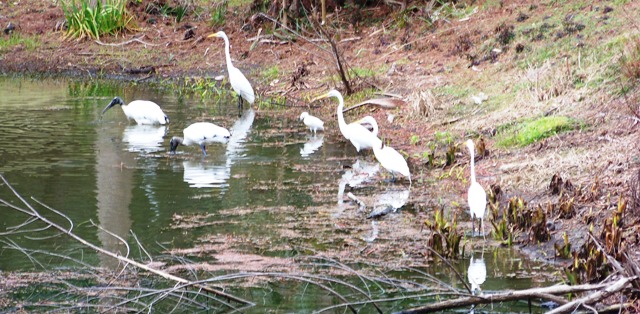
On an overcast, humid morning I went to Waverly, welcomed by a noisy chorus of snowy egrets, wood storks, and anhinga. There was much flapping about as a lone hawk swooped and circled even alighting for a moment. Having thought better of it, the hawk had somewhere else to be. I understood.

That I am able to hold my own physically again in a relatively short period of time indicates the incredible progress my body and I continue to make together. That some joints are too well-worn for some activities does not mean there are not other ways to live.

All was as had always been, and all was as had never been. Such is living the life that is one’s own.

(Regular blog posts will resume by March 2, 2014; recovery is assured but always at a pace of its own.)

A Festival of Firsts at St. Marks Wildlife Refuge

Gratitude abounds on any visit to St. Marks Wildlife Refuge but on the first Saturday in Festival Crowd St Marks 0214February, the Wildlife Heritage and Outdoors Festival is a celebration that is a refuge for all. The festival is one of many firsts that signal spring.

The afternoon is overcast but warm, almost balmy. Snow, ice, and road closures of the previous week are a mere matter of record. The joy and gratitude of being alive is in the music that is in the air. Hot Tamale is playing.

Hot Tamale 0214Every time I hear Adrian and Craig perform, the music of another century returns–folk, easy listening, country, rock and roll—all songs to which I still know almost all the words.

I sway to the nuance Hot Tamale brings to each cover for Craig and Adrian are also songwriters, sensitive to the music in words. Not surprisingly, their own music is layered in story. Sometimes, it is pure poetry.

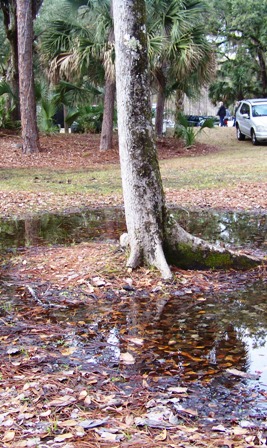
The “natural stage” for Hot Tamale overlooks mini pools of clear water covering golden leaves and amber needles. That is also a festival first as pine and oak trees signal islands of spongy, black dirt tufted like frosting on a cake.

Here and there, boardwalks become bridges to provide passage to and from these “temporary Festival islands 0214 St Marksislands” that offer picnic table seating. Strangers share space, music, and a bit of themselves.

Adrian’s rendition of  “Somebody to Love” echoes Grace Slick and 1971, a year Adrian and I shared similarly, although completely unknown to each other and physically, thousands of miles apart.

In another century, Adrian first sang that song in a gymnasium somewhere on the East Coast, and I, in the Rocky Mountain West, was also singing Grace Slick in a building very like a gymnasium. It is entirely improbable that Adrian and I were singing the same song on the same day for the first time but it is not completely impossible.

The memory moment passes as Hot Tamale turns to calypso–“Day-O…D-a-a-y-O”–there is mention of “The Lion King” and Harry Belafonte but it is the movie that most seem to remember as occupied picnic tables sway in rhythmic response.

A young girl with sunshine blonde, kinky hair whispers to me she has not seen the movie. That is a first. I have never met anyone else who has not seen the movie. I do not ask her about Harry Belafonte. It is enough that we sing along as if we were born to it.

After the performance, Adrian comes over and we hug, saying how good it is to see one another. The young girl wonders whether Adrian and I are sisters, definitely a first. We smile at one another as Adrian responds, “we’re just good friends.”

And then we all talk for a while as friends, new and old, before leaving the picnic table, the makeshift island and the music. I drive on to the St. Marks Lighthouse on Apalachee Bay.

All along the roadside, cars pull over and stop, a wildlife event, as cameras of every size and shape point and shoot, lenses looking East as well as West.

Gator on Festival Day 0214

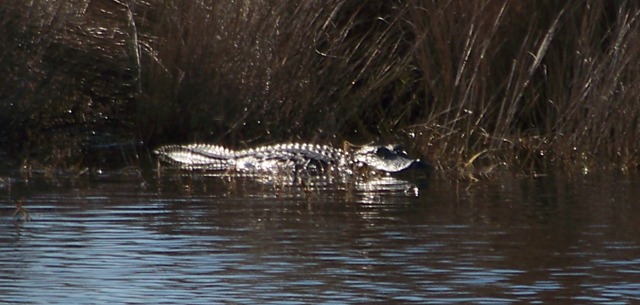
It is late afternoon now and the warm sun has diminished the clouds, an event welcomed by alligators. In less than three miles, I spot four gators but there are a lot more if the sea of cameras is to be believed.  Waterfowl, mostly cormorants, form a crowd away from the banks of basking gators.

I park near St. Marks River and walk to a point on the bay. It is high tide, a first for me in all the years I have walked the refuge so there is no balancing on old oyster beds. I am content to watch the bay waters lick the sanded shore.

Firsts at the Refuge are a constant whether one visits day by day, year by year, or month by month. The turn of time and tide, the changer and the changed.

High Tide St Marks 0214

When Ice Falls from the Sky in Florida

Snow on unit 012914It is the year it snowed, and the year is yet young–2014 has stuff to strut it seems—already, it impresses. Just the possibility of snow/sleet in Florida is not only newsworthy but requires action.

Whether there will be enough ice from the sky to roll into a snow figure or enough to lie down in to make the wings of an angel are serious considerations.

Snow is an interloper in a subtropical land but the curiosity of experiencing it outweighs its inconvenience.

City thoroughfares and interstates closed, some for over 24 hours, as did I-10 from the Florida border to Georgia and Alabama. Sand is one thing we have plenty of so we spread it about.

I did witness a few flurries that were not bouncing sleet balls of white, although I saw those as well. Decades of Rocky Mountain West wintering renders me a bit of an expert on frozen precipitation. I know my snow.

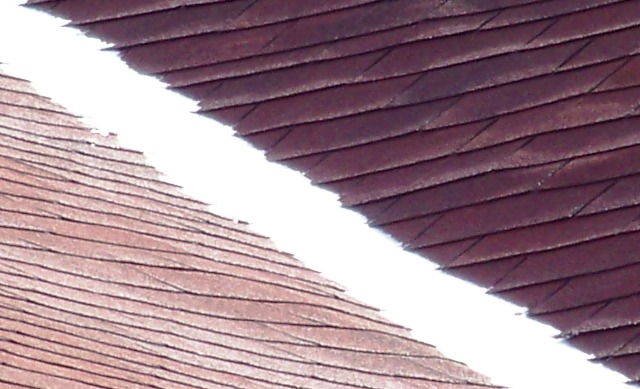
Whether it was sleet, snow or both, there was ice on trees, rooftops, and even on outside air conditioning/heater units. All are constructed, naturally or otherwise, to withstand hurricane-whipped rain but ice falling from the sky shocks. After all, it has been a quarter of a century since the White Christmas of 1989, and memory does not always serve.

Ice from the sky crossed a boundary because it could or because boundaries are meaningless when it comes to weather. Yet we believe we can predict the temperature and whether or not there will be precipitation.  Whatever we predict, the weather delivers what it has to deliver and moves on.

Watching ice fall from a Florida sky is like watching moments coming into physical existence, not lost in the flurry of a glass, snow orb but one by one, sleet balls bouncing, flakes floating, all completely present and content in their moment of existence, their lives.

Snow on roof 020214

I am reminded of my own moment that is my life. Do I receive each moment as it is given or am I too busy predicting weather that may or may not arrive?  Not opening the gift I am given is a lifelong trait. Perhaps that is why my life span is longer than ice that falls from the sky. I need lots of practice so I have more substance.

The wind cannot shake a mountain.
Neither praise nor blame moves the wise man.
He is like a lake,
Pure and tranquil.
~ Buddha: Dhammapada ~

When I am not the mountain, I am in a winter of discontent, allowing my mind to shake me. Rather than becoming a lake and absorbing all weathers, I am tempest-tossed, neither pure nor tranquil but frozen in flight.

Yet thaw I do, as nature, a force all its own, wends the way it is what with what it has. When I am who I am–unshaken—I am not limited by the weather of the world but open to the weather of its storms.

Ego Pop-Ups: Drama on Demand

If we listen only to our ego, we are never enough and never will be.  The essence of ego is to chatter constantly for that is how it thrives. Ego is not concerned with what choice we make ultimately for as soon as we make a decision, ego considers the choice not chosen and cites consequence after consequence.

The chatter is deafening at times yet it is ego’s duplicity that does it in for at some point, we realize we are caught up in ego’s never ending storyline. Ego is like the pop-ups on our computer screens—drama on demand—our choice is whether to allow or to block.

As humans, our ego pop-up blocker is found in joy, love, gratitude, and compassion where ego dare not tread for within these emotions, we are always enough. There is no need for drama.

Compassion, love, joy and gratitude remind us to be thoughtful in our speech, not to take things personally, to stay present in what we do so we make no assumptions about anyone or anything for when we are mindful, we really are doing the best we can.

Still, some days it seems as if all we ever do is deal with our ego pop-ups. Ego seems to know our vulnerabilities better than we do no matter how hard we try to remain present.  Why is that?
Ego 1113

Michael Singer says that “reality is just too real for most of us, so we temper it with the mind….”  Often, we just avoid those places where ego pop-ups abound or we run rather than facing what is occurring. Other times, rather than blocking the emotional pop-up, we stay with its storyline for it is a drama we know.

It is not for us to cling to our ego drama nor to suppress it. It is for us to acknowledge our ego’s existence:

Like two golden birds perched on the selfsame tree, intimate friends, the ego and the Self dwell in the same body. The former eats the sweet and sour fruits of the tree of life, while the latter looks on in detachment. Mundaka Upanishad

We are not our ego but we are the one who experiences emotions; we are the one who hears constant chatter. When we allow our ego to block us to our true self, we are not enough. Continuously, we surf screen after screen searching for freedom from our ego. Yet, exist with ego we must.

We are partners with our ego, one emotional pop-up after another. If we view our emotions as passing thoughts, momentary screenshots, we ground ourselves in the eternity that is the life force.

Ours is the compassionate response, grateful for the experience of being, of knowing love and joy.  We live as we breathe, inhaling each moment so that we may let it go. We are alive, and it is enough.

Aim for Even: Bringing Zen Into Every Day

This is the beginning of my third year of blogging about bringing Zen, the “meditative state,” into every moment of every day. There is no one way to do this, as I have learned, but Zen is possible in any and every moment.

The meditative state is being engaged in life, immersed in it, actually. “When coming out of sitting, don’t think that you’re coming out of meditation, but that you are changing postures” (Ajahn Chah).

The act of meditating is to sit in stillness while the practice of yoga moves around the body’s fluids. In both, there is the sensation of being alive. Taking a meditative moment at the end of a yoga session allows the fluids to balance within the body. What was in motion is now in balance for the day.

The postures or positions we assume are unique to us as are our everyday responsibilities. We join with one another in many activities, especially in our work, but even our collective effort is comprised of the unique points of light that each one of us is. That is the meditative state, our own Zen, which we bring to life.

Bringing Zen into our every day may mean stops and starts for a river’s flow is not always smooth, choppy or a torrent but rather, it is steady and swirling simultaneously. Making the meditative state integral to our lives is to aim for even, to meet each moment for all that it is without looking ahead or behind.

To aim for even is to “…stop being carried away by our regrets about the past, our anger or despair in the present or our worries about the future” (Thich Nhat Hanh). Aiming for even is to maintain our balance through the rapids of our lives and to float on moments of reflection. One is not more than the other ever.

Aim For Even 1113

To aim for even is to throw off emotional weight past, present or future, to “…see that the emotions themselves arise out of conditions and pass away as the conditions change, like clouds forming and dissolving in the clear open sky” (Joseph Goldstein). Emotions have the substance of a cloud and the energy of the life force, pure and wakeful.

Bringing Zen to the every day is letting the clouds of emotion delight, darken, and dissipate. Emotional balance is more than shrugging off a difficult moment. It is accepting that the dark never stays and neither does the light. Life is impermanent eternally.

“For things to reveal themselves to us, we need to be ready to abandon our views about them” (Thich Nhat Hanh). To aim for even is to forego pre-conceived notions of what or how life should be. To meet each moment is to allow it to reveal itself in all that it is and then respond.

If we allow the meditative state to remind us that silence is always a response, we are able to immerse ourselves in all that comes to us for as long as it may take but not a moment longer for there is so much more to come.

In meditation, we watch thoughts come and go for that is the posture of the practice. In bringing Zen into the everyday, we allow moments to move through us rather than holding onto them.

These past two years of blogging have been rich years. So many of you have revealed to me perspectives I may not have otherwise considered or have ever discovered. Thank you for bringing Zen into my every day, reminding me to aim for even.