Fail Better: Break the Sound Barrier

“The question is, are you going to grow or are you going to just stay as you are out of fear and waste your precious human life by status quo-ing instead of being willing to break the sound barrier?” Pema Chödrön from Fail, Fail Again, Fail Better, Commencement Address at Naropa University.

In a year like 2025, breaking the sound barrier seems the only choice. There is no status quo. One of the many questions I’ve been asking myself for the last 11 months is how loud does life have to get for people to wake to reality? It would seem sound barrier quality at least, yet there is a desperate clinging to the same old, same old yesterday be it politics or Christmas.

The “good old days” is the stuff of Currier and Ives’ lush, hand-colored lithographs whose reprints are still available on Christmas cards (as well on canvas); the same is true for the light in an idyllic Thomas Kinkade landscape, also now available as Christmas cards.

Nostalgia sends us to the moments when we knew what to do, who to be and how to succeed. Maybe even be happy. There is no failure in scenes of nostalgia, only the warmth of a moment when life was more a picture postcard than not.

Is there a way to make the magic stay? No thing, no one, no place stays the same. Therein may lie an answer.
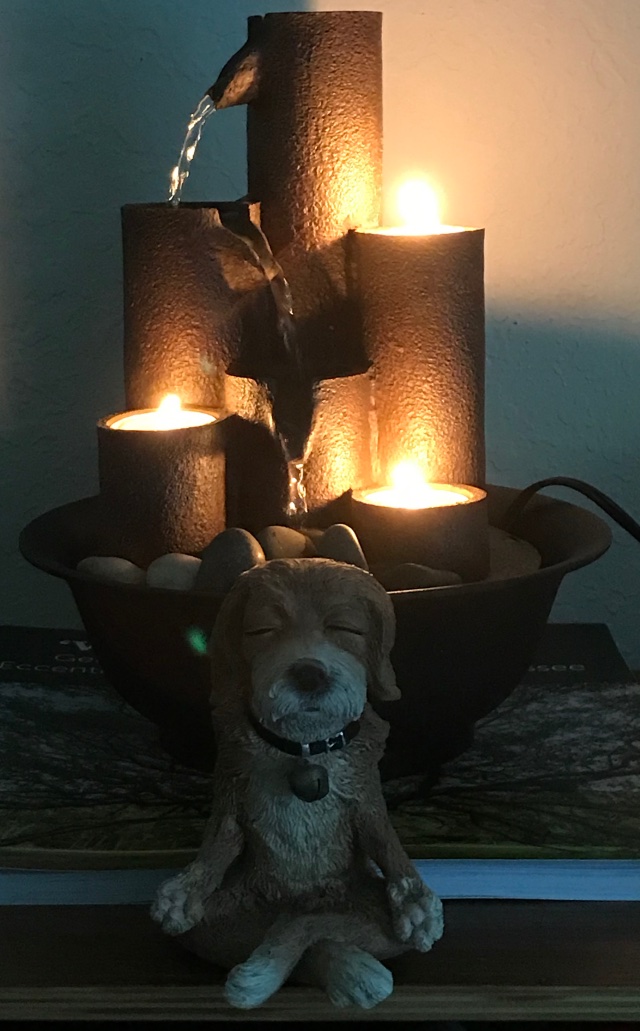
Any center cannot hold if its edges, its fractures, its cast adrift pieces are never explored. Think of a kaleidoscope. When light enters its chamber, mirrors reflect pieces a jumble—we can hear them rolling around—as the chamber rotates one unique image into another. So fragile its impermanent beauty.

We are not momentscaptured on canvas or the mirrored light in a kaleidoscope. We are the real deal, flesh and blood, prone to failure.

In America, we just don’t give failure enough credit, if any. It may be why I so eschew winning, for everything is a competition and nothing matters but the win. To be fair, I am constantly contrary, unable to be like everyone else. I’ve tried, not with great conviction, but I have made an effort from time to time. It never goes well for anyone.

But I have grown so weary of the competitive American. In this land of supposed equality, I have never found the exceptionalism so often attributed to us. We are on the edge of losing our democracy because voting is now a competition between two colors, not a matter of who will best represent and serve all colors.

The upside is we have failed—spectacularly, dangerously so—wiping out any semblance of status quo. And we keep failing but we are beginning to fail better. Neither at light speed nor breaking the sound barrier but the November 2025 elections are a definite fail forward.

We are redefining our democracy as we approach the 250th anniversary of our first revolution. Seems we have good timing. This is not a throw out the Constitution with the kleptocrats moment. Our Constitution is us—we the people—an informed and vigilant electorate governed by the rule of law and no other.

Let’s think of it as fail forward because as Americans, forward is our thing. We are not exceptional. We have proven ourselves to be as susceptible to the forces of fascism as any other country on earth. We are a democracy with a Constitution like no other. With that, we can go forward.

Yet, failure, even failing better, is not a rallying cry. I don’t have any of those. I do my best to meet the moment. Having failure as a tool provides another life lens to broaden my perspective.

Before turning to Zen Buddhism some 13 years ago, I replaced the word/idea of failure with many a euphemism. That version of me still dwells within, as does every iteration of who I have been, but the idea of failure, the thought of failure as a fear no longer has a hold.

I can say this with some confidence because I know everywhere I go there I am. I sit and will continue to sit with many versions of me, reflecting on all the moments I cannot change. There’s purpose in reflecting rather than reliving, a kaleidoscope of light turning over one image after another.

Nowhere is this truer than in my writing, a stalwart that continues to surprise. Writing is my one strength that remains fiercely loyal to me. I am more subconsciously loyal to writing than I ever know. I have walked away from writing—or tried to—thinking maybe not this lifetime. Failing without acknowledging the word failure.

As a Buddhist, I’m counting on reincarnation. Especially when it comes to writing. We are inextricable. I’m always writing in my head until my ego steps in to say, ”but you’re not a writer.”

It has nothing to do with the quality of my words or my small list of publications. It has to do with working in an established framework. I neither have the talent nor the discipline to do that. I all but turned myself upside down and inside out when I tried to blog on certain days of the week. Failing again but with curiosity.

There is no one routine, no established writing hours or days. Before my last post, I hadn’t blogged for two years. I’ve never had any problem saying I’m a blogger.

“Oh,” ego is happy to interject. “Is a blogger really a writer?”

“Shut up.” Failing better.

There have been some excellent reasons why writing was not the order of the day, and sometimes, I’m just lazy. Who isn’t? When I meet the reality of my day, I’m a writer whether I write that day or not.

Just recently, I found an excellent placement for an essay I’m working on about my near-death experience with sepsis. Right now, it’s mostly notes and a very raw draft of part one. The issue was the deadline. When I found this publication possibility, I had enough time but not every day would be a writing day for me. Not without getting sick and losing a lot of days for everything in my life. A damaged spinal cord and rheumatoid arthritis dictate how long I will be sitting and even with voice recognition, there is always some keyboarding.

Failing better is knowing my sepsis essay is going to be a good one. I can feel it. And then I’ll see where it might find home. Like the Currier and Ives lithographs or the Kinkade paintings, when I allow the images to wend their way, words tumble like the light of the kaleidoscope, finding their way to one sentence and then another.
Part II: A Drip of Life

If you have not read part one, no worries. It was long ago and far away. There is no longer a flood outside my door but the leaks persist, now inside rather than outside.

I am a privileged, old white woman who is not without a bucket and an extra large, Halloween-orange bowl for when the drips fan out. Our building boiler is many decades old like the people it serves (and the plumbers it baffles).

A steady drip of life, water, and in these last two-and-a-half years, I have known oceans. More of the mind, yes, but also an actual glimpse of the ebb and flow of life and how it might end or not.

Cancer takes you there.

Mine was endometrial, grade one, stage one B. Early, early stages, quite common for a 73-year-old woman; the protocol is radical hysterectomy, which I had. I was in the hospital less than 24 hours. The pathology report revealed four remaining cells had invaded my lymphatic/vascular system. Three direct radiation treatments later and no more cancer. I continue to have checkups every three months.

That’s how endometrial cancer was for me, not painful but persistent and eventually eradicated. I was going to leave my bout with cancer at that until I heard 49-year-old poet laureate Andrea Gibson read their poem, “Love Letter From the Afterlife.” The reading was to Gibson’s wife, Megan Falley, during the last days of Gibson’s life. Very soon after, Andrea Gibson died of ovarian cancer, stage four.

You may or may not know (I didn’t) that the terms ovarian and endometrial cancer are sometimes used interchangeably. Gibson wasn’t the right grade/stage for even a fair prognosis much less a good one. You either are or not, with cancer. It’s not much of a spectrum.

“Why did no one tell us that to die is to be reincarnated in those we love while those are still alive.”

(Andrea Gibson, “Love Letter from the Afterlife”)

I have been waiting for that sentence all my life. Not that I knew it, of course. That kind of clarity just arrives, and the world changes. The life force that infuses this dimension is a 49-year-old poet writing a love letter to the world as they fade from life.

I have not the clarity of a poet or the bursting, immense love of Andrea Gibson but in this past year I came close to slipping the veil.

Six weeks later after my radical hysterectomy and before the radiation treatments, I almost died of urosepsis, a blood infection. I ran fevers as high as 103 and my heart raced to keep pace with a kind of Russian roulette playing out in the hunt for just the right antibodies, as my kidneys began to shut down.

I have never known such presence as machines beeped, doors opened and closed, food plates came and left undisturbed. I was immersed in life without clinging to it, as aware of pain as of joy, afloat in an ocean of love, as wave after wave of clarity buoyed me in timelessness.

I was so grateful for having had a chance to live—nothing seemed more precious—until the depth of my meditative state lightened with the swarm of antibodies and reality broke through, bright and cold on the afternoon of the fourth day. After a discussion with the hospitalist, I went home.

During those three and a half days I sensed I would live. It wasn’t a given; it was more like no time left to lose. To use Pema Chodron’s term, stop practicing “idiot” compassion, no more tilting at windmills, build boundaries firm. Meet people as they are and be compassionate but know that sometimes walking away or saying no is the kindest thing that can be done.

I did not feel easy days were ahead nor have they been but in my ocean travels, I sailed true North.

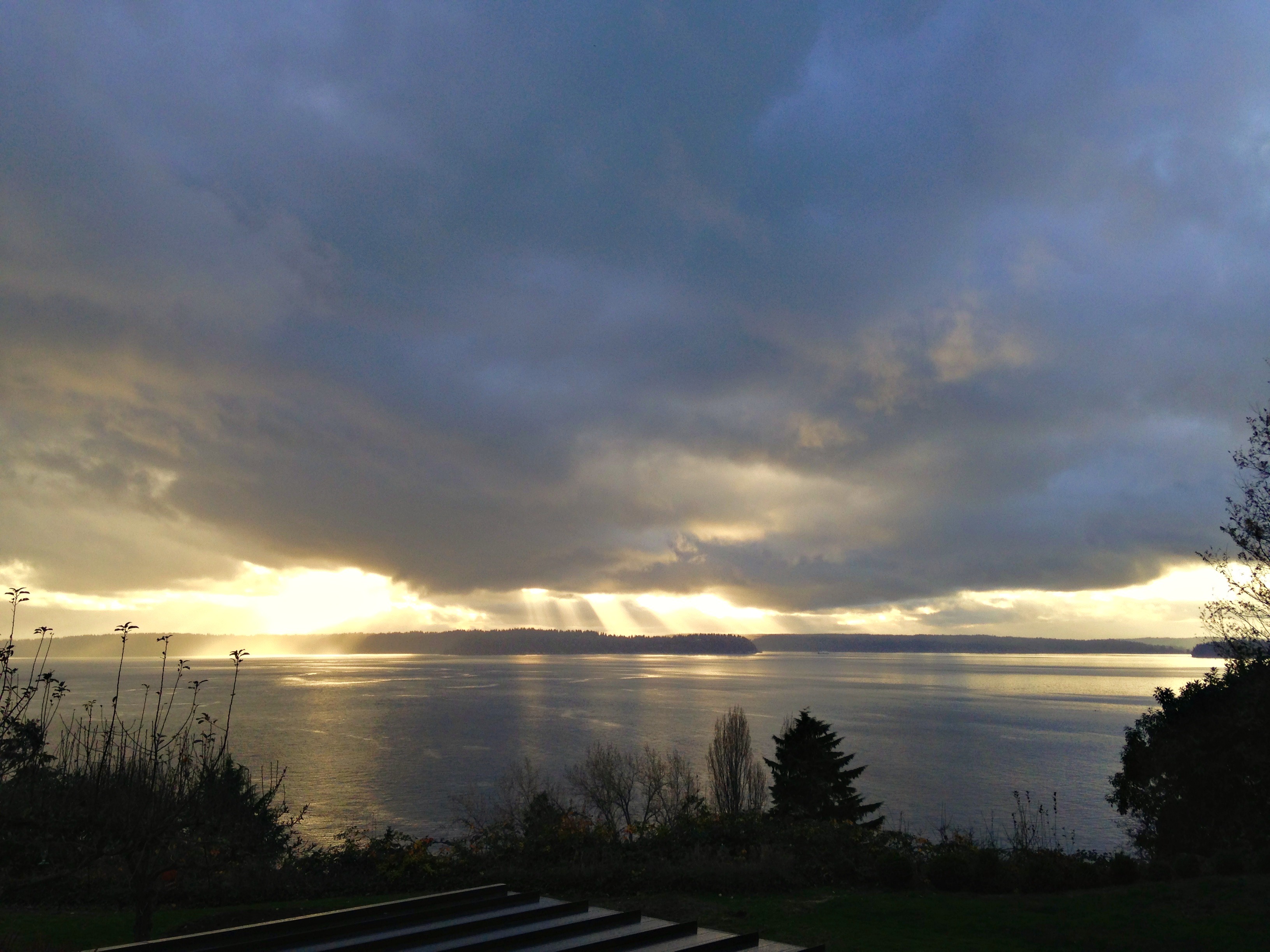
Puget Sound (Len Huber)

Wet or Dry, the Dish Is the Work

I felt as if I were joining up with the past tense as my father slipped slowly through the veil of the present. We were 2000 miles apart in that moment, both of us asleep only to awaken in different dimensions.

My version of Edward Lorenz’ chaos theory, I guess, where my being asleep meant I would waken much as I always do but my father would discover a dimension beyond definition. I am now and he is forever there.

For every generation that passes so does a way of life that will never come again. No two moments or movements ever repeat, not exactly. They become history, the story of us, if we write it as it happened. Certainly, similar stories, events, and fashions reappear but Groundhog Day is entirely cinematic.

My dad’s generation had a work ethic of “showing up, no matter what.” He did not retire until he was 88, a man of extraordinary energy even in the last days of his battle with pancreatic cancer. He met each day with all he had. That was his work, I came to realize, much moreso than being a real estate agent or a geologic draftsman. Meeting the day mattered, no matter what.

I can’t say that my father’s work ethic was a fit for me—maybe I just didn’t have the shoulders for it. My adventures were not his, of course, his work ethic but a beacon, showing me the teeth of treacherous waters. I dashed more than one ship there—too foolish to be afraid—until I came to clarity, my constant through any storm. That became my life’s work.

Clarity, peace of mind, contentment, living in the moment—whatever words fit—is confining the mind to the task at hand. Wash the dish, dry the dish stops my ego from flashing past-future, future-past with scenarios that are nothing but a time suck. The dish is the moment, wet or dry. The flashbacks of “what if” will neither wash nor dry the dish. In fact, the dish may break from inattention.

One of the first things I learned in Zen Buddhism was the Buddha’s teaching of “all of life is suffering, and all I teach is the end of suffering.” I didn’t get it. What did he mean by suffering? And when it ends, then what? I am enough of my father’s daughter to want boundaries.

So, I went in search of the teaching, slowly stripping my being to its core, my suffering evaporating, thought by thought, as once again my father’s work ethic revealed itself: show up every day, no matter what. Ride the waves of the horrific and the humble without the “what might have been” scenarios of the ego. After all, they never happen. Life does.

My father may have peacefully passed but the ensuing ego whack-a-mole was one judgment after another. A dear friend reminded me of “the work” of Byron Katie, a way to unravel any thought my ego offers me—with four questions and a worksheet—a dismantling of my ego’s neat and tidy judgments that by now were an impressive pile.


Life is layered until it isn’t.

I faced my ego whack-a-mole with a completed worksheet and watched a few of Byron Katie’s free weekly events. The suffering surrounding my father’s death wasn’t that he died or that he had cancer. It was what was happening because he had died. If I did not sit in the stillness of clarity, I faced years of running down rabbit holes and probably a lot of broken dishes in my inattentiveness to wash the dish, dry the dish.

In his fight against pancreatic cancer, my father believed that massive doses of chemotherapy were his best chance at life. It was a longshot, this belief, but it gave him a way to define each day. It was “his work,” his kind of inquiry into the life he had left.

My father would live eight months, increasingly aware that his decision offered options he may not otherwise have known. He found joy just sitting in the stillness, listening to life, sometimes opening an eye to the waters of Puget Sound. He said his daily rosary contemplating its mysteries, as if they were anew.

“I should not have done as much chemotherapy,” he said to me one day. His tone was matter of fact, thoughtful, without regret. Inquiry only illuminates. His determination to live gave way to the love and wonder of just being alive until life waned.

“I don’t want to live anymore,” he told me in one of our daily conversations. And we discussed what he wanted to happen next. He would no longer be wheeled to his living room chair from the hospital bed that hospice had provided. Within a matter of days, his life force returned to the energy that animates us all.

His body was consumed by the cancer but his mind remained one of inquiry, a summons of courage to face reality and find the possible in the impossible until life no longer is.

As for me, I wash the dish, dry the dish. I do “the work.”

Owning the Outrage in a World of “Hold My Beer”

(Note: For those who prefer my posts that are more Zen than bite, you might want to give this one a pass. Then again, stay. We cannot keep walking away from one another, especially here in the United States. So, sit a spell. Have a beer or a coffee, and at the end of my say, I’ll hold your beer, your coffee—whatever—while you have your say.) 

In her book, Welcoming the Unwelcome: Wholehearted Living in a Brokenhearted World, Pema Chodron writes that there is a group of resilient people who never give up on the world.

Hold my beer, Pema.

I doubt even Margaret Mead would think that a small group of thoughtful people can change what is coming to fruition in the United States. It’s well-thought out and the result of decades of planning, pretty much religion wrapped in a flag. I suspect the truly thoughtful (and no doubt resilient) have left the planet, having hijacked Elon Musk’s SpaceX for other worlds.

Not being among the most thoughtful, Musk is too busy enjoying “former guy” status as the soon-to-be—or not—war lord of Twitter. Of course, there are so many brilliant billion-dollar distractions for Musk that nothing is a loss or maybe it’s all a loss.

We have met the enemy and it is us. In an increasingly fascist world, democracy seems too hard. And anyway, how bad can a fascist regime be? That remains a legitimate question for far too many people in America, old and young. In our classrooms, the already whitewashed US history is being replaced by snow white fairytales. Will this bring back knights in tights and chastity belts?

Hold my beer.

The fencing is up around the building of the United States Supreme Court, in anticipation of the court’s archaic ruling regarding reproductive rights for women:   they have none is the majority opinion of the court. In response, some state legislatures, eerily echoing one another, are enacting laws making any abortion for any reason a criminal act. In Louisiana, they wanted abortion to be considered a homicide but the bill died in withdrawal.

The leaked court opinion sets aside precedent, opening the way for aborting all civil rights—sexual orientation, interracial marriage, voting. What woman wouldn’t wear a chastity belt (modified for sex toys because girls gonna have fun). Minnie Mouse is leading the Disney charge.

And speaking of Florida, any sexual orientation or skin color other than white cisgender cannot be mentioned in elementary education, which also abstains of any meaningful sex education. Governor DeSantis calls special legislative sessions as often as the former guy twerked at his rallies. Yeah, those knights in tights.

Hold my beer.

As in a Dar Williams’ song, I am “like my country in the eyes of the world,” forever the ugly American, from sea to shining sea. We are either privileged or poor, partisan or bi-partisan, owners of the biggest arsenal of destruction on the planet to ensure the American way, a democracy dying as we cannot be bothered to vote in Every. Single. Election.

Here’s to the Ukrainian people who know democracy is worth being fire-bombed Every. Single. Day.

It is coming to pass that authoritarians/oligarchs are owning all of America much like they once “owned the libs” who have spent far too much time jousting at the outrage windmill. Witness the recent symbolic vote in the United States Senate to codify abortion. What do you get when you own the outrage? I’m old enough to remember when Don Quixote was required reading.

There is no majority of Americans, in any poll, that agrees with the soon to be rendered Supreme Court opinion regarding Roe v. Wade but will the American people storm the 2022 primary season demanding to know every single representative’s stand on women having the right to make their own decisions about their bodies? It’s a yes or no question, needing no muddled meandering. It’s not a Left or Right answer, just a yea or nay on a human right.

If people who can get pregnant do not have control over their bodies, there is no freedom in America for anyone. Every civil right is at risk with the striking down of the Roe v. Wade precedent. Every. Single. Civil Right. And every American owns this failure. Maybe we never deserved our republic for we are certainly doing everything we can to lose it.

If I am wrong, I will lead the cheer, loud and long, for I have loved my country, and I am old enough to remember those halcyon days, idyllic and ill-informed as they were.

Hold my beer.

So, now that the bite is out of the way, here’s the Zen I have left—to live in the eternal present–like living in a democracy and keeping a country from going off the rails, maintaining a Zen practice is hard. What to do is basic but it won’t work without commitment and dies in complacency.

The moment is all we ever have, the energy to effect change over owning outrage.

Peace exists in every moment if we stay open to what it reveals, doing what we can with the options we have, immersing ourselves in what must be. Moments are met or not at all.

Life is a lot of facts with sharp edges but even on my worst days of staying present, it’s better than jousting at a windmill grinding.

Now, I’ll hold your beer.

The Flipside View of Life’s Turning Dime

I am in the throes of physical therapy for my lower back, specifically a right side L4-L5 disc herniation. This is not my first rodeo (but my fourth) that the disc between these two vertebrae has spilled onto the nerve root. So, yeah, we have history.

In 2010, this same disc spilled over on the left side and sent me screaming to the Emergency Room (ER). A dear friend was good enough to drive me and let me lie down in the backseat of her car, leg straight up, foot planted on the car ceiling (I’m short).

Upon arrival, the ER attendant said, “Why didn’t you call us?”

Money is the short answer but more importantly, I had no clue about pain, going to its core and stripping away all the drama to reveal the root cause. I didn’t know life turns on a dime and voila! A new life lens whose view is nothing like the flip side.

That night I was remembering what had happened in the emergency room in 2003 when the disc squirted a bit more of itself onto the nerve root. I was given a hefty pain medication injection and sent home with enough pain pills to get me to the orthopedic surgeon who did the same surgery as he had done in 2000.

The 2010 flipside view proved a new life lens is just that, new. For reasons not clear to me or to my friend, the ER attending physician decided I didn’t have a disc herniation so I had no pain. After a while, I think he offered me a tramadol, something I scoffed at because I had tried that at home.

To be fair, I don’t think there’s any medication that stops nerve pain at its source, and the physician may have said something to that effect but I was in full fight/fear mode, and we were there for hours while my fear raged. I have since discovered that heat and a hefty dose of prednisone helps most but a nerve on fire, pinched in a disc spill over, will have its day.

At some point it was decided I would have an x-ray. I wasn’t about to let any ER personnel help me onto the x-ray table but, of course, I couldn’t do it. To this day, I remain grateful to the radiology techs who were quick to help. I would lie on that table for quite some time after the x-ray was taken.

In the radiology tech booth there was a lot of repetitive discussion.

“No, she doesn’t.”

“Yes, she does.”

And then more of the same medical jargon before the attending physician shouted, “What do you mean there’s a (medical jargon with swears)! There can’t be!”

And the radiologist explained the X-ray results again to the attending physician who responded, “She can’t have!”

“Yeah, she does,” the radiologist said.

After I had been returned to my ER cubicle, the attending physician stuck his head around the curtain and said, “So, you’re Huber?” Neither my friend nor I could have anticipated that question; one or both of us agreed that I was.

Immediately, it was apparent that the attending physician thought I was someone else. It would be another emergency room physician who would explain about the herniation and provide me with a prescription.

Before we left, the initial attending physician made a bad situation even worse by kissing my hand and offering a groveling apology. I’m still amazed that I did not go off on him but my friend and I were tired and hungry, and my pain was better—maybe because I was vindicated, maybe because my fear subsided, maybe because….

Within a few days, I would have my third surgery, and the pain would be gone. I do remember the neurosurgeon saying “no wonder, no wonder” regarding my pain, and he cleaned up the mess the orthopedic surgeon had left in 2000 and 2003.

In 2022, the jelly has spilled out of the disc doughnut yet again. I am needing the same surgery by the same neurosurgeon, a 40-minute procedure. However, he’s also offered that “about 87% of these” (herniations) resolve themselves.

The pain did not send me screaming to the ER—just a lot of stay-at-home F-bombs—so impossible to ignore, and in the beginning so severe, I had to use my wheelchair any time I cooked or did the dishes. Standing was almost impossible so getting into my tub/shower was out of the question. It was bathroom sponge baths and washing my hair at the kitchen sink, while sitting in my wheelchair for about two weeks.

Still, I am reluctant to pursue a fourth laminectomy so I am playing the neurosurgeon’s percentages but without Sue, my favorite physical therapist who has seen me through two hip replacements and a fractured pelvis. However, she did do the initial physical therapy (PT) intake.

Ours was a long conversation, and the flipside view of this turn of the dime was once again not what I expected.

Sue all but said I should have the surgery followed by physical therapy (PT) rather than PT and then surgery.

“I have history with laminectomies, remember?” I start to tell her the 2010 ER story and she waves me off.

“This pain once sent you screaming to the emergency room, and with you, that’s saying something,” she says, and then checks off boxes on her tablet.

“But then, I did not understand the nature of pain,” I start to explain and stop. Zen is… otherworldly to her, so I say, “I have a neurosurgeon who is suggesting physical therapy and a physical therapist who is suggesting surgery.”

Sue doesn’t disagree before she explains, “We don’t really know how to fix backs—not medicine, chiropractors, physical therapy, or acupuncture.”

I nod. I have tried them all, even naturopathy but I keep that to myself.

“We treat symptoms with a 50-50 chance for success. In comparison, the success rate for knee or hip replacement is 96%.” Sue throws up her hands as if to say, get it?

She knows I have wrapped my head around that 87% figure of this herniation resolving itself with physical therapy and the few yoga poses I can do. As in 2010, I’m not seeing that the dime has turned but Sue has.

In what appears apropos of nothing she says, “You know with myelopathy all bets are off.”

I nod. My spinal cord is short circuited— it has dead spots in places—a daily mystery as to what nerves will fire when or if at all.

“At some time, whether it’s today or years from now, you have got to get a power wheelchair,” Sue says. And I know she says this with 30+ years of experience as a physical therapist who truly loves her profession.

Using the manual wheelchair is exhausting and not a good fit with the nerve damage in my hands and arms. And it’s heavy for my friends and Lyft drivers to maneuver. A lightweight, foldable power chair would take me to my apartment building lobby to get my mail, allow me to take my recycle items to the bins, keep me out and about without the constant concern of falling.

My gut tells me Sue’s right but her words land with a thud. I didn’t think I was “there” yet and why does that bother me so much? It feels ableist because it is. It is eerily reminiscent of the ER attending physician only this time, I’m the one with the attitude.

“Maintaining my independence is based upon my not falling,” I say, as I look at Sue who clearly has nothing more to say.

A power wheelchair will mitigate the risk of falling just as my three-wheeled walker still does but myelopathy is progressive so it…progresses. A disc herniation is a distraction, a weakness with no spinal cord involvement, but nonetheless a signal of the flipside view of life’s turning dime.

Where We Are All Alive Always

Recently, I was reminded I have been blogging for 10 years as of this month. It doesn’t feel that long any more than it feels like I am in my 70th year. Once I would have been world weary with the passing of a decade and getting older—I would have put it in a box and labeled it—agonizing over the passing of time, as if I did not live in the eternal present. But that’s fear for you.

When I began blogging I was terrified of putting myself out on the Internet, especially my writing. What did I have to say that had not already been said (and no doubt much better than I could). I was trying to define what was possible, as if I had that kind of power, when all I had to do was wake to the world as it is.

Despite all the fear, I was determined to have a post published on January 1, 2012 so I posted Andrew Marvel’s poem, “To His Coy Mistress”; the opening line is “had we but world enough and time.” It was not me actually writing but it was a blog post published. I had to begin where I was as I was, not that I knew that at the time.

And there was something else about 2012 that was important. It was the year the world would end, according to popular Mayan calendar conspiracy theorists. After all, it was on the History Channel so it had to be true. So, it could be a short blogging experience—there was that—but the Mayan calendar possibility worked neatly into yet another version of a book I have yet to finish. So many signs, so little time.

Early on, I found the structure of the blogging challenge, a Round of Words in 80 Days, quite helpful. I had to publish my writing goals, whatever they may look like—daily word count or number of writing hours. I tried all the strategies but what worked for me was blogging regularly. Still does.

About seven or eight years into blogging I added another blog, aimforeven.com, because I wanted to explore, specifically, the idea of living evenly, not to settle for mediocrity but to live with an open heart, constantly mindful of life, digging deep into change and what it offers.

I thought I might write a book about aiming for even, if it worked for me. It has. As for the book, I have shelved it for that other book that never goes away and is making yet another appearance. My 70s feel like the years I will write my books, and I put that down to blogging, the constant flexing of the writing muscle. It’s not about the fear of finishing or self-publishing that stalls me.

In these last seven years, there have been so many new health scenarios. First there was one hip replacement then another, some of my cervical vertebrae needed to be fused, I fractured my pelvis, and now I am dealing with what appears to be a herniated disc in my lumbar area (I’ve had this happen three times), and I cannot stand long enough to take a shower.

I have ordered some durable medical equipment for the bathroom, and I am now outfitting my wheelchair to accommodate my package and mail pick up in the lobby of my apartment building. This is the stuff of getting older, being offered new lenses through which to view life, and the adjustment takes awhile. In the meantime, awareness is key.

And yeah, I aim for even. Living evenly gives me space no matter how little there may appear to be. It’s great for the tough stuff in life, those moments that take the breath away, especially when it involves the ones we love most.

My 90-year-old father is living with stage four pancreatic cancer. It’s been hard waiting for the diagnosis that the early scans made obvious. Dad says, “Well, the first day I blubbered, but then I decided to get on with it.” He knows there will be more days of blubbering, as he calls it, but he also knows that no one is guaranteed tomorrow—not a one of us—so we might as well dig deep into today to see what it offers. And that’s what he does and has done all his life.

Being 90 is just a number to Dad for he has always been so much younger than his years but he rather likes the idea of living to 100. There is something to be said for having lived all the days of a century and staying curious about life, as my dad does. At 88, he decided to retire to do other things beyond being part of the everyday work world. Not surprisingly, Dad was onto something.

A New England Journal of Medicine study, published in 2018, revealed the years of 60 to 80 as being our most productive. My father has certainly proven that to be true so it may be that that 90 to 100 are our prime retirement years, whatever that may look like. I remember reading about a writer who thought his most productive writing years were in his 90s. He was 104 and still writing.

In a sense we have “but world enough and time” if we live in the moment we have, immersed in what the day offers, unconcerned about the past or the future, for no one lives there. No one. The eternal present is where we are all alive always.

Zen Meets a Boojum with Snark

Alan Watts tells a story about translating Zen texts into English and the selecting of those books. He consulted a Zen master who found the translation idea pretty preposterous, particularly the selection of certain books. After all, any and every book is Zen, be it Alice in Wonderland, the Bible, or a dictionary for “the sound of rain needs no translation” is what the Zen master had to say on the matter.

There is no separating Zen from being alive.

The first time I came across the Alan Watts story was some years ago, when I was on my own quest for anything Zen, wanting to capture and analyze Zen so I could keep it as a constant companion, completely oblivious to the fact that everywhere I went, there I was, in the eternal presence of Zen.

For everyone there is a way but there is no one way for everyone. I get that now.

But then, I explored quotations and Zen memes to suit any occasion, read books about Zen, and listened in rapt attention to Pema Chodron offer Zen just as it is as. And from her lips to my ears, the sound of rain needed no translation but only when she whispered it.

So, still translating with no Zen of my own or so I thought.

It may have been in the fall or spring. In Florida it is the color of the leaves that distinguishes those two seasons, so similar in temperature. It was raining with a constancy and clarity I have come to know of early morning rain, steel rod straight without wind.

It was just an hour or so into the light of day, and I was in the middle of monkey mind meditation. I have long forgot the pressing issue of that day—so important it was—or it may have been the frustration of yet another monkey mind day of meditation. Agitation has such an array of possibilities.

And then I was one with the rain. Just like that.

I don’t know when it started. All I know is that once I realized what was happening, it stopped, and I was back watching the rain with an awareness, an evenness of mind, that would stay with me for at least a few hours. I was completely present to each task but soon my mind started wandering and trying to explain that which does not translate.

I have had this happen to me three times in the years I have been meditating and it is much the same each time. I am aware of returning but not where I have been—that is a complete blank. And for the next few hours in the day, there is a heightened awareness, which I do my best to make stay, but I think too much about what was and not what is.

The moment is all I have and I don’t let it be enough.

Twice this meditative state has involved nature and once it involved what I can only describe as a feeling of knowing I was going somewhere. I was particularly tired that morning and quite low on energy yet I remember thinking “Oh, this will be good.”

And it was.

It was the longest time I have been “gone”—two to three hours—the heightened sense of awareness stayed with me for some days afterward and has never completely left. I turn to it when I find myself moving away from the moment I have. There is nothing back there and everything right here.

I questioned whether I had simply fallen asleep and maybe I did. It was some time before I told a friend, and she said Eckhardt Tolle had described a very similar experience and wondered the same thing about falling asleep. We always know when a moment changes us. And that is enough. The sound of the rain needs no translation.

There is no way to analyze or translate what is beyond our knowledge of the physical dimension. And considering human limitations, not the least of which is our penchant for labels, I have no doubt we deny what we know to be true. We have words but they are not always what they once were.

Consider the Snark in Lewis Carroll’s “The Hunting of the Snark.” The poem might be about the unanswerable theological or philosophical questions or simply nonsense, without meaning at all. (However, the idea makes a very interesting episode of Inspector Lewis [Series 5, Episode 1]).

In the poem, there are nine tradesmen and one beaver who go in search of the Snark—and if this reminds you of a snipe hunt—when they find the Snark, it “gently and softly vanish[es] away [to] never be met with again.” And to this end, the episode of Inspector Lewis offers an interesting twist.

Detective Constable Hathaway tells an anecdote from the late 1870s about a young girl who writes to Carroll, wanting to know why he didn’t explain the Snark to which Carroll responds, “Are you able to explain things you can’t yourself understand?” It works well with the script but I can find no tell of such tale.

Reverend Dodgson, an early Carroll biographer, writes in 1876 of a young girl who loves the poem so much that she recites it at will, whether or not she has an appreciative audience. Her favorite venue, it seems, was the carriage ride. She knew a captive audience when she had one.

Lewis Carroll, writing to an American friend about the Snark says “I’m very much afraid I didn’t mean anything but nonsense. Still, you know, words mean more than we mean to express when we use them” (The Life and Letters of Lewis Carroll, Stuart Dodgson Collingwood, 1899).

The last line of the poem is “for the Snark was a boojum, you see,” an animal of the imagination and in 1922, Godfrey Sykes would name the Boojum tree found in the Baja Peninsula for it is like no other. Even in physics, there is a geometric pattern on the surface of helium known as a boojum. At the moment, there is a brewing company in the Carolinas with the name of Boojum Brewing.

It seems to me that once again, everywhere we go, there we are, in the eternal present defying definition. All we have is awareness, preferably heightened.

And somewhat tangentially related is a “what would you choose” scenario of two choices: a.) $1 million in cash, free of any taxation burden; b.) returning to my 40s, knowing everything I know now, as I approach 70.

Even if this were a multiple guess question my answer would be immediate and the same. (In full disclosure, forced into either or, I chose returning to my 40s but life is neither this nor that. It is on its very good days, a Boojum).

Money has never been an attraction, much to the chagrin of those who love me. I am not good with money because I just don’t care about having more than enough to meet my needs, and only this has been true in the last act of my life. For most of it, I followed the magical thinking form of finance, of which the worry was harder than maintaining a monthly spreadsheet.

And I have to admit that I enjoyed my 40s but mostly, I became comfortable with each decade as it revealed itself, a series of leit motifs in the overarching experience of life, not that revelation is always pleasant. Each decade has required adjustment but I have no wish to return to any time, even the past nanosecond. Been there, experienced that.

Only the eternal present offers what is new under the sun.

A Beagle, a Scale, and the Weight of the World

I no longer mark my weight as a number. It’s no longer a measure of who I am. So, I have gone “scale-less,” and it is not easy for me to give up my scale. For these past ten years, my weight as a number, whether it went up or down, was a constant in my life—my scale all but a friend yet not all relationships last a lifetime.

In 2010, I was physically, emotionally and fiscally bankrupt, living with a diabetic and visually impaired beagle named Gumby. I had no idea what I was going to do other than face the world as who I was with what I had. No big pronouncement about a healthy lifestyle, no new writing schedule or exercise plan that would last as long as a New Year’s resolution.

Mine was a new life lens, a broader perspective, come with may. Oh, and three-to-five-mile daily walks that Gumby led. Putting one foot in front of the other is so much harder than anyone ever says and scarier, too. Looking through a new life lens is basic but demanding.

When I looked back to how I once lived, I didn’t turn into a pillar of salt like Lot’s wife but I lost so much ground. And I fell hard, really hard. I will always be grateful for Gumby taking the lead as I finally found my feet, and somewhere in the process, I learned Zen.

My other constant was my scale. I did not set a weight goal. I wanted to see what my body found sustainable, and I became curious about food because I wanted to like what I ate—all of the time—it seemed to me if I learned what is a starch and a fat and a carbohydrate and how I might mix all of these up with some protein, I could enjoy my food.

I experimented with every facet of my life with spectacular failure and more than one dark night of the soul but it is the joy that sustains. The thing about exploring different viewpoints—new lenses—is finding possibility in the least likely places and giving it a try, no matter what. It didn’t take long to broaden my perspective beyond total weight loss.

One day in February 2012 I weighed myself and was shocked that I was now in the 150’s after being over 220 pounds. I wrote a blog post about it, of course, and for the next nine years, maintained a weight loss between 60 and 70 pounds, except when I was quite ill and the weight loss reached 75+ pounds for a short period of time.

Did I give up some things? Absolutely. Inflammation is the biggest issue with my autoimmune disease, and I have reduced it considerably. Does that mean no processed sugar? Yes. Was it hard? One of the hardest things I’ve ever done but I fell in love with apples and blueberries and vegetables, so many vegetables.

Of course, it’s easier to look back on these years than it was to live them, and it was challenging to eat gluten-free but unless I wanted my face to break out in blisters and live with gluten belly all my life, my scale and I had to find another way. Ten years ago, gluten-free eating was a lot more expensive with fewer options and most of them tasted like cardboard. Now, not so much.

During my early childhood, between four and six years, one of my dearest friends was my cousin Larry, who was “skinny as a rail,” and I was a chunky kid called “fatso” by a favorite uncle. I can still hear his laughter and see his huge smile. He was just joking and jokes about fat people, women in particular, were pretty commonplace during the 1950s.

But context is everything. Was the nickname kind? No. But my uncle was a good and kind man, exceptionally thoughtful. If I had ever shown that it hurt me, he would’ve never said it again. He liked to tease, maybe because he spent most of his life as “sonny boy.” But that’s another story I will never really know.

We are not that far removed from fat jokes. We have evolved in our language, if not necessarily in our thoughts or actions. We’re not quite so quick with those fat labels but they are not without their euphemisms. So, we have not moved the needle that far from appearance is everything.

Fast forward 70 years later and nobody calls me fatso but my BMI tells me I’m overweight, if it had a voice with my physicians and so far, it does not. My scale and I have maintained a 55-60 pound weight loss but in the last five years, I have added three prescription medications known for weight gain—prednisone, methotrexate, and gabapentin—also, as age increases so does the waistline spread.

Not surprisingly, the idea of going scale-less provides purpose and a new lens, a way of living I’ve not tried, and the older I get, the more I enjoy the view through a new lens, perhaps the quality of “staying young” as I see in my own father, ever appreciating a new perspective with the gusto of wanting to know what comes next.

There are many ways to measure my weight such as the fit of my clothes, especially those that are form fitting and a bit tight, the shape of my face when it is more round than oval, and as I have been doing for the last ten years, being aware of the inflammation of my joints. In any moment, I know when I am carrying extra pounds without the weight of the scale. I do not lack for lenses.

Weight is a number and numbers are not nothing but neither they nor weight are the total measure of a human being, and sometimes that’s the biggest load to lose.

“We don’t eat to live; because we are alive, we eat. We usually think it’s the other way around, that we eat and breathe so we’ll be or remain alive. But no, because we’re alive, we breathe, we eat, we do.”

(Bernie Glassman, Infinite Circle: Teachings in Zen, pages 9-10)

When Zero Was Not a Number

In the woods outside my window, it seems like nothing will stop this growing of green and the flurry of flashy red cardinals as they prepare their nests with their olive brown mates, who blend beautifully with the firebush, sparkleberry, and mesh of the passionflower vine. 

In spring, every day is endless.

I am not immune to all this wonder of squirrels munching on the tender leaves of a wax myrtle, a treat seemingly worth the trek from the hole in the leaning Live Oak across the longleaf pine and down the passionflower vine.

Frankly, it makes the human world pale in comparison but then, nature usually does. 

Here at the Apartments in the Woods, we have replaced watching the murderer among us with having to deal with mandatory online rent payment. Checks are no longer accepted. Not amazingly, emotions run high as if life itself, again, was threatened. 

Quite the welcome for a new manager who had been assured the online payment system for our 55+ community of 144 apartments was in effect, one of many untruths she will discover for truth is not always what it appears.

I don’t know the percentage of people who pay rent online but I imagine the majority of residents use the convenience, which was not true just a few years ago when the majority cohort was more like 75+ but no one lives forever. Nonetheless, their numbers are still sizable, including my 93-year-old neighbor, Sybil, who somehow still maintains her flip phone, despite threats from everywhere and everyone that it can’t be done. 

Although we have been neighbors (sharing a common wall) for 11 years, and true friends for the last five, I often forget Sybil is Sicilian and have to be reminded, which she does with pride. Round faced with a slight rosacea on her high cheekbones, Sybil is a clear-eyed beauty with flowing white hair, agile yet fragile as her petite body begins to fail her. 

Sybil is prone to one point of view on any subject (until she’s done with it), no matter the cost. She traces this to the island existence of her Sicilian ancestors who were faced with one invasion after another. Hers is a kind of reticence, which some have called stoicism, and with this visage, she faces all weathers.

Something like 30 or 40 years ago, Sybil decided the Internet was a passing phase and only last month did she admit that had “probably been a mistake.” 

To their credit, Sybil’s family is proceeding at her pace, in their completion of the online payment process, relying on the information Sybil provides, such as the documentation sent out by Apartments in the Woods Enterprises (AWE) for the online payment portal. 

AWE is to be commended for a streamlined and simple process. Residents who had never made any kind of online payment completed the process in about a quarter of an hour. It feels rather worldy, this being on the web, writing electronic checks for rent. 

Sybil is not so sure, although some days she sees its truth, yet when it comes time for her son, Paul, to complete the process, Sybil lies awake at night worrying about hackers, for she is well read and has an amazingly accurate understanding of the World Wide Web for someone who has only looked upon but never browsed or received an email. 

“It seems that there is still a problem with the rent,” Sybil tells me. “Paul is exhausted by all this.”

“There is no problem with the system, Sybil.” The words are out of my mouth before I can stop myself, clipped and cold. I’m tired of the conversation before it begins yet again, but I do better with “what’s the problem Paul is having.” 

“There is no place to put the routing or account number,” Sybil pronounces this as fact. “I don’t want Apartments in the Woods to have access to my checking account.” 

We have been having this conversation two or three times a day for the last two weeks, and I know where it’s going, but I also know Sybil vets her ideas with me before she shares them with her family, for reasons understood only by Sybil, but there is a lot of fear, too, always a tough subject, which is to say that I, too, sometimes get the wrong end of the stick. 

“Sybil,” I say, wincing at my tone of voice, not quite terse but close. “If Paul enters your routing and account numbers into the AWE system—

“The WHAT?” Sybil begins to talk over me, thankful for the tangent. “I don’t even know—

“Sybil, stop. Just. Stop. Talking. Over. Me.” And finally, she does. “When you write a check for your rent, isn’t the routing number and the account number on the check? Yes or no.” 

“Yes.” 

“So, Paul is going to enter that same information into the online system. It’s an electronic check rather than a paper one. That’s it. Nothing more.” 

“Okay. I’m fine with that. But we’re going to use a credit card.” 

“You do you, Sybil, but know there will be at least a 3% charge for using your card. That’s about $30.” 

“Paul says five or 10 dollars,” Sybil fires back.

“He’s wrong, just wrong.” 

We are both so over this conversation, but we both know it’s not yet resolved. Sybil is upset at herself, not for the first time, for refusing to have any kind of online presence over all those years. So many missed moments, those, but I’ve made that kind of mistake, too. It hurts.

At 93, both Sybil and her family are doing everything they can to maintain her independence. Increasingly, that means more to do for them and less for her. They love her deeply and do not mind, and Sybil is grateful, but with each task, there is one more thing out of her control. It’s such an uneasy balance for all of them.

Somewhat similarly, my body is far older than my almost 69 years, and I am ever adapting to maintain my independence. So, Sybil and I are each at an age where decisions close a door and not always does another window open.  

My heart is a bit sad that my tone of voice has been firm with Sybil—well, terse at times, if I am honest—Sybil, too, is a bit sad that she can’t write a check to pay her rent as she has always done for the last 17 years. For her generation, loyalty and consistency were just about everything in life. I get it.

As usual, I turn to Pema Chödrön to see if I can find something in her words for my frustration. I don’t want to repress it or reject it. I want to go to its core to see what I can learn from it and maybe help Sybil look at hers. In other times, Sybil has done it for me, in her own way, which is not mine.

Turns out Pema has a friend who talks about this very thing.

“As a way of working with our aggressive tendencies, Dzigar Kongtrül teaches the nonviolent practice of simmering. He says that rather than ‘boil in our aggression like a piece of meat cooking in a soup we simmer in it.’” 
Pema Chödrön

Not exactly the imagery I was seeking but I get the metaphor.

“We allow ourselves to wait, to sit patiently with the urge to act or speak in our usual ways and feel the full force of that urge without turning away or giving in.” 
Pema Chödrön

I am aware of the energy in “edginess,” or what Pema Chödrön refers to as “groundlessness,” and I find it attractive, that unknown. How to manage when I don’t have my feet on the ground, when what I know is not of worth to someone else or is not what they can yet receive, and I must be patient and listen in acceptance. 

“Neither repressing nor rejecting, we stay in the middle, between the two extremes, in the middle between yes and no, right and wrong, true and false.”  
Pema Chödrön

Most of my life I was a “fixer,” offering the obvious solution only to have it rejected because the choice was not mine to make. Not everyone comes to change the same way or at the same pace. Patience in every moment—to sit and simmer—although easier with age, it is no guarantee.

There is only one solution for Sybil no matter how many times we talk through what must happen. What is not an issue for me is a game changer for her but we offer what we have to one another, although it doesn’t feel like it’s what we need. I don’t hear anything about online rent payment until the fifth of the month, the last day before rent is late.

“I was going to have to pay almost $28 if I used my credit card!” Sybil has never been a stranger to umbrage. 

“So, Paul found where to enter the routing and account numbers?” I just have to know, which feels a bit unfair but somehow, it feels important. “He received a receipt by email, correct?”

“Well, if you can call it a receipt. It says, ‘Dear Sybil’ and then gives only my apartment number without which building. There are at least four different apartments with the same last three numbers.”

We talk about unique transaction numbers for a while, which is what is important for a transaction to take place between the two systems.

“But that’s just it. It hasn’t cleared my bank. There is no transaction.”

“Sybil, we just went through the receipt, line by line. You have a transaction number. The receipt says it was sent. That specific transaction was sent.”

“The bank has not received it. I’m going to be late on my rent.” 

“You are not going to be late on your rent because you have a receipt saying you paid it on the 29th.”

“But there is no transaction is what the bank is saying,” Sybil says, with a calm that is surprising.

That is a problem but there also seems to be a solution or maybe she’s been winding me up. I can’t say I might not do the same.

“Paul is working with the AWE manager.” Sybil pauses, pleased with her use of the acronym, and I find myself smiling. She goes on, “The account number was wrong.” 

“Did Paul enter it incorrectly?” 

“No!” Sybil snaps. Her son does not make mistakes. “I didn’t give him the zero.” 

“The what??!!” And for a moment I am as lost, if not moreso, than Sybil was when all this started.

“The zero in front of my account number on my check. I never use it. When I was in school, we were always told that zero isn’t a number. It’s nothing.”

“Let me put it this way, Sybil. Data is made up of nothing but ones and zeros.” I pause before adding, “that’s just probably adding to the confusion.”

“No, it’s not! I understand that. I’m saying that when I was in school zero wasn’t a number.”

“Zero is a number and it has value, Sybil. It may look empty but it’s anything but nothing.” We wait for a moment before I ask, “Didn’t you give Paul a voided check so he could enter the numbers?”

“Yes, but he said he didn’t need it because I read the numbers to him.”

“So, Paul had a check but he entered the numbers you read to him.

“Correct.”

“But he has now entered the correct account number into the system????” 

“I don’t know.”

This time I don’t go there. I look at the woods outside my window and tell Sybil I watched a goldfinch singing this very morning, sitting atop a still bare branch of the fire bush, yet another add to my birding life list. 

And Sybil who has taught me so much about the flora and fauna that is the woods outside my window begins to tell me yet another story about spring in some year before the Internet, when you could believe zero was not a number and not be bothered at all.

*Pema Chodron excerpts from Living Beautifully with Uncertainty and Change, page 49.

An Ounce of Compassion

Truth, like light, blinds. Falsehood, on the contrary, is a beautiful twilight that enhances every object (Albert Camus).

Mount Rainier Len Huber Photo

I. An ounce of compassion is all I need.

While Trump was in the hospital those first 24 hours, compassion dominated social media (in word and meme). If we could feel for him, there might be a way through this time of Trump but that would’ve been too easy.

Before the election, I had a brief exchange on Twitter with a young woman who was wondering whether Donald Trump would gain her eternal soul. As a disabled, newly unemployed, young black woman, she had lost pretty much everything so it was to her soul she clung.

The very fact that she was asking, I offered, showed she could still feel for another being, regardless of circumstances. Compassion doesn’t require much. An ounce will do. She had this I assured her.

Compassion does not live at the surface of our emotions but at their core, an inward journey, fraught with detours and maybe requiring a dark night of the soul—or two—for truth, like light, blinds….

In almost unfathomable numbers, Americans are dying as Trump ignores COVID, desperately seeking his next gig for the money he needs almost as much as the power he craves. Republicans stay complicit in their silence. They fear life with him as much as they fear him gone. They do not seem to fear for their souls, however.

Vulnerability is what wakes us at four in the morning.

It’s what causes our hearts to race and panic to rise in our throats.

It’s where our skin wears thin, where our armor and our self-contained walls cannot withstand the truth of what’s happening.

And because of this, it is the exact place we can recognize our interdependence with all things.

This is how we become free, and it is where deep hope is to be found (Diane Eshin Rizzetto)*

Len Huber Photo

II. So, now I have a Eureka robot vacuum. I have been saving for it, initially because I truly loathe household chores of any kind but in particular, vacuuming and sweeping.

Both have become if not impossible, very risky chores to do while using a three-wheeled walker. So, I saved for “Euri,” as I have come to call him, and although I was certain I must supervise, it turns out I’m not needed. In fact, it’s best if I’m not in the room at all. Like the recliner, I am an obstacle.

It is true if you live long enough, some chores will become obsolete. Who knew there was that kind of joy.

Euri favors what I can only describe as a horizontal pattern of cleaning, not exactly a zigzag but always on alert for the most efficient cleaning angle. Sometimes his pattern is an isosceles triangle, while other times an obtuse one but always the angles are acute. There is little to none of the mundane up-one-row and down another. The corners and edges I avoided he favors.

Euri’s sensors are exact and his patience everlasting. No matter how many times he bumps into obstacles, he adjusts and adapts. And when he reaches 20% of his battery power, he returns to his docking station and recharges. He beeps to let me know he’s “home.”

The other day, Euri discovered the area under my bed. I had hoped that would not happen but he is not to be denied when he’s in the room. It wasn’t too long before Euri stopped, the signal for me to empty his dust cup and clean his roller, which I did and then returned him to duty. But he’d had enough and returned to his docking station. After all, it is dark under my bed, the dust is deep, and sometimes, monsters be there.

The intelligence may be artificial but its application feels human. Our interdependence with all things…is how we become free, and it is where deep hope is to be found.

Perhaps I will yet find that ounce of compassion.

Kristin MacDonald Photo


* Excerpt from Deep Hope: Zen Guidance for Staying Steadfast When the World Seems Hopeless by Diane Eshin Rizzetto, pages 13–14.