Learning Zen from a Beagle

Humans have to work at equanimity for often there is a well-established mindset that stifles openness. Mindset often closes the door on mindfulness. There is, however, an enviable equanimity—evenness—that we associate with dogs. They can meet a moment with all they have and let it go.

If you can sit quietly after difficult news; if in financial downturns you remain perfectly calm; if you can see your neighbors travel to fantastic places without a twinge of jealousy; if you can happily eat whatever is put on your plate; if you can fall asleep after a day of running around without a drink or a pill; if you can always find contentment just where you are:

you are probably a dog.

Jack Kornfield

 A Lamp in the Darkness: Illuminating the Path Through Difficult Times

My mindset in reading the Kornfield quote was, “Great! A pithy, Zen quote about how to meet difficult moments.” Well, it is and it is not—such is the nature of Zen. Mostly, however, I thought of a dog named Gumby.

First Days 0708A beagle mix–maybe dachshund, maybe rat terrier, maybe neither–Gumby was mostly black and tan with a bit of white on her chest. Long-legged yet petite.

I was thinking of the evening when diabetes claimed her sight. We were on our walk with Gumby determining our route, as always.

In an instant, her long legs searched wildly for the sidewalk that seemed to have disappeared. Yet, she did not stop but kept going until she found her stride again.

That evening and every walk thereafter, she decided our route by beagling– scent memory.  She walked me miles—some days as many as five—I followed, trusting her to take us where we needed to go.

Blind but completely present, Gumby walked me into the world so I could see it as it is. It was not the world I wanted but it was the world we were in. We walked, every day and every night for two-and-a-half years.

We even appeared on the evening news as concerned residents regarding a dangerous cross walk. Gumby’s blindness went unremarked. Few ever noticed she was mostly blind, unless they looked directly into her clouded eyes. And even then, who could be sure?  Gumby remembered 011812

But if any light ever entered her eyes it was in listening to Puccini’s La Boheme. Whether it was a “Live at the Met” radio performance on a Saturday afternoon or from a CD, we sat through all four acts together every time.

She came to me as an older dog with few teeth—hence the name, Gumby–I never knew the origin of her love for classical music or opera.  It ceased to matter how she had once lived before her life with me.

She taught me to meet the moment with whatever I happen to have wherever I might happen to be. She took me many miles through many difficult moments. Years later, I am changed and unchanged.

I still sit through all four acts of La Boheme, completely present in its story, as if for the first time. It was my favorite opera before I knew Gumby but now each performance is a new experience. Was it her favorite opera? That has ceased to matter as well. It was the only opera in which we sat together in meditative stillness.

Mindset comes from experience, our memory of a time past. But sometimes, with enough time and space, we can reflect on difficult moments, returning to the unchanged as the changed being we are.

I took her beagling. She taught me Zen.


The Magical Spice of the Gingerbread House

Perhaps the real spice in ginger is its magic, similar to the sparkle more in evidence this time of year than during other seasons. Resembling ginger’s spice, there is a warming of hearts and sometimes, even the healing of them. Of course, that’s where the magic is.

Ginger, and in particular gingerbread, has been associated with Christmas since the 17th century when gingerbread became a popular art form across Europe. It was in the 1800s when the Germans began baking and building gingerbread (lebkuchen) houses.

Hansel 1214The popularity of these houses coincided with the publication of a Grimm’s fairytale about “Hansel and Gretel,” two children who could not resist eating a gingerbread house. Very few people ever have, young or old.

Gingerbread houses are still associated with the holidays, a remembrance of one way the magic is celebrated. After all, gingerbread houses have their own kind of magic, rather like the hearts of children in any season but during Christmas, well….

You can see it in their eyes every day of the season, reflected in the soft glow of colored lights, mirrored in the round, red baubles hanging from the branch of a Christmas tree.

If you are fortunate enough to catch a child’s image in a bulb, you might also look more closely into what the ornament reveals for you. It is not as if the magic excludes.

It is as if we are once again that child in stolen moments wondering just what awaits us. Perhaps wishing for a certain gift or just being dazzled by the sparkle of everywhere we look. The scent of the freshly cut tree, an aroma reserved for one time of year only.

As an adult I may be mostly Buddhist but I delight in remembering the Christmases of holiday seasons past. Also, IGretel 1214 am almost child-like in enjoying the wonders of this giving season, be it gingerbread houses or their creators with their works in progress.

For me, there is no greater love than in the eyes of these two children, my great-niece and great-nephew. In their home, they carry on their family tradition of celebrating Christmas. They share it with me—some 2,000 miles away—courtesy of their grandmother’s love—and her camera.

The Artist 1214Every time I look at these photos, it is Christmas.

And yes, there is my naïve hope that the heart of the giving season—the magic that the heart of a child knows—will stay as the heart of the world this year and not be boxed up with the shiny bulbs and colored lights.

We can hold onto the spirit of the season—there is no need to keep it locked away for another year—its spice will sustain us, heal us like the ginger so necessary for a gingerbread house.

The spirit opens our hearts in ways we find difficult—even impossible–during other seasons. Increasingly, we are weary of the shininess of the season yet we thrill to the glow of colored lights, imagining lives behind windows in gingerbread houses, as if magic only lived in the imagination.

It does not. It lives within our hearts.

Any child can remind us on any day. It is for us to return to a moment in our lives–maybe it’s Christmas or maybe it’s not–when we believed in magic, the spice that heals.

Gingerbread houses 1214


If We Learn to Read Hearts

There is one gift appropriate in any season or on any occasion. It is the gift of relationship. After all, we are always in relationship, one of the many miracles we experience every day.

Most miracles have a certain sparkle, and relationship is no exception. Eckhart Tolle says in this amazing miracle “ultimately, you are not a person but a focal point where the universe is becoming conscious of itself.”

Here we are, having this remarkable experience as human beings, born with this and without that but physically each of us travels the life cycle from two major states, birth and death. What happens in-between those two events is the unique, individual experience of you and me.

It is not as if we reside in existence, it is that we are existence having these individual experiences. And it is not just about humans, either. It’s everything we can imagine and all we cannot.

The flower is aware of the fact that it contains everything within it, the whole cosmos, and it does not try to become something else.

Thich Nhat Hanh

No matter how many ways I write about relationship or how many quotes I find, I am astounded by the reality of always being in relationship. Often, its immensity is beyond my grasp.

I look to the elephant as the creature that most embodies relationship.

Elephants define family beyond any words we have ever written. For elephants, relationship is forever, absolutely essential to life and not broken with death. Elephants remember their dead, travelling miles to visit graveyards.

It seems a miracle that elephants maintain this richness of relationship as they come closer and closer to extinction. Yet, these loving and compassionate beings know what we have not learned: they are always in relationship for everywhere they go, there they are.

“They can read your heart” are the words of Daphne Sheldrick, a woman who has, for 50 years, given love and created family for orphaned elephants. It is the kind of story that always opens our hearts—giving season or no—sometimes, we donate to such a cause but what of learning to read hearts?

Not living as separate from existence but as existence experiencing itself is learning to read each other’s heart. Like the elephants, we must have the physical touch, comfort, and compassion of family—no matter how family is defined.

We must learn to read hearts so that when family is lost, family is created again, and we are not orphans. We have role models such as Daphne Sheldrick. We need not be orphans. We need only to read hearts.

Note: This writer and this blog thank Zen Flash for the post and video on Daphne Sheldrick and the orphan elephants.

An Unconditional Life for all Seasons: A Remembrance

Cooper Birthday 12; KMHuberImageAutumn is my favorite time of year, and when Thanksgiving is all but-on-the-doorstep of December, I begin my review of the year in preparation for a final toast on December 31.

This time in-between, for me, is one of reflection, a time of note writing or even a phone call just to say, “I am thinking of you.” Being thoughtful and having compassion for all sentient beings is peace on earth regardless of the season.

I remind myself of that every year but this year, the memory of Thanksgiving of 2012 with beagle Cooper James loomed large. Longtime readers of this blog may remember our adventures together.

Mine is a mostly vegetarian home for I am mostly Buddhist. Yet, in 2012, I could not let go of the thought—even through meditation—that I needed to purchase a fresh turkey for Thanksgiving.

As is often the way with these nagging thoughts, it was not about a mostly vegetarian/Buddhist human purchasing a turkey. It was about canine Cooper being on turkey watch, his personal aroma therapy.

It would take me two years to make the connection.

Cooper was curious about life, always willing to explore, yet he had a respect for boundaries, especially when it came to human food. He had learned treats come from behavior that humans like.

He was a master of canine kitchen behavior; always, he waited until I left the room. I was grateful for the way Cooper kept the floor clean–I hated sweeping and mopping floors more than any other chores–Cooper seemed born to both.

Thus, Cooper on turkey watch was at a respectable distance from the oven door but in full view of every possible Cooper James; KMHuberImageangle of the kitchen. He quickly mastered the timing of turkey basting. His low, beagle keen was within minutes of the timer’s announcement.

From afar, he watched in complete contentment as I basted the turkey. It was as if he loved the aroma of anticipation as much as the turkey he knew would come his way. Cooper was in the moment, and it was one of his best.

Food was Cooper’s first love. I never minded playing second fiddle. He was not greedy in the way he ate or how much he consumed. For a beagle, he was remarkably patient.

He simply got through moments as they were presented to him, no matter how familiar or beloved the scent. He met each one as if it were for the first time. He lived with an enthusiasm I have not met again.

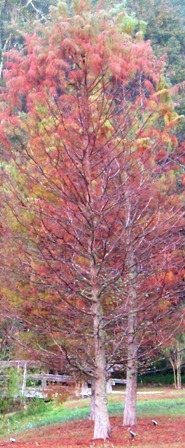
KMHuberimage; larch in autumnThe aroma of life is heady in itself for life is a banquet, and we need not starve ourselves with conditions or certain ways to partake of it. It need not always be set up like a Thanksgiving dinner eaten off plates used once a year.

The zest of life is in each new moment we have, whether it is the aroma or the actual bite of turkey, there need not be conditions or expectations.  We need merely experience the joy of the moment.

Cooper had an unconditional love for living life unconditionally. I do my best to remember this on all the days of these years I live without him.

His last Thanksgiving was that November 22, 2012, the year that some believed the world would never begin as all others had. As an ever-present, sentient being, one day or forever were the same to Cooper. His presence on this planet ended on the last day of 2012.

I do think of Cooper on New Year’s Eve but it is on Thanksgiving that the heady scent of Cooper’s memory wafts through my mind. And yes, there is the aroma of roasting turkey.

********

A Kindness Note for All Seasons: The awesome August McLaughlin is hosting the first #SparkleFriday kindness event on November 28, Black Friday. Check out her blog post or RSVP the Facebook event page.


Of Alarms, Animals, and Awakened Hearts

When the fire alarm went off, feline EmmaRose and I seemed sure it had something to do with me. She gave me her usual look of what now? My thought was I had finally succeeded in leaving an empty tea kettle on a hot burner long enough to melt the kettle’s bottom.

Quickly, I realized it was not our smoke detector but the fire alarm for the entire building. It was someone else’s burner/pan/tea kettle. I went outside into the warm, North Florida midnight air as did the rest of the building’s residents.

I did not put EmmaRose in her carrier and take her with me for she has such dread of any interruption of our routine—it upsets her for days—and although she is not fond of the fire alarm, it is not an unknown to her. Was this not yet another human event occurring for no apparent reason?
In her sun 0413

That seemed EmmaRose’s attitude, and she was correct. We never knew who pulled the alarm and probably never will. However, it would take 40 minutes before the alarm was finally silenced. Neither management nor the fire department could locate a key. This was not routine.

Within minutes, I decided the alarm was too much for EmmaRose’s ears. Standing among my neighbors, I heard myself say, “Well, I’m going to go get my cat.” I turned and walked toward my apartment.

Why I said aloud what I was thinking I have no idea but it produced another kind of human alarm.

“WHAT GOOD IS A CAT GOING TO DO??!? HOW WILL THAT HELP US?!?”

My back was to the man who was bellowing. I knew who it was, Carl. He had been talking nonstop to anyone and everyone but no one seemed to want his opinion, especially the firemen.

Still garrulous with my thoughts I shouted, “I think a lot more of animals than I do of people.” His retort was a strong suggestion that I grow up. I offered he might do the same and walked into my apartment.

EmmaRose met me at the door, ready to get into her carrier, and together, we went outside and away from the building but still in the vicinity of Carl’s voice.Eyes Open 0513

“I’ve been on the battlefield! I was in Special Ops! This is nothing! We are all upset!” Then, he stopped and looked around. After a few breaths, he mumbled something to the effect that I was making it worse for everyone.

It seemed more residents were bringing their pets outside. Maybe I had made it worse.

I looked at Carl. “Well, I didn’t think I was but if I have, I apologize.”

“Well, I apologize, too,” he said, adding, “peace?”

“We’re done,” I said.

Both of us remained quiet for the duration of the alarm as did every dog and every cat.

The next morning, Carl and I found ourselves face-to-face, again. We rarely saw each other.

“Good morning,” I said to Carl and meant it.

“So, we’re okay after last night?”

“We’re fine, really.” I extended my hand to him, and he shook it.

“I don’t know why I said that about your cat.”

“The alarm is hard on animals’ hearing,” I said, adding “I didn’t need to say what I said, either.”

“No, that was all right.”

KMHuberImages

At this point, we actually heard each other; our own alarms had finally shut off. For longer than the 40-minutes at midnight, Carl and I acknowledged each other’s value—a traditional Catholic soldier and a Buddhist animal lover—each worthy of respect for the human beings we are, a veteran and a hippie.

Carl is a fine teller of stories and excels at revealing the punch line. We laughed a lot and genuinely. We found common ground in a thoughtful discussion on democracy, in our mutual disdain for both prejudice and the healthcare system.

As he started up the stairs to his apartment and I to my vehicle, I heard the limp in his step, something I had not noticed.

I called out to him. “How do you feel about acupuncture?”

“I believe in it. Why?”

“I know a good one. Would you like her card?”

He says he would. I return to my apartment for the card, and he comes down the stairs to get it.

He thanks me and adds, “When you make a mistake you just have to own up, don’t you?”

“Yes, and then let it go,” I say.

And so we separate with hearts awakened.

The quality of modesty, or humility, comes naturally when we’re attentive. When we see how reactive and unkind we can be, this humbles us considerably.

Instead of causing despair, however, this painful realization can connect us with the tenderness of bodhichitta [or, awakened heart].

Modesty, or humbleness, is the opposite of armoring ourselves: it allows us to be receptive and hear what others have to say.

Pema Chödrön

(No Time to Lose: A Timely Guide to the Way of the Bodhisattva, pp. 134-35)

Sparkling Waverly 1013

Expanding the Cone of Habit

Duff in Outer Space 091414

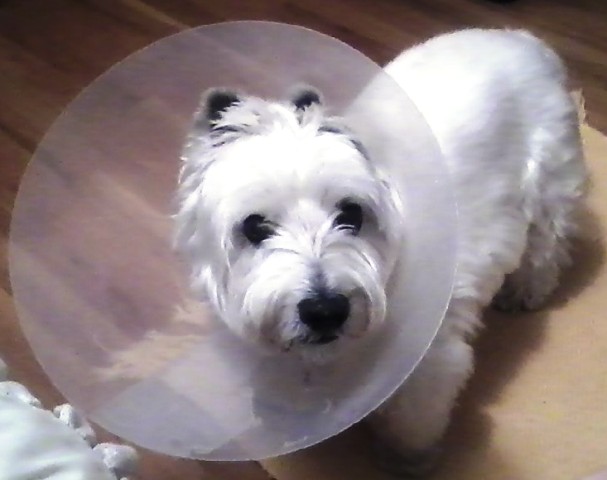
This bright-eyed Westie is a member of my extended family. Formally, he is known as McDuff but to all he loves and to all who love him he is “Duff.” Recently, he had minor surgery on his ears and in order to aid his healing, he wore a cone, a change of habit for him.

Change is how we form habits, forging new neural pathways for our brain to record as a new response to life’s experiences. It is how we physically open up to possibility.

Thanks to impermanence, everything is possible

(Thich Nhat Hanh)

I have been wearing my own cone of habit believing I was open to all healing possibilities. I was unaware that I could not see outside the scope of my cone of habit. It’s easier to do than one may think.

Undoubtedly, there are habits that serve us for as long as we live. Unique to each one of us, we know what they are. It is when we wear our habits as the only way to live that we create a cone, reducing our ability to see alternatives that may even improve our current practice.

Because you are alive, everything is possible

(Thich Nhat Hanh)

Thanks to impermanence, there is always another way. All we have to do is be in the reality we have and adapt like canine Duff. Ultimately, he figured out a way to use his cone to toss his ball, not far, but far enough to create a new way to continue to play ball. He was not confined by his cone.

My health issues also involve mobility. Months ago, I found myself in a situation where I could not walk to my destination and needed a wheelchair. It scared me, and it narrowed my vision regarding my mobility. I gave up walks but continued my daily, gentle yoga flow.

Although I increased my flexibility, the musculoskeletal pain increased and spread up my spine to my neck. Still, I stayed within my cone of comfort. It took a lupus flare-up involving my kidneys to expand my vision.

In opening to the reality I was living rather than being stuck in a moment that may never occur, I expanded my cone of habit and found an alternative health practitioner. Like Duff, I wanted to keep playing.

I did not have to look long or far. There is a licensed physician of Chinese medicine within blocks of my apartment. At my first appointment, I sat stunned as she revealed to me, in astonishing detail, what various teams of medical doctors had taken years to tell me.

Most of my medical history I had not mentioned for I had tried acupuncture previously with no results but I had never met a physician of traditional Chinese medicine.

Her estimation of my prognosis is geared to the life I have. As she reminds me, nothing is 100% but there is relief, and there are alternative ways, if I remain open to them.

After the first acupuncture treatment, I began taking short daily walks, sometimes including a stroll around my beloved Waverly pond. After the second treatment, the searing pain in my right knee significantly diminished and has yet to reach previous pain levels.

With food and some herbs, we are working with the lupus inflammation. There is a lot of hard work ahead but as long as I am alive, I can find a way to play ball, as Duff showed me.

Duff without cone 091414

A Note About Duff: Remarkably handsome, this wise Westie lives in Seattle with my dad and his wife.

When to Carry and When to Let Go

My previous post considered the constant connection we have with our world, one more immediate than ever before. There is a continuous buzz of busyness. It can overwhelm one to stillness, this blogger included, so I took a week off from publishing a post.

A break in routine is an opportunity to create a change in the way we live unless the break is just another form of busyness—same behavior just different surroundings or situations.

Taking a look 0714

A true break means we attend to basic requirements only and not carry the world with us so we may meet the mundane as if for the first time, eyes fresh and bright. It requires us to drop what we carry so that we hold only the moment we have.

There is a well-known story of two monks who come to a river where they meet a woman who needs assistance in crossing.

Without a word, one monk picks up the woman and carries her across. She thanks the monk and leaves. The two monks continue on their way, one troubled and one not.

Finally, the troubled monk can stand it no longer and asks, “Why did you carry that woman across the river when you know we are prohibited any contact with women?”

The untroubled monk responds, “I only carried her across the river. You are still carrying her.”

If it is a break we intend, then it is much like residing in the gap between thoughts. In no thought there is no mind just pure consciousness. In a break from our routine, we no longer carry the busyness of everyday. We put it down and rest. When we return to our river of routine we cross, carrying our load again.

For me, this short break from blogging was different than previous ones. It started with a stop. Simultaneously, I dealt with a colorful but significantly sprained toe on my left foot and an aggravated inflammation of my right knee.

I note that the injury to my toe is probably related to increasing lupus inflammation issues but the injury occurred after my trip to the library in search of Zen novels (I found two). In fact, it was after I put down my library load that I stubbed/sprained/jammed my toe.

Resting and reading Zen provided me another perspective on balance both physically and emotionally. Perhaps my knee was more troublesome that particular day as in addition to wandering around the library, I had stocked up on groceries for the week.

My usual routine is either the library or the grocery store but not both yet organic, freshly ground almond butter was on sale, and I had new recipes to try, in particular Zoe’s cookies.  I would have to wait most of the week to make them but they were worth every step to get the ingredients. EmmaRose thought so, too. EmmaRose meets Zoe Cookies 0814

When not reading, I put down other emotional baggage that tends to clutter my routine, remembering that people really are doing the best they can and there are always options–this is true for me, as well. Sometimes, my routine blinds me to what others face so I do not see what they are carrying.

Now, I return to the river of my routine. I know the moment is all I ever have and that it is more than enough. After all, I only need to carry it to the next moment.

The First Peace in Relationship is Life Anew

This past Monday, feline EmmaRose and I experienced the imperative inherent in impermanence. One being can never know another completely, which is as it should be. The richness of relationship, its mystery, keeps us curious and often, in awe.

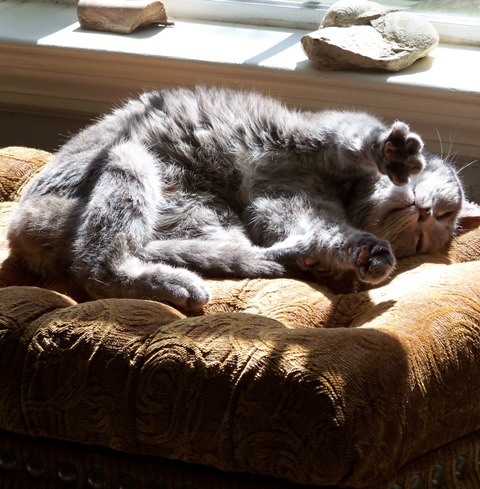
In her sun 0413As a cat, EmmaRose is ever present. Routine is her preference for that means food and shelter—her sense of security—is not threatened.  For the three and a half years she has lived with me not even the furniture has been rearranged. It seems she appreciated this more than I knew.

We spend most of our time in the bedroom, which doubles as my work area. I work from an adjustable Tempurpedic bed complete with laptop and bed table. EmmaRose is quite partial to sleeping on the Internet router, especially in winter, or near/on my lap while I write.

Our living room has never had much furniture. There is still a lovely antique, wooden rocker with a padded seat. It is more comfortable than it looks. Also, there is a large, rust-colored ottoman suitable for human and feline window gazing.

There WAS a twin bed box springs and mattress that I tried to disguise as a sofa-daybed. For me it was ugly, uncomfortable, an unpleasant reminder of another time. From time to time, however, I would find EmmaRose curled up and asleep on it.

That I regularly removed accumulated cat hair from its quilt cover should have told me that this was a nocturnal sleeping place. Did we not once watch a possum in moonlight from the sofa-daybed?

Staying with Familiar 0614

In hindsight, it is obvious that a good deal on a used loveseat and recliner changed our relationship. In fact, EmmaRose seemed to sense imminent change the moment we heard the knock on our front door.

She did not watch the daybed leave the apartment, preferring the familiarity of the bedroom to wait for the moving in and moving out to cease. Only then did she return to the living room.

Although she is only five and a half pounds, she has an immense presence, especially when she communicates. We don’t focus on the actual meow or word. Rather, we pay attention to tone, and her feelings regarding the loveseat and recliner were quite clear.

Here we were in the reality of impermanence. The known furniture was gone and the unknown leather furniture was here. Accepting loss precedes learning to live with what is. Becoming once again secure in one’s world is unique to each being–there is no set amount of time.

KMHuberImage; Meditation Cat;

We can immerse ourselves into the newness of our world or we can skirt the change for awhile. Regardless, it is up to us to seek that first peace so integral to relationship, which is precisely what EmmaRose did three days and four nights later.

It was during the opalescent hours, as one day becomes another, that EmmaRose beckoned me to the loveseat for window gazing. In the light of the waning crescent moon, I glimpsed an occasional firefly but soon the purr of EmmaRose brought me, too, to sleep.


On Either Side of the Windowpane

watching 0314We are always in relationship–some small, others grand–ours is to co-exist. Life is what we have in common. It is sharing space with one another, including the insect in the room.

In the subtropical climate in which I live, co-existence with insects and bugs is possible year around. There are seasonal changes, sometimes marked by a winter’s bloom and other times, yet another change in foliage color.

Through it all, insects and bugs make their way on either side of window panes. The world of bugs and insects is fragile in its beauty and terrifyingly transient. There, living life to its fullest, even for a nanosecond, is never questioned, and death is just as imminent. The more I watch this world, the larger my own life becomes.

Insect and bug death is more common outside my windowpane than on the inside. Feline EmmaRose and I are content to observe all the life around us, although there are times I escort bugs and insects to the world on the other side of the pane. Relationship requires decisions.

Our windows look onto a carpet of grass that slopes to live oaks, pines and vines of woodland too thick for human occupation. Gray squirrels flick their feather-plumed tails, scurrying in and out of the woods in constant search of nuts not yet sprouted. Rarely, do they look to insects and bugs as food but they are never off the menu. Woods within 0514 This spring, EmmaRose and I have watched a pair of cardinals pecking seeds at woods’ edge as well as enjoying bug protein. The silken-red male most often appears in mornings, taking breakfast from what seems to be a favorite series of spots.

It is early evening when we see an earthen-brown female with a tufted, red crest and subtle red highlights. She stays closer to the woods, most often preferring low branches to the ground.

The brown thrasher is quite common of late. It seems a good year for insects and bug protein. To me, the reddish-brown streaks of the thrasher splashed through its mostly white chest seem velvet in texture. Thrashers, cardinals, and squirrels can be territorial but EmmaRose and I have yet to see a squabble.

The world outside the windowpane seems orchestrated and random. I wonder at all that I never see. I like that there is yet another world beyond mine.Bunny right side 072813

This week, there is a new crop of clover, always a favorite for the eastern cottontail rabbits that enjoy the cover of the woodlands as well as the grassy area borders. We watch kits and adults alike.

EmmaRose seems most attuned to rabbit watching. Often, she puts her paw on my arm and meows; it is my cue to look to the world outside the windowpane. More often than not, a rabbit munches the green slope at the edge of the woods.

Relationships are a collage of images collected over a lifetime, snapshots of the world on either side of the windowpane.

Love Lives In Inconvenient Places

Love lives in places and ways often missed for love only needs an open heart to thrive. Such is the story of Harriet and Hal, a human and a Chihuahua.

They shared food and constant companionship as they spent their days in a well-worn, overstuffed recliner not far from a medium-sized, flat-screen television. Sometimes they watched current events and other times they just left the television on “for the noise.”

They did not care for quiet so when they tired of the background noise, they talked to each other. Hal seemed to take sound seriously. When they walked outdoors, Hal greeted neighbors with a steady stream of squeaks and yips that had a lower and upper register. He always had a lot to say. Harriet translated, if she felt it necessary.

Harriet is older, mid-70s, and Hal was in the middle of his eighth year. He put on weight but Harriet did not. Her health is in decline—congestive heart failure and significant vascular issues—she is a smoker, although she has tried to stop and prays every day she will.  Other than a steady increase in weight, Hal’s health was remarkably good.

Harriet often worried that Hal might outlive her. From time to time, she would formulate a plan to provide for Hal but each idea faded. She seemed to recognize their way of life was unique to them. It was as if she decided she would just have to outlive Hal. And so she has.Clarity in the wild 0413

On the second day in October, Hal’s health went into decline. Like Harriet, he developed congestive heart failure and there was fluid in his lungs; then, he had trouble walking and finally, could no longer stand.

Harriet rearranged their lives as best as she was able, including securing a new veterinarian who makes house calls. Hal did spend just over 24 hours at the animal hospital but his need for Harriet was greater than his need for better nutrition, a smoke-free environment or medical care.

Upon Hal’s return home, he yipped and squeaked until he had told Harriet all he had to say. They spent their last night together in their chair with Harriet doing most of the talking. The next day, Harriet held him in her arms as he died.

In Hal’s last two weeks I was a part of their world more than I had ever been for we only saw each other in the way that neighbors do these days, fleetingly. I was aware and not aware of how they lived.

Once inside their home, I struggled to keep judgment at bay. At times, my compassion left me, and I should have followed. I was trying to change the outcome as well as the story line, neither of which was mine to do.

It was only in embracing the pain of two friends saying goodbye–living as they had always lived—that I was able to help them, which is all they had asked. In letting go, another way of living began.

We are pure awareness experiencing life in all its appearances. In breaking open, all the labels and judgments spill out, leaving only the raw, pure energy of being alive. It is then we touch what is deepest in us and extend it to another.

This month’s Bloggers for Peace considers the challenge of embracing life as it is when everything in your being resists. Harriet and Hal showed me one way.forpeace6

Other Bloggers for Peace Posts:

Chronicles of a Public Transit User

Faith Fusion

A Quiet Prayer of Thanks