Humility: The Art of Being Enough

The art of being enough begins with the complete and total acceptance of ourselves (maitri), without labeling our shortcomings or our strengths. There are no credits or debits within the flow of life.

“All streams flow to the sea

because it is lower than they are.

Humility gives it its power.”

 ~Lao Tzu~

KMHuberImage
KMHuberImage

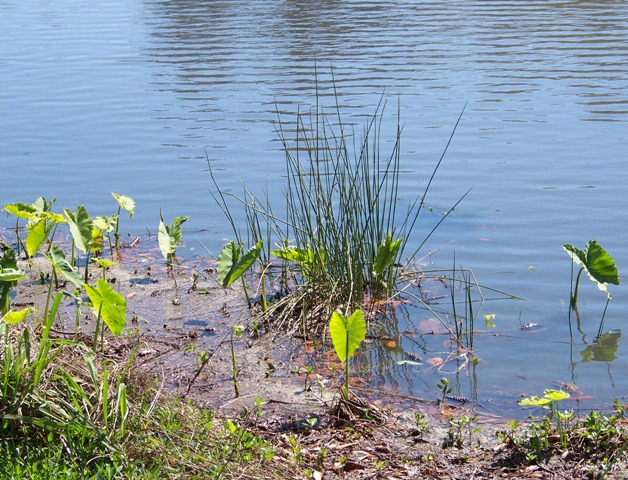
The art of being enough is accepting that we meander with the river of life on our way to the sea. Each horseshoe bend of life is the forgiveness of ourselves and others so essential to the flow of being enough. Each bend reflects a challenge met, yet another way discovered.

Bending with life rather than letting life bend us is the power of humility, a delicate balance of keeping our thinking subordinate to our heart. The strength of humility is not denying our uniqueness but in expressing it, although those waters seem murky at times. Ego will do that.

When we allow our ego to supersede our heart, we cut ourselves off from the flow of life. Essentially, we are saying we are not enough. Continuously, we add up what we are and are not—our debits and credits are never enough–and with our abacus of self, we total up the world’s worth, which also falls short. There is never enough for ego without a heart.

The art of being enough regards life as an adventure with infinite possibilities. Rather than adding up life as a positive or negative, in humility we pursue life for the pure experience of it. We are not trying to mold it to assure a certain outcome; we bend with the possibilities, trusting the flow of being enough.

KMHuberImage
KMHuberImage

How we live our lives is our unique contribution to the oneness of existence. Sooner or later, we become enough. Perhaps the best illustration of this is the story of the Hindu master and his apprentice.*

The apprentice is constantly complaining about life, how it measures up or does not. The Hindu master grows weary of the apprentice’s complaints and sends him to purchase salt.

Upon the apprentice’s return, the master tells him to put a handful of salt into a glass of water and drink it. Immediately, the apprentice pronounces the taste of the water as bitter. The master smiles and informs the apprentice they are going to the lake.

At the lake, the apprentice is told to throw a handful of salt into the lake and then take a drink from the water’s edge. The apprentice says the water tastes fresh. The master tells the apprentice:

“`The pain of life is pure salt; no more, no less. The amount of pain… remains…exactly the same. But the amount of bitterness we taste depends on the container we put the pain in.’”

KMHuberImage
KMHuberImage


There is a grace in learning to bend with life, and perhaps in bending, we just may discover that our unique purpose is to do just that, express ourselves in the meandering flow of life on our way to the sea.

In the words of the Hindu master, “`…the only thing you can do is…enlarge your sense of things….Stop being a glass. Become a lake.’”  You are enough.

*The story of the Hindu master and apprentice first appeared in a January 2012 post; all citations are from Mark Nepo’s Book of Awakening.
Thursday Tidbits: A Lasting Innocence

This week’s Thursday Tidbits considers April’s Bloggers for Peace theme, children and peace. Whenever I think of children, I think of animals for both remind that life on the physical plane is ever ongoing, is ever born in innocence, is ever lasting.

In her sun 0413
KMHuberImage

Within all of existence, innocence is born again and again, always with the possibility of peace everlasting. For neither innocence nor peace carry the burden of judgment nor do children and animals.

Indeed, they are “all bright and beautiful as well as great and small.” Perhaps that is not a fair paraphrase of the opening lines of the Cecil Frances Alexander poem but I cannot think of children or of animals without remembering that classic poem. It is in their eyes that one sees the world as it is.

I am not a parent so my experience with children is limited to nieces and nephews that have always delighted. Another favorite experience was working with young writers eager to tell their stories yet they were also just as eager to listen, if the story was good enough. These days, I enjoy the grandchildren of friends and count myself most fortunate in that. The world through a child’s eyes is ever expanding.

Perhaps what is most revealing in both children and animals—beyond being forever young–is they are also ever present. It may be their greatest gift, this constant revelation that peace resides in the lasting innocence with which we are all born, and all we need to do is awaken what we allow to sleep within so soundly.

KMHuberImage
KMHuberImage

Animals stay present their entire lives–no matter how long they live– they never lose their innocence of being, despite what some endure just to survive. For those whose innocence lies calloused beneath scars that nearly break them, they remain present. Innocence is, no matter how deep.

Unfortunately, what some children must endure just to survive can bury their innocence, too. Yet, innocence is the birth right of all beings on the physical plane. We do not readily recognize our innocence as adults—for we struggle to be present, if we are that aware—we look to the children for innocence we once knew, perhaps making sure it still is.

No doubt, it sounds unrealistic to view innocence as everlasting, and some would argue that a lasting peace is just as unrealistic but sometimes we pass life by, too busy defining what it should look like when all we have to do is look into the eyes of the nearest child or animal to remember what life actually does look like.

This week’s video features “Bless the Beasts and the Children,” sung by the Carpenters and complete with images of both beasts and children.

Hope you have a moment to browse the related posts about children and their stories.

My favorite children’s author is Adrian Fogelin. Her latest novel for children, Summer on the Moon, placed second in the Florida book awards for 2012. The book link is to her website so you may read all about her. She also blogs at SlowDance Journal where you will always find thoughtful essays.

Peace Garret provides six children’s story recommendations.

Bayard and Holmes remind us just how amazing and bright young people are with their youth achievement awards.

Grandmalin provides parent wisdom as well as words to the wise for the rest of us in respecting children in her April Post for Peace.

forpeace6

Thursday Tidbits are weekly posts that offer choice bits of information to celebrate our oneness with one another through our unique perspectives. It is how we connect, how we have always connected but in the 21st century, the connection is a global one.

In Buddha Nature, No Excuse is Necessary

KMHuberImage
KMHuberImage

“The reason everything looks beautiful is
because it is out of balance,
but its background is always in perfect harmony.

This is how everything exists
in the realm of Buddha nature, losing its balance
against a background of perfect balance.

So if you see things without
realizing the background of Buddha nature,
everything appears to be in the form of suffering.

But if you understand the background of existence,
you realize that suffering itself is how we live,
and how we extend our life.”

~Shunryu Suzuki

My blog posts are a bit out of sync for this has been a week of resistance, meaning accepting what is has not come easily. Whenever we resist what is, we suffer, for we hold on and tug at a moment, as if to reshape it and the future, as if we could.

That kind of attachment never works, ultimately. The freedom inherent in every moment is not only more palatable but more realistic, for every moment is framed within the harmony of Buddha nature.

When suffering is viewed through Buddha nature, resistance reveals itself as a struggle against what is being extended to us. If we just open up to whatever the moment is offering us, if we just trust the harmony of Buddha nature, we do not escape suffering nor do we push it away for another day. We accept and move through it.

It is tempting to trot out reasons and excuses for why we resist–some of them are really good stories in and of themselves–yet resistance relies on past moments that are beyond changing, which is not to say those moments may not find themselves in a story. Writing extends life to any moment as a new story playing out within the balance of Buddha nature.

Quite often, I lose my balance in life, unlike the old woman whose story I am writing. She knows her story and accepts Buddha nature as basic but she did not always. Writing a story is secondary to living one but like real life, story plays out on a blank canvas, as choices color each scene, ultimately revealing Buddha nature.

KMHuberImage
KMHuberImage

I try to remember the old woman when I slip away from Buddha nature for her story shows me what is possible—no matter what—but unlike the old woman, I do not have the benefit of knowing all my story, not yet. Rather, my advantage is the clean slate that every moment presents to me, as a writer and as an old woman, uncertain in both and curious about what happens next for either.

“Do not try to know the truth, for knowledge by the mind is not true knowledge. But you can know what is not true—which is enough to liberate you from the false. The idea that you know what is true is dangerous, for it keeps you imprisoned in the mind. It is when you do not know, that you are free to investigate. And there can be no salvation, without investigation, because non investigation is the main cause of bondage.”

~Nisargadatta Maharaj

Shedding: An Act of Immortality

KMHuberImage
KMHuberImage

Spring knows many faces but regardless, it is renewal, a restoring to existence. Present moment awareness is like spring in that each moment is new, unattached to any outcome, full of the breath of infinite possibilities.

Each moment sheds itself for the next, an ongoing renewal of life, our own cycle of the seasons, our own glimpse into immortality, if we are willing to embrace the unknown and let go of the known.

Shedding is a term I learned from Mark Nepo’s Book of Awakening; he is a great teller of stories for he knows their power. One of the early stories of humans shedding their skin comes from the North Borneo Dusuns who believe when “God finished creating the world, He announced that ‘Whoever is able to cast off his skin shall not die’” (Nepo).

Stories of immortality evolve around the inevitable change involved in choice.

The Melanesians of the New Hebrides offer a story of such a choice (Nepo). In the beginning, humans shed their aged skins for the new skin of youth, as is the way of immortality.

One day, as an old woman cast her skin into the river, she noticed that it caught on a branch downstream. The woman returned to her home in her new skin. Her child, however, wailed inconsolably for the mother’s old, familiar skin. The woman returned to the river to retrieve her skin and live in it, as is the way of mortality.

In the twenty-first century, we know our physical bodies undergo a lifetime of transformation, a sloughing of old cells for new, whether we are spiritual beings having a human experience or mere mortals seeking a spiritual experience.

Perhaps present moment awareness mirrors our ongoing physical shedding of our cells. Transformation, it seems, will out.
Waverly Larch Spring 0313
“In essence, shedding opens us to self transformation. Paradoxically, those of us who refuse such renewal will, sooner or later, be forced to undergo transformation anyway as a result of being broken or eroded by the world. Very often both occur at the same time: that is, we shed from within while being eroded from without” (Nepo).

Like immortality, transformation at any level exacts a choice for we are shedding the skin that has been familiar to ourselves as well as to the world. Often, the outer world reacts immediately to the loss of what was, rather than  responding to the new that is now.

There is no way that we ever prepare ourselves or anyone else for the outcome of shedding a worn skin for one that is new, unknown, and uncertain. Yet, if we do not shed what is no longer us, we lose “access to what is eternal” (Nepo). It is a choice, an immortal one, but a choice.

Shedding moment after moment to access the ever-expanding field of possibilities—the unknown—is a renewal the outer skin knows only from the inside out, as is the way of immortality.

Thursday Tidbits: The Zen of Kitchen Tasks and Meditating Cats

This week’s Thursday Tidbits post considers Zen as revealed through meditating cats and kitchen tasks, the everyday of  Zen spirituality.

“Zen does not confuse spirituality with thinking about God while one is peeling potatoes. Zen spirituality is just to peel the potatoes.”

Alan Watts

Perhaps more than I should admit, Zen spirituality is a constant in my kitchen, which is not to say that I am able to tend to the task at hand completely, far too often not. Rather, as I am chopping onion I consider what the next moment might offer. Rarely, do I consider the onion.

EmmaRose in MeditationKMHuberImage
EmmaRose in Meditation
KMHuberImage

Often my musing ranges far beyond the physical plane–my own private “soaring with the over-soul*–rather than considering the outcome for the onion, usually mere mush.

At best, I might be considering whether I will scramble eggs or shred lettuce for a salad; both are dictated by the state of the onion and just how far my thoughts have strayed.

It is scrambled eggs if I am envisioning the next scene in my old woman novel but the salad may be saved if I have only strayed to whether or not laundry needs to be done. The answer to that is always the same, a crisp, clear “no.”

Every time I immerse myself in the Zen spirituality of the mundane, I discover something new. It never fails. To be fair, when my thoughts are anywhere but the task at hand, there are also discoveries, including the best tasting cup of coffee is made from the proper proportions of both water and coffee.

Regardless of the outcome, discovery expands the moment to its brim. There was a time that a burnt coffee carafe or hot, coffee-colored water dismayed me, and although I may greet those moments in resignation, I am able to see them in their own Zen spirituality.

Living with animals has taught me more about Zen spirituality than any other resource, including kitchen tasks. This week’s video, courtesy of ZenFlash, features just over a minute of cats meditating, which I found illustrative of Zen but not the kind of meditation that feline EmmaRose has taught me.

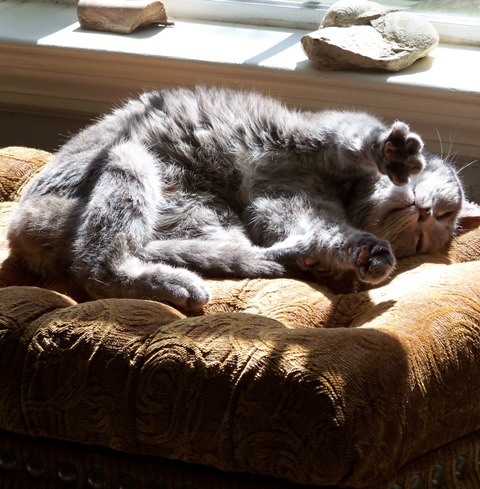
EmmaRose has always been a meditating cat but not with any kind of object, especially round and especially large, as she tops the scale at five-and-one-half pounds. For EmmaRose, small, round objects are for batting and chasing into obscure areas invisible to human eyes. She prefers meditating at the window, which she does daily, and she considers the panes carefully.

Choosing Her PaneKMHuberImage
Choosing Her Pane
KMHuberImage

Often, squirrels are visible from the right pane while the left side might offer a darting, lime-green lizard–EmmaRose seems to sense the season for lizard viewing–the middle pane offers the most sun on any day. Whatever these moments provide EmmaRose, she is at her window to discover anew each day.

Who is to say whether or not she “soars with the over-soul”* for she has the light of day, which may offer a squirrel or the infrequent lizard as well.

I and my onion can only aspire.

Thursday Tidbits are weekly posts that offer choice bits of information to celebrate our oneness with one another through our unique perspectives. It is how we connect, how we have always connected but in the 21st century, the connection is a global one.

*Soaring with the over-soul” is from a satirical essay Louisa May Alcott wrote regarding her father’s involvement with 19th century transcendentalism. 

On My Way to the Way With Everyone Else

Single Path 0313I do not believe there is only one way for everyone—never have—but rather, we are all on our way to the Way. We have various labels for the Way–Christianity, Buddhism, Taoism, Hinduism—regardless, the Way always has been and always will be.

“The Tao is both named and nameless. As nameless it is the origin of all things; as named it is the Mother of 10,000 things” (Tao). Our path is our experience of the 10,000 things of the Way: “I am the way, the truth and the life” (John 14:6).

Everyone practices in order to find out for him or herself…how to be balanced, how to be not too tight and not too loose. No one else can tell you. You just have to find out for yourself” (Pema Chödrön, The Wisdom of No Escape).

Any and all of the ways teach us, no matter what label resonates individually: God, the Universe, the Source, the Unified Field, Spirit, Creator, Krishna, Buddha, or the eternal phenomena of the Chinese “web that has no weaver.”  The unique expression that is each of us is also our connection to one another.

Deepak Chopra says “we are all God in different disguises”; God is having a unique experience on the physical plane through each one of us. As such, we are the energy that is God, the Oneness that is our connection to one another.

It seems we should celebrate our connection to one another but often we separate rather than celebrate, disconnect rather than connect, although we are hardwired to love and belong—it is in our DNA. When we separate from our own way, we leave the path to the Way, and we suffer.

We all know suffering–no matter how we label craving and clinging—weThick of it 0313 do not have to know others’ experiences nor they ours to feel what  DNA is tugging on us to do: connect with one another. When we are separate, we do not trust our way to the Way.

Going out and changing the world doesn’t work for me…It only feeds into the same judgmental energy….Instead, letting go of attachment to any way of believing or thinking has made me feel more expanded and almost transparent so that universal energy can just flow through me. More positive coincidences happen in my life when I’m in this state of allowing” (Anita Moorjani, Dying to be Me)

The need to connect with one another keeps us in search of our way to the Way. Our journey begins at birth. We bring our own bits of light and dark to the being that is our life. The darkness and lightness of each of us is what we offer to the world, what we come to know as our path to the Way.

We do not have to live as labels for it is in our Oneness with one another that we find our way into the Way.

Thursday Tidbits: Digging Deep for “Meraki”

This week’s Thursday Tidbits considers meraki, a modern Greek word for that “extra something” we add to whatever we’re doing, no matter the task. Usually intangible and often inexplicable, meraki helps us immerse ourselves into whatever is at hand. We dig deep for meraki.

Over the last few weeks, I have had to reinvent my diet, in fact my entire daily way of being. Thanks to Prompts for the Promptless, I now have a word for it, meraki, which actually is often associated with cooking, that hard to identify ingredient or quality so essential to adapting to life.

Although I thought I was on a Slow Boat to Fitness, it seems it was not my boat at all. Last November, I began supplementing Meraki Momentmy diet with a few legumes, bread made from brown rice, and a few fruits. I was able to tolerate the extra carbohydrates but steadily the inflammation increased as did the discomfort. Only apples are still allowed.

At first, I thought it was the yoga so I modified my practice yet eventually, I had to stop. I continued with my walking but as the inflammation and discomfort increased, my distance lessened. Yet, after five months, I finally had a meraki moment.

Did I gain weight? Yes one day and no the next and then yes again, the usual roller coaster that has been my experience with the inflammation from degenerative arthritis and lupus. Overall, my weight did not change, which I attribute to the doshas of Ayurveda, of which I am kapha, mostly. Ayurveda eased me into my meraki moment regarding my food.

The ancient art of Ayurveda is not concerned with classifying carbohydrates, proteins, and fats but concentrates on the six tastes found in food: the hot tastes of pungent, sour, and salty; the cold tastes of bitter, astringent, and sweet. Those tastes carry different messages to the body and it reacts accordingly. Ayurveda is so much more than that but I am just beginning.

For me, Ayurveda provides a way to practice my meraki with maitri or loving-kindness as I let go of a diet that I enjoyed but did not provide my body the fuel it must have to fight inflammation and support my joints. I was looking outside myself for answers that were always within me:

If you look for the truth outside yourself,
It gets farther and farther away.
Today walking alone, I meet it everywhere I step.
It is the same as me, yet I am not it.
Only if you understand it in this way
Will you merge with the way things are.” ~ Tung-Shan ~

Meraki helps me listen to my body rather than sending it commands to which it cannot comply because it does not have the energy. A return to yoga is actually relieving some of the discomfort in my joints, and the walking is easier.

With meraki, which always involves one’s enthusiasm for life, I have added daily trips to the delightful blog, Zen flash, an online temple offering daily posts of solitary images and transcendent lines.  It is a part of my morning meditation practice but I also visit at other times to remember:

“Everyday life

is not divorced from

the Eternal State.

~~Sri Ramana Maharshi

In the spirit of Zen flash, this week’s video offers Schumann’s Opus 15 as a moment of merkai from me to you.

Thursday Tidbits are weekly posts that offer choice bits of information to celebrate our oneness with one another through our unique perspectives. It is how we connect, how we have always connected but in the 21st century, the connection is a global one.

Joy Without the Hangover

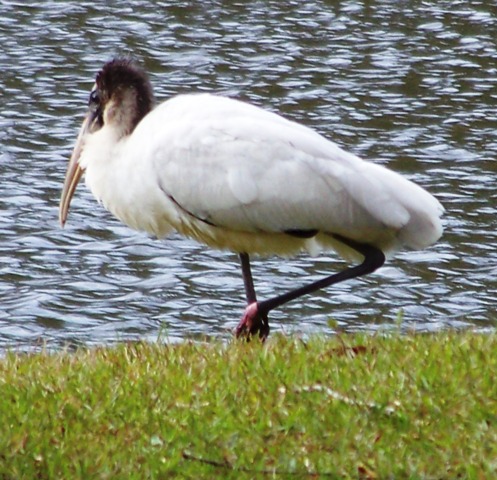
Stork and Joy 0313
KMHuberImage

The “trust in our fresh, unbiased nature brings us unlimited joy– happiness is completely devoid of clinging and craving. This is the joy of happiness without a hangover” (Pema Chödrön, The Places That Scare You, 2009).

To experience the unlimited joy of every moment, we trust the innate goodness of our open heart. Joy is no more an adrenaline rush than it is an attempt to keep a moment from passing, no hanging on or yearning allowed, only gratitude. It is a matter of equanimity in all matters in all moments.

In revisiting Buddhism through Pema Chödrön, I am reminded of just how basic joy is and just how difficult. As Einstein said, “Everything should be made as simple as possible, but not simpler.” Nowhere is this more evident than in practicing the “four limitless qualities” of joy, equanimity, love, and compassion where ego never dares to tread.

In this past week, I knew moments of suffering in the Buddhist sense–any feeling or action outside the four limitless qualities–I also knew moments of happiness. In either, I did not want the hangover of holding onto the happiness or avoiding the suffering. I just wanted to be.

KMHuberImage
KMHuberImage

Unexpected as the events were, I practiced staying and not straying from each moment, difficult as it was. Equanimity in any moment—trying to remain unbiased—allows us to receive what each moment offers. We look within ourselves to our open heart for our compassionate response.

In opening ourselves to our own worth, each of us finds our way “to the truth that we have always been warriors living in a sacred world” (Chödrön). Within our truth is “the ongoing experience of limitless joy” if we will just trust ourselves within that experience.

At the beginning joy is just a feeling that our own situation is workable. We stop looking for a more suitable place to be” (Chödrön). When we stop looking outside for what is inside us, we immerse ourselves in reality. No matter what is occurring, we are alive, and we rejoice in all that we have and all that we are for “it is easy to miss our own good fortune” (Chödrön).

The practice of unlimited joy is our life’s work in every moment we have. “Rejoicing in ordinary things is not sentimental or trite. It actually takes guts… Everything we see, hear, taste, and smell has the power to strengthen and uplift us” (Chödrön). All we have to do is show up and be amazed, moment by moment.

Sunday Anhingas 0313
KMHuberImage

As unique as each one of us is, we are all connected in our suffering and happiness of our everyday lives, our source of unlimited joy.  “In a nutshell, when life is pleasant, think of others. When life is a burden, think of others. If this is the only training we ever remember to do, it will benefit us tremendously and everyone else as well” (Chödrön).

Our connection with one another is the expression of our love for the unlimited joy inherent in life, in whatever way it is served to us. We keep life simple, as it is, and not simpler, making it something it is not.

This simple way of training with pleasure and pain allows us to use what we have, wherever we are, to connect with other people. It engenders on-the-spot bravery, which is what it will take to heal ourselves and our brothers and sisters on the planet” (Chödrön).

To face every moment with equanimity is not always possible but doing the best we can with what we have lessens any hangover and increases unlimited joy.

Thursday Tidbits: The Wu Wei In All of Us

This week’s Thursday Tidbits post considers Taoism’s “wu wei,” literally translated as non-doing or non action. Reaching for the good that is in all of us—listening to our heart over our head—is innate in us, as is the risk of opening ourselves to the world. In addition, wu wei is the current prompt in rarasaur’s delightful series, Prompts for the Promptless. Here is rarasaur’s description of the essence of wu wei:

“Wu wei, or non-doing, is a Taoist practice involving letting one’s action follow the simple and spontaneous course of nature rather than interfering with the harmonious working of universal law by imposing arbitrary and artificial forms.  In other words, it is the action of non-action.”

I had not considered wu wei for this week’s Thursday Tidbits until I read rarasaur’s prompt, yet wu wei encompasses the heart of the three posts I chose from dailygood.org. In considerably different ways, each is a story of the open heart, the voice of instinct.

An Astounding Act of High School Sportsmanship is about a high school basketball game in El Paso, TX. Although the video is no longer available, the words revealing the thoughts of the young basketball player will open your heart. It’s a wu wei reminder that every day we have an opportunity to let another person shine, to realize it is the other person’s light that is necessary, and our role is to make that happen. In this case, the game’s outcome was not in jeopardy for this moment was not about the game. It was about knowing whose turn it is and rising to the occasion.
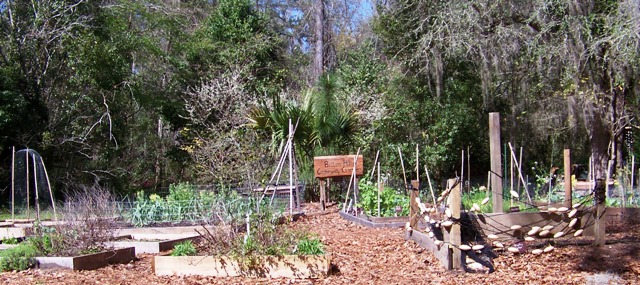
Community Garden 0213

The second story opens with: “It says something about where we’ve come as a society that the simple act of fixing something that’s broken is considered a revolutionary act. Yet here we are” at The Repair Café. The Café originated in the Netherlands in 2010 and is slowly but steadily gaining global awareness. It is a decide-for-yourself café where people can learn how to fix items or have items fixed. They can have a coffee or read a do-it-yourself book to learn how to or wait for an item to be fixed.

The Café is a place to work with stuff—recognizing what comprises it and how it works—it is a place to hone inner resources as well, passing skills from one generation to another. It is the wu wei of sharing who we are and what we have with one another in respect for the resources of the planet.

Finally, there is the poignant story of Susan Spencer-Wendel who wrote Until I Say Goodbye, a book based on her year of living with joy. She used her iPhone to write her 89,000 word book as she only had the use of her right thumb.

Her herculean effort is consistent with her comment regarding her diagnosis of ALS (Lou Gehrig’s Disease): [I was] “equally grateful for a life of perfect health and determined to face it with bravery.” Hers is the way of the wu wei warrior, brave in her acceptance of what is and ever seeking all that it may give her.KMHuberimage

Wu wei is the way of the open heart, immersing ourselves into what is without trying to control the outcome. It is acceptance. Wu wei is not something we pursue but a reminder that our natural state is to open ourselves to all that we are so we may be:

And the day came when the risk to remain tight in a bud was more painful than the risk it took to blossom” (Elizabeth Appell).

This week’s video features the Indigo Girls’ “Galileo,” a man who risked a lifetime for truth.

Thursday Tidbits are weekly posts that offer choice bits of information to celebrate our oneness with one another through our unique perspectives. It is how we connect, how we have always connected but in the 21st century, the connection is a global one.

Staying and Straying: The Tension of Two

KMHunerImage; McCord Park; Tallahassee
KMHuberImage

The fear of letting go makes staying hard and straying easy. As Mark Nepo says, it is “so hard to feel the stone and not the ripple.” It is the tension of trying to be in two places at once, resisting what is for what might be.

“The moment we stray from where we are…we [block] the sensation of being fully alive because being split in our attention prevents us from being authentic” (Mark Nepo).

When we stray to a past moment that gives us pain or joy or both–how we label it really doesn’t matter–the memory provides us with what it has always provided us, a moment that was reality but no longer exists. Yet, that memory appears in the present moment.

KMHuberImage
KMHuberImage

In staying with what each moment offers, memories bubble up—memory is the context of our mind–it is one thing to witness our memories and another to engage them. When we stray to them, we divide our attention and are no longer authentic but somewhere in between.

We can’t help but remember, yet if we allow our memories to stay as bubbles, floating up and through us, we let them go as they are, untouched and whole. As Pema Chödrön teaches, it is the energy beneath memory that is worth our attention for it is the source of the bubbles.

For each moment that we practice being present—neither running from nor holding onto—we feel the stone and not the ripple for we are not attaching or resisting. There is no tension of straying or staying. These moments seem few.

The difficult and the joyous moments we always revisit for those are bubbles we want to forget or we want to remember always. Regardless, we stray. In remembering, sometimes we try to change the outcome by daydreaming new scenarios or we just simply want to relive the moment, maybe embellishing it just a bit. Once we stray, there are no limitations.

Regardless, the memory bubbles will return and keep returning until we practice staying in each moment we have. Our practice begins with our inner resources, the “four limitless qualities [of] loving-kindness, compassion, joy, and equanimity” (Pema Chödrön). We begin with whatever quantity there is of each, no matter how shallow the pool.

We go to what we are because it is what we genuinely and completely feel. We may aspire but we begin right where we are. A well can fill, a pool can become a lake but always, there is the first drop.  For us, always there is the present.

KMHuberImage; McCord Park; Tallahassee; Florida
KMHuberImage

What we actually are–a limitless pool of inner resources–spills into our actions in everyday life. It is a pool to which we may return again and again, staying with what is genuine rather than straying into what was or might be. There is no resistance, just the feel of the stone.

“That we stray from the moment is not surprising. The more crucial thing is that we return” (Nepo).