Looking Through the Lens of Limitation

Looking within 0213For nearly four decades, I viewed disability through a lens of limitation. For me, that shutter had only two settings, open or closed, a.k.a. able or disabled.

Some years, I fully embraced the label of disability, assuming it as my identity. And then better health would return. Always, I believed the return permanent, and it never was.

My ego had this to say: “You are better and can do more so do it.” No matter the state of my health, I believed my ego. Sheer stubbornness prevailed more often than not. Yet, disease processes can only be suppressed for so long.

My ego was not without an opinion on poor health, either. “You can get better. You have before. So do it.” Sometimes, remission lasted for years but always, disability returned.

All the while I was struggling with the disability label, I kept accumulating medical diagnoses. I gave them little notice other than to put them in a neat stack for later consideration, which I never did.

Rather, I rode the roller coaster of disability as if it were the only experience of my life. Until one day, not too long ago, I got off. No more struggling to rise only to rush back down. No matter how long it took to climb up, the trip to the bottom never lasted long enough.

The Pause of Life 101313

Undoubtedly, my ego had an opinion but I did not listen. Rather, I followed my instincts: why not float upon impermanence? Stay open to experience. Meet it with curiosity. Impermanence will take you on the ride of your life.

And then the bottom fell out, as I wrote in my last post almost three months ago. I’m still afloat, which is not easier than riding on a roller coaster just different. I sail with the current rather than setting a course for lands lost or for shores beyond my reach.

I discover myriad angles in the ever widening lens of impermanence, even if the dawning day is dark. Always, there is a sliver of light, and if I’m mindful, I will discover it.

Familiar disease labels are never far off but I do not seek them out or try to steer away. They will find me, and I will meet what they have to offer. Just recently I added a new label, rheumatoid arthritis. It offers yet another perspective on the Zen koan, “The obstacle is the path.”

I stay the course, scanning dark skies for the inevitable sliver of light.

Autoimmune disease— lupus, Sjogren’s, and rheumatoid arthritis— are quite active currently as is spinal cord disease (myelopathy). Working with degenerative disc disease, myelopathy has permanently affected my gait (ataxia) as well as the reflexes in my limbs (hyperreflexia).

Each label is its own lens of limitation. To attach to a label or to avoid it will not change the experience it brings. Labels float in and out of life. I aim to let them do just that.

The C2-C4 donor bone fusion is still “not taking” but “my films look good” my neurosurgeon tells me. The fusion hardware holding the donor bone in place can last as long as 10 years. Even autoimmune disease is doing its part as it provides more than enough inflammation to assist the fusion process. My neurosurgeon remains optimistic and so do I.

Sliver of light in a sea of labels.

Sparkling Waverly 1013

All of my medical practitioners support my daily, gentle yoga practice, no matter the disease experience of the moment. Not every day am I able to perform each yoga pose completely but every day I practice yoga.

In yoga and meditation, there is only the lens of impermanence, a mindset of acceptance that no thing ever stays or is ever the same, no matter how many times met. I agree to medications that I once rejected: a weekly dose of methotrexate and a small, daily dose of prednisone. The methotrexate requires monthly blood test monitoring.

Inflammation may be assisting the donor bone fusion but it is damaging my joints and tissues. Accepting the medication is as essential to maintaining my independence as are yoga and meditation. In an open-ended mindset, labels pass freely.

In every moment there is movement, a breathing in only to let go.

As in meditation, the breath in yoga is critical to sensing the body’s signals.  With my breath I soften the pain of movement, all the while experiencing its energy. Every day is a new communication with the body, no matter how many yoga poses I complete or how long I meditate.

Even on those days when there is only a sliver of light, the impermanence of each experience is worth the ride. After all, I am looking through an ever widening lens with myriad angles.

High Tide St Marks 0214


When the Bottom Falls Through

Recently, I received some unexpected health news, which is why there has been a longer break than usual between posts. Just as I was getting ready to resume regular posting, everything changed.

Impermanence is like that.

large waves 0215

The bone graft in my cervical fusion—C2–C4— is not fusing. There is no healing; the graft is not “taking.” Initial x-rays seemed to reveal healing but x-rays taken six months later do not.

You might think that after nearly 40 years of dealing with chronic illness and disability, I would take this news in stride. I did not. I was devastated. Myriad scenarios, all of which began with “what if,” descended.

I buckled under the weight. The bottom of my world fell through. I found myself in the depths of my vulnerability. I cried. A lot. Rarely have I felt so hopeless. As I wrote to a friend, “I really wanted to beat this.”

Ah, but I am not in a race.

Footprints 1013


I am experiencing life as a human being. My life is not a race against chronic illness or disability—it is not a competition on any level — it is a moment of life, one stitch in the tapestry of existence.

To live, to be a stitch in time, is to be vulnerable. Let me not build “castles in the air”; let me “inhabit” my vulnerability.

The only choice we have as we mature is how we inhabit our vulnerability, how we become larger and more courageous and more compassionate through our intimacy with disappearance….

David Whyte, Consolations: the Solace, Nourishment, and Underlying Meaning.

I had to become comfortable with my vulnerability. Although it runs deep, so do the wells of compassion and courage. And from them, all I had to do was drink. Vulnerability connects us with one another but it is courage and compassion that reveal us. They keep us fear-less.

I am not seeking the pot of gold at the end of the rainbow. It may or may not be there. I am experiencing my life as it unfolds, putting a foundation beneath my castle and inhabiting it.

Art 0514

The bone graft fusion in my neck—C2–C4–is not fusing is a thought never far from my mind, a frequent visitor during my morning meditation, accompanied by fear in all its forms. Words weave in and out, some wounding and others opening old scars.

It is a circle of wolves. I feed each one.

I sit in my vulnerability as I observe all the reasons the bone graft is not taking. There is the donor bone, possibly not a good match, always an unknown.

I was not the best surgical candidate. This was the fourth surgery on a spine with degenerative disc disease. And after nearly 40+ years of autoimmune issues, my bones may just not be good enough for that donor bone. After all, my cervical vertebrae did pinch my spinal cord.

My breath brings me back to what is.

In this moment, a metal plate and four screws are holding the vertebrae and donor bone in place. This is my reality, not what was or what might be.

A silent wolf patiently awaits the stillness. There is a possibility—a long shot–that the graft may take two years to fuse. No one gives this wolf much attention but I feed it as much as I feed the others.

The wolf demanding the most attention concerns the low dose of prednisone I am taking as well as the limited, over-the-counter anti-inflammatory medications. Neither of these is a surprise nor a secret– each reduces my pain level and keeps me mobile–together, they are now viewed in a new light.

It is possible the autoimmune disease medications reduced the level of inflammation so the fusion cannot take place. Without the medications, my mobility would be so limited it would slow if not stop the fusion from taking place.

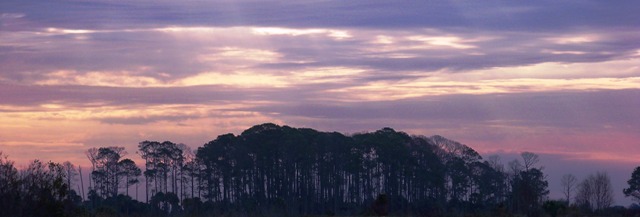
KMHuberImage; St. Mark's Wildlife Refuge; Florida; USA


It is my neurosurgeon, the reader of x-rays, who says so succinctly, “you are between a rock and a hard place.” Indeed. Autoimmune disease versus spinal fusion. Which one do you feed?

New blood tests reveal neither prednisone nor the over-the-counter medications have dramatically reduced my body’s inflammation. Still, “between a rock and a hard place” remains the medical phrase.

Mine, however, is not to look for the fringe of the future. Rather, I inhabit my vulnerability, exploring the reality I have. The balance in the circle of wolves remains fluid.

Daily, a new experience awaits me. I sip from my wells of courage and compassion, content to reside in my castle of vulnerability. And like everyone else, with each experience I become more intimate with disappearance, the exit each one of us will take someday.

Strolling along 112113

Here Are My Shoes

I did not know to send my shoes to Paris but here they are, virtually. Even the Pope sent a pair of plain black dress shoes; UN Secretary General Ban Ky Moon sent a jogging pair.shoes 120915

Type, condition, or owner is not the criteria. Solidarity of the human spirit is.

20,000 pairs of shoes arrived in the Place de la République in support of the activists who were not able to march at the UN climate summit. French authorities banned large outdoor marches in light of the recent terrorist attacks.

Activists turned to the compassionate response for terrorism is never a match for compassion, a truly revolutionary act. Compassion connects. The world sent shoes and then, hundreds of thousands in cities across the globe marched for those who could not.

In solidarity, there is awareness, a sliver of light where there once was darkness. That is change.

Black Bears of Florida, here are my shoes.

Black out for the bearsActivism did not stop the black bear hunt. It was a mismanaged slaughter as predicted. The Florida Wildlife Commission (FWC) sold over 3,700 hunting permits for the “harvesting” of 320 bears. In less than 48 hours, 298 bears were dead. As of this writing, the final bear death total is 304.

There had been no black bear hunting in Florida for 21 years. The population was considered endangered but in recovery. No one knows the total number of black bears in Florida. Most agree it is around 3,000, including the FWC who sold more hunting permits than the estimated number of bears.

The continued presence of activists did shut down the hunt five days early. They gathered at kill reporting checkpoints to monitor the hunt as well as to photograph and record bear data. And yes, they posted the data on social media. It is still getting attention.

Black bears found a way back from being an endangered species only to discover they are refugees in their own land.

In Tallahassee, there was a Requiem for Bear ceremony. When there is reverence for life, there is a spark, a way to begin anew. Increasingly, pairs of occupied shoes are coming to Florida courthouses and county commission meetings for the rights of black bears.

Seminole County is enacting an ordinance outlining specific requirements for humans to do their part in living with bears. Sponsored state legislation for 2016 will help municipalities cover the costs.

Virtual connections as well as person-to-person contact allow the issue the light of day. Solutions appear and disappear. Not all are feasible. Increased awareness results in increased opportunities for connection. That does work. It is how change occurs.

Syrian refugees, here are my shoes. Winter Solstice Skies 1214

Hundreds of thousands of refugees have died in Syria, and millions are fleeing. Numbers are fluid but an inter-agency group reports over 4.2 million “are persons of concern.”

I am reminded of a Flannery O’Connor short story, “The Displaced Person.” The title reflects a well-known and often-used term for WWII refugees. Themes of this story—bigotry, racism, xenophobia—are evident in every day events across the globe. We connect to them virtually.

Of late, America has given fear center stage. All of it is spew, the stuff of authoritarian regimes, so similar to what the refugees are fleeing. They must wonder what to do, knowing death is certain if they stay and life is uncertain if they go.

When it comes to refugees or any “displaced persons,” we wrap ourselves in labels—hold up our signs–so there is no doubt as to our identity, provided we are able to spell it correctly.

Hiding behind a label keeps us from making the compassionate response. We forget labels reveal not only who we are but who we are not. Our fear and paranoia crackle and pop like the short-lived flames they are, ever in need of an outside wind.

The compassionate response arises from the stillness within. It thrives on our connection to one another. That we are human is label enough. The compassionate response is the thoughtful tear on an ember of fear. One is all it takes before there are two. Solidarity of the human spirit is that basic.

Humanity, here are my shoes.

The Last Roller Coaster Ride

KM Huber image

There are roller coaster lives–the downward rush, the upward crawl–as energy and inertia swirl present into past. Life-changing events slow the roller coaster, sometimes to a stop. These are the moments of sifting through the life experience.

Of late, I have been in such a pause, taking a long sit in my past. I decided I do not want to repeat the familiar upward crawl or the rush to a bottom I know too well. I want off the roller coaster. To do so, I return to the moment I decided to ride.

It is a warm, August night in Colorado at Red Rocks, 1976. The naturally occurring amphitheatre provides perfect acoustics. At over 6,400 feet, the stars seem close enough to touch.

On stage, Judy Collins is singing the Ian Tyson ballad, “Someday Soon.” It is a song of a doomed relationship: a young girl loves a cowboy who loves the rodeo more. She is “going with him,” anyway.

I am 24, and what I hear in “Someday Soon” has nothing to do with loving cowboys or rodeos. Someday soon means the risk is worth it, no matter the odds.

I was euphoric, confident in the new life I was about to begin. I am not sure just when I reached for the stars. I only know they were in my eyes.

Sparkling Waverly 1013

What felt like endless possibility, however, was only one moment at the top of the roller coaster. It is not always easy to recognize the ride is downward. Not in the early years of chronic illness. It is easier to believe in someday soon.

I ride the roller coaster for nearly 40 years, until 2015. In July, I weary of chasing someday soon. I develop myelopathy—quadriplegia is a possibility–in addition to autoimmune disease.

Successful surgery sweeps me up in the energy and inertia of the ride. So much seems possible as the cervical fusion actually begins to take. As unexpected as that is, there is more good news. The inflammation from autoimmune disease is helping my vertebrae heal.

Inflammation is vital to healing bones. It is the body’s way of dealing with intrusions although my immune system is so exuberant it attacks itself.

Framed within a healing mindset, autoimmune disease does not seem a downward ride. But pain reminds me it is. The stars in my eyes stay until October. It is my last roller coaster ride. Risk has lost its appeal as has the idealism of that night in 1976 and “Someday Soon.”

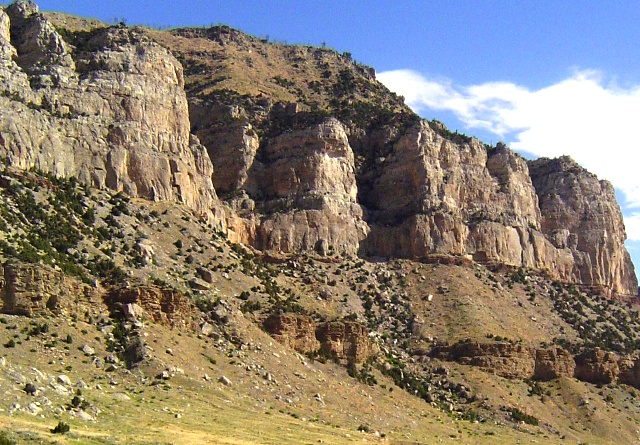
Wyoming rock face 0413

I hold the memory close for it is a night when a lifetime began. After nearly four decades of roller coaster days, each high and low is invaluable. They are the experiences that make me who I am now.

And that is where I begin, not starry-eyed but focused on the middle ground, accepting what is: framing the pain of autoimmune disease within a healing mindset that includes medication.

There are no good choices but some are less toxic than others. Immune suppressing drugs will affect—maybe even stop—the healing in my neck. Same is true for steroids. In fact, my healing is possible because I am not—nor ever have been—on immune suppressants. Rarely, have I taken a course of steroids.

So, I decide on the drug, Gabapentin. No odds given or promises made but there were none with my spinal cord surgery, either. There is the comfort of impermanence–nothing and no one stays the same.

Oh, I still look to the stars with wonder but I have no desire to reach for them. I am content to explore impermanence. I aim for even.

High Tide St Marks 0214

On this blog, I have written more about chronic illness than I ever intended. Perhaps publishing weekly posts increased my awareness of its presence. 🙂

I will post as regularly as I am able. Everything is taking a bit longer these days but then, I am making a lot of changes. Some I will share here. And the medication seems to cloud my thought process. Writing just takes a lot longer.

As always, I read your comments—I enjoy our exchange—I will respond.  And I have missed reading blogs. That, too, will resume. Thank you for reading this blog.


Revolutionary Acts

Awareness.

Compassion.

Equanimity.

Loving-kindness.

These are revolutionary acts. Their endgame is peace. Their leitmotif, trust that we will do what is required.

Just as peace is available to us in the experience of every moment so is the ability to commit revolutionary acts. They change us, usually forever. In trust, we experience the flow of change.

Change cycles through our lives like seasons. Acknowledgement or no, we will experience it, often as a storm, for change is energy. As we know, energy, even on its best behavior, is chaotic.Lake Ella Fountain 0115

Trust reminds us there will be another morning, another opportunity for revolutionary acts.

It is one thing to know the sun will rise but it is another to trust in what the rising of the sun brings. Regardless, each day dawns in total vulnerability, the wellspring of trust.

It is an extraordinary example of tenderness, this daily dawn reminder of what we are capable.

This revolutionary act of treating ourselves tenderly can begin to undo the aversive messages of a lifetime.

Tara Brach

It is no effort to store a lifetime of aversive messages, for each experience can be so labeled, if we choose. The energy of boxing up a life is minimal for it requires no updating just the initial experience and then re-runs. It becomes its own newsreel, skewed in comfort.

Ah, aversive, the coming undone of an attitude or feeling. Ours is a slow dawn, this throwing off of aversion, yet we do rise as we face what we once would not.

We stand in revolutionary awareness, ready to commit acts of compassion, loving-kindness, and equanimity.ocean pine 0215

Rage has its own set of acts—not revolutionary–its endgame fear, pain, and death. We are averse to its message, its messengers, and its weapons–guns, knives, poison, bombs—we are diminished by each death, all of the life landscape forever changed.

Revolutionary acts may or may not make us stronger—I do not know—I am not sure that is their purpose. I suspect it is awareness. What I do know is the open heart is a revolutionary beat ready to rush rage.

To undo rage is to undo the averse messages of a lifetime. It takes tender conviction, a commitment to a lifetime of revolutionary acts. That is my call to action, my arms open to all.

These are not days for sunshine patriots for the dawn is grey.

Revolutionary acts do not require the radiance of a sunrise, just a dawning, a promise the sun will rise. Trust is enough to keep the open heart beating. Revolutionary acts rise not to war but to the absence of battle. Theirs is the tender touch of awareness.

Note Regarding This Post: Once again, there has been a mass shooting in the United States. As a Zen Buddhist, my position is obvious. This post is about revolutionary acts that involve a call to the heart. I am not the first to do so or, unfortunately, the last. Would that I were.

My position is often called naïve. That it may be but this is what I know: a change of heart produces results every time. It is our hearts that ultimately get our minds to re-thinking.

To open our hearts is a revolutionary act, requiring constant vigilance, and a belief that the sun still rises.

Miccosukee water lily 0713

Getting Hooked and Giving It Up

Each of us is a unique point of light, a bright, shining moment within the eternal life force. Zen, our meditative state, is just as individualistic. Uniqueness is what we carry into our every day.

In the meditative state, we observe. Sometimes, thoughts come and go but other times, stillness suffices. In bringing Zen into our every day, we emulate the meditative state, experiencing every moment only to let it go.

We experience the physical dimension with and through a physical body, no less unique than our meditative state. Both provide sustenance for the mind-body. In meditation, there is being; in feeding and caring for the body, there is doing.  How we nourish our every day presence in life affects how we respond to the events of our lives.

Beginning the Day 092015

We are offered a multitude of ways to develop a daily meditative practice.  As for diet, there are billion-dollar industries offering nutrition through a series of steps, a number of days, eliminating certain foods altogether.

Just as there is no one way to meditate, neither is there one diet or food plan for everyone. Developing a diet unique to the mind-body’s nutritional requirements is as easy as walking through a minefield.

It seems safest to nibble one’s way in all the while clinging to what is sweetest. In clinging to food that comforts, it is difficult to discover our mind-body’s unique nutritional requirements.

Meditative Morning 1114

In the meditative state, one sits with the dark and light wolves of emotion, feeding or denying neither but rather, observing both so there is no separation of the two. Observation eliminates competition.

This is not as easy to do with food cravings—at times it is impossible–the principle is the same, however. Clinging to foods that momentarily comfort us rather than nurture our mind-body, is like keeping our light and dark wolves in constant competition.

Our thinking  becomes dualistic, either/or. We eat for comfort, unaware of our true hunger as we deny our body’s nutritional needs. Rather than feeding our mind-body, we are feeding a craving, which is only a thought, an ever empty one at that.

Feeding a craving is akin to feeding the ego. No comfort is possible for the ego always wants more. In Buddhism, such comfort food eating is a form of shenpa, often translated as “attachment.”

Shenpa is in all areas of life for old behaviors die hard, if they die at all. Pema Chodron refers to shenpa as “biting the hook.” As comfort food eating has been a lifelong issue for me, I prefer this translation.

Whether or not we bite the hook is not the issue— it is human nature that we will—it is in the awareness of our attachment that we spit out the hook and begin anew.  Each moment offers that opportunity.

This has certainly been true for me in my comfort food sessions, which are infrequent but still happen. There are no more binges. Honestly, I do not know that I would survive one.

EmmaRose does not have comfort food issues.

Because these comfort food moments are much fewer and far between, my mind-body is not as forgiving. I can feel it struggle with food that does not support its nutritional needs.

There is a sense of frustration in processing empty calories that offer sluggish and stiff body movement, muddled thinking, zigzagging emotions ranging from euphoria to the blues.

Overall, there is fatigue, enough to scare me into thinking the mind-body might want to quit. But that is only my attaching to a thought that has not been fed as it soars on empty emotion.

To live, thrive, is the nature of the mind-body–all unique points of human light coming together as one–to experience life in the physical dimension, including biting the hook.

Making Lemonade, the Patient Pause

“What else might this mean?”

Recently, I came across the question in this context: how different the world might be if we asked that question when facing a tense moment, when feeling anger or aggression, whenever there is pain.

To ask the question is to pause, creating a distance from the situation, preventing an immediate and perhaps pointed reaction.

We have given ourselves the opportunity to make the compassionate response.

Juggling for space 0414

Rather than clinging to the pain of the moment, we release it. We are not boxed up in a mindset or limited in our choices. In the compassionate response, we are open to the unimaginable.

We are not relinquishing our beliefs or changing our goals. We are not giving up or accepting less. We are standing in the reality we have, taking a moment to step back and make the choice that suits the moment.

We find ourselves less concerned with identity, the beliefs of “I,” and more concerned, maybe even intrigued, with how we might offer more to many.

Good Neighbors 0214

Asking what else might this mean reminds me of a well-worn meme—when life gives you lemons make lemonade— there was a time that I would roll my eyes whenever I was told this, which was rather often.

At some point, and I have no memory of any “aha” moment, I considered what it might mean to experiment with life’s lemons. It is an exercise in patience. In making lemonade, I found curiosity and grew to trust it.

Was I lowering my standards?

These days, I live a routine of no routine, relieved of the stress of tasks assigned to specific times. There is enough freedom so that on the days when life is one lemon after another, lemonade seems more than sufficient. I never know how tart or naturally sweet the lemonade might be.

I sip and stay curious.

Stork and Joy 0313

In the last two months, I produced more solid writing than I have in the last year and a half.

Physically, I am markedly different. I am not referring to walking with a cane or wearing a soft neck collar. These are temporary conditions of myelopathy.  Once again, the question of lowering my standards drifted through my ego. That required more than one glass of lemonade.

In short, myelopathy relieved my suffering for I had no choice except to slow down. Myelopathy accomplished what nearly 40 years of autoimmune disease could not. That is the difference.

In slowing down, I gained life anew. I have just begun to consider what this might mean for me.

KMHuberImage

Although my pace of life is slow, more measured, it is now possible for me to comfortably complete two or three errands in one outing, something I have not been able to do.

In rest, I find awareness, options never imagined. No longer am I pushing through to the end of a task, exhausting all of my resources.

In exhaustion, I find energy. To me, they are opposite ends of the same spectrum. I aim for even. The day does not dawn to certain tasks, it lights up with curiosity.

Still, there are the daily lemons.

My biceps feel as if there are weights on them; little has changed since the spinal cord surgery. The same is true for the numbness/tingling in my hands, particularly my index fingers and thumbs. They are unpredictable.

I use voice recognition software so that the frustration of typing does not impede the writing. My thumbs and index fingers have difficulty pinching or picking up small objects such as pens or pills, a mushroom slice, coins for the laundry.

Daily, I do dexterity exercises for my fingers and thumbs, a bit of yoga for my arms as well. There is no pushing just gentle flexibility. There is a lot of lemonade as well.

For all those moments when the world rages, as it does for all of us, if I ask, “what else might this mean,” I choose the compassionate response. It is not about having an answer. It is about asking the question.

The Rhythm in a Routine of No Routine

Of late, I am pursuing a routine of no routine. As much as I would like to do away with all artificial constructs of time,  the best I can do is settle into 24 hours, immersing myself in the amount of time most assured to me, a single day.

Watercolor 0815

Within these hours, I am not pushing, shaping, or molding a future outcome. Rather, I focus on the rhythm, the beat of the moment and what it requires. I cut up vegetables to put into scrambled eggs, slice ginger root for my daily tea.

There is also the daily revising of words, working a single sentence round and round only to realize its moment has not yet come—or has.

More and more I am aware of the flow in being. It is all but palpable. There is a rhythm in a routine of no routine, momentary and impermanent. Labels float by, never overstaying their welcome.

Often, it is only when I stray from the moment that I sense its flow. The past gives me a sense of the present. As Mark Nepo reminds, it is not that we stray from the moment that is important—that is part of being human—what is imperative is that we return to it.

Watercolor II 0815

Regaining a sense of the present through the past is valuable but I have noticed it also opens the door for my ego. And as I recently discovered, my ego is like the Hydra, the mythological beast of many heads and thus, many voices.

Ego can take many different forms and shapes. It is like the hydra.

You cut off one head and another head replaces it.

You cut off that head and see a third head and a fourth head ad infinitum.

This is because in the manifest dimension, ego identity is the root of life, and if the ego identity is lost,

then life as we know it no longer exists.

It exists as light; life becomes light.

Swami Niranjanananda Saraswati

Val Boyko introduced me to this metaphor in a post on her wonderful blog, Find Your Middle Ground. Far too often, I strike at my ego, as if I might actually conquer it once and for all.

In cutting off one head, I only create another.  As Val advises, what is the point of that? She reminds that the new ego may be even more deceptive.

It is a powerful incentive to float on the rhythm of a routine no routine, allowing the moment to reveal its rhythm. There are fewer heads, fewer strikes.

The rhythm of a routine of no routine encompasses body sensations as well as the emotions of the mind. They are signals, physical points of light. Their intensity varies but sometimes a signal is the total experience of the moment.

It is not for me to escape or suppress it. Like not cutting off the head of the hydra, I observe the sensation. It will only still if I sit with it. It is the well of energy available to me.

Some days, the bottom of the well seems close; other days, the well seems bottomless. Either way, if I sip and do not gulp, the available energy will sustain me.

Watercolor III 0815

Every day, there are requirements that must be met for a routine of no routine is not without its responsibilities. If and how I meet those responsibilities depends on whether or not I sip to the moment.

If I take large gulps–as if to anticipate the day–I will be back at my well sooner and more often. These are days frenzied with energy, brimming with new Hydra heads. They are laid waste, unproductive and exhaustive.

Perhaps the greatest advantage of a routine of no routine is that it is available in every moment, as close as the next breath. It relies not upon expectation but upon showing up.

It is a rhythm in which the mind does not squeeze itself; the body does not constrict its vessels. Always, there is the breath that will release as well as renew.

There is no reason to cut off the heads of the Hydra. It is just as easy to allow them to nod to one another.  After all, they are my identity, the life I have as a human.

When I am without identity, I am light.  In this moment, I am human.


Ponding: Pooling of Unwanted Thoughts

Sometimes, rather than practicing mindfulness, we engage in an exercise in focus. We are casting about the past and future rather than “living richly in the present” (Sylvia Plath).

I call such an exercise ponding. In nature, ponding is the pooling of unwanted waters. In being, ponding is the absence of mindfulness, the pooling of thought outside the present.

As Plath reminds us, to live richly in the present is the “hardest thing” to do.

It is a lifetime practice.

Spending days kmhuber imageI grew up in a high plains desert where rivers rush, streams gush. Ponds are few. In the Rocky Mountain West, water is on the go, impermanence on the fly.

Now, my home is the meandering rivers and ponds of the Florida panhandle, subtropical lushness.

That both the West and South offer life opportunity opposites—mile high to sea level—once occupied much of my thought and time.

Then, it was location, location, location rather than living richly in my present. I spent years pooling unwanted waters for the future, trying to re-create past ponds.

It never works, even as an exercise.

This past week I found myself at Chapman, a pond I once visited daily as my life in the South began.

I missed the rush of water, having little consideration for the life that teems within a pond.

All that changed within the comfort of Chapman, contained under canopied, moss-draped oaks and towering Ponderosa pine. Daily, I focused on the peace I attributed to Chapman pond, unaware the peace was within me, always available.

Of course, I was ponding, unaware of my life as I was living it, pooling up thoughts, the unwanted waters of my past and future.

I was fishing, a practice I began in childhood.

Always, I searched any and all waters to see if they supported fish. I had to know if there was life. Fishing would occupy me for decades. I practiced consistently.

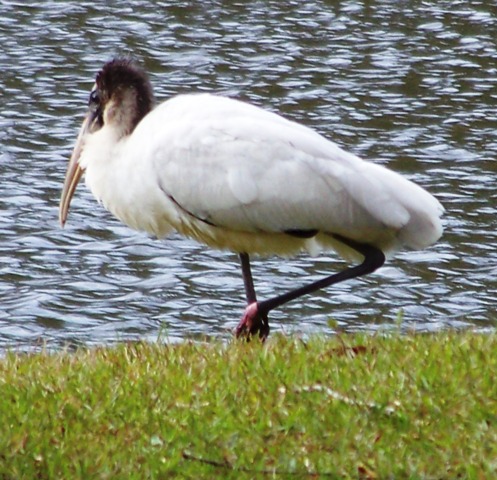
KMHuberImage; Wood Stork Fishing

As I aged, casting a line with no hook replaced catching a fish. With each cast, I did my best to imitate a fly afloat to tease a fish.

Whenever I went fishing, I was living richly, completely confined to the cast of the moment.

Perhaps it was the beginning of a mindfulness practice; perhaps, it was just fishing.

I gained a sense of the tide of time, the fisher and the fished, impermanence at its best.

There was no ponding, no thoughts of bigger or lesser fish or even the one that got away—only, the energy of the experience, the sensation that never stays.

I have not owned a rod and reel in years but still I fish.

On Birthdays, an Advantage of Aging

Laziness 010514I do not mind growing older. I do not believe I ever have nor do I remember wanting to return to a previous age in the belief it was the best time to be alive. As a friend said not too long ago, “it has been pretty good so far.”

And it has. This third act of my life presents new challenges—as did the other two—it seems to be a natural progression.

Do the challenges fit each act? In retrospect, the answer is yes, unequivocally.

What has been true with each act is that aging has its advantages. That assurance keeps me curious. And the handmaiden of curiosity is often celebration.

This past week I marked my 63rd birthday. It was a week of gifts–each thoughtful, unique. It is humbling, this great exchange of good feeling. The joy lasts more than a single day or week. It is what fills the years of a lifetime.

Every birthday reaffirms how fortunate I am in the life I have. The older I am, the more advantages I have. Aging is a list of gifts. Each year, some are unique to that birthday while others are forever.

Unique to the age of 63, I am now past the pregnancy test protocol for women who still have a uterus and have not had a tubal ligation. This surgery protocol may be unique to where I live. Nonetheless, it is on and off my list.

While the number of my chronic illnesses seems to have increased, I have finally accepted the great advantage they provide: I can sleep whenever I am tired, eat when I am hungry no matter the time of day or night, and write when I have sufficient energy, when my mind is clearest.At Rest 0215

What chronic illness has given me for the rest of my life is the routine of no routine. It is a lifetime gift that I finally recognized in my 63rd year.

Many people fear retirement for the lack of routine. I am here to tell you do not fear it. It is up there with the greatest gifts you ever receive. You will never be more present in your life. Mindfulness gives you all the time you need. You need not wait for retirement. 😉

As one day slides into another, the trappings of time that we have contrived—calendars, alarms, agendas– appear for what they are, our attempts to box up and label each moment.

Life is impermanent and neither boxes nor labels will hold.

Perfect Shell 0514I no longer am concerned about being awake during the dark hours that begin each day. It is a great time to listen to a recorded book. I do not disturb the dark with unnatural light. I do not disturb the day turning into itself.

These night-morning hours of opalescence are also prime “hunting” hours for feline EmmaRose. The prey is a catnip-filled “mouse” that is as easily airborne as it is grounded. The chase is a vocal one, high-pitched meows and a growl that seems much too large for a 5.5 pound cat.

The “hunt” was my birthday eve present from EmmaRose and later in the day, dear friends called and sang the birthday song. Both of these birthday eve gifts are unique to my 63rd birthday.

My birthday dawned as I sat on my favorite bench in Waverly Park, my first visit in many months. I shared the moment with three geese.

Animals, it seems, would mark my birthday in ways I could not have imagined.

Unique to this birthday was the gift of becoming a foster for an older elephant named Kora. Regular readers of this blog may remember a post on elephants reading hearts. The post featured the Sheldrick Trust in a video. Kora and I will age together.Kora older 2015

The same thoughtful friend made sure that another animal was part of my birthday, my favorite pit bull. I was treated to a video of Frisbee catching and happy birthday dancing. Ever available for viewing, it is a lifetime gift.

Also unique to this year, just before my birthday week dawned, I was given a surprise, living-room concert by my favorite local singing duo, Hot Tamale. All I had to do was sit back in my recliner and listen. For an hour, I immersed myself in their story songs, sometimes reminiscent of the ’60s, sometimes just great blues but always Hot Tamale.

Every gift I received— food, spirits, cash, and so many words of joy–was its own card, offering its unique celebration of a day. Ageless, the day resides in memory, celebrated as an advantage of aging.