We are all Home

To sit within ourselves is to be at home. Our home is full of emotional energy continuously streaming through our body, the structure we rely on for the experience of being human. All we have to do is sit down.

The more you are willing to just let the world be something you’re aware of, the more it will let you be who you are….

Michael Singer (The Untethered Soul)

Michael Singer introduced me to the “seat of self” as he calls the center of consciousness that is within us all. It is from here that the “great mystery begins once you take that seat deep within” (Singer). We become aware of being aware of the world around us, and we do it from the safety and comfort of home.

Peace is available to us in every moment. We don’t have to go anywhere.

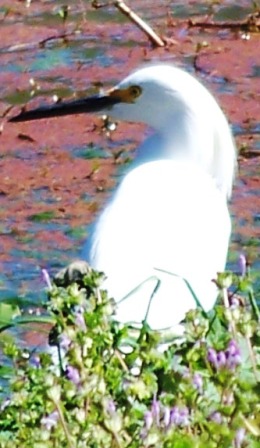
white-heron-110311Some settings may seem more peaceful than others but I find it quite powerful that peace is always available to me if I will just sit down in the seat with my name on it. Everyone has one. We are all home.

A little over twenty years ago, Willie Baronet began his “We Are All Homeless” campaign. He wanted to ease his own discomfort in seeing homeless people. In doing so, he has provided comfort to thousands of others.

Baronet decided to purchase signs from homeless people, offering anywhere from $10-$20 per sign, but that was not what eased his discomfort nor increased his awareness of himself and the world around him.

The purchase was the way to start a conversation with each homeless person who sold him a sign. The conversations continue as his collection of signs grows. It has become a wall of awareness about homelessness and the human story.

Each sign is a line in the story of the multi-dimensional person who created it. Each sign is a single thread in the tapestry of humanity. The stories run the gamut of what it is to be human, sometimes desperate and other times, simply inspirational.

We all are homeless until we come home. Not all who carry signs believe home is a physical shelter as Baronet discovered. Many are home, living in the peace of an open heart. They are always home whether they reside in subtropical peninsulas, high plains deserts or on city streets.

But do not ask me where I am going,

As I travel in this limitless world,

Where every step I take is my home.

Dogen

If we can bring ourselves to sit down in the home we always have—our seat of self—and be comfortable with all that we are and are not, we will find ourselves looking through a lens of equanimity and compassion at the world around us.

Oh the stories we will tell, the stories we will hear.
Weather in weather 0314

The Life Cycle of a Moment

Initially, this post seemed to be about dying into the moment and that was its working title. Working titles are quite Zen, I think. They are as impermanent as are the moments of our lives and just as complete in their birth, life, and death.

So the title of the post is now, “The Life Cycle of a Moment.” In another week in a different venue the title will change again as will the post but its essence, its cycle, will not. Whether similar or seemingly new, each moment cycles.

Three at Waverly 0714

In Jake Fades: A Novel of Impermanence, dying into the moment is the doorway into the next:

“…dying now means coming to each moment fresh… Seeing every person, even your partner, as if you have never met before. Hearing the birds as if you have never heard a chirp in your life. Our past is what we think of as our life, that whole life of thought and memory that we carry around all the time, but nothing actually repeats itself. Every moment is new, and you cannot live this moment until you die to the past one.”

(David Guy, p. 172)

Yet to consider death as integral to every moment was quite a shift for me, and as often happens in Zen, my view of the world turned inside out. For me, opening to the ending inherent in every moment makes the familiar fresh, a wave worthy of its own experience.

Some moments are like riding on the crest of a whitecap while in others it is as if I am becalmed and awaiting a wind until the wave washes upon the sand. All moments pass only to return as life anew.

So, how long is a moment? Consider this math: there are 6,400,099,980 moments in one day; one finger snap=65 moments; dividing 65 into 6,400,099,980=98,463,077 finger snaps per day (Ruth Ozeki, Appendix A, p. 407, The Tale of the Time Being).

That is a lot of living and dying at a rate I can barely wrap my mind around. Yet, a snap of fingers is such an immediate image of impermanence that it makes a wave upon the sand seem like an eternity. And yet, both are.

Wave upon the water 0514

“Everything in the universe is constantly changing, and nothing stays the same, and we must understand how quickly time flows by if we are to wake up and truly live our lives.”

(Ruth Ozeki, p. 408)

When awareness is the measure of the moment, any linear sense of time—such as a finger snap–fades into simply being, often enhanced by memory, flashes of moments similarly spent. Surely, the math of memory flashes is at least equal to, if not greater than, the number of moments in a finger snap.

And here we are near the end of another moment, perhaps measured more by awareness than by snaps of fingers or memory flashes. Well, that is what is true for me in this moment as it takes its place in the story that is me, maybe to return as a flash or maybe not.

We write (and read) stories to provide perspective on passing moments, recording the progress of our stories with working titles, changing with the measure of the moment.

A Small World It Is

Wondering 0614Having “virtual” access to one another–day and night–leaves little doubt how small the world really is. We are ever connected.

That may have always been an issue as even the 19th century romantic Wordsworth observed, the “world is too much with us late and soon.”

For all of our existence, thoughtful connection has been a human issue. We have always told stories to understand our relationship to life and our reverence for it but now, our stories seem out of sync with both.

Every minute of every hour we show each other who we are, and now that we have revealed ourselves to one another, thoughtful connection is even more of an issue.

Internet or no, to connect is to send and receive thoughtful messages, most often with language but sometimes with symbols or images that reveal more than words. Connecting is the light dawning, a window opening, an idea born.

In the 21st century, a virtual message is sent at speeds faster than we are able to think, making it not only easier to be thoughtless but at a speed beyond what we are able to physically experience.

This is a new wrinkle in our history and it is yet to be shown whether or not we will smooth it out. In the ancient traditions, the thoughtful life is living in the moment that one has rather than wandering to moments already lived or imagining days that do not yet show a sunrise.

A thoughtful connection is not without its weight or burden for a thoughtful connection is considerate, perhaps even painful but not unkind. It is the compassionate connection that allows us to know pain without being consumed by it.

We know what to say, because we have experienced closing down,

shutting off, being angry, hurt, rebellious, and so forth,

and have made a relationship with those things in ourselves. 

(Pema Chodron)

In the Beginning 0614

We have to heal the relationship we have with ourselves if the world that we are so passionate about in our rhetoric has any chance. Relationship on our planet is at a tipping point as thousands of species become extinct or face extinction.

We are the one species that can make a thoughtful difference. Indeed, we are the one species that has had more impact on this planet than any other.

`There are people who are past being hurt, beyond being hurt. You should know this is true. You should try to become one of those people, to make an understanding with yourself that you are not your body, you are something bigger. That is your work on this earth, do you see? Every experience here is to teach you to do that. Living, dying, every experience.’

 (Volya Rinpoche to Otto Ringling, Breakfast with the Buddha P. 275)

As humans, we have to get beyond our reactions. If it seems impossible to be kind, it does not follow that the only response is to return hurt. Silence is ever a thoughtful connection for it reveals a reverence for life, for getting beyond hurt. It reveals that we are something bigger.


(Note: Regular posts will resume August 3, 2014.)


The Light in Our Stars

Single movin' 0614It is the second day of summer in the northern hemisphere, June 22nd, the first day when the amount of sunlight no longer increases for the longest day of 2014, the summer solstice, has passed.   

In what will seem no time at all—just a jumble of days and nights—it will be the shortest day of the year, the winter solstice, followed by December 22, the first day the amount of daylight no longer decreases.

The seasons cycle as does all life on the physical plane. Some pass away and others remain longer. It is love that sustains the coming and going of life.   

I made the above notes in my journal while I was at Waverly the afternoon of June 22nd. This is the first summer my dear friend, Maurya, is not here, having died this past winter. It is a lifelong habit, this marking of seasons and remembering love given and received.

It is my way of accepting that all pass away, as will I someday, and remembering that love is beyond time, form, or condition. One need only look to the light in the stars or to the shimmering light of the sun on a pond to see love expressed over and over as life.

And on this June 22nd there was something else occurring, a gathering of cyclists and walkers at 2 p.m. on the Charles River in Massachusetts. The event was Movin’ for Maurya, another celebration of her life and a fundraiser for endometrial cancer research.

Those unable to be in Massachusetts went to places they walked or cycled with Maurya or to places she knew only through pictures or conversation. Wherever we gathered, the memories of Maurya were many and rich in the equanimity and compassion that flowed so gently, so easily from her.

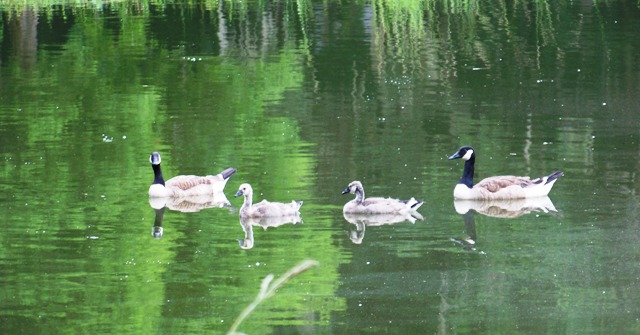
Goslings 0614

Each friendship was unique to her, treasured and nurtured. To have known such love in a lifetime is to feel invincible, awash in waves of unconditional love. On many occasions it has nearly brought me to my knees for the sheer wonder of it.

And for me, not surprisingly, it is at Waverly that Maurya seems so near, although she knew Waverly only through the pictures and posts on this blog. But then, Waverly is like stepping out of time and into the endless energy of existence.

We are here to awaken from the illusion of our separateness.
~Thich Nhat Hanh~

The oneness of existence is beyond this body, this I that experiences life on the physical plane, one of seamless sensations, boundless as the breeze upon my face. On this physical plane love announces itself as sight and sound, as touch and taste, a heady aroma this experience of existence.

movin' for Maurya blog 0614

It is just after 2 p.m. when the goslings and their parents slip into the waters of Waverly as I look to the northeast and to the Charles River. Endless existence washes over me in waves of gratitude that is no less than the light in the stars.

On some nights, it seems the stars wink in recognition. Perhaps they do for one day I, too, will be among the energy of existence as are those who I loved and who loved me during our shared experience on the physical plane.

Occasionally, I have thought our time together too brief but then I remember that I am not separate but one with existence beyond form, dimension or condition. I look to the light in the stars and sometimes, I wink back.

Life as a Juggler

The act of living, breath by breath, is our practice, unique to each one of us and universal to all. Our practice is what we do with the life we have. In some form or another, this idea has always framed the way I live.

where now 0425

There were the decades that I brandished about the label of 19th century romantic, comfortable in believing that life is in the striving and the arriving is secondary. It was my variation of Emerson’s “life is a journey not a destination.”

For me, however, arriving was important. It meant goal accomplished, an item checked off my list. Age has shown me that the value of a list is in its items. If the items reflect our practice, every day is a fresh read of our life list.

These days, my list is limited to four: compassion, loving-kindness, joy, and equanimity for all in all things. This universal list is inherent in every major spiritual tradition, eastern or western. They are not items to check off but to practice in every experience I have.

What we give to the world is our daily practice; it reveals how we are doing.  At the age of 90, cellist Pablo Casals said he continued to practice, “’because I think I am making progress.’” Practice is personal first and public second.

 To be disciplined is to follow in a good way. To be self-disciplined is to follow in a better way.
Corita Kent

I came late to practice and its heart, discipline, but I arrived.  My daily practice of meditation and yoga bring me to my list of compassion, joy, love, and gratitude every morning. Some days, I can see progress but there are many days of practice for its discipline.

In the thick of it 0425

Discipline helps me as a writer and as a chronically ill person, as my life not only constantly changes but expands in ways I never imagined. Yet, the list that guides my life stays the same. No longer interested in striving or arriving, I perceive my life through perspectives new and bold. My discipline is not manipulating my state of being but being in my life as it unfolds.

My life and my list differ from yours yet it is the practice of our lives that connects us. Together, we are coloring existence for every other form of life.

In my life practice, meditation is more than a matter of sitting in stillness. It really is a matter of “changing postures,” as Ajahn Chah called it, bringing stillness into the chaos of every day as life unfolds, moment by moment, nanosecond by nanosecond.

I am learning to juggle rather than to struggle, no matter how many balls are in the air. I need only watch one at a time to keep all the rest in the air, allowing attention to each in its turn. It is my practice of the list that is my life.

Juggling for space 0414

On Either Side of the Windowpane

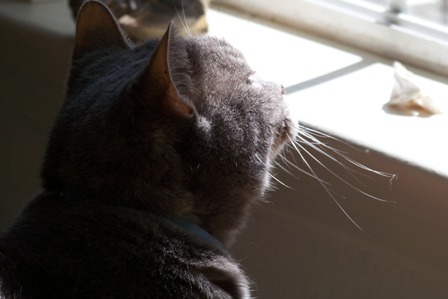
watching 0314We are always in relationship–some small, others grand–ours is to co-exist. Life is what we have in common. It is sharing space with one another, including the insect in the room.

In the subtropical climate in which I live, co-existence with insects and bugs is possible year around. There are seasonal changes, sometimes marked by a winter’s bloom and other times, yet another change in foliage color.

Through it all, insects and bugs make their way on either side of window panes. The world of bugs and insects is fragile in its beauty and terrifyingly transient. There, living life to its fullest, even for a nanosecond, is never questioned, and death is just as imminent. The more I watch this world, the larger my own life becomes.

Insect and bug death is more common outside my windowpane than on the inside. Feline EmmaRose and I are content to observe all the life around us, although there are times I escort bugs and insects to the world on the other side of the pane. Relationship requires decisions.

Our windows look onto a carpet of grass that slopes to live oaks, pines and vines of woodland too thick for human occupation. Gray squirrels flick their feather-plumed tails, scurrying in and out of the woods in constant search of nuts not yet sprouted. Rarely, do they look to insects and bugs as food but they are never off the menu. Woods within 0514 This spring, EmmaRose and I have watched a pair of cardinals pecking seeds at woods’ edge as well as enjoying bug protein. The silken-red male most often appears in mornings, taking breakfast from what seems to be a favorite series of spots.

It is early evening when we see an earthen-brown female with a tufted, red crest and subtle red highlights. She stays closer to the woods, most often preferring low branches to the ground.

The brown thrasher is quite common of late. It seems a good year for insects and bug protein. To me, the reddish-brown streaks of the thrasher splashed through its mostly white chest seem velvet in texture. Thrashers, cardinals, and squirrels can be territorial but EmmaRose and I have yet to see a squabble.

The world outside the windowpane seems orchestrated and random. I wonder at all that I never see. I like that there is yet another world beyond mine.Bunny right side 072813

This week, there is a new crop of clover, always a favorite for the eastern cottontail rabbits that enjoy the cover of the woodlands as well as the grassy area borders. We watch kits and adults alike.

EmmaRose seems most attuned to rabbit watching. Often, she puts her paw on my arm and meows; it is my cue to look to the world outside the windowpane. More often than not, a rabbit munches the green slope at the edge of the woods.

Relationships are a collage of images collected over a lifetime, snapshots of the world on either side of the windowpane.

No Separation of Space and Time Here

I do not remember ever distinguishing the dimensions of space—length, depth, width, breadth, height—from time. Edgar Allan Poe, H.G. Wells, and even Marcel Proust wrote of space and time as one. I came late to the word space-time (or spacetime) but not to the concept, not really.

For me, space-time has always been more about mindfulness, paying attention to the details of life as they unfold. The space of a moment is a combination of any three of the spatial dimensions–width, depth, breadth, length, or height. Its time is its unfolding as a scene in life. It is as if each moment has four dimensions, a trio of space in time, 3+1.
Space-time 0414

Space-time gives me a better sense of the present as a bridge between the past and the future. The present provides open-ended access to both yet serves as a reminder that the only time we actually live is now.

Having access to the past and to the future is not the same as being in either for we are always only in the present. Yet, it is in paying attention to the details of our lives as they unfold that provides the access to both the past and to the future.

If being completely immersed in the moment reminds us of a similar scenario, that past moment might flash through the mind. It usually does for me. In that flash of familiarity, I have accessed the immutable past but the present scene is of its own unfolding. The scenes are similar but not the same.

Awareness also seems to color the future. Sometimes, I wonder whether or not awareness is the source of infinite possibilities. When we are truly present maybe we are stockpiling for our future; perhaps by minding the details of the present, we provide options for the future.

It is tempting to try to re-create the past as well as frame the future, as if either were possible. Neither is. I know. I have tried. The present is all there ever is and to ignore it is like separating space from time, something I cannot do.

After all, everywhere I go, there I am. I might as well be who I am in the moment that I am.

A Festival of Firsts at St. Marks Wildlife Refuge

Gratitude abounds on any visit to St. Marks Wildlife Refuge but on the first Saturday in Festival Crowd St Marks 0214February, the Wildlife Heritage and Outdoors Festival is a celebration that is a refuge for all. The festival is one of many firsts that signal spring.

The afternoon is overcast but warm, almost balmy. Snow, ice, and road closures of the previous week are a mere matter of record. The joy and gratitude of being alive is in the music that is in the air. Hot Tamale is playing.

Hot Tamale 0214Every time I hear Adrian and Craig perform, the music of another century returns–folk, easy listening, country, rock and roll—all songs to which I still know almost all the words.

I sway to the nuance Hot Tamale brings to each cover for Craig and Adrian are also songwriters, sensitive to the music in words. Not surprisingly, their own music is layered in story. Sometimes, it is pure poetry.

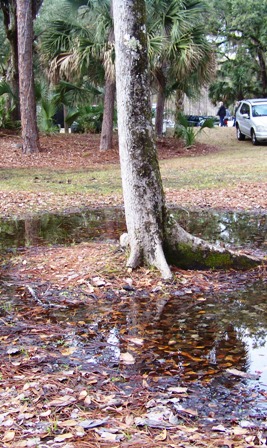
The “natural stage” for Hot Tamale overlooks mini pools of clear water covering golden leaves and amber needles. That is also a festival first as pine and oak trees signal islands of spongy, black dirt tufted like frosting on a cake.

Here and there, boardwalks become bridges to provide passage to and from these “temporary Festival islands 0214 St Marksislands” that offer picnic table seating. Strangers share space, music, and a bit of themselves.

Adrian’s rendition of  “Somebody to Love” echoes Grace Slick and 1971, a year Adrian and I shared similarly, although completely unknown to each other and physically, thousands of miles apart.

In another century, Adrian first sang that song in a gymnasium somewhere on the East Coast, and I, in the Rocky Mountain West, was also singing Grace Slick in a building very like a gymnasium. It is entirely improbable that Adrian and I were singing the same song on the same day for the first time but it is not completely impossible.

The memory moment passes as Hot Tamale turns to calypso–“Day-O…D-a-a-y-O”–there is mention of “The Lion King” and Harry Belafonte but it is the movie that most seem to remember as occupied picnic tables sway in rhythmic response.

A young girl with sunshine blonde, kinky hair whispers to me she has not seen the movie. That is a first. I have never met anyone else who has not seen the movie. I do not ask her about Harry Belafonte. It is enough that we sing along as if we were born to it.

After the performance, Adrian comes over and we hug, saying how good it is to see one another. The young girl wonders whether Adrian and I are sisters, definitely a first. We smile at one another as Adrian responds, “we’re just good friends.”

And then we all talk for a while as friends, new and old, before leaving the picnic table, the makeshift island and the music. I drive on to the St. Marks Lighthouse on Apalachee Bay.

All along the roadside, cars pull over and stop, a wildlife event, as cameras of every size and shape point and shoot, lenses looking East as well as West.

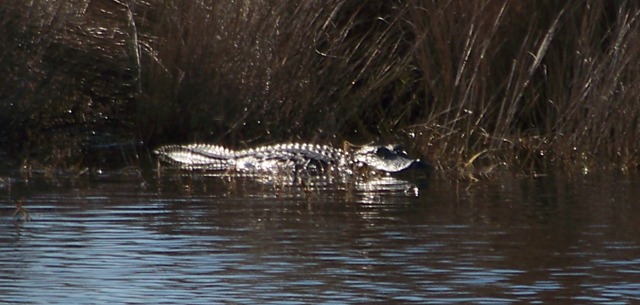
Gator on Festival Day 0214

It is late afternoon now and the warm sun has diminished the clouds, an event welcomed by alligators. In less than three miles, I spot four gators but there are a lot more if the sea of cameras is to be believed.  Waterfowl, mostly cormorants, form a crowd away from the banks of basking gators.

I park near St. Marks River and walk to a point on the bay. It is high tide, a first for me in all the years I have walked the refuge so there is no balancing on old oyster beds. I am content to watch the bay waters lick the sanded shore.

Firsts at the Refuge are a constant whether one visits day by day, year by year, or month by month. The turn of time and tide, the changer and the changed.

High Tide St Marks 0214

The Well of Compassion is Full of Emotion

When we get to the core of any emotion, even anger, we discover a wakeful energy free of drama, unattached to any situation. We have come to the well of compassion into which all emotion empties eventually. No longer do we thirst for we drink what we once found undrinkable.

It is a story we relive all our lives.

Immersed in our own drama, we exhibit behaviors to hide the heart of our anger. It is only when we strip away the story we have told ourselves—perhaps for years—that we discover the core of our anger. Once revealed, we empty ourselves, slaking our thirst with a cup of compassion.
Hawk 3

Not surprisingly, I am thinking of a story about the Buddha and an angry, young man. As the Buddha was walking through a village, he was approached by a young man who screamed at him. He taunted the Buddha, calling him stupid and a fake. The Buddha, the young man declared, had no right to teach anybody anything.

The Buddha quietly considered the young man before asking him a question. “’Tell me, if you buy a gift for someone, and that person does not take it, to whom does the gift belong?’”*

The question was not what the young man expected, and he readily replied, “’It would belong to me, because I bought the gift.’*

“The Buddha smiled and said, `That is correct. And it is exactly the same with your anger. If you become angry with me and I do not get insulted, then the anger falls back on you. You are then the only one who becomes unhappy, not me. All you have done is hurt yourself.’”*

That the Buddha did not react to the young man is anticipated yet in not accepting one gift, the Buddha offered another, the compassionate response: “If you want to stop hurting yourself, you must get rid of your anger and become loving instead. When you hate others, you yourself become unhappy. But when you love others, everyone is happy.”*

The story ends with the young man giving up his anger and deciding to follow the Buddha. Stories are illustrative, sometimes metaphorical, but always they enrich our lives with what is possible. Compassion is always an option, which is not to say it is an easy response. Anger confines, love expands—our choice.

Anger is not easily eschewed either, whether it comes from within or whether it is offered to us. Like love, anger has survived and evolved with us. Chagdud Tulku Rinpoche observed: “Meeting anger with anger is like following a lunatic who jumps off a cliff. Do I have to go likewise? While it’s crazy for him to act the way he does, it’s even crazier for me to do the same.”**

In the 21st century, opportunities abound as daily we crisscross our planet and the paths of others. Each meeting is an opportunity to drink a cup of compassion or to go crazy with the craziness.

*Buddha and the Angry Young Man

**Reacting With Anger

The Eternal Now of All Seasons

The holiday season and I have an ambivalent history. Some years, I was unable to let the season go, and other years, I never quite showed up for it. Yet, there is one seasonal constant: tradition says we harvest in fall and give thanks; as winter begins, we give gifts, goodwill among them.

All that is left

to us by tradition

is mere words. It is up to us

to find out what they mean.

~ ibn al-`Arabi~

In the Midst of 112113

Each holiday season, I reconsider its traditions in words well-worn as well as new ones:  “…to be detached from both the past and future [is] to live in the Eternal Now.  For in truth neither past nor future have any existence apart from this Now; by themselves they are illusions” (Alan Watts).

The promise of the Eternal Now is life as a seamless season, gifts available in every moment of eternity. If we embrace this holiday season as the Eternal Now, we open ourselves to a way of life that extends goodwill this day and every day.

Yet, any moment of the holiday season offers us experiences that unwrap us raw. These are gifts that cannot pass quickly enough–or so we think–whether it is the first holiday of loss or just another year that we mark a loss. We remember, as we should.

Like the holiday season, the Eternal Now is not a matter of endurance but a matter of meeting each moment just as we are. We may only manage a breath but that is enough to take us into the next moment. Emptying ourselves into loss opens us to gratitude for having loved at all. In love, we let loss go.

Strolling along 112113
KMHuberImages

For those holidays I could not let go, I was clinging to the bright and shiny rather than experiencing them. I never really opened their gifts. In those years I completely avoided the holidays, I was surrounded by sparkling gifts not only unopened but unnoticed.

In trying to hold onto a moment and make it stay, we cause ourselves to suffer; if we refuse to show up, we are still seeking what is not and we suffer.  Yet, the field of infinite possibilities is always available to us as long as we breathe for we are never out of sync with the Eternal Now, no matter what.

“You may believe yourself out of harmony with life and its Eternal Now; but you cannot be, for you are life and exist Now—otherwise you would not be here” (Alan Watts). We can celebrate our entire lives with the warmth of the holidays if we remember that existence— the Eternal Now — is always in perfect harmony.

My gift to you, and thus to me, is a life lived in the Eternal Now in all seasons.

Regular blog posts will resume December 8, 2013.