The Life Cycle of a Moment

Initially, this post seemed to be about dying into the moment and that was its working title. Working titles are quite Zen, I think. They are as impermanent as are the moments of our lives and just as complete in their birth, life, and death.

So the title of the post is now, “The Life Cycle of a Moment.” In another week in a different venue the title will change again as will the post but its essence, its cycle, will not. Whether similar or seemingly new, each moment cycles.

Three at Waverly 0714

In Jake Fades: A Novel of Impermanence, dying into the moment is the doorway into the next:

“…dying now means coming to each moment fresh… Seeing every person, even your partner, as if you have never met before. Hearing the birds as if you have never heard a chirp in your life. Our past is what we think of as our life, that whole life of thought and memory that we carry around all the time, but nothing actually repeats itself. Every moment is new, and you cannot live this moment until you die to the past one.”

(David Guy, p. 172)

Yet to consider death as integral to every moment was quite a shift for me, and as often happens in Zen, my view of the world turned inside out. For me, opening to the ending inherent in every moment makes the familiar fresh, a wave worthy of its own experience.

Some moments are like riding on the crest of a whitecap while in others it is as if I am becalmed and awaiting a wind until the wave washes upon the sand. All moments pass only to return as life anew.

So, how long is a moment? Consider this math: there are 6,400,099,980 moments in one day; one finger snap=65 moments; dividing 65 into 6,400,099,980=98,463,077 finger snaps per day (Ruth Ozeki, Appendix A, p. 407, The Tale of the Time Being).

That is a lot of living and dying at a rate I can barely wrap my mind around. Yet, a snap of fingers is such an immediate image of impermanence that it makes a wave upon the sand seem like an eternity. And yet, both are.

Wave upon the water 0514

“Everything in the universe is constantly changing, and nothing stays the same, and we must understand how quickly time flows by if we are to wake up and truly live our lives.”

(Ruth Ozeki, p. 408)

When awareness is the measure of the moment, any linear sense of time—such as a finger snap–fades into simply being, often enhanced by memory, flashes of moments similarly spent. Surely, the math of memory flashes is at least equal to, if not greater than, the number of moments in a finger snap.

And here we are near the end of another moment, perhaps measured more by awareness than by snaps of fingers or memory flashes. Well, that is what is true for me in this moment as it takes its place in the story that is me, maybe to return as a flash or maybe not.

We write (and read) stories to provide perspective on passing moments, recording the progress of our stories with working titles, changing with the measure of the moment.

A Small World It Is

Wondering 0614Having “virtual” access to one another–day and night–leaves little doubt how small the world really is. We are ever connected.

That may have always been an issue as even the 19th century romantic Wordsworth observed, the “world is too much with us late and soon.”

For all of our existence, thoughtful connection has been a human issue. We have always told stories to understand our relationship to life and our reverence for it but now, our stories seem out of sync with both.

Every minute of every hour we show each other who we are, and now that we have revealed ourselves to one another, thoughtful connection is even more of an issue.

Internet or no, to connect is to send and receive thoughtful messages, most often with language but sometimes with symbols or images that reveal more than words. Connecting is the light dawning, a window opening, an idea born.

In the 21st century, a virtual message is sent at speeds faster than we are able to think, making it not only easier to be thoughtless but at a speed beyond what we are able to physically experience.

This is a new wrinkle in our history and it is yet to be shown whether or not we will smooth it out. In the ancient traditions, the thoughtful life is living in the moment that one has rather than wandering to moments already lived or imagining days that do not yet show a sunrise.

A thoughtful connection is not without its weight or burden for a thoughtful connection is considerate, perhaps even painful but not unkind. It is the compassionate connection that allows us to know pain without being consumed by it.

We know what to say, because we have experienced closing down,

shutting off, being angry, hurt, rebellious, and so forth,

and have made a relationship with those things in ourselves. 

(Pema Chodron)

In the Beginning 0614

We have to heal the relationship we have with ourselves if the world that we are so passionate about in our rhetoric has any chance. Relationship on our planet is at a tipping point as thousands of species become extinct or face extinction.

We are the one species that can make a thoughtful difference. Indeed, we are the one species that has had more impact on this planet than any other.

`There are people who are past being hurt, beyond being hurt. You should know this is true. You should try to become one of those people, to make an understanding with yourself that you are not your body, you are something bigger. That is your work on this earth, do you see? Every experience here is to teach you to do that. Living, dying, every experience.’

 (Volya Rinpoche to Otto Ringling, Breakfast with the Buddha P. 275)

As humans, we have to get beyond our reactions. If it seems impossible to be kind, it does not follow that the only response is to return hurt. Silence is ever a thoughtful connection for it reveals a reverence for life, for getting beyond hurt. It reveals that we are something bigger.


(Note: Regular posts will resume August 3, 2014.)


On Not Becoming a Buddha

Above all, don’t wish to become a future Buddha;

Your only concern should be,

As thought follows thought,

To avoid clinging to any of them.

~Dogen~

Hawk looking down 0614I do not think I have ever wanted to be a Buddha. I do not remember that thought at all. I do focus on trying not to cling to my thoughts but my lifelong practice of hairsplitting has been a sanctuary as well as a war.

My fondness for making excessive distinctions in reasoning allows me to dress up old behavior as new. I may not have expressed a wish to become a Buddha, but I have desired acquiring inner peace for the rest of my life.

Quite often it feels as if I am stomping through myriad thoughts, trying to shake off first one and then the other. I am amazed at the substance I give to a thought–I walk around in it–giving it a life it does not have.

Usually, it is a thought I know well but until I have examined it thoroughly, I am not able to let it go. I like to think that hairsplitting serves me here, much like Ajahn Chah’s distinction between holding and clinging:

We pick up [a flashlight], look at it and see, `Oh, it’s a flashlight,’ then we put it down. This is called holding but not clinging, we let go. We know and then we let go. To put it simply we say just this, `Know, then let go.’

~Ajahn Chah~

For me, knowing to let go requires trust, and when I do, the named thought floats by, a mere reminder of what is. However, knowing an object, a thing, is easier than meeting a familiar emotion.  Yet, the practice is the same.Hawk looking up 0614

In fact, the practice of looking and letting go is what the mind learns to trust; Chah says that in “constancy of mind, wisdom arises.”

That constancy of mind is what I need most when emotion pulls at me, when I face patterns of a lifetime. Hairsplitting allows me to breathe between thoughts but it also makes for interesting detours.

As I began my regimen of healthy eating, meditation and yoga, I defined and redefined my practice of each as well as the union and intersection of all three. That is neither bad nor good but my initial focus was on results and now, it is to live.

In the beginning we practise with some desire in mind; we practise on and on, but we don’t attain our desire. So we practise until we reach a point where we’re practising for no return, we’re practising in order to let go.”

~Ajahn Chah~

“Practicing for no return” would not have been what I needed to know as I began my practice. I would not have trusted it. My wishing to become a Buddha was disguised as various emotional and physical health goals. In order to change my physical and emotional being, I had to let go of trying to become a future Buddha.

There’s Still Time to Make Art

natural art 0514Perhaps each life is a painting, an infinitesimal rectangle or even the equanimity of a square. Beginning with a blank canvas, an entire life swirls with the colors of choice, shifting scenes until ultimately blending into the tapestry of existence.

Existence is endless art, it seems, as delicate and precise as a sand painting—a mandala—once a life is complete, the sand shifts and returns to its state before shape. Always, there is another shape to come.

There is an art to life, I suspect, no matter how minute one’s tile in the mosaic of existence may seem. It is not the size or shape of a life that looms but rather the choice of options from the palette provided.

The colors of choice vary as does the brushstroke that reveals them. Some moments the stroke is as subtle as moonlight and just as changing. During the dense, life-changing events–dark moments that mark a life for its duration–the swath of the brush is broad and opaque.

Yet each life has an array of choices—a palette of options—to absorb change as it colors a life, ultimately illuminating, much like light of the moon.

At night, I open the window

and asked the moon to come

and press its face against mine.

Breathe into me.

Close the language-door

and open the love-window.

The moon won’t use the door,

only the window.

~Rumi~*

We might want to look to the moon when facing the doors it ignores. Sometimes, the broad brushstroke Art 0514wrinkles the canvas in a determined color of choice. Other times, the subtle stroke turns opacity into transparency, rather like darkness leaving for light.

The tapestry of existence is in constant flux, swirling with infinite possibilities as we work through daily decisions, choosing our colors. Some are doors and some are windows but both eventually open, either by the light of the moon or by the love of life.

Our living canvas is not yet a still life nor is our sand mandala complete. There is still time to make art.

*This lovely Rumi quote comes from a favorite blog of mine, ZenFlash.  Thank you.


The First Peace in Relationship is Life Anew

This past Monday, feline EmmaRose and I experienced the imperative inherent in impermanence. One being can never know another completely, which is as it should be. The richness of relationship, its mystery, keeps us curious and often, in awe.

In her sun 0413As a cat, EmmaRose is ever present. Routine is her preference for that means food and shelter—her sense of security—is not threatened.  For the three and a half years she has lived with me not even the furniture has been rearranged. It seems she appreciated this more than I knew.

We spend most of our time in the bedroom, which doubles as my work area. I work from an adjustable Tempurpedic bed complete with laptop and bed table. EmmaRose is quite partial to sleeping on the Internet router, especially in winter, or near/on my lap while I write.

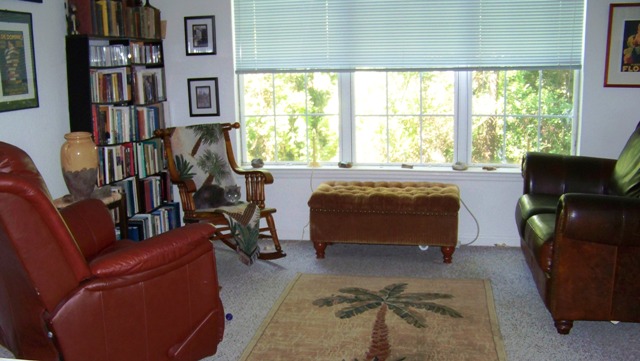
Our living room has never had much furniture. There is still a lovely antique, wooden rocker with a padded seat. It is more comfortable than it looks. Also, there is a large, rust-colored ottoman suitable for human and feline window gazing.

There WAS a twin bed box springs and mattress that I tried to disguise as a sofa-daybed. For me it was ugly, uncomfortable, an unpleasant reminder of another time. From time to time, however, I would find EmmaRose curled up and asleep on it.

That I regularly removed accumulated cat hair from its quilt cover should have told me that this was a nocturnal sleeping place. Did we not once watch a possum in moonlight from the sofa-daybed?

Staying with Familiar 0614

In hindsight, it is obvious that a good deal on a used loveseat and recliner changed our relationship. In fact, EmmaRose seemed to sense imminent change the moment we heard the knock on our front door.

She did not watch the daybed leave the apartment, preferring the familiarity of the bedroom to wait for the moving in and moving out to cease. Only then did she return to the living room.

Although she is only five and a half pounds, she has an immense presence, especially when she communicates. We don’t focus on the actual meow or word. Rather, we pay attention to tone, and her feelings regarding the loveseat and recliner were quite clear.

Here we were in the reality of impermanence. The known furniture was gone and the unknown leather furniture was here. Accepting loss precedes learning to live with what is. Becoming once again secure in one’s world is unique to each being–there is no set amount of time.

KMHuberImage; Meditation Cat;

We can immerse ourselves into the newness of our world or we can skirt the change for awhile. Regardless, it is up to us to seek that first peace so integral to relationship, which is precisely what EmmaRose did three days and four nights later.

It was during the opalescent hours, as one day becomes another, that EmmaRose beckoned me to the loveseat for window gazing. In the light of the waning crescent moon, I glimpsed an occasional firefly but soon the purr of EmmaRose brought me, too, to sleep.


The Universal Stuff of Us

From earliest times we have wondered about our existence and our connection to the stars. Many myths and stories reveal our longing to return to the skies, as if we are trying to remember how to fly home. We wonder about the return trip after this adventure, our life, is over.

We are a way for the universe to know itself. Some part of our being knows this is where we came from.

We long to return. And we can, because the cosmos is also within us. We’re made of star stuff.  

~ Carl Sagan ~

This “star stuff” is the stuff of our minds as well as of the natural world. In our art and our philosophy we explore the questions of who we are and from whence we came. This spiritual universe is more personal yet eternal, emotional rather than rational. It is the light in our stars, this comfort from the cosmos when we look to home.

The physical universe is one of rational laws, measurable and impersonal. Essentially, these laws are true throughout the physical universe until proven otherwise. Continual discovery and exploration of the cosmos seems to be what makes or breaks such laws yet in the physical universe constant inquiry is essential for law.

There is room for both a spiritual universe and a physical universe,

just as there is room for both religion and science.

Each universe has its own power.

Each has its own beauty and mystery.

~ Alan Lightman ~

Wave upon the water 0514

To recognize and appreciate the uniqueness of the physical as well as the spiritual universe is to observe life with a sense of wonder. In wonder, the physical and the spiritual do not contradict but co-exist so we are able to observe both.

In the observer effect, the act of observing influences what is being observed. One of the many marvels of science is that attributes and behaviors invisible to the naked eye are still observable.

We cannot see the law of gravity or the Higgs boson. We are left observing that what goes up comes down, although the law of gravity is much more than that. The Higgs boson may be observed after protons collide about a trillion times but even after all that, its existence lasts less than a billionth of  a trillionth of a second. Even so, the boson is observed only because of what it becomes.

Life begins 0514

In the more personal spiritual universe, belief systems underlie our reactions. Do we observe every event or experience with our complete attention or are we more concerned with how to respond?

My sense is that our observation is obscured. If an event is familiar, we search for a previous and similar response; if an experience is unknown, we search for some kind of  familiarity so we can respond. We are not observing fully so our influence is incomplete as well.

The biggest communication problem is we do not listen to understand.

We listen to reply.*

We may be missing the wonder of being alive, of being part of this adventure that is both spiritual and physical, each universe complete in its beauty and mystery. We are star dust, this universal stuff of us. Ours is a guaranteed round-trip. Why not observe this life with wonder?

******

*This quote seems not to have an attributable source.

Reading Alan Lightman’s The Accidental Universe: The World You Thought You Knew is like having your own personal guide to the cosmos. In my post “No Separation of Time and Space Here,” Kay mentioned this Lightman work as well as his novel, Einstein’s Dreams.  I enjoyed both immensely. Thank you!

A recent post from Tiramit mentions the observer effect in his thoughtful post, “Responsibility & Mindfulness.” Thank you!

A Little Night-Morning Musing on Magic

Magic has properties, rules that govern it, but with magic, just when we believe what we are seeing, something else is revealed. It is as if the more aware we are, the more the magic reveals.

Murky Shell 0514That seems a bit murky yet that is precisely as it should be. Magic is elusive, restless even, for it is and it is not. What is tangible in magic regardless of ritual, symbol, or illusion is technique.

Technique is the mechanism of the magician, the means to an end, for there is always an end. The grand illusion that is life is a mixture of individual experience and human nature, the unknown shrouded in the mist of the known.

The realm of magic is murky by design so that it is able to remain on the cusp of believable.

Often, I visit magic in the hours when a day ends and begins. These hours when night and morning are dark seem suited to illusion.

This time of in-between, as night becomes morning, are restless hours for one is not yet another. I, too, am murky in my mind, dull with the day that has ended, not yet open to the day that has begun.

By the light of my laptop screen, I sometimes surf the Internet, not for substance for I do not wish to engage but rather, I am content to float in and out of websites. On some nights, I visit  an online solitaire game that offers magic.

At first glance, it is traditional solitaire: seven piles of cards, some face up and some not, red on black, black Perfect Shell 0514on red, and four aces at the top. Then, the illusion begins. Magic is given freely and at regular intervals; neither purchase nor friend invitations are required.

Win or lose, you may play forever. Winning means advancing and receiving more magic; losing means just playing another game. There is an intricate scoring mechanism that makes the play of every card worthy of consideration.

How and where a card is played determines the number of points. Not all plays are equal—some may be undone—using magic produces a card to keep the game going but more magic may be required to win.

Ultimately, the player decides whether a game is worth continuing, whether winning is worth using magic. Life seems much the same in that regard, whether to be or to seek what may be.

Ah, once again I am far afield in my musing. Restless magic is fitting for those dark hours of night-morning yet in the light of day, it is less so.

(In a comment on a long ago post, “Do You Believe In Magic,” J.B. Whitmore offered the idea of the word magic as restless. Thank you for that. ) 

Graduating is a Lifelong Practice

Single Path 0313We graduate from one moment to the next. Every breath we take has a beginning and an end, and what occurs between that beginning and end is a lesson in living.

From the intake of the breath and all that it holds–the experience of it–to the release of the breath as the moment unfolds is an exercise we practice all the days of our lives.

Graduation is neither success nor failure but a series of milestones, markers of where we were, indicators that we have gone on to what comes next. Sometimes, that is only the next breath. Other times, graduation is a moment of accomplishment, of adding another tool to the toolbox that we carry through life.

Life is its own school, with assignments unique to each one of us. Always, there are questions; always, there are options.

I get up every morning determined to both change the world

and have one hell of a good time.

Sometimes, this makes planning my day difficult.

E.B. White

Graduation does not guarantee changing the world or having a hell of a good time but it does get us from one point in life to the next. It is a reminder that breathing is always an option. For the rest, we have our ever-expanding toolbox.

Road Awaits 072813

Throughout our lives we make choices. It is indeed a milestone when we are thoughtful in our word, taking nothing and no one for granted, doing our best not to take things personally. This moment of graduation is available in every moment we live. Its lifelong tool is awareness.

Awareness helps us sort our options wisely, carefully, especially when our choice is one difficult path or another. Awareness reveals the hollowness in magical thinking for no decision made with heart ever rings hollow.

Many times, we approach crossroads that seem so familiar that we are sure we have been in this same spot before yet life does not afford us that luxury, not quite. We are not the same as we were, and neither are our options. Each moment in life is as unique as each breath. We graduate from one decision to the next.

Two roads diverged in a wood, and I,
I took the one less traveled by,
And that has made all the difference.

(“The Road Not Taken,” Robert Frost)

Path in Mic 0713

Graduation requires we immerse ourselves into life with our head below our heart so that we do not leave the difficult choices to someone else while we wither in weakness. Rather, we lead with our heart as we stand, perhaps alone, for what we know is right.

Our lives begin to end the day we become silent about things that matter.

Martin Luther King

Our graduation from the womb to the outside world is the first of many, the beginning of miles of stone markers of the path traveled, the one that made all the difference.


Befriending Demons Begins with Naming

Stay watchful of gluttony and desire, and the demons of irritation and fear as well.

The noonday demon of laziness and sleep will come after lunch each day, and the demon of pride will sneak up only when you have vanquished the other demons.

(Evagerius as quoted in A Path With Heart by Jack Kornfield)

Hiding Mashes Sands 1013I have avoided putting a name to my “demons,” those every day “physical energies, emotions, and thought patterns [that I meet] within my relatively ordinary state of consciousness.” (Kornfield). My resistance was that I confused naming or recognizing these demons with attaching to them.

Mine is not to disassociate but to experience, or in the wise words of Rosanne Rosannadanna, “It’s always something.”  I might as well name my emotions so I can recognize them immediately.

This recognition both “honors and nurtures” the demons as I look beneath these emotional states for the pure energy that is at their core (Kornfield). In that energy is the experience they offer me. The emotional states are familiar but every occurrence is a new experience of them.

The naming of the familiar whether it is mental anguish or bodily pain opens us to the experience without attaching to the drama of it. Rather, we recognize the feeling and face the sensation as it occurs.

Upside down 0414

We might say to ourselves, “I know that feeling,” and we do. If we recognize that naming the feeling is the first step in freeing ourselves from its drama, we are more apt to open ourselves to the experience at hand. We face the familiar with a fresh being.

All of the spiritual traditions have a practice for facing the demons in our lives. For the Sufis they are the Nafs; some 2000 years ago, there were the Christian Desert Fathers, of which Evagerius was one; Buddhism knows these difficult forces as either Mara (God of Darkness) or the Hindrances to Clarity.

Naming our demons allows us to explore our body’s reaction to our emotions. Recognizing a familiar emotion without its drama allows our body a fresh and new experience of the familiar without the baggage.

As long as you have all sorts of ideas about yourself, 
you know yourself through the mist of these ideas. To know yourself as you are, give up all ideas. 
You cannot imagine the taste of pure water, 
you can only discover it by abandoning all flavourings.

~ Nisargadatta Maharaj ~

Pure emotion is pure energy. Naming it gives us the green light for a familiar yet fresh experience. Our Posing 0813emotions are our greatest allies, if we recognize them as a yet another way to experience any moment.

We feel our emotions with all of our being, in every cell of our body.  When we are mindful of these sensations, and as Pema Chodron says, “make friends with them,” we come to recognize that mindfulness opens us to options.

Blind determination walls in what we want and walls out what we fear. It digs a ready rut. In mindfulness, we name the feeling so that we may experience it anew. We do not experience the same scenario or emotional state twice, similar maybe but not exactly.

Whether we open to life as it is or whether we try to confine life to our way is the measure of our peace of mind. In every grain of sand there is yet another view.

The Conquering of Self: All in a Day’s Outing

100_1171

It is a spring day of which poets write and painters paint but my mind is all a jumble as thoughts tumble, each more urgent than the last. My body has joined the revolt, sending one pain message after another. This mind-body battle means it is a perfect day to take myself off to Waverly.

It is better to conquer yourself than to win a thousand battles.
~ Buddha ~

No matter how many times I visit Waverly, it whispers to me, sometimes to remind and other times to reveal. Regardless, a breath here is less ragged with frustration. The mind-body battle is still present but now resides at the edge of my awareness as if the stillness of Waverly is all-pervasive.

Waverly offers something for each of my senses. With the focus of a juggler tossing each ball high enough so that the others remain in the air, I take in one view completely before leaving it for another. In a moment’s stance, the mind-body is absorbed otherwise.

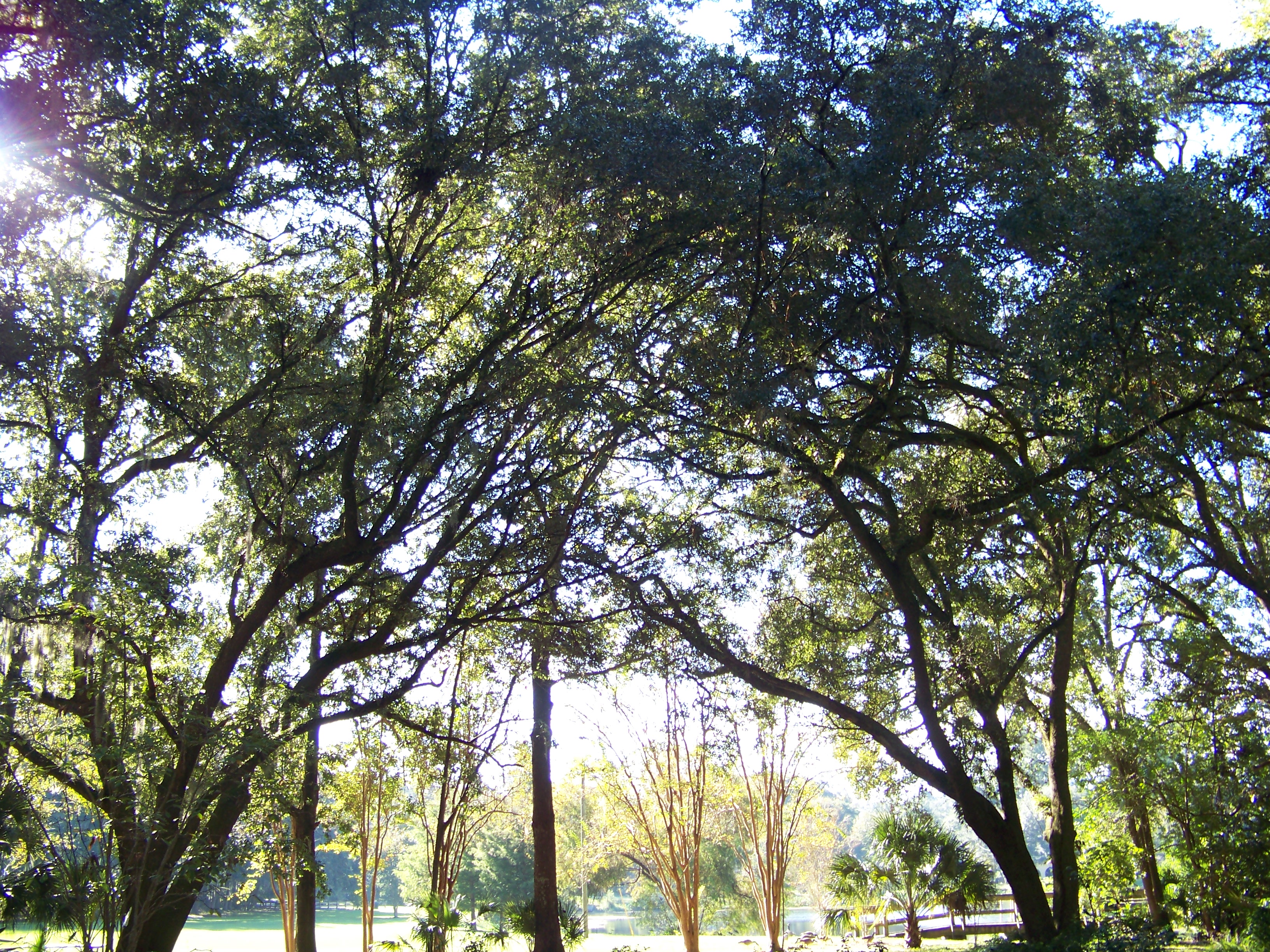
Standing at the edge of the circle of live oaks whose branches intertwine into a year-round canopy of shade, Waverly as park and pond is mine to survey. I will not walk the park and pond today but I decide to try to make my way to the bench on the bridge that crosses the pond.

Stillness of Waverly 0514

My steps are deliberate, almost mindful, as my right knee wobbles. My focus shifts to the pain in my shin and then to my calf and back up my thigh into my hip. I take in what I have come to know as a “pain breath,” which gives me a way to communicate with it.

Sometimes, the pain will release but this is not one of those times. Again, I assume the juggler’s focus, tossing the pain as high and as far away as I can, knowing it will come round again but I have made it to the bridge.

Waverly has never seemed so vibrant. I have lost count of the times that thought has come to me as Waverly’s purity of color and panorama of life stun. This is a world not shy about life.

There is tightness in my lower back but this time it releases simultaneously with my noticing parent geese and their two, yellow-brown goslings in full down just at the edge of the other side of the bridge.

I will not disturb you is the only thought of which I am aware as I quietly open my camera. The sun is behind me so all I can do is aim and hope that the goose family is somewhere in one of the shots but regardless, my mind’s eye has this one.

Goose Family 0514

In my three years of visiting Waverly, these are the first goslings I have seen.  My entire mind-body watches with a focus that had seemed impossible moments earlier. This has been a spring of uncertainty.

The hawk and the geese 0514The red-shouldered hawk also decides to watch from atop the light post, perhaps to watch for a failure in focus, perhaps not. The parent geese are ever alert while the goslings are otherwise engaged yet in this moment, the world is theirs. They do not dawdle in their gusto of being alive.

As a human, I am easily snagged by the “what if” of drama but in the natural world, life is lived as it comes. Each moment is so precious, so all-consuming that it cannot possibly be anything but enough.

I rub my right leg in gratitude for each sensation it sends, as my mind opens to being rather than to battle. Such is possible with each breath, this being in life as it is. How it dazzles.