Part II: A Drip of Life

If you have not read part one, no worries. It was long ago and far away. There is no longer a flood outside my door but the leaks persist, now inside rather than outside.

I am a privileged, old white woman who is not without a bucket and an extra large, Halloween-orange bowl for when the drips fan out. Our building boiler is many decades old like the people it serves (and the plumbers it baffles).

A steady drip of life, water, and in these last two-and-a-half years, I have known oceans. More of the mind, yes, but also an actual glimpse of the ebb and flow of life and how it might end or not.

Cancer takes you there.

Mine was endometrial, grade one, stage one B. Early, early stages, quite common for a 73-year-old woman; the protocol is radical hysterectomy, which I had. I was in the hospital less than 24 hours. The pathology report revealed four remaining cells had invaded my lymphatic/vascular system. Three direct radiation treatments later and no more cancer. I continue to have checkups every three months.

That’s how endometrial cancer was for me, not painful but persistent and eventually eradicated. I was going to leave my bout with cancer at that until I heard 49-year-old poet laureate Andrea Gibson read their poem, “Love Letter From the Afterlife.” The reading was to Gibson’s wife, Megan Falley, during the last days of Gibson’s life. Very soon after, Andrea Gibson died of ovarian cancer, stage four.

You may or may not know (I didn’t) that the terms ovarian and endometrial cancer are sometimes used interchangeably. Gibson wasn’t the right grade/stage for even a fair prognosis much less a good one. You either are or not, with cancer. It’s not much of a spectrum.

“Why did no one tell us that to die is to be reincarnated in those we love while those are still alive.”

(Andrea Gibson, “Love Letter from the Afterlife”)

I have been waiting for that sentence all my life. Not that I knew it, of course. That kind of clarity just arrives, and the world changes. The life force that infuses this dimension is a 49-year-old poet writing a love letter to the world as they fade from life.

I have not the clarity of a poet or the bursting, immense love of Andrea Gibson but in this past year I came close to slipping the veil.

Six weeks later after my radical hysterectomy and before the radiation treatments, I almost died of urosepsis, a blood infection. I ran fevers as high as 103 and my heart raced to keep pace with a kind of Russian roulette playing out in the hunt for just the right antibodies, as my kidneys began to shut down.

I have never known such presence as machines beeped, doors opened and closed, food plates came and left undisturbed. I was immersed in life without clinging to it, as aware of pain as of joy, afloat in an ocean of love, as wave after wave of clarity buoyed me in timelessness.

I was so grateful for having had a chance to live—nothing seemed more precious—until the depth of my meditative state lightened with the swarm of antibodies and reality broke through, bright and cold on the afternoon of the fourth day. After a discussion with the hospitalist, I went home.

During those three and a half days I sensed I would live. It wasn’t a given; it was more like no time left to lose. To use Pema Chodron’s term, stop practicing “idiot” compassion, no more tilting at windmills, build boundaries firm. Meet people as they are and be compassionate but know that sometimes walking away or saying no is the kindest thing that can be done.

I did not feel easy days were ahead nor have they been but in my ocean travels, I sailed true North.

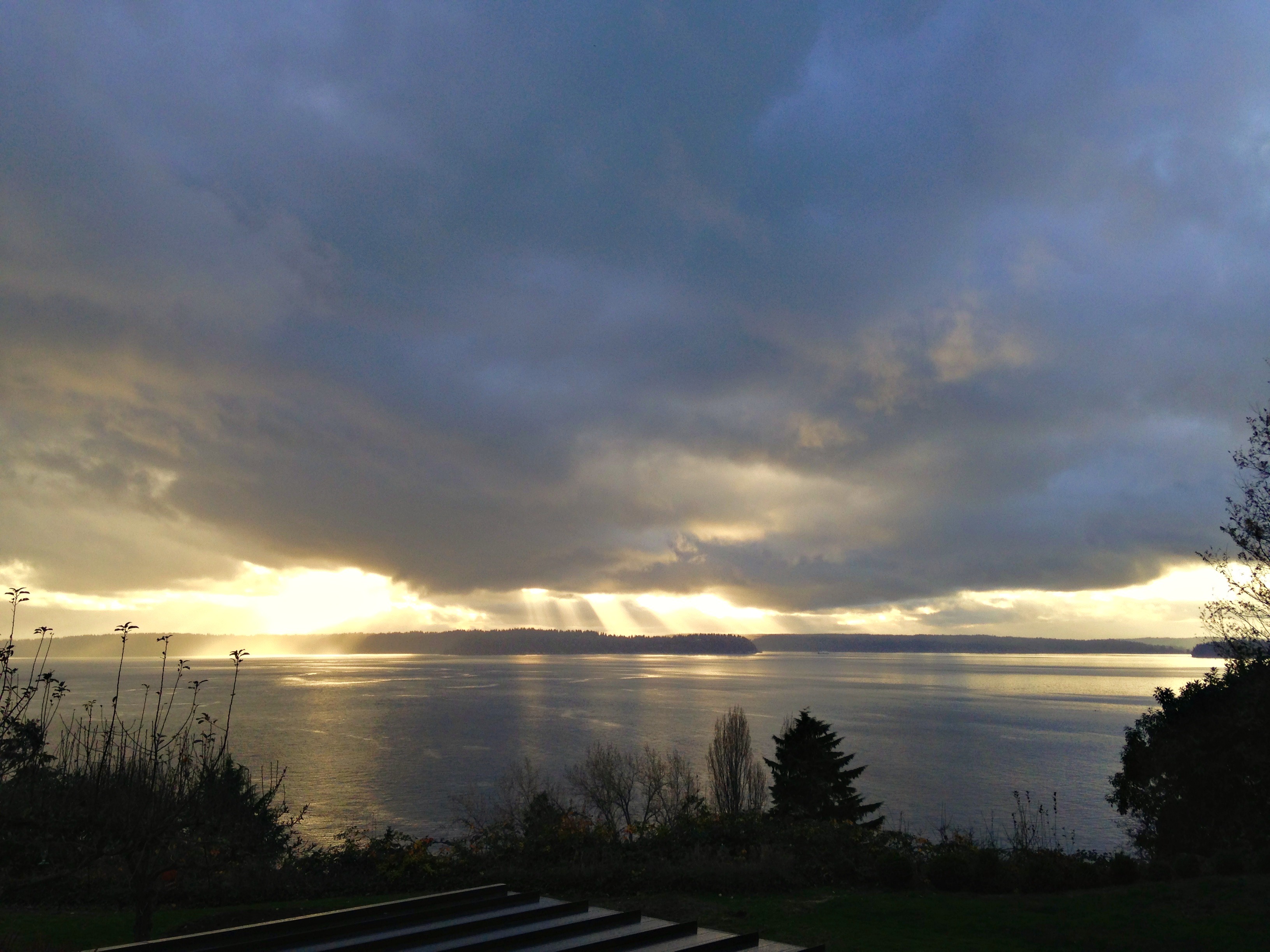
Puget Sound (Len Huber)

Rest, Part I: The Flood Outside My Door

It was just Sunday noon and the excited voices outside my apartment followed by a sharp rap on each door meant emergency. Out of dread rather than curiosity, I opened my door.

Without taking a step into the hallway, I leaned left and looked to the sitting area across from the elevator where the two mahogany, oversized flower-cushioned chairs sat on either side of the matching, double-drawered buffet —in at least two inches of water.

To me, the set of furniture seems bespoke but its origin is murky in this 50+ year old apartment building for retirees. Many a resident, upon their death, donates furniture and belongings to what is known as the community. Thus, there are other equally lovely pieces—polished every week by the same woman for over 40 years—on each of the 12 floors.

I shut the door.

I needed to take a shower, ASAP, after I tucked what were once luxuriously soft towels, now faded gray and ecru but still absorbent, under my apartment door, with washcloths stuffed in the sides of the threshold.

Taking a shower may not seem intuitive in the time of an imminent flood but I had no idea how long we might be without water for we have had pipes burst before, and I knew the drill. This water event was particularly bad.  Not only did it flood the second floor but the lobby and offices below, as “if the heavens had opened” is how it was relayed to me.

Nearly every floor has had its flood and subsequent fire alarm events.

About six weeks ago, the fire alarm went off and this time it was not a resident with a grease or oven fire but an alarm system too damaged from all the floods. It took 2 1/2 hours to finally figure out how to turn off the alarm system and keep it off—for that day.

No one evacuates for fire alarms or floods nor do the firemen come. We all know the drill. Mostly, these things happen in the midnight hour or some equally inconvenient time. Any alarm event after 3 AM and I make myself breakfast, spending the day with less light, more dark in a world of wet wires.

It’s an issue with the HVAC system but the maintenance team is optimistic because finally there are resources to replace the plumbing and electrical systems that have lasted five decades, almost.

I’m optimistic, too, for I love this old concrete and stucco building with spacious lobby, dining and living rooms—big enough for a baby grand piano and full pool table—in what is called Midtown, one of the oldest parts of Tallahassee.

Surrounded by live oaks and the occasional maple is our flower garden complete with crêpe myrtle, lemon, orange, and fig trees. Many garden plants have been left by former residents including flower bulbs from residents’ parents and grandparents. There is even a small fountain.

It’s true we are a community that loves its past be it bespoke furniture or bulbs of the amaryllis. It’s life in fire and flood.

The building was designed for retirees and so it has remained. It’s like hotel living that was a common in the first part of the 20th century. And every apartment is a room with a view. It’s a style of living now gone, only the furniture and structure last.

Sometimes a flood, sometimes a fire alarm.

That was how my time of rest began, that Sunday some seven months ago now. I felt so fortunate that day as the flood came within six inches of my door and no more, hence the gratitude and the shared optimism with the maintenance man, who would later get  soaked as if he were a winning football coach. Three other apartments were flooded that Sunday and for the next 10 days, the drying fans roared 24/7.

For other reasons, he and I have seen each other as the replacement of the plumbing and electrical systems began in January and the work will continue throughout the year, daily it seems.

We refer to it as “the construction,” which it is and isn’t, but it’s the term the new administrator uses. It even has its own bulletin board and every week there is a schedule of what should happen and sometimes it does but to completely replace the lifelines of an apartment building—its plumbing and electrical systems—with residents in situ is not easy for workman or resident.

That Sunday flood was our final one but far from our last alarm.

To be continued….


Wet or Dry, the Dish Is the Work

I felt as if I were joining up with the past tense as my father slipped slowly through the veil of the present. We were 2000 miles apart in that moment, both of us asleep only to awaken in different dimensions.

My version of Edward Lorenz’ chaos theory, I guess, where my being asleep meant I would waken much as I always do but my father would discover a dimension beyond definition. I am now and he is forever there.

For every generation that passes so does a way of life that will never come again. No two moments or movements ever repeat, not exactly. They become history, the story of us, if we write it as it happened. Certainly, similar stories, events, and fashions reappear but Groundhog Day is entirely cinematic.

My dad’s generation had a work ethic of “showing up, no matter what.” He did not retire until he was 88, a man of extraordinary energy even in the last days of his battle with pancreatic cancer. He met each day with all he had. That was his work, I came to realize, much moreso than being a real estate agent or a geologic draftsman. Meeting the day mattered, no matter what.

I can’t say that my father’s work ethic was a fit for me—maybe I just didn’t have the shoulders for it. My adventures were not his, of course, his work ethic but a beacon, showing me the teeth of treacherous waters. I dashed more than one ship there—too foolish to be afraid—until I came to clarity, my constant through any storm. That became my life’s work.

Clarity, peace of mind, contentment, living in the moment—whatever words fit—is confining the mind to the task at hand. Wash the dish, dry the dish stops my ego from flashing past-future, future-past with scenarios that are nothing but a time suck. The dish is the moment, wet or dry. The flashbacks of “what if” will neither wash nor dry the dish. In fact, the dish may break from inattention.

One of the first things I learned in Zen Buddhism was the Buddha’s teaching of “all of life is suffering, and all I teach is the end of suffering.” I didn’t get it. What did he mean by suffering? And when it ends, then what? I am enough of my father’s daughter to want boundaries.

So, I went in search of the teaching, slowly stripping my being to its core, my suffering evaporating, thought by thought, as once again my father’s work ethic revealed itself: show up every day, no matter what. Ride the waves of the horrific and the humble without the “what might have been” scenarios of the ego. After all, they never happen. Life does.

My father may have peacefully passed but the ensuing ego whack-a-mole was one judgment after another. A dear friend reminded me of “the work” of Byron Katie, a way to unravel any thought my ego offers me—with four questions and a worksheet—a dismantling of my ego’s neat and tidy judgments that by now were an impressive pile.


Life is layered until it isn’t.

I faced my ego whack-a-mole with a completed worksheet and watched a few of Byron Katie’s free weekly events. The suffering surrounding my father’s death wasn’t that he died or that he had cancer. It was what was happening because he had died. If I did not sit in the stillness of clarity, I faced years of running down rabbit holes and probably a lot of broken dishes in my inattentiveness to wash the dish, dry the dish.

In his fight against pancreatic cancer, my father believed that massive doses of chemotherapy were his best chance at life. It was a longshot, this belief, but it gave him a way to define each day. It was “his work,” his kind of inquiry into the life he had left.

My father would live eight months, increasingly aware that his decision offered options he may not otherwise have known. He found joy just sitting in the stillness, listening to life, sometimes opening an eye to the waters of Puget Sound. He said his daily rosary contemplating its mysteries, as if they were anew.

“I should not have done as much chemotherapy,” he said to me one day. His tone was matter of fact, thoughtful, without regret. Inquiry only illuminates. His determination to live gave way to the love and wonder of just being alive until life waned.

“I don’t want to live anymore,” he told me in one of our daily conversations. And we discussed what he wanted to happen next. He would no longer be wheeled to his living room chair from the hospital bed that hospice had provided. Within a matter of days, his life force returned to the energy that animates us all.

His body was consumed by the cancer but his mind remained one of inquiry, a summons of courage to face reality and find the possible in the impossible until life no longer is.

As for me, I wash the dish, dry the dish. I do “the work.”

The Flipside View of Life’s Turning Dime

I am in the throes of physical therapy for my lower back, specifically a right side L4-L5 disc herniation. This is not my first rodeo (but my fourth) that the disc between these two vertebrae has spilled onto the nerve root. So, yeah, we have history.

In 2010, this same disc spilled over on the left side and sent me screaming to the Emergency Room (ER). A dear friend was good enough to drive me and let me lie down in the backseat of her car, leg straight up, foot planted on the car ceiling (I’m short).

Upon arrival, the ER attendant said, “Why didn’t you call us?”

Money is the short answer but more importantly, I had no clue about pain, going to its core and stripping away all the drama to reveal the root cause. I didn’t know life turns on a dime and voila! A new life lens whose view is nothing like the flip side.

That night I was remembering what had happened in the emergency room in 2003 when the disc squirted a bit more of itself onto the nerve root. I was given a hefty pain medication injection and sent home with enough pain pills to get me to the orthopedic surgeon who did the same surgery as he had done in 2000.

The 2010 flipside view proved a new life lens is just that, new. For reasons not clear to me or to my friend, the ER attending physician decided I didn’t have a disc herniation so I had no pain. After a while, I think he offered me a tramadol, something I scoffed at because I had tried that at home.

To be fair, I don’t think there’s any medication that stops nerve pain at its source, and the physician may have said something to that effect but I was in full fight/fear mode, and we were there for hours while my fear raged. I have since discovered that heat and a hefty dose of prednisone helps most but a nerve on fire, pinched in a disc spill over, will have its day.

At some point it was decided I would have an x-ray. I wasn’t about to let any ER personnel help me onto the x-ray table but, of course, I couldn’t do it. To this day, I remain grateful to the radiology techs who were quick to help. I would lie on that table for quite some time after the x-ray was taken.

In the radiology tech booth there was a lot of repetitive discussion.

“No, she doesn’t.”

“Yes, she does.”

And then more of the same medical jargon before the attending physician shouted, “What do you mean there’s a (medical jargon with swears)! There can’t be!”

And the radiologist explained the X-ray results again to the attending physician who responded, “She can’t have!”

“Yeah, she does,” the radiologist said.

After I had been returned to my ER cubicle, the attending physician stuck his head around the curtain and said, “So, you’re Huber?” Neither my friend nor I could have anticipated that question; one or both of us agreed that I was.

Immediately, it was apparent that the attending physician thought I was someone else. It would be another emergency room physician who would explain about the herniation and provide me with a prescription.

Before we left, the initial attending physician made a bad situation even worse by kissing my hand and offering a groveling apology. I’m still amazed that I did not go off on him but my friend and I were tired and hungry, and my pain was better—maybe because I was vindicated, maybe because my fear subsided, maybe because….

Within a few days, I would have my third surgery, and the pain would be gone. I do remember the neurosurgeon saying “no wonder, no wonder” regarding my pain, and he cleaned up the mess the orthopedic surgeon had left in 2000 and 2003.

In 2022, the jelly has spilled out of the disc doughnut yet again. I am needing the same surgery by the same neurosurgeon, a 40-minute procedure. However, he’s also offered that “about 87% of these” (herniations) resolve themselves.

The pain did not send me screaming to the ER—just a lot of stay-at-home F-bombs—so impossible to ignore, and in the beginning so severe, I had to use my wheelchair any time I cooked or did the dishes. Standing was almost impossible so getting into my tub/shower was out of the question. It was bathroom sponge baths and washing my hair at the kitchen sink, while sitting in my wheelchair for about two weeks.
Still, I am reluctant to pursue a fourth laminectomy so I am playing the neurosurgeon’s percentages but without Sue, my favorite physical therapist who has seen me through two hip replacements and a fractured pelvis. However, she did do the initial physical therapy (PT) intake.

Ours was a long conversation, and the flipside view of this turn of the dime was once again not what I expected.

Sue all but said I should have the surgery followed by physical therapy (PT) rather than PT and then surgery.

“I have history with laminectomies, remember?” I start to tell her the 2010 ER story and she waves me off.

“This pain once sent you screaming to the emergency room, and with you, that’s saying something,” she says, and then checks off boxes on her tablet.

“But then, I did not understand the nature of pain,” I start to explain and stop. Zen is… otherworldly to her, so I say, “I have a neurosurgeon who is suggesting physical therapy and a physical therapist who is suggesting surgery.”

Sue doesn’t disagree before she explains, “We don’t really know how to fix backs—not medicine, chiropractors, physical therapy, or acupuncture.”

I nod. I have tried them all, even naturopathy but I keep that to myself.

“We treat symptoms with a 50-50 chance for success. In comparison, the success rate for knee or hip replacement is 96%.” Sue throws up her hands as if to say, get it?

She knows I have wrapped my head around that 87% figure of this herniation resolving itself with physical therapy and the few yoga poses I can do. As in 2010, I’m not seeing that the dime has turned but Sue has.

In what appears apropos of nothing she says, “You know with myelopathy all bets are off.”

I nod. My spinal cord is short circuited— it has dead spots in places—a daily mystery as to what nerves will fire when or if at all.

“At some time, whether it’s today or years from now, you have got to get a power wheelchair,” Sue says. And I know she says this with 30+ years of experience as a physical therapist who truly loves her profession.

Using the manual wheelchair is exhausting and not a good fit with the nerve damage in my hands and arms. And it’s heavy for my friends and Lyft drivers to maneuver. A lightweight, foldable power chair would take me to my apartment building lobby to get my mail, allow me to take my recycle items to the bins, keep me out and about without the constant concern of falling.

My gut tells me Sue’s right but her words land with a thud. I didn’t think I was “there” yet and why does that bother me so much? It feels ableist because it is. It is eerily reminiscent of the ER attending physician only this time, I’m the one with the attitude.

“Maintaining my independence is based upon my not falling,” I say, as I look at Sue who clearly has nothing more to say.

A power wheelchair will mitigate the risk of falling just as my three-wheeled walker still does but myelopathy is progressive so it…progresses. A disc herniation is a distraction, a weakness with no spinal cord involvement, but nonetheless a signal of the flipside view of life’s turning dime.