Fail Better: Break the Sound Barrier

“The question is, are you going to grow or are you going to just stay as you are out of fear and waste your precious human life by status quo-ing instead of being willing to break the sound barrier?” Pema Chödrön from Fail, Fail Again, Fail Better, Commencement Address at Naropa University.

In a year like 2025, breaking the sound barrier seems the only choice. There is no status quo. One of the many questions I’ve been asking myself for the last 11 months is how loud does life have to get for people to wake to reality? It would seem sound barrier quality at least, yet there is a desperate clinging to the same old, same old yesterday be it politics or Christmas.

The “good old days” is the stuff of Currier and Ives’ lush, hand-colored lithographs whose reprints are still available on Christmas cards (as well on canvas); the same is true for the light in an idyllic Thomas Kinkade landscape, also now available as Christmas cards.

Nostalgia sends us to the moments when we knew what to do, who to be and how to succeed. Maybe even be happy. There is no failure in scenes of nostalgia, only the warmth of a moment when life was more a picture postcard than not.

Is there a way to make the magic stay? No thing, no one, no place stays the same. Therein may lie an answer.
Any center cannot hold if its edges, its fractures, its cast adrift pieces are never explored. Think of a kaleidoscope. When light enters its chamber, mirrors reflect pieces a jumble—we can hear them rolling around—as the chamber rotates one unique image into another. So fragile its impermanent beauty.

We are not momentscaptured on canvas or the mirrored light in a kaleidoscope. We are the real deal, flesh and blood, prone to failure.

In America, we just don’t give failure enough credit, if any. It may be why I so eschew winning, for everything is a competition and nothing matters but the win. To be fair, I am constantly contrary, unable to be like everyone else. I’ve tried, not with great conviction, but I have made an effort from time to time. It never goes well for anyone.

But I have grown so weary of the competitive American. In this land of supposed equality, I have never found the exceptionalism so often attributed to us. We are on the edge of losing our democracy because voting is now a competition between two colors, not a matter of who will best represent and serve all colors.

The upside is we have failed—spectacularly, dangerously so—wiping out any semblance of status quo. And we keep failing but we are beginning to fail better. Neither at light speed nor breaking the sound barrier but the November 2025 elections are a definite fail forward.

We are redefining our democracy as we approach the 250th anniversary of our first revolution. Seems we have good timing. This is not a throw out the Constitution with the kleptocrats moment. Our Constitution is us—we the people—an informed and vigilant electorate governed by the rule of law and no other.

Let’s think of it as fail forward because as Americans, forward is our thing. We are not exceptional. We have proven ourselves to be as susceptible to the forces of fascism as any other country on earth. We are a democracy with a Constitution like no other. With that, we can go forward.

Yet, failure, even failing better, is not a rallying cry. I don’t have any of those. I do my best to meet the moment. Having failure as a tool provides another life lens to broaden my perspective.

Before turning to Zen Buddhism some 13 years ago, I replaced the word/idea of failure with many a euphemism. That version of me still dwells within, as does every iteration of who I have been, but the idea of failure, the thought of failure as a fear no longer has a hold.

I can say this with some confidence because I know everywhere I go there I am. I sit and will continue to sit with many versions of me, reflecting on all the moments I cannot change. There’s purpose in reflecting rather than reliving, a kaleidoscope of light turning over one image after another.

Nowhere is this truer than in my writing, a stalwart that continues to surprise. Writing is my one strength that remains fiercely loyal to me. I am more subconsciously loyal to writing than I ever know. I have walked away from writing—or tried to—thinking maybe not this lifetime. Failing without acknowledging the word failure.

As a Buddhist, I’m counting on reincarnation. Especially when it comes to writing. We are inextricable. I’m always writing in my head until my ego steps in to say, ”but you’re not a writer.”

It has nothing to do with the quality of my words or my small list of publications. It has to do with working in an established framework. I neither have the talent nor the discipline to do that. I all but turned myself upside down and inside out when I tried to blog on certain days of the week. Failing again but with curiosity.

There is no one routine, no established writing hours or days. Before my last post, I hadn’t blogged for two years. I’ve never had any problem saying I’m a blogger.

“Oh,” ego is happy to interject. “Is a blogger really a writer?”

“Shut up.” Failing better.

There have been some excellent reasons why writing was not the order of the day, and sometimes, I’m just lazy. Who isn’t? When I meet the reality of my day, I’m a writer whether I write that day or not.

Just recently, I found an excellent placement for an essay I’m working on about my near-death experience with sepsis. Right now, it’s mostly notes and a very raw draft of part one. The issue was the deadline. When I found this publication possibility, I had enough time but not every day would be a writing day for me. Not without getting sick and losing a lot of days for everything in my life. A damaged spinal cord and rheumatoid arthritis dictate how long I will be sitting and even with voice recognition, there is always some keyboarding.

Failing better is knowing my sepsis essay is going to be a good one. I can feel it. And then I’ll see where it might find home. Like the Currier and Ives lithographs or the Kinkade paintings, when I allow the images to wend their way, words tumble like the light of the kaleidoscope, finding their way to one sentence and then another.
Part II: A Drip of Life

If you have not read part one, no worries. It was long ago and far away. There is no longer a flood outside my door but the leaks persist, now inside rather than outside.

I am a privileged, old white woman who is not without a bucket and an extra large, Halloween-orange bowl for when the drips fan out. Our building boiler is many decades old like the people it serves (and the plumbers it baffles).

A steady drip of life, water, and in these last two-and-a-half years, I have known oceans. More of the mind, yes, but also an actual glimpse of the ebb and flow of life and how it might end or not.

Cancer takes you there.

Mine was endometrial, grade one, stage one B. Early, early stages, quite common for a 73-year-old woman; the protocol is radical hysterectomy, which I had. I was in the hospital less than 24 hours. The pathology report revealed four remaining cells had invaded my lymphatic/vascular system. Three direct radiation treatments later and no more cancer. I continue to have checkups every three months.

That’s how endometrial cancer was for me, not painful but persistent and eventually eradicated. I was going to leave my bout with cancer at that until I heard 49-year-old poet laureate Andrea Gibson read their poem, “Love Letter From the Afterlife.” The reading was to Gibson’s wife, Megan Falley, during the last days of Gibson’s life. Very soon after, Andrea Gibson died of ovarian cancer, stage four.

You may or may not know (I didn’t) that the terms ovarian and endometrial cancer are sometimes used interchangeably. Gibson wasn’t the right grade/stage for even a fair prognosis much less a good one. You either are or not, with cancer. It’s not much of a spectrum.

“Why did no one tell us that to die is to be reincarnated in those we love while those are still alive.”

(Andrea Gibson, “Love Letter from the Afterlife”)

I have been waiting for that sentence all my life. Not that I knew it, of course. That kind of clarity just arrives, and the world changes. The life force that infuses this dimension is a 49-year-old poet writing a love letter to the world as they fade from life.

I have not the clarity of a poet or the bursting, immense love of Andrea Gibson but in this past year I came close to slipping the veil.

Six weeks later after my radical hysterectomy and before the radiation treatments, I almost died of urosepsis, a blood infection. I ran fevers as high as 103 and my heart raced to keep pace with a kind of Russian roulette playing out in the hunt for just the right antibodies, as my kidneys began to shut down.

I have never known such presence as machines beeped, doors opened and closed, food plates came and left undisturbed. I was immersed in life without clinging to it, as aware of pain as of joy, afloat in an ocean of love, as wave after wave of clarity buoyed me in timelessness.

I was so grateful for having had a chance to live—nothing seemed more precious—until the depth of my meditative state lightened with the swarm of antibodies and reality broke through, bright and cold on the afternoon of the fourth day. After a discussion with the hospitalist, I went home.

During those three and a half days I sensed I would live. It wasn’t a given; it was more like no time left to lose. To use Pema Chodron’s term, stop practicing “idiot” compassion, no more tilting at windmills, build boundaries firm. Meet people as they are and be compassionate but know that sometimes walking away or saying no is the kindest thing that can be done.

I did not feel easy days were ahead nor have they been but in my ocean travels, I sailed true North.

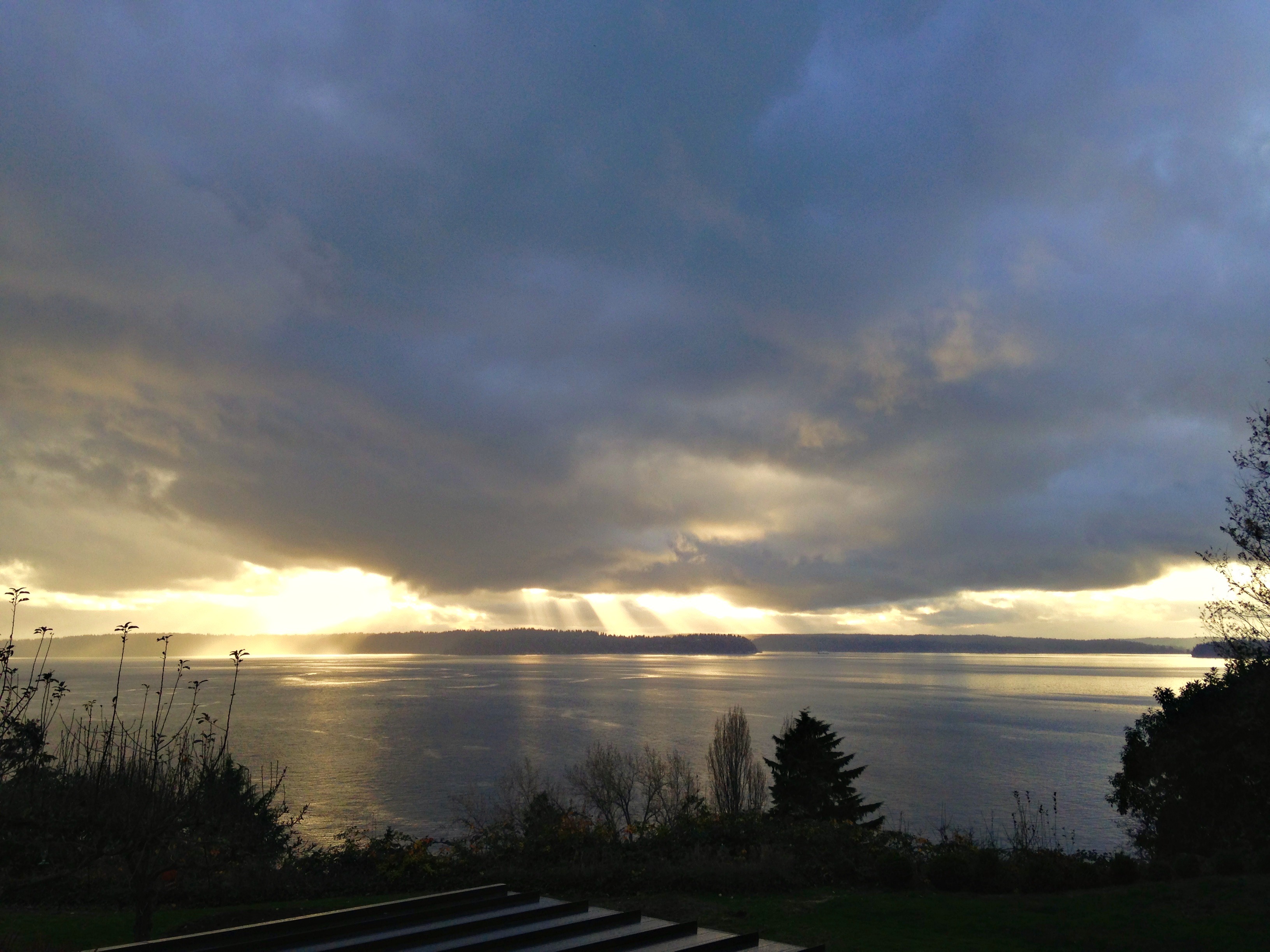
Puget Sound (Len Huber)

Warts and All, Democracy Is Worth the Vote

So, I gathered a few quotes about voting—well, to me they are representative of the importance of voting—certainly, they are not meant to inspire for as Jack London said, “you can’t wait for inspiration. You have to go after it with a club.”

🇺🇸

Begin by avoiding harm. —Myozen

Much of the time, living in a democracy is like being served a daily dish of clear and present danger. Freedom has never been free. What distinguishes democracy from any kind of autocracy or oligarchy is the integrity of the vote.

Hundreds of thousands, maybe millions the world over, have died for the right to cast a ballot.

The United States has one of the most remarkable and radical documents that has ever been written, a truly brilliant constitution that was sacrosanct until 2016. Its Achilles’ heel, however, has always been voter apathy.

🇺🇸

Change will come. As always, it is just a matter of who determines what that change will be.— Winona LaDuke

In every election, democracy is on the line. That is how the system works. We elect people who go to Washington to represent their constituents and through compromise, hammer out the best deal possible. Well, unless you are a present-day Republican who will do one of two things, either obstruct or not show up at all for the vote, not that the two are mutually exclusive.

As a Floridian, I have the best of both these worlds in my senators: Scott who will only vote for his way and Rubio who just can’t be bothered to show up to vote. Florida is reminiscent of the fall of Rome, with Nero DeSantis fiddling as the state drowns in development. He even wants Mickey Mouse to move, and maybe the mouse will—to Wisconsin, where cheese is renowned.

🇺🇸

The world breaks everyone, and afterward, some are strong at the broken places. —Ernest Hemingway

We just barely survived an insurrection on January 6, 2020. Republican candidates, some of them, are threatening not to accept the 2022 vote if they lose. It sounds like I am picking on Republicans—well, they are broken—they’re not the party of Lincoln or even of George Will. They are oligarchs in search of a country, preferably the most powerful one on the planet.

Liz Cheney is an exception, for me proof that I can be completely against a politician’s point of view but if she has integrity and believes in the rule of law, I know the country will survive as a democracy, although her policies will keep us well supplied with broken places.

Cheney lost her primary—she got pummeled. However, the minute the networks called the race, she went on national television and conceded, saying “this is how it works.” Also, she called her opponent to concede, something her opponent at first denied, but Liz has been at this game a long time and recorded her date-stamped concession voice message.

This current iteration of the Republican Party is all about power and for them, election integrity is a nuisance. Such is the way of autocracy.

🇺🇸

The world will not change until we do. —Jim Wallis.

We have seen the result of one election, 2016, that forever changed the Supreme Court of the United States. Can we survive a SCOTUS that throws aside the rule of law for political beliefs?

In overturning nearly 50 years of legal precedent, SCOTUS reversed the rights of women to make choices about their healthcare, setting up challenges to the right to marry whom you choose and even the right to vote. In an autocracy, legal precedent exists at the whimsy of any autocrat.

🇺🇸

Death is not the greatest loss in life. The greatest loss is what dies inside us while we live. —Norman Cousins

I want to see a landslide vote in November for I believe an historic turnout is a landslide victory for America, showcasing its democratic republic principles and its progress so far, warts and all. America the republic, a bit banged up but the Statue of Liberty still stands.

Cast your ballot, Americans, for democracy. Ignore the polls, the pollsters, the parties but especially, the mainstream media (MSM). Turn the tables on them. Create a story that proves them wrong about who we are. Demand election integrity, settle for nothing less.

🇺🇸

Wet or Dry, the Dish Is the Work

I felt as if I were joining up with the past tense as my father slipped slowly through the veil of the present. We were 2000 miles apart in that moment, both of us asleep only to awaken in different dimensions.

My version of Edward Lorenz’ chaos theory, I guess, where my being asleep meant I would waken much as I always do but my father would discover a dimension beyond definition. I am now and he is forever there.

For every generation that passes so does a way of life that will never come again. No two moments or movements ever repeat, not exactly. They become history, the story of us, if we write it as it happened. Certainly, similar stories, events, and fashions reappear but Groundhog Day is entirely cinematic.

My dad’s generation had a work ethic of “showing up, no matter what.” He did not retire until he was 88, a man of extraordinary energy even in the last days of his battle with pancreatic cancer. He met each day with all he had. That was his work, I came to realize, much moreso than being a real estate agent or a geologic draftsman. Meeting the day mattered, no matter what.

I can’t say that my father’s work ethic was a fit for me—maybe I just didn’t have the shoulders for it. My adventures were not his, of course, his work ethic but a beacon, showing me the teeth of treacherous waters. I dashed more than one ship there—too foolish to be afraid—until I came to clarity, my constant through any storm. That became my life’s work.

Clarity, peace of mind, contentment, living in the moment—whatever words fit—is confining the mind to the task at hand. Wash the dish, dry the dish stops my ego from flashing past-future, future-past with scenarios that are nothing but a time suck. The dish is the moment, wet or dry. The flashbacks of “what if” will neither wash nor dry the dish. In fact, the dish may break from inattention.

One of the first things I learned in Zen Buddhism was the Buddha’s teaching of “all of life is suffering, and all I teach is the end of suffering.” I didn’t get it. What did he mean by suffering? And when it ends, then what? I am enough of my father’s daughter to want boundaries.

So, I went in search of the teaching, slowly stripping my being to its core, my suffering evaporating, thought by thought, as once again my father’s work ethic revealed itself: show up every day, no matter what. Ride the waves of the horrific and the humble without the “what might have been” scenarios of the ego. After all, they never happen. Life does.

My father may have peacefully passed but the ensuing ego whack-a-mole was one judgment after another. A dear friend reminded me of “the work” of Byron Katie, a way to unravel any thought my ego offers me—with four questions and a worksheet—a dismantling of my ego’s neat and tidy judgments that by now were an impressive pile.
 

Life is layered until it isn’t.

I faced my ego whack-a-mole with a completed worksheet and watched a few of Byron Katie’s free weekly events. The suffering surrounding my father’s death wasn’t that he died or that he had cancer. It was what was happening because he had died. If I did not sit in the stillness of clarity, I faced years of running down rabbit holes and probably a lot of broken dishes in my inattentiveness to wash the dish, dry the dish.

In his fight against pancreatic cancer, my father believed that massive doses of chemotherapy were his best chance at life. It was a longshot, this belief, but it gave him a way to define each day. It was “his work,” his kind of inquiry into the life he had left.

My father would live eight months, increasingly aware that his decision offered options he may not otherwise have known. He found joy just sitting in the stillness, listening to life, sometimes opening an eye to the waters of Puget Sound. He said his daily rosary contemplating its mysteries, as if they were anew.

“I should not have done as much chemotherapy,” he said to me one day. His tone was matter of fact, thoughtful, without regret. Inquiry only illuminates. His determination to live gave way to the love and wonder of just being alive until life waned.

“I don’t want to live anymore,” he told me in one of our daily conversations. And we discussed what he wanted to happen next. He would no longer be wheeled to his living room chair from the hospital bed that hospice had provided. Within a matter of days, his life force returned to the energy that animates us all.

His body was consumed by the cancer but his mind remained one of inquiry, a summons of courage to face reality and find the possible in the impossible until life no longer is.

As for me, I wash the dish, dry the dish. I do “the work.”

Owning the Outrage in a World of “Hold My Beer”

(Note: For those who prefer my posts that are more Zen than bite, you might want to give this one a pass. Then again, stay. We cannot keep walking away from one another, especially here in the United States. So, sit a spell. Have a beer or a coffee, and at the end of my say, I’ll hold your beer, your coffee—whatever—while you have your say.) 

In her book, Welcoming the Unwelcome: Wholehearted Living in a Brokenhearted World, Pema Chodron writes that there is a group of resilient people who never give up on the world.

Hold my beer, Pema.

I doubt even Margaret Mead would think that a small group of thoughtful people can change what is coming to fruition in the United States. It’s well-thought out and the result of decades of planning, pretty much religion wrapped in a flag. I suspect the truly thoughtful (and no doubt resilient) have left the planet, having hijacked Elon Musk’s SpaceX for other worlds.

Not being among the most thoughtful, Musk is too busy enjoying “former guy” status as the soon-to-be—or not—war lord of Twitter. Of course, there are so many brilliant billion-dollar distractions for Musk that nothing is a loss or maybe it’s all a loss.

We have met the enemy and it is us. In an increasingly fascist world, democracy seems too hard. And anyway, how bad can a fascist regime be? That remains a legitimate question for far too many people in America, old and young. In our classrooms, the already whitewashed US history is being replaced by snow white fairytales. Will this bring back knights in tights and chastity belts?

Hold my beer.

The fencing is up around the building of the United States Supreme Court, in anticipation of the court’s archaic ruling regarding reproductive rights for women:   they have none is the majority opinion of the court. In response, some state legislatures, eerily echoing one another, are enacting laws making any abortion for any reason a criminal act. In Louisiana, they wanted abortion to be considered a homicide but the bill died in withdrawal.

The leaked court opinion sets aside precedent, opening the way for aborting all civil rights—sexual orientation, interracial marriage, voting. What woman wouldn’t wear a chastity belt (modified for sex toys because girls gonna have fun). Minnie Mouse is leading the Disney charge.

And speaking of Florida, any sexual orientation or skin color other than white cisgender cannot be mentioned in elementary education, which also abstains of any meaningful sex education. Governor DeSantis calls special legislative sessions as often as the former guy twerked at his rallies. Yeah, those knights in tights.

Hold my beer.

As in a Dar Williams’ song, I am “like my country in the eyes of the world,” forever the ugly American, from sea to shining sea. We are either privileged or poor, partisan or bi-partisan, owners of the biggest arsenal of destruction on the planet to ensure the American way, a democracy dying as we cannot be bothered to vote in Every. Single. Election.

Here’s to the Ukrainian people who know democracy is worth being fire-bombed Every. Single. Day.

It is coming to pass that authoritarians/oligarchs are owning all of America much like they once “owned the libs” who have spent far too much time jousting at the outrage windmill. Witness the recent symbolic vote in the United States Senate to codify abortion. What do you get when you own the outrage? I’m old enough to remember when Don Quixote was required reading.

There is no majority of Americans, in any poll, that agrees with the soon to be rendered Supreme Court opinion regarding Roe v. Wade but will the American people storm the 2022 primary season demanding to know every single representative’s stand on women having the right to make their own decisions about their bodies? It’s a yes or no question, needing no muddled meandering. It’s not a Left or Right answer, just a yea or nay on a human right.

If people who can get pregnant do not have control over their bodies, there is no freedom in America for anyone. Every civil right is at risk with the striking down of the Roe v. Wade precedent. Every. Single. Civil Right. And every American owns this failure. Maybe we never deserved our republic for we are certainly doing everything we can to lose it.

If I am wrong, I will lead the cheer, loud and long, for I have loved my country, and I am old enough to remember those halcyon days, idyllic and ill-informed as they were.

Hold my beer.

So, now that the bite is out of the way, here’s the Zen I have left—to live in the eternal present–like living in a democracy and keeping a country from going off the rails, maintaining a Zen practice is hard. What to do is basic but it won’t work without commitment and dies in complacency.

The moment is all we ever have, the energy to effect change over owning outrage.

Peace exists in every moment if we stay open to what it reveals, doing what we can with the options we have, immersing ourselves in what must be. Moments are met or not at all.

Life is a lot of facts with sharp edges but even on my worst days of staying present, it’s better than jousting at a windmill grinding.

Now, I’ll hold your beer.

Sex and the Throw Pillows: A Good Soul Story

Part I: Sometimes Elegant, Other Times Not

In the moment before any story there is an image and then the translation of that thought into words, directing the actions of our lives. Of course, this is not always a good thing nor even a bad thing but it is how we roll.

In her iconic essay, “Why I Write” (NYT December 1976), Joan Didion says “I write entirely to find out what I’m thinking.”  The essay title, Didion acknowledges right away, is borrowed from James Orwell, and that’s how it is with all words—borrowed—from a common culture to communicate, sometimes elegantly and other times, not so much.

I cannot say I had Joan Didion in mind when I received Celeste’s text about throw pillows. Rather, sex was on my mind as I was trying to write a scene about a health and sexuality podcast in a small town buried by time (think Girl Boner Radio meets Brigadoon).

“You really need some color on your loveseat and throw pillows look great. Which ones do you like?” 😊

“I’m not big on throw pillows. I don’t like them.” I believe this will suffice but like sex in a small town, the story becomes much more than any actual act.

I then receive three images of throw pillows in different shapes: a green and white check square, a green and orange circle, an oblong red and green Scottish plaid. I don’t like throw pillows; have never owned any. I don’t think I ever had a thought about a throw pillow until I met Celeste, truly a good soul.

My use of the term, “good soul,” is not complimentary but refers to people who are “just trying to help,” meaning they help their way and only their way, as if they were born with a vision better than the rest of us mere mortals. Dorothy Parker, elegant as ever, described good souls this way:

“There is simply no keeping them down–back they come, with their little gifts, and their little words of advice, and their little endeavors to be of service, always anxious for more.”

All of this is to say that I would soon find myself in H-E double toothpicks yet again.

Part II: The Curmudgeon and the Good Soul

Celeste is determined to make me like other people, believing that deep in my soul it is what I desperately seek. In other words, mine is the façade of a curmudgeon desiring to fit finely into another fold. Thankfully, every time I’ve attempted to be like everyone else, I found myself instead.

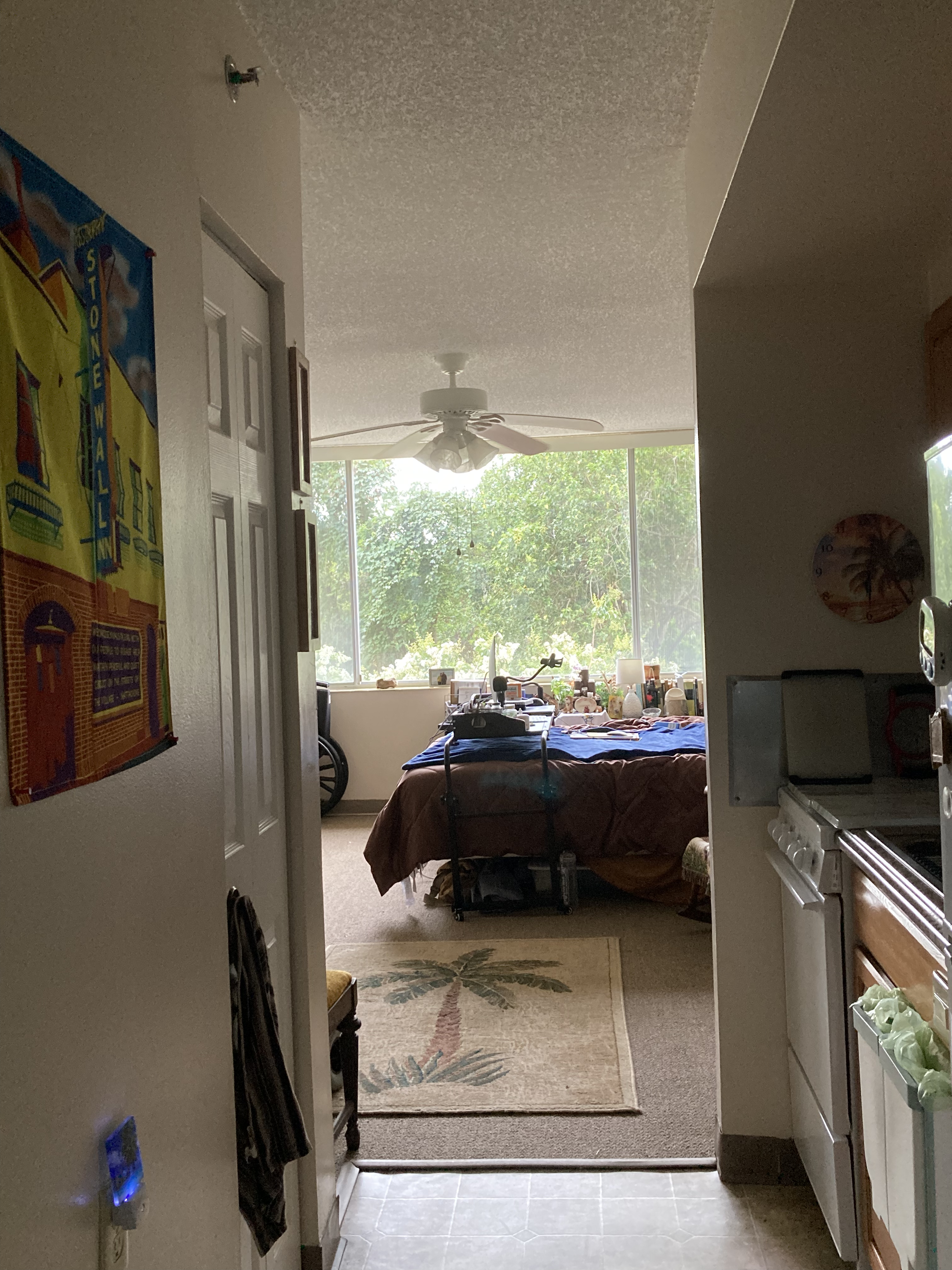
She and I would never have met if it were not for my recent relocation to an efficiency apartment of 17 ½’ x 12 ½’ with half galley kitchen (including a granite countertop just big enough for a small microwave) and bathroom. These measurements are important, dear reader, and not extraneous text.

Celeste is the daughter-in-law of a former neighbor, my dear Sibyl. As is befitting her name, Sibyl is wise and has seen almost all of the 20th century during her 93 years. Sibyl loves Celeste deeply but she also knows her as the kind of person who loves a cause and one who “will take over if you let her.”

And so it was that Celeste was looking for household items—”just about anything, really”—for some migrant families who moved into our area of the Florida Panhandle. After asking me, Sibyl sent her along. In truth, I was delighted!

It was less than 36 hours before I would move, and I still had more “stuff” than I knew what to do with and although I would not admit it, I was increasingly hampered by both spinal cord and autoimmune disease. I don’t know why I thought I could be anything more than the person who wrote the check for the move.

So, it wasn’t as if I could just box up/bag up items and take them to Goodwill or any other donation center. Literally, I did not have the physical wherewithal. Also, I don’t believe that Goodwill or any agency taking donations are dumping grounds for anything that isn’t dust.

In hindsight, I cannot imagine a poorer plan for moving household but hindsight is like that, a pair of eyes I rarely seek, perhaps at my own peril. What might have been is not the best view of the past so meh, I say.

Enter my good soul, Celeste, surveying my mismatched wares in size and color: plates and glassware, flatware, and utensils; towels, a yellow fitted sheet, a green sheet, a brown mustard colored pillowcase; knickknacks of absolutely no worth (or meaning to me) stored in bins for eleven years. Yet, Celeste seemed to find good in all but very little and that we shoved into black plastic bags for flinging into the dumpster. It was a hard day’s work.

Without Celeste at this juncture in the move, both my wallet and my body would be even worse for wear. I was and remain grateful, although that may not always be evident.

When there was less than 12 hours left, I had overworked my body into such an inflammatory state that my tissues were leaking freely and every joint was supersized while my moisture glands were as dry as the Sahara. Chronic illness is nothing if not contradictory.

I had been eating nitrate and nitrite free turkey hotdogs stuffed into quinoa tortillas with vegan cheese and a bit of spinach for the last 10 days. I will die a comfort food eater always with one eye to the healthy. Oh, and apples, always lots of apples and blueberries.

And that is how Celeste found me that final day, sitting in the middle of my living room floor facing a wall of filled boxes, shoving food fast. We had discussed my new efficiency apartment and she had mentioned a degree in design. Yes, I encouraged her and once again, I was ever grateful.

Patiently, she explained the floor plan of my new efficiency apartment was not what it seemed so she drew, to scale, a floor plan five feet shorter in length, which meant my loveseat would not fit.

With most of my food swallowed, I reply, “I guess I didn’t mention that I was actually in an apartment similar to the one I’ll be renting. We measured it and my 12-foot tape measure ran out with about five feet to go.” But such is not the mind of a good soul who knows all.

She is unmoved and only has eyes for her floor plan. “You really can’t tell about these floor plans,” she says and shakes her head. “See this closet? More than likely they are including it in the 17 feet.”

“But I was there. In the room. With my tape measure. With five feet to the closet door.”

More head shaking on her part and then she looks directly into my eyes and says what I have been thinking but have been unable to consider, “You won’t have room for the loveseat.”

I am not in love with the loveseat and originally considered selling it but I am now down to less than 10 hours before the movers arrive and bereft of bandwidth for Facebook Marketplace, as lucrative as it proved to be. Even Celeste’s church will not help.

For reasons I will never understand, I waste another two hours trying to convince Celeste she is wrong but methodically and calmly, she continues to explain that closets are hidden in floor plans. And the longer we go on, she becomes convinced the bathroom may also be included. “I will be shocked,” she says, “if that room is longer than 12 feet.”

Moving day proves me (and my floor plan) right and her wrong.  I’m so angry about the added stress, the lost sleep and the unflappability that is Celeste so I wait a day before I text her: “It’s 17 1/2′.”

We go text silent for a week.

(Paulie Jenkins Photo)

Part III Only Her Kind of Love to Give

And now, dear reader, we return to the throw pillow texts or from whence this post began.

“To be clear, I don’t want throw pillows.” I think about adding 🙏 but I think better of it.

“OK. Sibyl and I would like to gift you these pillows. It’s really uncomfortable sitting on your loveseat and throw pillows would help.” 😊

I am reminded of a saying about people having only their kind of love to give. In Celeste’s case, it includes using my friendship with Sibyl. There really is no keeping a good soul down.

“Well, buy them, then! I certainly can’t have that!!? 🙄 By now, I have stopped writing the sex-in-a-small town podcast scene. Sexuality cannot hold a candle to a throw pillow in the hands of a good soul. I wish it were not so. But before Celeste can respond, I text:

“When you are not here, I’ll throw them in the closet. I don’t like throw pillows and I won’t make myself look at them.”  In a room of 17′, EVERYTHING is in view, including a fleck from a taco shell. And yes, I’m being a bit childish. 😬

“But you have so little space!”

“Exactly.”

We go text silent for the day but I wake up to:

“Good morning! I’m wondering how you feel about the throw pillows today.” 😊

“Same as yesterday! But you already bought them so????” 😣 Ah, perhaps she did not purchase the pillows. I am reminded of Leonard Cohen’s “there is a crack in everything; it’s how the light gets in.”

“Who doesn’t like throw pillows?” 🤔

“I don’t. I told you I don’t. I’m not like other people.”

“But this means Sibyl and I will have to bring our own throw pillows when we come to visit.” 😕

As much as I love Sibyl I’m not living with throw pillows, which I suspect the prophetess has known all along. I offer her good soul daughter-in-law an out:

“It seems to me that most of our visits will take place in Sibyl’s apartment.” 😊

“That’s a good point.” 😊

There is some silence before Celeste texts:

“Sibyl would be really upset, I mean really upset, if she knew about this exchange.” 😳

“I have no intention of telling her.” I know I won’t have to because Celeste will, and Sibyl knows (and loves) both of us, who we are and as we are.

There have been no visits to either apartment but Sibyl and I converse on the phone regularly, as we have done for all the years of our friendship—we’re phone friends—she in her rocker with her throw pillow and I on my loveseat in restorative recline.


Into a Forest Darkly: A Moving Experience

Into a forest darkly—the act of moving household after 11 years—making one’s way through leaving and arriving, often simultaneously, with lots of bumps, bruises, and breakage at both a physical and fiscal cost. As the physical toll makes itself known in the days and months to come, the fiscal total is immediately clear, just when a bit of obscurity would go a long way.

It is a forest dark indeed.

Moving undoes daily life, which is its purpose, leaving one life for another and in-between are boxes, which are always in short supply no matter how many are ordered, borrowed, begged. Boxes become the bitcoin of the moment.

And while recycle and up cycle are the catch words of living responsibly, not everyone wants what you have to give but the best of your friends will take it as you sort pans, Christmas bulbs, and shampoo into their respective boxes, hopefully.

Those same best friends ignore your babbling and just tend to what needs to be done. Later, they brush aside your inept attempts to thank them for being the wonderful people they are. However, they warn, “Don’t do it again.” And I won’t. I am too old to walk this forest again.

I have moved quite a bit in my life, more as a renter than as a homeowner, with much the same furniture and usually books in the hundreds, sometimes the high hundreds but this move is different, the last I make on my terms. The next is nursing home or death, and I prefer the latter. On my wheel of fortune there is no assisted living.

I keep what I love deeply and only that. In books that amounts to 33, mostly nonfiction; in furniture, an antique, mahogany bedroom set of my childhood from Aunt Mary and an oak rocker from Aunt Susie, which is the one item of a temporary nature. Someday, it will reside with my brother.

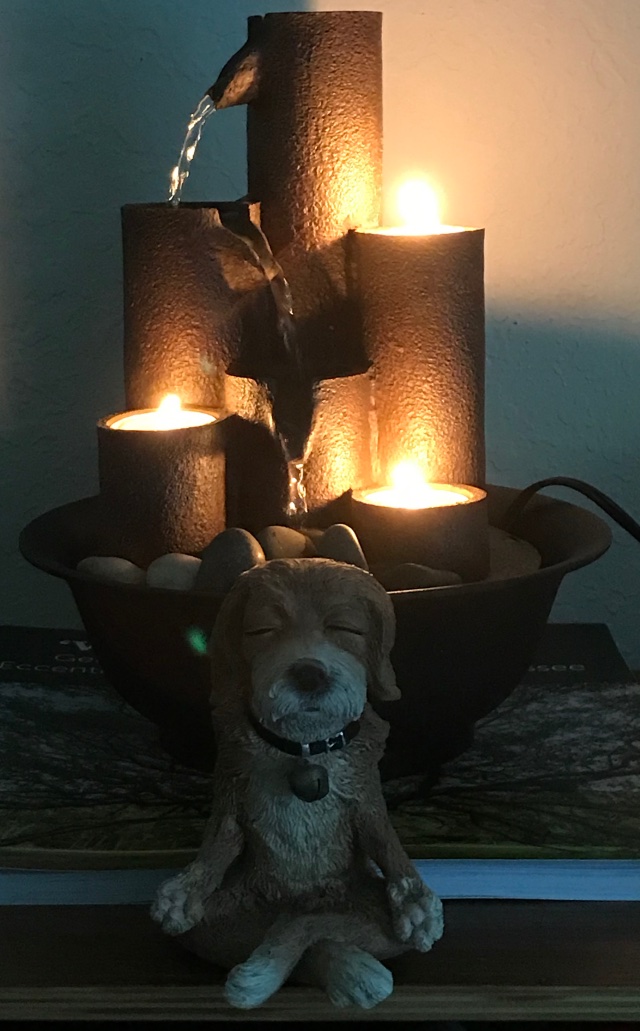
For everyday living, there’s a brown leather love seat and two black mesh filing cabinets that sit below each end of an oak door painted black years ago. Atop are the books, the fountain, yoga cats, pinecones, and meditating dog. I chose carefully and thoughtfully, keeping my eye on the prize, life on the other side of the move.

I had no choice but to leave my 690 ft.² apartment. My rent was raised twice in six months; the COLAs from both of my pensions no longer come close to covering the rent of “affordable” housing. So now I am in HUD housing in a market rate efficiency apartment of 222 ft.² It’s like tiny house living in a room with a view.

I had three weeks to move, which seemed like more than enough time to sort through belongings, box up what was left, and at night, watch home design shows on Amazon Prime. My challenge was a 12 ½’ x 17 ½’ room with galley-like kitchen and pantry (eight square feet total) to fill with furniture and 23 book-size boxes.

The hourly rate for professional movers is not insignificant. Even with boxes packed, the cost was staggering but within a forest darkly the only way is through and sometimes that means delays and detours.

The movers arrived late and then took their time, which was concerning not only to me but to the occupancy specialist at my new apartment building who values promptness and a singular way of doing things, such as signing papers upon move in (not a moment earlier or later). It’s her system of 20 years and I am not that fool to question it.

While I was signing, the movers were wandering, first to the wrong apartment building and when they found their way to my 12-story building, they entered the underground entrance improperly. Underground discussions ensued as captured on CCTV. It was the kind of day when it seemed certain the elevators would go down and so they did.

Time turns only on its dime.

Ultimately, I had less than 10 minutes to look at my actual apartment before the Tempurpedic adjustable bed, furniture, and boxes turned what I had known only as a floor plan into reality.

My nights of design time were well spent as only the vanity/desk and chest of drawers exchanged places (yes, those same best of friends were again on the scene), after I was notified of a building-wide apartment inspection in three days. A neighbor’s son and daughter-in-law were kind enough to hang my wall art.

Yet, my move was not yet complete.

For reasons I no longer understand (if I ever did), I decided to combine moving to a new apartment with donating my car to PBS. So much seems possible in the beginning of any life-changing event but then reality smiles and says, “Hold my beer.”

To be sure, there was far too much back and forth of I’ll donate the car/I won’t donate the car. Oh, I have yet another someone to buy it and yet another someone who cannot drive a stick shift. I had been done with driving for some time but to be done with car ownership is to be caught in a game of bumper cars with PBS, its vehicle vendor, and the state of Florida yet no thing lasts forever, even in the Sunshine State.

There are lots of conversations with truck drivers before the actual pick up of the vehicle as dates change, messages are mixed or parking spots are taken. Regardless, the truck drivers travel back and forth from Alabama with car trailers full or not for there’s always another run.

Here in historic, midtown Tallahassee, parking spaces and street sizes are from another century; the cement street curbs are steep, vintage 1950s, met by sloping, narrow boulevards of St. Augustine grass. A semi with a car trailer stops traffic in every direction so efficacy is appreciated.

When the day finally arrived for my car to be hauled away, I was instructed to put the title in the glove box and the key where the truck driver and I had agreed.

I don’t do well with sloping boulevards so I stood at the curb and locked my Traveler (walker) in place on the boulevard, away from me, so I could use the side and front of my white Toyota Psion XB for balance—there was enough room for a feather between my car and the car in front of it—as I lifted the weaker of my legs from the street over the curb and onto the boulevard, stabilizing myself with my stronger leg still left at the curb.

I did not feel the fire ants immediately, a testimony to my focus on getting the rest of me onto the boulevard so I could unlock the passenger door, put the car title in the glove box—THEN I felt the fire ants, tossed the key somewhere inside the car and slammed the door.

Nothing mattered anymore. Nothing. I was done except for brushing off the fire ants, which is no mean feat as they go wherever they want, especially between your toes, but this was my moment, too, and I made the best of it as the ants  scrambled but not without leaving me stinging and later scarred yet all of us to home eventually.

It was weeks and days after my move began that I finally cleared the forest. In the subsequent months, a new chapter writes itself from my room with a view but sometimes I nod to the world as I once knew it.

When Zero Was Not a Number

In the woods outside my window, it seems like nothing will stop this growing of green and the flurry of flashy red cardinals as they prepare their nests with their olive brown mates, who blend beautifully with the firebush, sparkleberry, and mesh of the passionflower vine. 

In spring, every day is endless.

I am not immune to all this wonder of squirrels munching on the tender leaves of a wax myrtle, a treat seemingly worth the trek from the hole in the leaning Live Oak across the longleaf pine and down the passionflower vine.

Frankly, it makes the human world pale in comparison but then, nature usually does. 

Here at the Apartments in the Woods, we have replaced watching the murderer among us with having to deal with mandatory online rent payment. Checks are no longer accepted. Not amazingly, emotions run high as if life itself, again, was threatened. 

Quite the welcome for a new manager who had been assured the online payment system for our 55+ community of 144 apartments was in effect, one of many untruths she will discover for truth is not always what it appears.

I don’t know the percentage of people who pay rent online but I imagine the majority of residents use the convenience, which was not true just a few years ago when the majority cohort was more like 75+ but no one lives forever. Nonetheless, their numbers are still sizable, including my 93-year-old neighbor, Sybil, who somehow still maintains her flip phone, despite threats from everywhere and everyone that it can’t be done. 

Although we have been neighbors (sharing a common wall) for 11 years, and true friends for the last five, I often forget Sybil is Sicilian and have to be reminded, which she does with pride. Round faced with a slight rosacea on her high cheekbones, Sybil is a clear-eyed beauty with flowing white hair, agile yet fragile as her petite body begins to fail her. 

Sybil is prone to one point of view on any subject (until she’s done with it), no matter the cost. She traces this to the island existence of her Sicilian ancestors who were faced with one invasion after another. Hers is a kind of reticence, which some have called stoicism, and with this visage, she faces all weathers.
Something like 30 or 40 years ago, Sybil decided the Internet was a passing phase and only last month did she admit that had “probably been a mistake.” 

To their credit, Sybil’s family is proceeding at her pace, in their completion of the online payment process, relying on the information Sybil provides, such as the documentation sent out by Apartments in the Woods Enterprises (AWE) for the online payment portal. 

AWE is to be commended for a streamlined and simple process. Residents who had never made any kind of online payment completed the process in about a quarter of an hour. It feels rather worldy, this being on the web, writing electronic checks for rent. 

Sybil is not so sure, although some days she sees its truth, yet when it comes time for her son, Paul, to complete the process, Sybil lies awake at night worrying about hackers, for she is well read and has an amazingly accurate understanding of the World Wide Web for someone who has only looked upon but never browsed or received an email. 

“It seems that there is still a problem with the rent,” Sybil tells me. “Paul is exhausted by all this.”

“There is no problem with the system, Sybil.” The words are out of my mouth before I can stop myself, clipped and cold. I’m tired of the conversation before it begins yet again, but I do better with “what’s the problem Paul is having.” 

“There is no place to put the routing or account number,” Sybil pronounces this as fact. “I don’t want Apartments in the Woods to have access to my checking account.” 

We have been having this conversation two or three times a day for the last two weeks, and I know where it’s going, but I also know Sybil vets her ideas with me before she shares them with her family, for reasons understood only by Sybil, but there is a lot of fear, too, always a tough subject, which is to say that I, too, sometimes get the wrong end of the stick. 

“Sybil,” I say, wincing at my tone of voice, not quite terse but close. “If Paul enters your routing and account numbers into the AWE system—

“The WHAT?” Sybil begins to talk over me, thankful for the tangent. “I don’t even know—

“Sybil, stop. Just. Stop. Talking. Over. Me.” And finally, she does. “When you write a check for your rent, isn’t the routing number and the account number on the check? Yes or no.” 

“Yes.” 

“So, Paul is going to enter that same information into the online system. It’s an electronic check rather than a paper one. That’s it. Nothing more.” 

“Okay. I’m fine with that. But we’re going to use a credit card.” 

“You do you, Sybil, but know there will be at least a 3% charge for using your card. That’s about $30.” 

“Paul says five or 10 dollars,” Sybil fires back.

“He’s wrong, just wrong.” 

We are both so over this conversation, but we both know it’s not yet resolved. Sybil is upset at herself, not for the first time, for refusing to have any kind of online presence over all those years. So many missed moments, those, but I’ve made that kind of mistake, too. It hurts.

At 93, both Sybil and her family are doing everything they can to maintain her independence. Increasingly, that means more to do for them and less for her. They love her deeply and do not mind, and Sybil is grateful, but with each task, there is one more thing out of her control. It’s such an uneasy balance for all of them.

Somewhat similarly, my body is far older than my almost 69 years, and I am ever adapting to maintain my independence. So, Sybil and I are each at an age where decisions close a door and not always does another window open.  

My heart is a bit sad that my tone of voice has been firm with Sybil—well, terse at times, if I am honest—Sybil, too, is a bit sad that she can’t write a check to pay her rent as she has always done for the last 17 years. For her generation, loyalty and consistency were just about everything in life. I get it.

As usual, I turn to Pema Chödrön to see if I can find something in her words for my frustration. I don’t want to repress it or reject it. I want to go to its core to see what I can learn from it and maybe help Sybil look at hers. In other times, Sybil has done it for me, in her own way, which is not mine.

Turns out Pema has a friend who talks about this very thing.

“As a way of working with our aggressive tendencies, Dzigar Kongtrül teaches the nonviolent practice of simmering. He says that rather than ‘boil in our aggression like a piece of meat cooking in a soup we simmer in it.’” 
Pema Chödrön

Not exactly the imagery I was seeking but I get the metaphor.

“We allow ourselves to wait, to sit patiently with the urge to act or speak in our usual ways and feel the full force of that urge without turning away or giving in.” 
Pema Chödrön

I am aware of the energy in “edginess,” or what Pema Chödrön refers to as “groundlessness,” and I find it attractive, that unknown. How to manage when I don’t have my feet on the ground, when what I know is not of worth to someone else or is not what they can yet receive, and I must be patient and listen in acceptance. 

“Neither repressing nor rejecting, we stay in the middle, between the two extremes, in the middle between yes and no, right and wrong, true and false.”  
Pema Chödrön

Most of my life I was a “fixer,” offering the obvious solution only to have it rejected because the choice was not mine to make. Not everyone comes to change the same way or at the same pace. Patience in every moment—to sit and simmer—although easier with age, it is no guarantee.

There is only one solution for Sybil no matter how many times we talk through what must happen. What is not an issue for me is a game changer for her but we offer what we have to one another, although it doesn’t feel like it’s what we need. I don’t hear anything about online rent payment until the fifth of the month, the last day before rent is late.

“I was going to have to pay almost $28 if I used my credit card!” Sybil has never been a stranger to umbrage. 

“So, Paul found where to enter the routing and account numbers?” I just have to know, which feels a bit unfair but somehow, it feels important. “He received a receipt by email, correct?”

“Well, if you can call it a receipt. It says, ‘Dear Sybil’ and then gives only my apartment number without which building. There are at least four different apartments with the same last three numbers.”

We talk about unique transaction numbers for a while, which is what is important for a transaction to take place between the two systems.

“But that’s just it. It hasn’t cleared my bank. There is no transaction.”

“Sybil, we just went through the receipt, line by line. You have a transaction number. The receipt says it was sent. That specific transaction was sent.”

“The bank has not received it. I’m going to be late on my rent.” 

“You are not going to be late on your rent because you have a receipt saying you paid it on the 29th.”

“But there is no transaction is what the bank is saying,” Sybil says, with a calm that is surprising.

That is a problem but there also seems to be a solution or maybe she’s been winding me up. I can’t say I might not do the same.

“Paul is working with the AWE manager.” Sybil pauses, pleased with her use of the acronym, and I find myself smiling. She goes on, “The account number was wrong.” 

“Did Paul enter it incorrectly?” 

“No!” Sybil snaps. Her son does not make mistakes. “I didn’t give him the zero.” 

“The what??!!” And for a moment I am as lost, if not moreso, than Sybil was when all this started.

“The zero in front of my account number on my check. I never use it. When I was in school, we were always told that zero isn’t a number. It’s nothing.”

“Let me put it this way, Sybil. Data is made up of nothing but ones and zeros.” I pause before adding, “that’s just probably adding to the confusion.”

“No, it’s not! I understand that. I’m saying that when I was in school zero wasn’t a number.”

“Zero is a number and it has value, Sybil. It may look empty but it’s anything but nothing.” We wait for a moment before I ask, “Didn’t you give Paul a voided check so he could enter the numbers?”

“Yes, but he said he didn’t need it because I read the numbers to him.”

“So, Paul had a check but he entered the numbers you read to him.

“Correct.”

“But he has now entered the correct account number into the system????” 

“I don’t know.”

This time I don’t go there. I look at the woods outside my window and tell Sybil I watched a goldfinch singing this very morning, sitting atop a still bare branch of the fire bush, yet another add to my birding life list. 

And Sybil who has taught me so much about the flora and fauna that is the woods outside my window begins to tell me yet another story about spring in some year before the Internet, when you could believe zero was not a number and not be bothered at all.

*Pema Chodron excerpts from Living Beautifully with Uncertainty and Change, page 49.

A Murderer Among Us

A murderer lives in my apartment complex and has for the last eight years.

Marie stomped her 82-year-old mother to death, after throwing her down the stairs. Marie then encircled her mother’s body with all the things they had fought about: the gas money purse, the television set, various foods, mentholated rub. It would take some days to find both mother and daughter.

No one in our apartment complex knew about Marie’s past until recently, when she fell in love, so much so she told her beloved what happened just over 15 years ago. Predictably, he dumped Marie and then told everyone else in the complex that they could find Marie’s story online. He and a new girlfriend moved away.

The story of Marie falling in love with a man who leaves her for another is a repeat scenario, although this time there was no child that had to be given up for adoption, but falling in love seems to be the catalyst for Marie to stop taking her bipolar medication and to begin grasping at whatever story will give her oxygen: she was raped, she wasn’t raped; she’s a danger to others, she’s not a danger to others; she loves everyone, she doesn’t love anyone.

“I’m not a danger to myself or others but I guess I am” is what Marie told the judge at the sentencing hearing for her mother’s murder. Marie is and is not a danger, often simultaneously, a reality whose boundaries only she can perceive. The rest of us draw different lines in the sand that she crosses almost daily.

We call the police, record and video her outbursts and send them to the apartment complex managers but mostly, we wait until she injures herself or somebody else as she systematically destroys her own apartment.

Every day is pretty much the same with Marie. Sometimes the police come, sometimes not, and other times it’s the sheriff, whoever draws the short straw is what it feels like. “I’ll f**cking kill her (or you)” is a favorite rant as Marie asks for money or to borrow a phone that she will never return.

She is being evicted and sometimes she knows this but mostly she just tells us “this is “MY f*cking neighborhood.” We really are all she has but we don’t want her, and she doesn’t want us, either, yet we all need a place to live.

Because she’s leaving, Marie gifts her neighbors with used deodorant, perfume or dead batteries, delicately placed on the tiny shelves beneath the message blackboards outside resident apartment doors. It’s not that she’s not crying for help or that we don’t hear her. A torn window screen hangs from one of the window panels of her second story apartment, like a flag that just can’t catch a breeze.

About every four or five days, she is taken to a mental health facility where she is held for 72 hours and then released. Her own father and his wife, now in their late 80s, are so scared of her they sold their house and moved into an assisted living facility. They don’t want to be beaten to death during a psychotic outburst, and they no longer know how to help her.

With me, Marie keeps her distance. She waves whenever I drive into or out of the parking lot. I suspect she knows that eight years ago I figured out her story, when I was thinking about putting together a writers group. Marie was rather excited about it and told me her psychiatrist was, too. There are many solid reasons I never started that writing group, but it would be a lie to say that Marie was not the major one.

Eight years ago the story of Marie was more prominent on Google with pictures of the family home and sidebar stories about her activist mother. It was a tragedy, the headline read, and it still is but this time—so far—no one has died. We have two weeks until Marie leaves us for nowhere and anywhere. In either direction lies homelessness.

We do the best we can with who we are in any given moment, which doesn’t mean we choose right or wrong, even when either is evident. Life is not that clear cut, and there are always consequences. Choices are not words alone but actions, too; together, the best and worst in us.

UPDATE 4/13/21: Marie was evicted effective April 2 but not before there was a small fire in her apartment, perhaps accidentally started, perhaps not. Nonetheless, that was the last access Marie had to her apartment. In the waning hours of April 1, she sat outside her apartment, leaning against the door of what had been home for eight years. I don’t know how long she stayed, only that she is gone to the streets, maybe jail, possibly the mental health center but she can’t come home anymore.

A Country of Compassion, If We Can Keep It

In what now feels like a year that never was, I drafted a new year’s blog post. But then it wasn’t a new year anymore but more of 2020, albeit a bridge too far. Soon, 2021 overshadowed almost every year of this republic’s history with the attempted overthrow of the government, deliberately deadly and publicly provoked by a president of the United States.

We knew Trump did not lose well but we gave him sense enough not to incite an insurrection. No one had taking hostage/killing members of Congress on their bingo card, all to overturn an election that had been won fairly and soundly, one of the most secure we have had in the U.S.

Shakespeare warned us of such a man: “O, it is excellent to have a giant strength, but it is tyrannous to use it like a giant.” But Trump was less a giant and more an orange balloon inflated with lies, flying the skies of the world of alternative facts, where, it turns out, Trump did not have leaving the presidency on his bingo card.

Sequim Bay, Olympic Peninsula (Paulie Jenkins)

Leaving was almost more than he could do that final Wednesday morning. More than once he looked back before boarding Air Force One for the last time, hoping that something, anything, would change but it didn’t. He had lost the presidency. In those last moments reality dawned, and the magnitude of his loss was laid bare. Within 24 hours, The Proud Boys and QAnon denounced him as “flaccid and weak.” Turns out he was not a messianic warrior but just an American citizen who was once a president.

And in this moment, I found an ounce of compassion for him, as he surveyed the waste land of his brand, all of it all his doing. Not one of his last words moved me for they were the same old lies. It was the pain on his face, the realization that he was losing the power of the presidency and the standing in the world it gave him—all that comes with being president—so much of which he never bothered to learn. Maybe that’s why he sounded somewhat presidential; he finally felt the depth of what he was losing. Even thugs have moments of revelation.

On Martin Luther King Day I found these words from a very young Thich Nhat Hanh, re-printed in an article from Parallax Press: “this country is able to produce King but cannot preserve King. You have him, and yet you do not have him.” We are a country that has produced Martin Luther King and Donald John Trump, a divide we have lived for centuries.

We are a cacophony of ideas and beliefs, opposing chasms whose common ground lies buried with truth, deep within a myriad of caverns. We fly hashtags as if they were our flag, hoping the romantic will take root and with the dawn, we will see in each other what we daily deny. These are not easy bridges we must now build. We do not lack the wherewithal but can we keep our compassion?

Living without just a drop of empathy for Trump left me empty, fertile ground for the bitter roots of snark and cynicism—my time in his wasteland—that I left with him on inauguration morning. It is ours to write “…the story that tells ages yet to come that we answered the call of history. We met the moment. That democracy and hope, truth, and justice, did not die on our watch but thrived” (President Joe Biden).

It’s hard to bring the better self to the surface every day but just an ounce of compassion will keep us afloat.