The Quiet Teachers

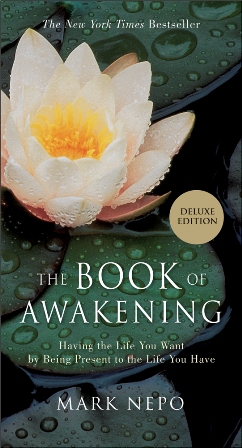
As I have mentioned more than once, I’m spending this year with Mark Nepo’s Book of Awakening, meaning that I begin my daily meditation by reading one of his 365 observations. More often than not, a series of readings—one day after another—will seem an awakening designed only for me. This past week, Nepo introduced me to the quiet teachers.

The quiet teachers are often ignored but are everywhere and are as solid as the ground upon which we walk. We know these quiet teachers by their “lessons [that] dissolve as accidents or coincidence…offering us direction that can only be heard in the roots of how we feel and think” (Nepo).

For me, the lessons have been clear but somewhat noisy for I am in the process of completely restructuring a novel I wrote seventeen years ago. What that means is the destruction of a weakly structured novel in order to salvage a stubborn story that has waited a long time to be told. It has required me to immerse myself into an old world, awakening characters long silent and provoking images fraught with memories. There has been much shattering of ideals but the shards of those ideals proved to be quiet teachers, the first of others that I met this week.

Nepo also introduced me to an observation from Megan Scribner: “‘I’m only lost if I’m going someplace in particular.'” I could not have described my own first attempt at writing a novel more succinctly. For over 80,000 words and seventeen years, I stayed with a story I no longer believed rather than facing the story that was trying to emerge. Once I began stripping away the façade, I heard the heart of the story and found myself at journey’s beginning: “Practice letting go of your plan and discover the path of interest that waits beneath your plan” (Nepo).
Not being attached to outcome or plan reveals the story waiting to be written. It is only when I have the courage to face failure do I heed the lessons of the quiet teachers. Accident and coincidence dissolve into the direction of the story. I am struck by the synchronicity of my own life’s direction with that of my writing life. Not for the last time, I am in awe at the oneness that is all.

“‘Be serene in the oneness of things and erroneous views will disappear by themselves'” (Seng-Ts’an) became clearer and clearer to me as I separated the heart of the story from the remnants of what was once a novel. All of the tearing apart and leaving of words is less difficult than I imagine. There are thorny moments but eventually, they give way to the relief of no longer having to hold up the façade of novel.

While the shininess of a new structure of a novel is a gift, the fear of idolizing structure at the cost of story, wherever it may wend, is a battle that will wage until structure and story support one another as a whole. I am confident in the lessons of the quiet teachers but mostly, I am vigilant for like life, writing is fraught with accident and coincidence as is the beating of my heart.

“As you enter your day, try not to reach for life. Try not to leave or arrive. Try to let life into you” (Nepo).
Gifts at 60

On this first day of my being 60, I am not writing the blog post I had planned; living in the moment is like that or so I am learning. Certainly, I thought about this particular post much more than I usually do—I kept considering it my first blog post of my next decade–but by mid-week, that ego balloon went airless.

The last week of my fifth decade proved to be a week of surprises, mostly in the form of sugar, but not entirely in the obvious way. For the most part, my system no longer tolerates sugar in any form other than what it produces itself. Generally, this is not a statement I have to consider but in my last post, I mentioned that I had an appointment with a practitioner of Eastern medicine. Not so surprisingly, she and I had different interpretations regarding Eastern medicine–and sugar–but rather surprisingly, I agreed to try two different remedies at least one time, which proved to be more than enough.

Buoyed by the possibilities presented by the practitioner, I decided to have one (1) glass of red wine, my first in three years.  Although my glass of wine and my dose of “remedies” were days apart, literally, my week collapsed before Wednesday noon. I am more recovered than not and leaning toward awareness.

KM Huber Image

I suspect I was caught up in birthday bliss for it has been a week of gifts beyond remembering the lesson of sugar.  Once again, I discovered that I really can, and should, trust my instincts and not my ego. It was not my instincts that chose the remedies or the wine but my ego filled with the idea of birthday, a balloon born to burst. I am reminded of Georgia O’Keeffe–“To see takes time”–a sentence for the rest of my life, yet another gift.

KM Huber Image

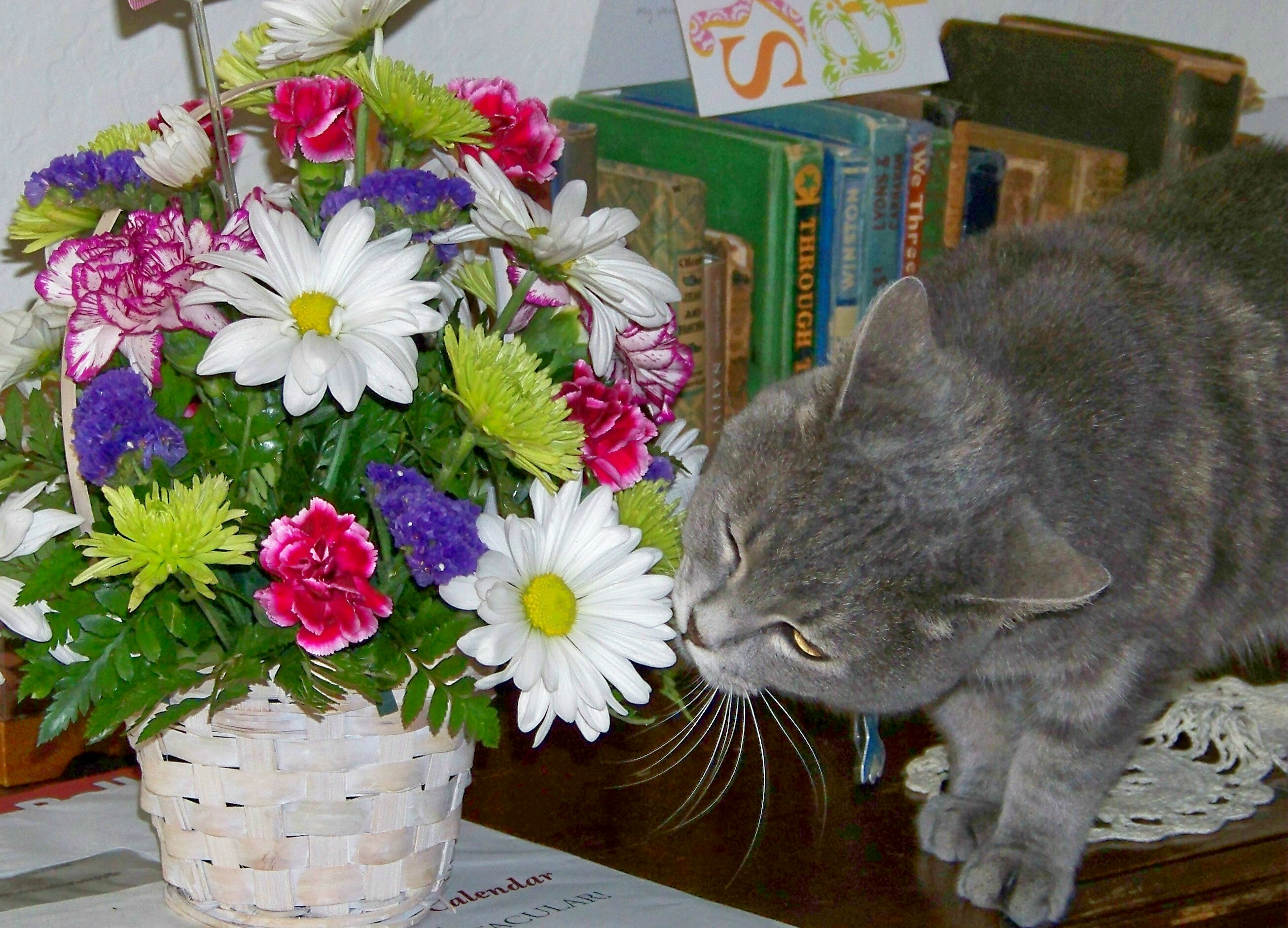
I was pleasantly surprised by lovely flowers from  Dr. Mac and all of the sanctuary “critters” at  secondchancefarms.org. As you can see, EmmaRose wasted no time in her inspection, and yes, all are “kitty safe” petals.

Cooper and I began our morning on the Gulf of Mexico, near this palm tree at St. Mark’s Wildlife Refuge but here is where we will both end our day.

Almost always, Cooper takes command of the remote. Like me, he is a bit ambivalent about television but he has a preference for the remote.

Thank you, Dear Reader, for stopping by to read my posts and to chat, from time to time. It is such a gift you give, and I am most grateful, always.

“Once during the day, think of who you are as living energy and not as a goal to be achieved or obstacle to be overcome. Feel yourself without inventory” (Mark Nepo, The Book of Awakening).

Final Days of 59

“… Transformation always involves the falling away of things we have relied on, and we are left with the feeling that the world as we know it is coming to an end, because it is” (Mark Nepo, The Book of Awakening).

This past February, I wrote a post about some unexpected milestones at age 59 ½. At the time, I was struck by the synchronicity. Still am. As this is my final week at age 59, I decided to revisit those milestones before I step into my sixth decade, one that promises even more transformation.

KM Huber Image

I have continued to lose weight beyond the 59 ½ pounds of February; I am down 69 pounds with another fifteen-twenty to lose but no more than that. My eating habits have not changed in the past six months but my taste buds have adjusted to other options, and I enjoy eating again. I found millet-buckwheat bread made with chicory root and without refined starch, absolutely critical for me.  Almond butter sandwiches are now a staple. While my future remains gluten, yeast, sugar, dairy and soy free, my grocery list items are crisp and fresh.

In my last week as a fifty-nine-year-old, I am in better health than I was at 58, sans an arsenal of allopathic medicine. I remain convinced that Eastern medicine– Ayurveda and Chinese–has a better understanding of autoimmune disease. Ted J. Kaptchuk’s The Web That Has No Weaver is an excellent overview of traditional Chinese medicine, and I am searching for a similar Ayurveda text. Until I find it, I am enjoying Deepak Chopra’s Perfect Health, an informative volume regarding Ayurveda traditions.  This Tuesday, I have my first meeting with a practitioner of Eastern medicine.

KM Huber Image

But in these final days of my 59th year, it is my writing that is undergoing the greatest transformation. My numbers alone are major personal milestones.  I no longer publish blog posts twice a week as I did in February but on June 2, I began writing the initial draft of a nonfiction manuscript. Currently, I am producing over 9200 words per week on this manuscript alone. At my 59 ½ milestone, my word count was 9800 words for the entire month of February.

While I do not write for a specific word or page count, numbers gauge a manuscript’s size so I knew the end of the nonfiction manuscript was close: currently, it is 330 pages or just over 91,000 words. But even before I tallied the numbers, synchronicity had come to call; what Deepak Chopra calls “a quantum leap of creativity…a relinquishing of the known for the unknown.” And like milestones, coincidence comes wrapped in the ordinary.

In February, I included my participation in ROW 80 as part of my regular blog posts.  Frequently, I discussed the initial draft of a novel that I wrote seventeen years ago; in some blog posts I’d opt for rewriting the novel and in other posts I’d refer to the novel as a life once lived. Rather than letting go, I was very like the speaker in Linda Pastan’s poem, “Ethics,” unable to decide whether to save the old woman or the painting.

So, I signed up for an online workshop, Conflict and Idea with Bob Mayer, and learned about “kernel idea.” I have not been the same since so I consider it my toehold in the unknown, a piece of a milestone.

Bob says that the kernel idea is what initially inspires the writing of a novel–it is the Alpha and Omega of a book–it starts and completes the creative process but here is the key point: the story that you write may and probably does change but the kernel idea of a book does not, ever.

KM Huber Image

During the course of the workshop, I came to understand that the “kernel idea” for my novel was not the story I had written. The kernel idea had not changed but the story I wrote moved away from the idea within the first 100 pages. Finally, I realized what I was hanging onto for seventeen years—my kernel idea and 100 pages—yet, it took me a while to understand just what that might mean but when I did, it felt like a “quantum leap of creativity.” Still does.

Thus, as I started writing a new nonfiction book—my current manuscript–I discovered the way to tell the story of my original kernel idea. Maybe the years sorted themselves, maybe I was letting go of what no longer serves but with transformation there is also revelation. In letting  go of a seventeen-year-old-story that no longer served, I discovered the kernel idea for a new nonfiction book.

“When faced with great change—in self, in relationship, in our sense of calling–we somehow must take in all that has enclosed, nurtured and incubated us so when the new life is upon us, the old is within us” (Nepo).

Life at Sixty

I had been dreading the evening when I would no longer have May Sarton’s The Education of Harriet Hatfield to read. Yet, as is often true with the really fine writers, Sarton pushed me along, knowing it was time for another book, another story.

I want to tell you about Harriet Hatfield.

The novel opens at the death of Harriet’s partner. It is the late 1980s in an exclusive, upper-class neighborhood in Boston—Chestnut Hill–where Harriet and her partner had lived for thirty years. It is not a novel in which a great deal happens but, of course, a great deal does happen to a sixty-year-old lesbian who has an opportunity to begin life completely anew. With the money she inherits from her partner’s estate, Harriet moves from Chestnut Hill to a working-class neighborhood where she opens a feminist bookstore that also serves as  her residence.

Harriet soon learns that hatred and prejudice run roughshod over any sense of security she may have once had. The anonymous but ominous threats Harriet receives do not weaken her resolve but strengthen her determination to stay in a neighborhood that does not want a “lady” lesbian or her feminist–and therefore must be pornographic–bookstore, Hatfield House.

Harriet Hatfield’s feminism is a belief in equality for all in all things–jobs, housing, existence–and is a constant source of tension throughout the novel. Hatfield House, with its overstuffed chairs and afternoon teas, is “‘the equivalent these days of men’s clubs…places where women can talk to each other, find sustenance, and come to some idea of who they really are.'” Yet, Hatfield House is much more. It is, perhaps, a “bridge” to and for all in Harriet’s neighborhood–including hate and prejudice–but as Harriet says of metaphor, “‘if you run it into the ground… it suddenly doesn’t quite work.'”

I was introduced to The Education of Harriet Hatfield on Cynthia Newberry Martin’s blog . While I am familiar with most of Sarton’s work, I was not aware of this novel but I was aware of a bit of a coincidence, being a sixty-year-old lesbian myself. Like Harriet, I, too, believe that at sixty I have been given a rare opportunity to live a life I have never lived. Unlike Harriet, I am anything but financially secure–her complete opposite financially–but I am rich in ways that continue to surprise me every day, which is so very like Harriet. One of the greatest perks of growing old is finally appreciating all that one is and how little, how very little is necessary to live a life fulfilled.

“‘I have just three things to teach: simplicity, patience, compassion.
These are your greatest treasures.
Patient with both friends and enemies, you accord with the way things are.'”
–Lao-Tzu (Translation provided in The Book of Awakening, Mark Nepo)

Above all, Harriet Hatfield has patience. She does not believe that all of her neighbors will accept her or her bookstore even eventually–she knows she will not outlive prejudice–the temporary truce in the neighborhood is indirectly provided by her dog, Patapouf: “‘there is a residue of compassion… that suddenly comes into view where an animal is concerned, as though the only pure thing left in this corrupt, hate filled world is the love of animals.'” The neighborhood belief that animals are beyond prejudice provides a brief respite as well as some consideration for what another human being may or may not be, even a lesbian.

This is a novel in which not a lot happens and in which everything happens. It is not a novel about understanding one side or the other much less taking sides. It is a novel about living one’s life fully and completely every day–whatever is presented–even if it is a new life at sixty.

“…Given enough time, most of our enemies cease to be enemies, because waiting allows us to see ourselves in them. Patience devastates us with the truth that, in essence, when we fear another, we fear ourselves; when we distrust another, we distrust ourselves; when we kill another, we kill ourselves”
(The Book of Awakening).

(All quotations from May Sarton’s The Education of Harriet Hatfield are from the 1989 Norton edition.)

Spending My Days

Consider the essence of magic as the enchantment of the unknown, a paradox that in the words of the Tao is the “named and the nameless.” Magic appears throughout this blog so similarly to its appearance in my life or to borrow from Annie Dillard:  “How we spend our days is, of course, how we spend our lives.”

What if we spend our days creating and re-creating our lives as works of art rather than scheduling our lives by the hour, defining ourselves by the number of tasks we accomplish. Only late in my life did I come to this magic, this nuance of routine. Now, I spend my days in the experience of each moment where every minute is a way of life and not a moment on a timepiece or a task on a list.

I am not without day-to-day demands—mine is chronic illness—nor am I without the gifts that life’s demands provide, and chronic illness has its gifts, too. Of course, it took me more than thirty years to notice there were any gifts from any demands. We just don’t look for these gifts. We focus our attention only on the demands, maybe even calling attention to ourselves. Mark Nepo says “the threshold to all that’s extraordinary in life is when we devote ourselves to giving attention, not getting it. [That’s when] things come alive for us…[we] find our place in the beauty of things by the attention we can give.”

Perhaps the best measure of giving attention is how we live the routine of our days. Of late, I’ve been experimenting with routine in the larger context of creating a resilient life, which is, among other attributes, a work of art according to Dr. Symeon Rodger in The Five Pillars of Life. The process is a simple one. I record the moments of my day as they occur and not as a schedule of what must occur. There are requirements for each day—some specific tasks must be done–but there is not a plan. Within a week, I discovered a natural flow to how I spend my days as I watched them unfold, regardless of the interruptions and the unexpected. Most important, I discovered resilience and flow reside in the creative unknown.

Here is how that translates in my everyday life. The day-to-day unpredictability of my dis-ease as well as Cooper’s does not change nor does it require any more attention than juggling finances, doing the laundry, grocery shopping, writing—all requirements of my days. In focusing on each moment, I not only accomplish what is required but I complete tasks and chores that have been waiting for months. Furthermore, there is energy in everything I do as I immerse myself into each task and only that task. There is no multi-tasking for each moment belongs to itself completely. Not one day is like another nor is any day exhausting. I schedule nothing and record everything.

Melissa Bowersock Image
WANA Commons

I am quick “to soar with the oversoul”—Louisa May Alcott’s phrase regarding her father and the transcendentalists—and like Thoreau, I have built my “castles in the air” but few times in my life have I put “foundations beneath them” that did not crumble. Yet, in living a routine as a work of art and embracing the enchantment of the everyday, I have a foundation for my current castle in the recording of how I spend my days.

The role of voice recognition software  in my routine is nothing short of finding a new energy source.  Once I began using Dragon NaturallySpeaking, I realized how much physical energy I was expending in typing, a necessity for a writer but  one I had overlooked. Ironically, I had spent considerable time, money, and thought in creating a comfortable work space. I work from an adjustable bed that supports my entire body, and my laptop rests on a spacious tray designed for use with adjustable beds. I believed I had a comfortable way to continue writing, and it was just a matter of settling into a writing schedule but those were days devoid of enchantment and full of design.

There never was a consistent writing schedule, and increasingly, neuropathy limited the length of time that I could use a  keyboard. Finally, I took a three-week hiatus from blogging and from scheduling my days. I knew I would no longer write as I had–I didn’t know whether I would write–yet, I knew I would continue to create and re-create, and that was enough as I explored the moments of my days. Then, I discovered Dragon NaturallySpeaking, and in the initial moments of using the software, I knew life was about to change even more, and so it has. Within two days, there was also a marked decrease in my physical discomfort.

Dave R Farmer Image
WANA Commons

For me, dictating my thoughts is quite different from typing thoughts on a screen using keys on a keyboard. Dictating is sending thoughts through speech; typing is the tactile sensation of selecting keys to produce words. The awareness involved  in each process is completely different, and I am allowed another perspective on creating. I find the combination quite freeing. I focus on the writing before I bring it to the screen through my voice. Then, with my fingers on the keyboard, I edit and shape the words on the screen, creating and re-creating yet another perspective on the story of how I spend my days.

Witness to Life

In this past week, a stunningly beautiful baby emerged from her mother’s womb; forty-eight hours earlier, a canine named Sam finally found the light that had eluded him all his life. One woman was the guide for both journeys.  I am reminded of the seventh verse of the Tao:

”Heaven is eternal–the earth endures. Why do heaven and earth last forever?  They do not live for themselves only. This is the secret of their durability. 

“For this reason the Sage puts himself last and so ends up ahead. He stays a witness to life, so he endures. 

“Serve the needs of others, and all your own needs will be fulfilled. Through selfless action, fulfillment is attained.”*

Dave R Farmer Image
WANA Commons

The woman serving as the guide for the baby’s birth and the canine’s death reminds me of the Sage, for she has always kept herself last. So well she understands that a new life has yet to experience all that physical existence can offer while a life at its end stands on the brink of what is beyond experience.

“Often the thing feared, once crossed, turns out to be an unexpected bridge from which we can see who we were and who we are becoming” (The Book of Awakening by Mark Nepo). Certainly, this is the sentiment shared by Sam’s veterinarian caretaker and guide to the bridge. Here, in her words, is a bit about Sam’s life as well as his death:

“Sam was truly a one person dog, and he had the potential to be dangerously aggressive toward other animals and people who made him uncomfortable. His aggression was most likely fear based, probably the result of prior experiences before he came to us [an animal sanctuary].

“When Sam did act out aggressively, it was intense, unpredictable and he truly could become very dangerous very quickly. But Sam wasn’t always aggressive.  In fact, he was actually quite affectionate, loving and trusting toward me. He always greeted me with a tail wag and never once did he act out aggressively. He and I had a relationship based on trust and respect, which ultimately made the decision to let him pass over the Rainbow Bridge that much harder for me.

“In addition to his potential for aggression, Sam was extremely storm phobic. Despite numerous attempts to help him–anti-anxiety medications, pheromone collars, and changes in housing–when the summer storms came through each year, Sam became uncontrollable from fear and anxiety. Even I wasn’t able to comfort him when he was at the height of his anxiety attacks.

“As Sam aged, his anxieties and fears became increasingly worse. He became more unpredictable and outwardly aggressive toward people simply walking by his kennel. He started to become destructive, had a wide-eyed and scared look about him, was excessively vocal at times, and occasionally seemed desperate to escape from his kennel.

“Sam continued to be affectionate and friendly toward me but it became apparent that Sam’s overall quality of life was deteriorating. He wasn’t happy. His fears and anxieties were getting the best of him. Our decision was incredibly difficult as Sam did not have anything ‘physically’ wrong with him. His body was still healthy but his mind was not. We made the very difficult decision to let Sam’s fears and worries finally be put to rest.

“After a scrumptious breakfast and spending some extra time with him, I reassured this handsome boy that everything would be okay and that he wouldn’t have to be scared ever again. I hugged him close and reassured him the whole time. He was clearly scared but he trusted me enough to know I was helping. Sam fell asleep quickly and quietly in my lap, and he finally appeared at peace.

“I have no doubt he knew I was helping him but letting him go was very difficult, more difficult than if there had been a physical, visible medical concern. The fact that Sam trusted me enough to hold him while he fell asleep meant a lot but also made it very difficult, yet for Sam, it was the best and only choice to be made.

“Three years ago, we made a commitment to keep Sam safe, happy, healthy and to protect him from fear and stress. By helping him to cross over the Rainbow Bridge, we feel that we held up our end of that deal. Rest in peace handsome boy. We hope that your troubled mind is finally able to be at peace and that you are once again able to enjoy just being a happy-go-lucky, care-free dog. You don’t have to be scared anymore.”


JM Randolph Image
WANA Commons

Both the death of the dog and the birth of the child are indirect experiences for me yet I am profoundly moved by each for they have in common a woman whom I admire and respect. I know I am fortunate in being able to call her friend. She is young enough to be my granddaughter but her wisdom is of the ages.

Some would say hers is an old soul—once, I ascribed to the notion of rating souls but for me, rankings disappeared with duality—this young veterinarian is acutely aware of her world, inner and outer. I doubt that she reads books on awareness or oneness nor do I remember her ever using those words. She just lives, keenly and completely. Her equanimity in listening to other perspectives, other points of view is rather remarkable. Yet, she is not always appreciated, initially.

Of course, Sam knew better. He trusted his friend to help him cross the bridge into an existence void of all he had known. Two days later, his friend gave birth to a baby, sweeping away the sadness of Sam’s absence but not his existence for the leaving and the arriving are always one for the witness to life.

*Tao translation from Wayne Dyer’s Change Your Thoughts, Change Your Life

Back From Turtle Row

Turtle Row

Not surprisingly, my daily reading of Mark Nepo’s The Book of Awakening guides me back from Turtle Row. It has been a restful stay but it is not my place.

As wondrous as the world is on Turtle Row—my current name for respite–it cannot pass as living fully. For respite, necessary as it may be, allows me to remove myself from the physical space that is my place on this planet.

In short, I am not a turtle, tempting though it may be. It seems such a fine existence, and it is, for turtles.

For some years now, I have been on a solitary search for awareness but my physical presence has been more of an afterthought, if considered at all. I did not ignore my physical self—I have lost a considerable amount of weight eating whole, mostly fresh, foods—I have done extensive research on autoimmune disease and have had considerable success with supplements, lifestyle changes, and diet.

I built my body up but its presence lagged; my solid, physical foundation was but a shadow. As usual, Nepo explains it best, “…the ways of others will fill the space we live in if we don’t fill that space with our own authentic presence.”

On Land After Turtle Row

In short, I became a turtle and believed such an existence would suffice. As I said, the view from Turtle Row is wondrous, and because I am not a turtle, I understand that I “do need to be here the way a cliff accepts a wave.” Not that I have to shout my presence or tax my body but within and without I must be whole, my consciousness complete.

I return to posting on this blog after a three-week hiatus. It has been a remarkable three weeks in every way. First and foremost, a heartfelt thanks for all the thoughtful comments and good wishes that you left on my last post. Although I did not post a response to your comments, please know I read your words frequently.

In addition, most of you know I am involved in a sixteen month course of study involving the major authentic ancient traditions, primarily Eastern Orthodox Christianity, Buddhism, and Taoism. Through these traditions, the course considers what it is it within us–physically, spiritually, emotionally—that gives us a way to change our lives, to build ourselves up by eliminating symptoms.

In short, the course does not encourage turtle behavior.

In the weeks to come, some of my posts will discuss what I am discovering. Mostly, I am reminded of William Stafford’s “A Ritual To Read To Each Other” as posted at writersalmanac.publicradio.org. in 2001.

A Ritual To Read To Each Other

If you don’t know the kind of person I am
and I don’t know the kind of person you are
a pattern that others made may prevail in the world
and following the wrong god home we may miss our star.

For there is many a small betrayal in the mind,
a shrug that lets the fragile sequence break
sending with shouts the horrible errors of childhood
storming out to play through the broken dyke.

And as elephants parade holding each elephant’s tail,
but if one wanders the circus won’t find the park,
I call it cruel and maybe the root of all cruelty
to know what occurs but not recognize the fact.

And so I appeal to a voice, to something shadowy,
a remote important region in all who talk:
though we could fool each other, we should consider—
lest the parade of our mutual life get lost in the dark.

For it is important that awake people be awake,
or a breaking line may discourage them back to sleep;
the signals we give—yes or no, or maybe—
should be clear: the darkness around us is deep.
William Stafford* 

And so, dear reader, we continue.

*“A Ritual To Read To Each Other,” by William Stafford from Stories That Could Be True: New and Collected Poems (Harper & Row).

“Do you Believe in Magic?”

These days, I find myself wrapped round story, magic, being—in any and every order—an entangled trio so reminiscent of a quantum entanglement known as “spooky action at a distance.”

It seems entanglement is the heart of this blog.

Becca Pugilsi Image
WANA Commons

The story I pursue is layered in the oneness of the 10,000 things of “the Way” (the Tao) that connects the consciousness of all always and simultaneously. That is the story of the human plane, I believe.

It is a story I want to know.

I have enrolled in a sixteen month course that offers a synthesis of the ancient traditions of the last 25 centuries including Buddhism, Taoism, and Christianity in its “original state,” meaning not according to St. Augustine of Hippo, a prospect much more exciting than it may seem. I may write a post on that but we are not there yet.

Dave R Farmer Image
WANA Commons

Perhaps a more practical way to consider the course is this: the predominant Western belief of “you are your rational mind” is lacking in magic and story, at the very least, and at its very worst, it is unsustainable dogma.

That is how I see the course, and while it is early in my study, I am impressed with its evidence-based emphasis, specifically that hypothesis is not fact.

The irony of my beginning this study as my lupus moves into its own story is not lost on me; I suspect irony is frequent when one leads with the heart and not with the head. Yet, to live with an open heart and to discover what that truly means–for there is not agreement upon it or about it—is to dive deep into the head-heart connection.

Mark Nepo writes that “with your head beneath your heart, you must stop doing….Time and time again, the head must be brought beneath the heart or the ego swells” (The Book of Awakening).

Consider the entanglement of placing the head under the heart, thereby creating the “voice” of the gut. Nepo calls it, “a truth of being for a truth of being.” The resonance of the gut is like a messenger rushing through every system of our being proclaiming a resilient, “I get it!”

And resilience is rather magical but it is not magical thinking. To me, resilience lies in remembering the distinction between believing and knowing. While believing is akin to knowing, what we believe often lies in faith but not always in fact. For fact, experience provides us evidence of all we come to know.

“By opening fully to our own experience, we can feel and see the resilience of life around us” (Nepo).

Amber N West Image
WANA Commons

Being completely within the experience of our life–being fully present—we experience what every other life form knows: living fully means denying nothing. Being present in every moment is to experience all the moment offers, a pure opportunity to be.

Being is the magical story that the natural world celebrates completely and constantly every moment. It is a story that plays out moment by moment, a real page turner.

For those of you who want to follow my ROW80 progress, you may view it here.

Shedding

Change is on the horizon, as always, but at times, it seems palpable even audible. Change is on the horizon rumbles from my gut and I know its knell will summon until I shed my skin. Even my morning meditation  from Mark Nepo’s Book of Awakening is entitled “Shedding”:

“…when we cease to shed what’s dead in us in order to soothe the fear of others, we remain partial. When we cease to surface our most sensitive skin simply to avoid conflict with others, we remove ourselves from all that is true” (Nepo).

Cooper on a bye-bye

I smile as I read “…such renewal will, sooner or later, [force us] to undergo transformation anyway” (Nepo).

I am so grateful for metaphor, for synchronicity yet still I squirm as my mind nudges close to the word surrender, never an easy concept for me. However, I am able to admit that less and less, control seems necessary so I settle in with regenerate and rebirth. I breathe.

In this way, we begin our day, and Cooper is ready for “bye-bye in the car.”

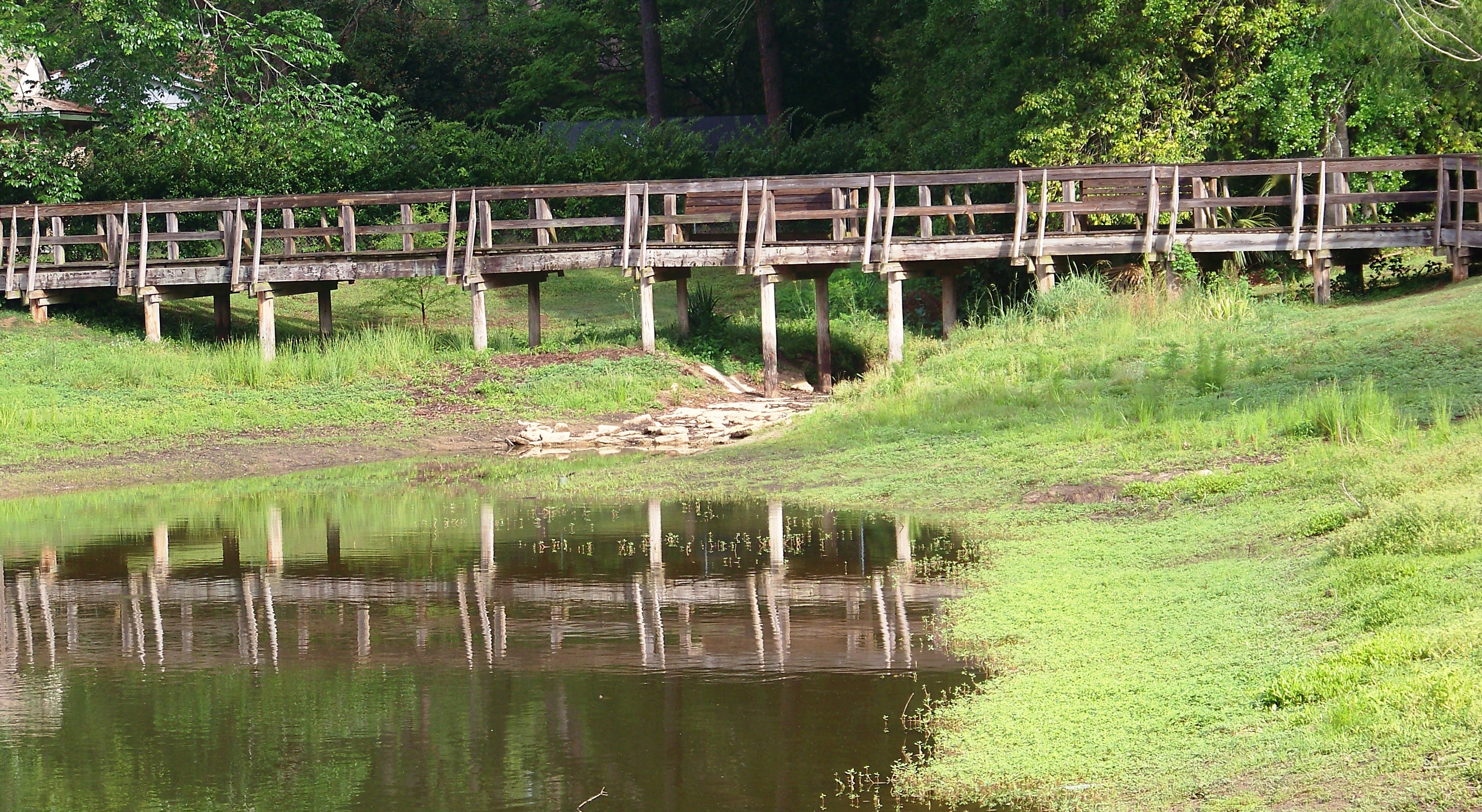
My meditation stays with me as I drive us to a new park, one we had “scouted” last winter. Quiet pond with a bridge, Ponderosa pines, live oaks, dogwood– each so grand in its own being– together they are a choir  for all seasons.

We are excited to explore, for the park and day are fresh with promise, with scents for both of us. Cooper sets his snout to tracking scent after scent as I make sure scent is all he finds. Cooper keeps me present, as do most beagles, I suspect.

Together, we stare at a lumbering turtle making its way from the pond, lifting one foot and then another, its shell shifting with each step, adjusting as necessary, purpose in motion, a rhythm steady and sure.

Cooper takes us here and there until he tires, which he does rather quickly these days so he takes us to a bench, not uncommon for him. Early on in our relationship, he indicated a fondness for benches, and while he no longer jumps up to sit beside me or in my lap, he is content to rest against my foot, making sure I stay.

I sit back and my morning meditation of shedding and renewal returns amidst this spring splendor. Everywhere, everything is coming to life as Cooper snores.

Just beyond us, there is a large black and yellow garter snake making its way away–sleek and sure—a symbol of eternity, of transformation and healing that so freely sheds its skin for life’s renewal, inviting the risk that comes with wearing a new skin.

There is a lifetime in this moment, as always.

ROW80 Wednesday Summary 

Sometimes, all I have to do is  consider the word goal and my entire being rises up in rebellion. My ego tells me—pretty much nonstop– goals are contradictory to the Tao and being, all nonsense but then what else is the ego?

April 4, 2012 is the start date for my second round of ROW80 goals, and they are located on a separate page that you may view here. In many ways, these goals are a new skin for me.

Stirring the Pot

“To let knowledge produce troubles, and then use knowledge to prepare against them, is like stirring water in hopes of making it clear.” Lao-Tzu
(Tao, Verse 87 as quoted in Mark Nepo’s Book of Awakening)

So very like “stirring the pot” was my initial reaction to this verse of the Tao as memories of harsh words—felt and returned—stirred one unkind pot after another. Never once did I think to take it off the stove nor did I imagine knowledge in any way other than as a glorious fount, effervescent, pure, dependable.

How sure I was of so much and so many–then.

Now, I appreciate knowledge within the context of creativity—the act of imagining—one of the greatest gifts life offers, requiring only an open heart.

As I begin my third act, words remain a major force in my life; I am so curious about so much. More than ever, I write, something I never quite accomplished with all the pot stirring although writing was my constant goal.

“Feeling unworthy or insecure, we create a goal, in hopes that achieving this will make us feel good about ourselves. Then we’re off scheming for success, preparing against failure, stirring the water, hoping it will go clear” (Nepo, Book of Awakening).

Seventeen years ago, my goal was to write a novel, which I managed amid much pot stirring. Always, I spoke of the experience with false fondness. I wrote 80,000+ words, allowing myself to tread water in any current of thought.

Natasha Hanova Image
WANA Commons

Frankly, I felt quite good about myself, proud even, for accomplishing my goal. To be honest, every year since writing that original draft, I tried one writing goal after another, stirring and stirring.

One of my favorite far afield attempts was to collaborate on an inspirational book of vignettes with the actual working title of Rising to the Occasion When You Can’t. Outside of considerable pot stirring for three years, our hearts were not open to a word we wrote.

From time to time, I returned to the goal of revising the 380+ page manuscript word by word—certainly a worthwhile goal within the first year of its writing—but at seventeen years later, it was time to take the pot off the stove.

“The mind is a spider that, if allowed, will tangle everything and then blame the things it clings to for the web it wants to be free of. I have done this with dreams of greatness and hopes of love, wanting so badly to see myself clearly in the water, while I kept stirring and stirring” (Nepo, Book of Awakening).

As I mentioned in my last few blog posts, I am yet again working with this first novel draft. Pursuing knowledge within experience, I stirred myself into a month-long, writing workshop. After so many years of empty goal-gazing, it took most of the workshop for the waters to still.

Truly, I did not recognize the actual moment the waters cleared. It was a gradual realization that I no longer was “scheming for success” or weaving any web. Frankly, my sediment sunk.

It was clear that I “don’t have to be finished in order to be whole” (Nepo) as a writer or as a human being. So, for the first time in seventeen long years, I saw the draft of my novel for what it is: the story of a moment passed, completely. Its worth is immeasurable.

With waters clear, I write.

Note: I am publishing only one post this week but will resume publishing two posts per week beginning Monday. As always, feel free to comment or Email me! your comments.