On Either Side of the Windowpane

watching 0314We are always in relationship–some small, others grand–ours is to co-exist. Life is what we have in common. It is sharing space with one another, including the insect in the room.

In the subtropical climate in which I live, co-existence with insects and bugs is possible year around. There are seasonal changes, sometimes marked by a winter’s bloom and other times, yet another change in foliage color.

Through it all, insects and bugs make their way on either side of window panes. The world of bugs and insects is fragile in its beauty and terrifyingly transient. There, living life to its fullest, even for a nanosecond, is never questioned, and death is just as imminent. The more I watch this world, the larger my own life becomes.

Insect and bug death is more common outside my windowpane than on the inside. Feline EmmaRose and I are content to observe all the life around us, although there are times I escort bugs and insects to the world on the other side of the pane. Relationship requires decisions.

Our windows look onto a carpet of grass that slopes to live oaks, pines and vines of woodland too thick for human occupation. Gray squirrels flick their feather-plumed tails, scurrying in and out of the woods in constant search of nuts not yet sprouted. Rarely, do they look to insects and bugs as food but they are never off the menu. Woods within 0514 This spring, EmmaRose and I have watched a pair of cardinals pecking seeds at woods’ edge as well as enjoying bug protein. The silken-red male most often appears in mornings, taking breakfast from what seems to be a favorite series of spots.

It is early evening when we see an earthen-brown female with a tufted, red crest and subtle red highlights. She stays closer to the woods, most often preferring low branches to the ground.

The brown thrasher is quite common of late. It seems a good year for insects and bug protein. To me, the reddish-brown streaks of the thrasher splashed through its mostly white chest seem velvet in texture. Thrashers, cardinals, and squirrels can be territorial but EmmaRose and I have yet to see a squabble.

The world outside the windowpane seems orchestrated and random. I wonder at all that I never see. I like that there is yet another world beyond mine.Bunny right side 072813

This week, there is a new crop of clover, always a favorite for the eastern cottontail rabbits that enjoy the cover of the woodlands as well as the grassy area borders. We watch kits and adults alike.

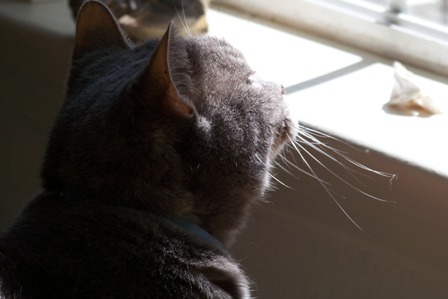
EmmaRose seems most attuned to rabbit watching. Often, she puts her paw on my arm and meows; it is my cue to look to the world outside the windowpane. More often than not, a rabbit munches the green slope at the edge of the woods.

Relationships are a collage of images collected over a lifetime, snapshots of the world on either side of the windowpane.

The View From Waverly: Bottoms Up!

Curiosity is standing on a moment’s edge, sharp with uncertainty, and deciding the leap is worth the risk. Staying curious closes the door on the known and opens us to the thrill of exploring familiar territory as if it were the first time.

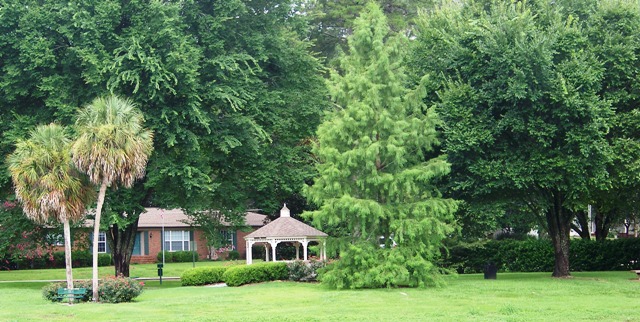
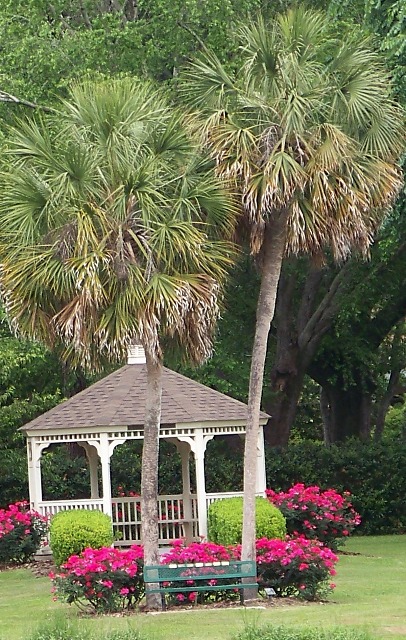
When the “world is too much with me,” I escape to Waverly pond and park—in my mind’s eye ever idyllic—once there, I believe I will regain myself, and I do, but never in the way I anticipate. For when I am at Waverly, curiosity shoves aside all of what I am so certain, and no matter what happens, the view is new.

Life goes on at Waverly, impermanent but not imperfect. It is a distinction well worth remembering for nature does not summon the past to understand or to avoid the present, no matter how daunting or mundane the moment might be.

Nature just is, unfolding in every moment, perfect and precise, providing another perspective, different from the moment previous and unlike the one yet to come. Nature is curiosity sustained.

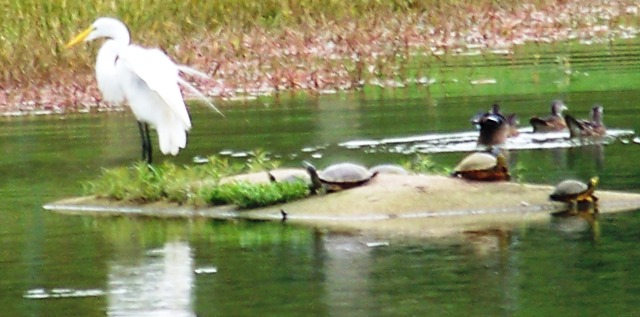
As I look across the waters of Waverly, there is not a single snowy egret or Canadian goose to be seen but the waters of Waverly are not as I have seen them–ever. Sediment, rust in color and seemingly the texture of sawdust, covers most of the pond.

Among the Muck 0314

Its red clay banks are deeply scarred by what was once roaring rivulets of seed pods and dead grass. Day long rains swept and splintered pine needles into fragments of themselves. Needles, pods and grass—a winter’s barge–now float.

Spring blossoms are sporadic, seemingly uncertain. Most trees stand bare, witnesses to a winter that seems in no hurry to leave. So far, spring is days of rain and weeks of gray. I do not know Waverly in this kind of spring. It is not what I want to see.

In response, my mind’s eye returns to Waverly idyllic, as if to wait out the moment that I have. I actually close my eyes on the nature that is for the nature I seek.

Standing on the edge of such a moment is a first for me at Waverly, and I open my eyes with a start, having heard nothing but having sensed something. It is the wonder of the world, whether at Waverly or wherever, that in the instance of knowing one thing, something entirely new reveals itself.

In this moment, it is the bobbing bottom of a duck amid murky waters, oblivious to winter’s floating barge. The duck rights itself, churning through the old as if it were new.

Almost bobbing ducks 0314

Once again, the duck is bottom up, now joined by yet another duck, also bottom up. For more than a while they are content within the muck, swimming one way and then the next, sometimes in circles, seemingly content in waters that are new yet the same.  Ultimately, they swim beyond winter’s barge to open water.

So often, the unknown is merely a new perspective on an old situation, one that seemed so ripe for escape. Escape takes us only to where we have been as we have been. Staying curious allows us to meet the moment’s edge, perhaps bottom up, completely unsure of what that may mean but confident that these waters offer life in yet another way.

Swimming Away 0314

Facing the Past Tense

Do not stand at my grave and weep,

I am not there; I do not sleep.

I am a thousand winds that blow,

I am the diamond glints on snow,

I am the sunlight on ripened grain,

I am the gentle autumn rain.

When you awaken in the morning’s hush

I am the swift uplifting rush

Of quiet birds in circled flight.

I am the soft stars that shine at night.

Do not stand at my grave and cry,

I am not there; I did not die. (Mary Frye)

Fifty years of friendship feels like only a moment yet it has been a lifetime.  It cannot be over. Not yet. I want Laziness 010514the conversation to continue but mostly, I want the past tense to be the present.

In death, the past tense looms. My mostly Buddhist self believes the past tense is a series of images always available for viewing but never again for experiencing.

I am not used to the past tense. I am not ready to live with my friend as mere memory.

If I think of my friend as dead, there is a hole in the sky that is my heart. I want to tell her how that feels, how that hole is now my world. The telephone that connected us as we aged from teenagers to sexagenarians is no longer in service. It is past tense.

In the last couple years, this blog provided yet another connection for us.  Sometimes, my posts sparked conversations, and other times, our conversations created posts. On this blog, my friend is eternally present.

Discussion was our way for five decades, not a daily occurrence or even monthly, but whenever there was a hole in the sky for either one of us we seemed to sense it. There would be a phone call or an email when least expected and most needed.

My friend was not one who labeled but one who listened. Her innate compassion and loving-kindness opened her to the world wherever she was. And the world responded to her light.

KMHuberImages

Along the wend and way of our lives, we each explored Buddhism and over the decades offered our experiences to one another. In these last three years when illness once again marked my life and then for the first time hers, we found ourselves less concerned with outcome and more with exploring the energy of raw emotion.

We were less interested in questions so we had little use for any answer that might appear for we recognized all outcome as temporary. It kept us curious, this being in the moment. We explored eternity as a web without a weaver, its vibrations animating humans, blades of grass–lifetime after lifetime–perfect in its impermanence, forever coming and going.

She is gone in a way I knew and exists in a way I am yet to know.  She is in every breeze, blossom, and glint of light in a night sky. She is. The past tense is no more.

My thanks to Diana J. Hale for her recent post, In Memoriam, as it led me to Mary Frye’s poem, which I could not seem to locate.  Also, thanks to all of you who have sent personal messages. I will respond to each one.

Dear ?: A Peace Letter

July’s Bloggers for Peace Post is to write a letter for peace, which was a real challenge for me beginning with the salutation. The forpeace6question mark is preferable to a mere blank as there is an acknowledged mystery in the question mark as well as an implied unknown and perhaps uncertainty. Yet, as mindfulness or present moment awareness reminds me time and again, it is in this unknown and uncertain realm where the infinite possibilities lie.

Dear ?:

This is a letter to existence, the life force that runs through everything on the physical plane. Deliberately, I have settled for a punctuation mark rather than a name, although there are many from which to choose, but more and more, I am convinced that putting a label on anything only excludes.

Now that I am past the salutation, there is the body of the letter that contains my current thoughts on peace. Like existence, peace is ever undulating, for peace is not a destination or even a goal but rather, a way of being.

“Peace begins when expectation ends”

~ Sri Chinmoy~
Co-existence on the Row 0713

The onus is on us, where it always has been, yet the planet seems so much smaller now for we crisscross it on a daily basis through images and words on screens. It is reminiscent of when the world wrote letters, and the challenge still is to respond rather than to react. Pen and paper required more of us physically and may have delayed reaction time somewhat.

The ability to communicate instantaneously to almost anywhere in the world has brought us face to face with ourselves. Ideals, illusions, and even institutions have been shattered as we find ourselves in immediate relationship with so many voices from so many places. There are few gaps between thoughts.

Peace is not some sort of lofty ideal nor is it an illusion or an institution. Peace is not a finite but an infinite state of being. Peace is not a one size fits all but is unique to each one of us. The oneness of peace is the acceptance of all of us just as we are for then—and only then—have we removed expectation. The possibilities are infinite.

Peace on the Row 0713

As always, I am overtly optimistic, which is not to say that I am not aware of how taxed our planet’s resources are or how many species are either being pushed to the edge of their existence or are already extinct. I am only too aware that “the world is too much with us” to the point of making my head explode but then I remember:

Never doubt that a small group of thoughtful committed citizens can change the world; indeed, it’s the only thing that ever has

~Margaret Mead~

We begin from within, putting our own house in order from the inside out, which is a lifetime task. And that is how the world changes for we cannot give the world what we do not have within ourselves. If we are not at peace with ourselves, we are not in peaceful existence with the world.

It is no wonder that peace eludes us for we look everywhere except where it resides, within our own existence. It may seem more practical to fix ideals or institutions but change—impermanence–is the nature of all existence.

Discovering our own oneness is how we recognize our connection to all of existence. When we love ourselves completely and compassionately for the beings that we are, recognizing our faults and forgiving our mistakes, then our house is in order for we accept our own existence, unconditionally.

It is the task of a lifetime and always has been.

Yours in Impermanence,

KM Huber

Summer at Waverly 0713


Thursday Tidbits: The Way to Fall Apart

This week’s Thursday Tidbits post considers retreat as a meditative withdrawal and as the idea of falling apart. As Pema Chödrön says, “Everything that comes together at some time falls apart.” Ours is to experience pain and pleasure–usually alternating but not always–for the nature of existence is impermanence.

Recently, I attended an online retreat offered by the Omega Institute, featuring Pema Chödrön. The retreat covered the four marks of existence–impermanence, egolessness, suffering, and peace–during the first minutes of the retreat, Chodron referred to the four as the facts of life. I felt a familiar stirring.

KMHuberimage
KMHuberimage

I had been drawn to the retreat from the moment the invitation arrived in my email box, about 72 hours prior to the event’s first session. I was not aware of having any connection to the Omega Institute, which is not to say I did not but is to say I do not remember a connection. Still don’t.

Serendipitous email or no, the retreat affirmed my suspicion that I was, indeed, falling apart again–health, writing, life–but the initial session on impermanence revealed how adept I had become at avoiding falling apart. That was an unexpected moment yet it was obvious I had been creating various bubbles of escape for some time. No wonder they felt so familiar, so comfortable.

You might think all my posts about allowing bubbles to float up and through us while remaining in present moment awareness might have had some effect on me other than escaping with the bubbles. They did, ultimately.

A few months ago when I started reading Pema Chödrön’s books, I chose The Places That Scare You over When Things Fall Apart. I felt a familiar stirring of avoidance when I made my selection but convinced myself I needed to read the former title–for what reason now escapes me.

Not surprisingly, the phrase that I kept hearing in the online retreat was “when things fall apart,” more by participants than by Pema Chödrön. That was not surprising, either.

“Things falling apart is a kind of testing and also a kind of healing. We think that the point is to pass the test or to overcome the problem, but the truth is that things don’t really get solved. They come together and they fall apart. And they come together again and fall apart again. It’s just like that. The healing comes from letting there be room for all of this to happen: room for grief, for relief, for misery, for joy” (When Things Fall Apart).

The words falling apart have always been difficult for me. I eschew vulnerability in the same breath that I advocate an open mind and open heart; however, I do know “strength does not come from a bubble of safety” (Chödrön).

Waverly gazebo 0513
KMHuberImage

My bubble burst within the first few minutes of listening to Pema Chödrön, and my tears streamed right along with the video; Chödrön is quite a wit so my tears were from laughter as well as from the pain of recognition. It was a great way to fall apart, actually.

Nothing has changed and everything has changed. I am still dealing with a significant lupus flare and adjusting my life accordingly; as always, diet, meditation, and yoga figure prominently. For me, it is not a matter of being less but a matter of being more, just as I am, which is new.

If I avoid the discomfort that is part of being alive, I am living in a bubble. Bubbles burst; it is their nature. If I open to both the pleasure and the pain of life, I am vulnerable but strength resides in accepting that things fall apart and come together. It is the nature of existence.

*****

Thursday Tidbits are weekly posts that offer choice bits of information to celebrate our oneness with one another through our unique perspectives. It is how we connect, how we have always connected but in the 21st century, the connection is a global one.