The Highest Good: No Fight, No Blame

Without a fight, there is no blame. This basic truth can be found in the Tao te Ching—no fight: no blame—as well as in the major texts of many spiritual traditions. Blame seems that integral to the human experience.

In last week’s post I chose the phrase aflame with blame as a reference to its incendiary nature. It is quick to flame, this blame, although it is not a trait with any substance.

Whatever person or event we blame is not what causes us to suffer (Byron Katie). Blame is a distraction, and it is easy to get caught up in its mindset.

We suffer when we hold onto a mindset; in a blind stance, we dig in for a last stand. Mindset is a misguided attempt to avoid the inevitable.

Nothing ever goes away until it teaches us

what we need to know

Pema Chödrön
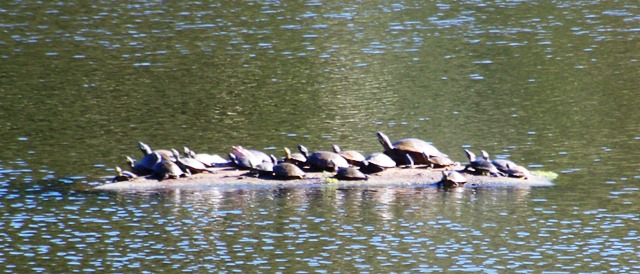
 Turtle Row in fall 1013

It would be hard, maybe impossible, to provide an example of a life experience that does not teach us for in every moment there is something to be learned. At a certain point in life, each of us becomes aware that what breaks us open is what we need to make us whole again.

It is how we learn. It is hard to accept, at least for me.

But time and again, I have realized this one lesson: when I open myself to learning rather than blaming and struggling against, I find the highest good in any situation. The flames of blame and the smoke of striving fade away.

Often, I turn to the teachings of the Tao (in translation) for I treasure its basic truths. Such reflections soothe and instruct every time I return. I am refreshed.

Water gives life to the ten thousand things and does not strive

(Tao, Verse 8)

And like water, the highest good is life-giving, “flowing in places men reject and so is like the Tao”  (Verse 8). All we need to remember is that water will flow—even through rock–rather than reject the route.

The highest good never rejects us, either, even when we do our best to shape what will not be shaped. There is no blame, no fight, no mindset.

Chronic illness is my greatest teacher, as I have mentioned many times. Even in my more difficult moments, I am more aligned with learning than striving, which is not to say I do not have some fiery moments of blame throwing. They are not as frequent.

I find it easier to recognize and to dismantle a mindset, and to do it with self-care and love. After all, a mindset deflates quickly for it is only made of air. And once I breathe it in, I can breathe it out.

Mindset is only a thought no matter how often it may appear. In my experience, mindsets return for they have unimaginable power IF they are allowed to attach and become unassailable belief.

We can learn from observing a mindset if we let it go for what it is. That is the way to keep learning rather than to continue struggling. I find hope in impermanence no matter how many times I meet similar situations. It makes the highest good in any situation seem not only possible but realistic.

We are more like water, wanting life for all and strife for no one. It is ours to flow, like water through rock if we must, open to the ten thousand things and like the Tao rejecting none.

High Tide St Marks 0214


Unplugged to Get Rewired

At Rest 0215

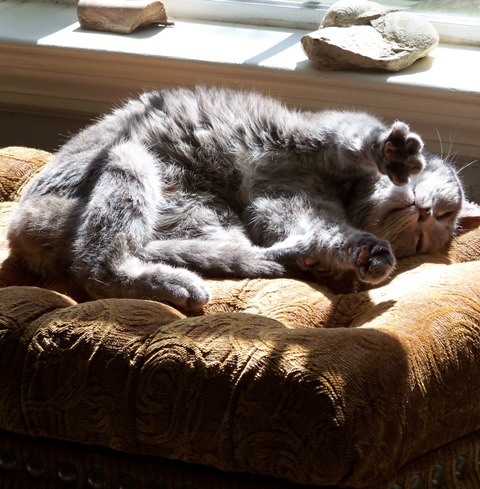
This image is of EmmaRose in her favorite place—in her plush and if necessary, heated bed–practicing her favorite pastime. If you live with a feline, you are constantly reminded how integral sleep is to life.

It is the way sentient beings unplug and get rewired, which is what EmmaRose and I have been doing for almost a fortnight. It is her daily way to unplug regularly.

I am, however, a slow learner yet I have another constant teacher, just as dedicated—autoimmune disease, lupus in particular and in a lesser role, Sjogren’s syndrome.  This is my sea to sail.

Not too long ago, I wrote a post about not unplugging, not ever coming to shore. I believed I could bully my way through any tempest—I was that kind of sailor–but that is not the law of the sea nor is it true self care. It is dangerous sailing, selfish and thoughtless.

large waves 0215

Self care is never a selfish act—it is simply good stewardship

of the only gift I have,

the gift I was put on earth to offer others.

Parker Palmer

Good stewardship requires a daily course adjustment of how to offer my gift without the dualistic thinking of there is only one way. Dualism exacts quite a price for in choosing one way, another way is excluded. Better to steer between the two for balance. They are within the same sea, co-existing with one another.

I was reminded of the inherent imbalance in dualistic thinking as I came across a lively Facebook group discussion on healthcare, specifically alternative versus traditional medicine. Here healthcare is a civil war with both groups firmly entrenched in their respective camps.

There is no one and only one way to health for all but for each of us there is a way to our best health. It may be a balance of both camps or it may lie more within traditional rather than alternative medicine or vice versa.

But without the benefit of learning what each camp offers, there is no balanced approach to one’s best health. In balance is wholeness and without it, we are aflame with blame. Our essence is diminished.

I do not haunt these discussion healthcare boards as I once did but I am reminded of my own imbalance in my approach to my best health. I am fortunate in having experienced the benefits of both camps but I do not know that I have expressed that in a broader perspective.

Sun and Sand 1013

And while my preference for traditional Chinese medicine (TCM) remains the course I steer, it is not without the benefits of traditional medicine. For traditional medicine continues to teach me about the western perspective on autoimmune disease. In turn, that perspective broadens my TCM options.

Wholehearted living is not a onetime choice.

It is a process. In fact, I believe it

is the journey of a lifetime.

Brene Brown

Good stewardship just may the journey of a lifetime, easy to drift off course or become becalmed. And then, there are the storms of life, much like the one I am in now, tossed about, swamped from time to time, but not run aground or sunk.

Some who read this blog also know chronic illness. We sail a similar sea as we chart our course anew for storm or to catch the wind for full sail. When we dock for a rest, we learn from our days at sea. We share our catch.

We know what we offer is the best we have to give, and that it only lasts a short time. We also know the impermanence of the sea requires we open our sails to the wind when and as it is given, and when it is denied to rest with a steady hand on the tiller.

Here are some of my favorite resources: Toni Bernhard’s How to Be Sick seems a guide for any storm as is Jan Chozen Bays, M.D.’s Mindful Eating. And through every storm I practice meditation and a gentle yoga flow.

Till we meet again.

Every Day 0215

Maintaining Moderation Requires Graceful Shifting

For me, moderation is elusive. I struggle for balance—the measure of moderation—at times, my struggling is painful.  When I become aware of pain, however, is when I cease suffering from it. I aim for even on the day I have rather than going in search of the day I want.

[When] balance comes of its own accord…

[it] has tremendous beauty and grace.

You have not forced it, it has simply come.

By moving gracefully to the left,

to the right, in the middle,

slowly a balance comes to you

because you remain so unidentified.

~Osho~

Osho’s words remind me of Michael Singer’s observer: “There is nothing more important to true growth than realizing that you are not the voice of the mind. You are the one who hears it” (The Untethered Soul).

I find his image of the observer quite helpful in finding the balance in any moment but especially in those where I am on the edge of right or dropping off far left.  As the observer, I have an immediate distance and thus, a broader perspective much like what happens in writing.

The thoughts are in my mind and with my fingers on the keyboard I search for consonants and vowels to create a physical representation of the thought.

The distance between the ever evolving thought and its concrete representation—the word(s)—moves me closer to the center. I am not identifying with the left or the right as I move to the center–not always with grace, I admit.

ocean pine 0215

That may be the overall process of moderation—each of us has our unique way with it—and at one time or another, we struggle with it. Why? We have to let go of what we have to receive what we are given. To me, that is the grace of moderation.

It means keeping the “big picture” in mind.  Whether we are discussing diet, climate change, or the world future generations will inherit. And that’s difficult to do. In terms of global issues, the big picture now looming is an ominous one.

In seeking a balance for a better world—finding moderation—we have to change the way we live, maybe even who we are. Balance—the measure of moderation—is a constant shift, an adjustment to the world as it currently exists. That will determine the world that is yet to come.

Often, the task feels overwhelming, especially if we anticipate a future we cannot know or gnash our teeth over a past that cannot be changed. All we have is the moment to gracefully move a little left or right to maintain our balance.

We begin with observing the life we know best–our own—ever aware of doing no harm to no thing, to no one. Then, we move gracefully to the right or to the left as life comes at us only to leave us. And when we leave, ultimately, both left and right are increased rather than diminished.

Testament of Friendship

The past ripples round me. It is a time of reflection—one last look—before I let go. In reflection is the unchanged past but looking through the eyes of the present, I am changed.

kmhuberimage

Sometimes, it feels like we are not remembering as fully as we might those loved ones who have died. It is the nature of life to evolve, one experience after another, changing us as we learn to live with the love from loss.

We cling to our memories. Our reluctance in letting go is as physical as it is emotional. It is a mind and body hold. Our cells store the emotion of a memory, often as pain. In letting go of the emotion, we release pain. The cell is changed.

Our body and mind are what we eat and how we meet each moment we live. In letting go, it is not that we love less but that we love completely.

My recent blog posts have been awash in memory. One post was about finding anger long forgotten; the other remembered the Zen master who taught me acceptance. That the anger has been denied longer than acceptance learned does not surprise me.

Both posts lead me to this one as this week marks one year that my beloved friend died of endometrial cancer. Our friendship spanned more than half a century. We grew up in the Rocky Mountains and eventually we both moved east, she to the north and I to the south.

I still think of her as frequently as I did when she was alive. Often, I have to remind myself there are no more conversations for us. I search my memory for the conversations we did have. They are a comfort and sometimes, I learn something new.

Weather in weather 0314

I was not able to be at the celebration of her life service but her partner sent me a DVD of images and music that completely captures her life. I have lost count of the number of times I have watched it, especially in the early months.

Always, I stop the DVD at one particular image. It is a long quotation, in her handwriting, regarding friendship. It is the opening and ending sentences that stay with me. It opens as:

Never cast aside your friends if by any possibility you can retain them. We are the weakest of spendthrifts if we let one friend drop off through inattention, or let one push away another, or if we hold aloof from one for petty jealousy, or heedless slights or roughness….

This was not how she talked but it is how she lived. It took me a while to locate a source for the quote. The words have changed a bit over the centuries—language evolves with us–but the meaning is unchanged.

We accept our shortcomings and our strengths, knowing that sometimes one becomes the other. We lean less on distinctions and more on acceptance.

And while I never knew the quote before Maurya’s death, it is what I have now, a testament of friendship for the life I still have to live, as the closing line of the quote reminds me:

It is easy to lose a friend but a new one will not come for the calling nor make up for the old one.

(Mother’s Magazine)

I do not know that she ever lost a friend. And yes, the diversity of her friendships is a rich legacy. I am changed by her death but more so by the way she lived. I hold close this testament of friendship for the years left to me, for the life I have yet to know.

We meet today.
We will meet again tomorrow.
We will meet at the source every moment.
We meet each other in all forms of life.

Thich Nhat Hanh

In letting go, I find forever.

Sun and Sand 1013

Seems I am on the Right Planet After All

I have never been fond of the practice of finishing someone else’s sentences. Memory reminds I am guilty of it but Just beginning 1014less so in later years. Of course, it depends on who’s having the conversation and the nature of their relationship.

Certainly, some topics lend themselves to a cooperative effort in constructing a conversation, sentence by sentence. Consider the combined effort of Pema Chödrön and Oprah Winfrey regarding suffering and impermanence:

Chödrön: “If you’re invested in security and certainty—

Winfrey: “Then you’re on the wrong planet.”*

Yes, indeed.

For me, in this sentence of combined effort is the essence of suffering. We invest in what is no longer possible, seeking a security in what once was. Pain, physical or emotional, comes, goes and will come again only to leave once more.

That we all know pain in our lives is part of the human experience but whether or not we suffer is up to us. In suffering, we hang onto a discontent, staying with a storyline because it is what we know, a trusted buffer.

Such buffers may just as easily blind rather than reveal. In these last two months, I have removed many blinders and buffers, once trusted tools, as I perceive physical pain with a perspective more consistent with the planet on which I live.

The needles of acupuncture, intent in balancing my Qi (energy), present my physical pain to me. Like the crescendo of a wave, the pain intensifies only to even out on the shore that awaits all waves.

These past eight weeks my physical pain has been high as my body awakens, attempting to return to a balance it has not known in decades.  The pain does not stay and it does return but each time the pain is its own new wave, and I, its waiting shore.

It is no longer a battle as I allow my body to do what it does best, repair itself. In fighting my pain I was fighting my body, trapped in the drama of battle, masking my pain as suffering.

on the right planet 1014More and more, I am convinced that all physical pain has an emotional component. It is not that the pain is emotionally created but emotion becomes the storyline of physical pain. Humans tend to respond to stories. We suffer if we stay with them rather than feel the pain.

It is the hardest thing I have ever done, and I don’t know where it will lead. I can tell you where I am right now–living a kind of health that I thought no longer possible. Some days feel like a setback but that is an old storyline of a moment past.

Whatever else, traditional Chinese medicine is affording me an opportunity, challenging as it is. It is not a panacea but hard work. This medicine–herbs, acupuncture and whole food—is helping me remove the ring of fear that surrounds my pain. I just do not suffer as I once did.

It feels as if I am completely rebalancing my life, emotionally and physically. Well, I am, at 62 after nearly four decades of disease. It is balance by moment.  I am definitely on the right planet.

Note: My dear readers, posts may continue to be a bit irregular for a while. To my fellow bloggers, I am quite behind in my reading but I am beginning to catch up. Thanks, everyone.

*Conversation on Super Soul Sunday, aired October 19, 2014.


The Eddying of Experiences

Seattle stars 012512

We are stardust—we know that—but as we are dust so are we energy. It is from this energy that we have a momentary experience as a human being, a blade of grass, or an armadillo.

And when we are no longer in this physical dimension, we remain energy, perhaps to know an experience in some other dimension or maybe to return for another physical life, leaving only our dust once again.

Our physical experience is unique to us—each of us has our own vibration—sometimes we’re a wave and other times, a particle.

Since subatomic matter makes up everything we can see and touch and experience in our macro world, then in a sense we—along with everything in our world—are also doing this disappearing act all the time. And so if subatomic particles exist in an infinite number of possible places simultaneously, then in some way so do we.

(You Are the Placebo: Making Your Mind Matter, Dr. Joe Dispenza, p. 183)

The quantum model is staggering with possibility, fascinating and even spellbinding, reality rooted in the pure energy we are. That’s the power of possibility, revealing that magic is real.

KMHuberImage; McCord Park; Tallahassee; Florida

I have always believed in magic, always sensed we had not yet grasped its true nature. For me, the quantum model is a magic carpet ride where the magic is the pure energy of life riding on reality, soaring and swooping, sometimes swirling.

The energy comprising the oneness of reality resembles a whirlpool as it “…fades out and the water passes on, perhaps to be caught again and turned for a moment into another whirlpool,” each its own eddy of experience (Charlotte Joko Beck).

Each whirlpool caught up in its own moment of existence yet ever connected to the energy of coming and going. Sometimes, we’re the  whirlpool, and other times, we’re a drop but always, we are the river.

There are many names and beliefs for the energy animating existence–God, the Universe, the Source. Each expression of this energy—as a human, as a blade of grass, as an armadillo–is a unique experience of life, a momentary whirlpool in the river that runs eternally.

When we learn to move beyond mistaken concepts and see clearly, we no longer solidify reality. We see waves coming and going, arising and passing. We see that life, composed of this mind and body, is in a state of continual, constant transformation and flux. There is always the possibility of radical change. Every moment – not just poetically or figuratively, but literally – every moment we are dying and being reborn, we and all of life.

~ Sharon Salzberg ~

The Life Cycle of a Moment

Initially, this post seemed to be about dying into the moment and that was its working title. Working titles are quite Zen, I think. They are as impermanent as are the moments of our lives and just as complete in their birth, life, and death.

So the title of the post is now, “The Life Cycle of a Moment.” In another week in a different venue the title will change again as will the post but its essence, its cycle, will not. Whether similar or seemingly new, each moment cycles.

Three at Waverly 0714

In Jake Fades: A Novel of Impermanence, dying into the moment is the doorway into the next:

“…dying now means coming to each moment fresh… Seeing every person, even your partner, as if you have never met before. Hearing the birds as if you have never heard a chirp in your life. Our past is what we think of as our life, that whole life of thought and memory that we carry around all the time, but nothing actually repeats itself. Every moment is new, and you cannot live this moment until you die to the past one.”

(David Guy, p. 172)

Yet to consider death as integral to every moment was quite a shift for me, and as often happens in Zen, my view of the world turned inside out. For me, opening to the ending inherent in every moment makes the familiar fresh, a wave worthy of its own experience.

Some moments are like riding on the crest of a whitecap while in others it is as if I am becalmed and awaiting a wind until the wave washes upon the sand. All moments pass only to return as life anew.

So, how long is a moment? Consider this math: there are 6,400,099,980 moments in one day; one finger snap=65 moments; dividing 65 into 6,400,099,980=98,463,077 finger snaps per day (Ruth Ozeki, Appendix A, p. 407, The Tale of the Time Being).

That is a lot of living and dying at a rate I can barely wrap my mind around. Yet, a snap of fingers is such an immediate image of impermanence that it makes a wave upon the sand seem like an eternity. And yet, both are.

Wave upon the water 0514

“Everything in the universe is constantly changing, and nothing stays the same, and we must understand how quickly time flows by if we are to wake up and truly live our lives.”

(Ruth Ozeki, p. 408)

When awareness is the measure of the moment, any linear sense of time—such as a finger snap–fades into simply being, often enhanced by memory, flashes of moments similarly spent. Surely, the math of memory flashes is at least equal to, if not greater than, the number of moments in a finger snap.

And here we are near the end of another moment, perhaps measured more by awareness than by snaps of fingers or memory flashes. Well, that is what is true for me in this moment as it takes its place in the story that is me, maybe to return as a flash or maybe not.

We write (and read) stories to provide perspective on passing moments, recording the progress of our stories with working titles, changing with the measure of the moment.

There’s Still Time to Make Art

natural art 0514Perhaps each life is a painting, an infinitesimal rectangle or even the equanimity of a square. Beginning with a blank canvas, an entire life swirls with the colors of choice, shifting scenes until ultimately blending into the tapestry of existence.

Existence is endless art, it seems, as delicate and precise as a sand painting—a mandala—once a life is complete, the sand shifts and returns to its state before shape. Always, there is another shape to come.

There is an art to life, I suspect, no matter how minute one’s tile in the mosaic of existence may seem. It is not the size or shape of a life that looms but rather the choice of options from the palette provided.

The colors of choice vary as does the brushstroke that reveals them. Some moments the stroke is as subtle as moonlight and just as changing. During the dense, life-changing events–dark moments that mark a life for its duration–the swath of the brush is broad and opaque.

Yet each life has an array of choices—a palette of options—to absorb change as it colors a life, ultimately illuminating, much like light of the moon.

At night, I open the window

and asked the moon to come

and press its face against mine.

Breathe into me.

Close the language-door

and open the love-window.

The moon won’t use the door,

only the window.

~Rumi~*

We might want to look to the moon when facing the doors it ignores. Sometimes, the broad brushstroke Art 0514wrinkles the canvas in a determined color of choice. Other times, the subtle stroke turns opacity into transparency, rather like darkness leaving for light.

The tapestry of existence is in constant flux, swirling with infinite possibilities as we work through daily decisions, choosing our colors. Some are doors and some are windows but both eventually open, either by the light of the moon or by the love of life.

Our living canvas is not yet a still life nor is our sand mandala complete. There is still time to make art.

*This lovely Rumi quote comes from a favorite blog of mine, ZenFlash.  Thank you.


The Light in Our Stars

Single movin' 0614It is the second day of summer in the northern hemisphere, June 22nd, the first day when the amount of sunlight no longer increases for the longest day of 2014, the summer solstice, has passed.   

In what will seem no time at all—just a jumble of days and nights—it will be the shortest day of the year, the winter solstice, followed by December 22, the first day the amount of daylight no longer decreases.

The seasons cycle as does all life on the physical plane. Some pass away and others remain longer. It is love that sustains the coming and going of life.   

I made the above notes in my journal while I was at Waverly the afternoon of June 22nd. This is the first summer my dear friend, Maurya, is not here, having died this past winter. It is a lifelong habit, this marking of seasons and remembering love given and received.

It is my way of accepting that all pass away, as will I someday, and remembering that love is beyond time, form, or condition. One need only look to the light in the stars or to the shimmering light of the sun on a pond to see love expressed over and over as life.

And on this June 22nd there was something else occurring, a gathering of cyclists and walkers at 2 p.m. on the Charles River in Massachusetts. The event was Movin’ for Maurya, another celebration of her life and a fundraiser for endometrial cancer research.

Those unable to be in Massachusetts went to places they walked or cycled with Maurya or to places she knew only through pictures or conversation. Wherever we gathered, the memories of Maurya were many and rich in the equanimity and compassion that flowed so gently, so easily from her.

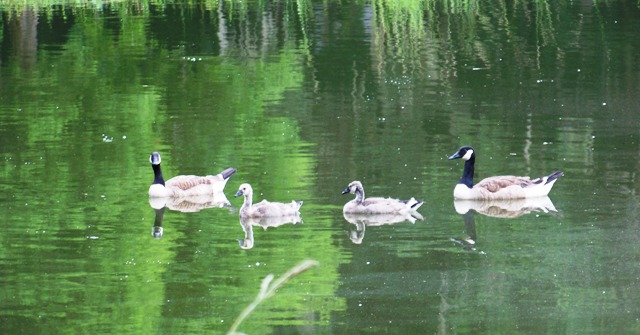
Goslings 0614

Each friendship was unique to her, treasured and nurtured. To have known such love in a lifetime is to feel invincible, awash in waves of unconditional love. On many occasions it has nearly brought me to my knees for the sheer wonder of it.

And for me, not surprisingly, it is at Waverly that Maurya seems so near, although she knew Waverly only through the pictures and posts on this blog. But then, Waverly is like stepping out of time and into the endless energy of existence.

We are here to awaken from the illusion of our separateness.
~Thich Nhat Hanh~

The oneness of existence is beyond this body, this I that experiences life on the physical plane, one of seamless sensations, boundless as the breeze upon my face. On this physical plane love announces itself as sight and sound, as touch and taste, a heady aroma this experience of existence.

movin' for Maurya blog 0614

It is just after 2 p.m. when the goslings and their parents slip into the waters of Waverly as I look to the northeast and to the Charles River. Endless existence washes over me in waves of gratitude that is no less than the light in the stars.

On some nights, it seems the stars wink in recognition. Perhaps they do for one day I, too, will be among the energy of existence as are those who I loved and who loved me during our shared experience on the physical plane.

Occasionally, I have thought our time together too brief but then I remember that I am not separate but one with existence beyond form, dimension or condition. I look to the light in the stars and sometimes, I wink back.

The First Peace in Relationship is Life Anew

This past Monday, feline EmmaRose and I experienced the imperative inherent in impermanence. One being can never know another completely, which is as it should be. The richness of relationship, its mystery, keeps us curious and often, in awe.

In her sun 0413As a cat, EmmaRose is ever present. Routine is her preference for that means food and shelter—her sense of security—is not threatened.  For the three and a half years she has lived with me not even the furniture has been rearranged. It seems she appreciated this more than I knew.

We spend most of our time in the bedroom, which doubles as my work area. I work from an adjustable Tempurpedic bed complete with laptop and bed table. EmmaRose is quite partial to sleeping on the Internet router, especially in winter, or near/on my lap while I write.

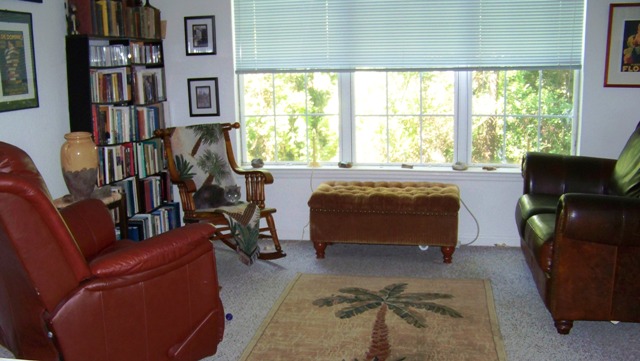
Our living room has never had much furniture. There is still a lovely antique, wooden rocker with a padded seat. It is more comfortable than it looks. Also, there is a large, rust-colored ottoman suitable for human and feline window gazing.

There WAS a twin bed box springs and mattress that I tried to disguise as a sofa-daybed. For me it was ugly, uncomfortable, an unpleasant reminder of another time. From time to time, however, I would find EmmaRose curled up and asleep on it.

That I regularly removed accumulated cat hair from its quilt cover should have told me that this was a nocturnal sleeping place. Did we not once watch a possum in moonlight from the sofa-daybed?

Staying with Familiar 0614

In hindsight, it is obvious that a good deal on a used loveseat and recliner changed our relationship. In fact, EmmaRose seemed to sense imminent change the moment we heard the knock on our front door.

She did not watch the daybed leave the apartment, preferring the familiarity of the bedroom to wait for the moving in and moving out to cease. Only then did she return to the living room.

Although she is only five and a half pounds, she has an immense presence, especially when she communicates. We don’t focus on the actual meow or word. Rather, we pay attention to tone, and her feelings regarding the loveseat and recliner were quite clear.

Here we were in the reality of impermanence. The known furniture was gone and the unknown leather furniture was here. Accepting loss precedes learning to live with what is. Becoming once again secure in one’s world is unique to each being–there is no set amount of time.

KMHuberImage; Meditation Cat;

We can immerse ourselves into the newness of our world or we can skirt the change for awhile. Regardless, it is up to us to seek that first peace so integral to relationship, which is precisely what EmmaRose did three days and four nights later.

It was during the opalescent hours, as one day becomes another, that EmmaRose beckoned me to the loveseat for window gazing. In the light of the waning crescent moon, I glimpsed an occasional firefly but soon the purr of EmmaRose brought me, too, to sleep.