Aim for Even: Bringing Zen Into Every Day

This is the beginning of my third year of blogging about bringing Zen, the “meditative state,” into every moment of every day. There is no one way to do this, as I have learned, but Zen is possible in any and every moment.

The meditative state is being engaged in life, immersed in it, actually. “When coming out of sitting, don’t think that you’re coming out of meditation, but that you are changing postures” (Ajahn Chah).

The act of meditating is to sit in stillness while the practice of yoga moves around the body’s fluids. In both, there is the sensation of being alive. Taking a meditative moment at the end of a yoga session allows the fluids to balance within the body. What was in motion is now in balance for the day.

The postures or positions we assume are unique to us as are our everyday responsibilities. We join with one another in many activities, especially in our work, but even our collective effort is comprised of the unique points of light that each one of us is. That is the meditative state, our own Zen, which we bring to life.

Bringing Zen into our every day may mean stops and starts for a river’s flow is not always smooth, choppy or a torrent but rather, it is steady and swirling simultaneously. Making the meditative state integral to our lives is to aim for even, to meet each moment for all that it is without looking ahead or behind.

To aim for even is to “…stop being carried away by our regrets about the past, our anger or despair in the present or our worries about the future” (Thich Nhat Hanh). Aiming for even is to maintain our balance through the rapids of our lives and to float on moments of reflection. One is not more than the other ever.

Aim For Even 1113

To aim for even is to throw off emotional weight past, present or future, to “…see that the emotions themselves arise out of conditions and pass away as the conditions change, like clouds forming and dissolving in the clear open sky” (Joseph Goldstein). Emotions have the substance of a cloud and the energy of the life force, pure and wakeful.

Bringing Zen to the every day is letting the clouds of emotion delight, darken, and dissipate. Emotional balance is more than shrugging off a difficult moment. It is accepting that the dark never stays and neither does the light. Life is impermanent eternally.

“For things to reveal themselves to us, we need to be ready to abandon our views about them” (Thich Nhat Hanh). To aim for even is to forego pre-conceived notions of what or how life should be. To meet each moment is to allow it to reveal itself in all that it is and then respond.

If we allow the meditative state to remind us that silence is always a response, we are able to immerse ourselves in all that comes to us for as long as it may take but not a moment longer for there is so much more to come.

In meditation, we watch thoughts come and go for that is the posture of the practice. In bringing Zen into the everyday, we allow moments to move through us rather than holding onto them.

These past two years of blogging have been rich years. So many of you have revealed to me perspectives I may not have otherwise considered or have ever discovered. Thank you for bringing Zen into my every day, reminding me to aim for even.

Rather Than Resolutions, Consider Laziness

I am not much on making resolutions for any period of time. My mostly Buddhist self knows that each moment is its own clean slate. Rather than becoming anything or anyone, I just need to meet each moment I am given and aim for even.

Some may consider that laziness, and I accept that label in any year, moment, hour, or nanosecond. As with any feeling or emotion, all we have to do is accept that each emotion has its own drama and demon players. Ours is to experience but not to become.Laziness 010514

Once we have named the emotion—“this is laziness”–we strip away the drama that has kept us from continuing the story that is our life. Laziness is not “…particularly terrible or wonderful…it has a basic living quality that deserves to be experienced just as it is” (Pema Chödrön).

There is no reason to run away or hide from any emotion. Removing the drama reminds us the duty of being alive requires us to experience our emotions, laziness among them.

If we enlarge our sense of what it is to live, we realize events and emotions are mere scenes in a daily drama, each replaced by the next experience. We are moved by the emotion of each experience but sometimes, we get caught.

“Whatever we discover, as we explore it further, we find nothing to hold onto, nothing solid, only groundless, wakeful energy” (Pema Chödrön). Our discovery that we have experienced laziness and that it is no longer worthy of our rapt attention is the dawning of a new day, a new moment or a new year. Transformation occurs when we no longer disguise or repress what our experience is.

“When we stop resisting laziness, our identity as the one who is lazy begins to fall apart completely” (Pema Chödrön). We have named it so that it becomes nameless and no-thing. The ego is revealed for the groundless dramatist that it is.

What remains is the wakeful energy that allows us a fresh look at ourselves and the world around us. We open to the experience of being alive as the drama unfolds yet again. All we need to do is show up and experience.

“Once More to the Lake” for Reflection on the Year

I am a big fan of New Year’s Eve neither for the noise nor for the celebratory streamers but as a day and night of reflection. Over the past two decades, the last day of each year has emerged as a major holiday for me.

Often, E.B. White’s essay, “Once More to the Lake,” comes to mind not because I am ever lakeside on the 31st of December but because this final day of the year has become one of “peace, jollity, and goodness” much like White’s childhood summers spent at a Maine lake in many a late August.

For me, New Year’s Eve is “infinitely precious and worth saving” no matter how I have marked the year. I flip through my memories of months as if I were watching the year as a slide presentation, images catching between ceiling and wall. Memories are often served skewed.

More than anything, remembering a year on its last day helps me “enlarge my sense of things” so that my perspective is not confined like water in a glass but broad and open like the lapping waters of a lake. In other words, I become a lake.

KMHuberImages
KMHuberImages

Remaining a lake is a lifelong process but the idea has intrigued me since I discovered the story of the Hindu master and his apprentice. Every year I re-tell the story on my blog—at least once—this year, the story seemed appropriate as my last blog post of 2013, a way to enlarge my sense of the year past and open myself to 2014.

As the story goes, a Hindu master grew weary of the constant complaints of his apprentice. No matter the day or the place, the apprentice was not satisfied with his life, how it measured up or how it did not.

One day, the master sent the apprentice to purchase salt. Dutiful but doubtful, the apprentice made the purchase and upon his return, the master told the apprentice to put a handful of salt into a glass of water and take a drink. The apprentice complained that the water tasted bitter.

This was a complaint that pleased the master. He then asked the apprentice to bring the rest of the salt and follow him. After some walking, they came to a lake.
Waverly bridge in spring 0413

At water’s edge, the master told the apprentice to throw the remaining salt into the freshwater lake. Then, the master told the apprentice to take a drink from the lake. The apprentice said the water tasted fresh. Again, the master was pleased.

The pain of life is pure salt; no more, no less. The amount of pain remains…exactly the same. But the amount of bitterness we taste depends on the container we put the pain in. Enlarge your sense of things. Stop being a glass. Become a lake.

(Mark Nepo’s Book of Awakening)

The story of the Hindu master and the apprentice frames all my New Year’s Eve reflections. Some years are larger than others, and it is true that as I age, I find life less bitter. Perhaps it is that I drink from life with less expectation and with more curiosity. I like to think so.

I do not have the opportunity to drink from a lake so I sip saltwater from a glass. The sting of the salt reminds me how easy it is to savor only the bitter. It is then that I enlarge my sense of things for the mere experience of life is “infinitely precious and worth saving.”

With Two Wolves is the Wisdom of One

In these days preceding the winter solstice, it is the Cherokee story of the two wolves within that is most on my mind. As the solstice is the darkest day of the year, it is also the solstice sliver of light that reminds us life renews–no matter what. Perhaps on no other day is the nature of fear and fearlessness so apparent.

Facing fear means we sit down with the two wolves that live within us–one light, one dark—and accept that denying either wolf creates a constant battle that cannot be won only continuously fought. Each wolf is the other’s half–left vs. right, good vs. bad, this vs. that—fearlessness seeks the wisdom of the whole.

As far as I know, the Cherokee story is the only version of the two wolves that advises wisdom may be found in both light and dark. Some days feature more of one than the other but insight is born of both. When we admit we are afraid—when we sit with our two wolves–all that is left is fearlessness.

“How you choose to interact with the opposing forces within you will determine your life. Starve one or the other or guide them both” (Beyond the Conflict of Inner Forces, a post at www.awakin.org). That we have a choice is critical to remember for even in the dark of the winter solstice there is light.

Storm Clouds 081913

“Nobody can give you fearlessness. Even if the Buddha were sitting right here next to you, he couldn’t give it to you. You have to practice it and realize it yourself. If you make a habit of mindfulness practice, when difficulties arise, you will already know what to do” (Thich Nhat Hanh).

And yes, no one can give us mindfulness, either—I am beginning to suspect it may be the other half of fearlessness–for being mindful means we meet the dark and light of life without favoring one or the other, only appreciating the wisdom of the whole:

“When we practice inviting all our fears up, we become aware that we are still alive, that we still have many things to treasure and enjoy. If we are not pushing down and managing our fear, we can enjoy the sunshine, the fog, the air, and the water. If you can look deep into your fear and have a clear vision of it, then you really can live a life that is worthwhile” (Thich Nhat Hanh).

The here and now is the only reality we ever have; to meet it fearlessly is to live life as it unfolds in the dark and in the light.

For me, these waning days of 2013 offer more unknown than known—maybe more light than dark or more dark than light—regardless, I sit with my inner wolves, mindful of the promise of the winter solstice and the wisdom of one.

(Regular blog posts will resume by December 29, 2013).

Recognizing What is Going On is a Mere Act of Being

Just the other day I realized I rarely recognize opportunity as it is unfolding.  Not rushing to label opportunity and put it in its box is a lifelong pattern and a beneficial one at that. It may be that not labeling any moment is what allows us to be most mindful and, thus, most present in our lives.

Do not try to become anything. Do not make yourself into anything. Do not be a meditator. Do not become enlightened. When you sit, let it be. When you walk, let it be. Grasp at nothing. Resist nothing.

~ Ajahn Chah~

The mere act of being invigorates us whether the energy we are feeling is familiar or seems a spark, strange and unknown. Regardless, the energy of each moment is unique, unattached, not ever having presented in quite the same way. All we have to do is let go of preconceived notions. That is the nature of being.

The meeting 112113

In the past few weeks I have had a lot of practice with just being. Although I have been more overwhelmed than not, I discovered an underlying energy I was sure I no longer had, a gift bright and shiny but an awakening as well as a remembering. Simultaneously, the energy I am experiencing is new and old so it is not surprising that I lurched a bit, trying to rely on past experience when all I had to do was just be and not be anything.

Regular readers of this blog know I have benefited from a diet of whole foods as well as a regular yoga and meditation practice. Regarding the diet, I am entering my fourth year of low sugar, low starch, lots of leafy, green vegetables and gluten-free grains; for the last year and a half, I have meditated at least six days a week and usually daily; I am approaching the six month mark of a regular yoga practice, which is all but daily.

I am now realizing a steady energy from this combination of diet, meditation, and yoga. However wonderful it is, there is even more. A professional opportunity is within my grasp, one I could not have imagined.

Amazingly, rather than greeting the opportunity mindfully—just being who I am–I relied on well-worn behaviors of the person I was. I fell into old patterns and not surprisingly, I started feeling physically and emotionally drained yet it was not a full lupus or Sjogren’s flare-up. Not at all.

KMHuberImages
KMHuberImages

It was as if I did not trust the person I am now. I knew I was being given more than a chance to contribute substantially to improving lives of animals; I was being given a chance to be a member of a professional team again.

Rather than being invigorated, I held opportunity at bay. I was so afraid of failing and at the same time I was so sure of succeeding. Then, I “recognized what was going on” as Pema Chödrön would say:

When we are distracted by a strong emotion, do we remember that it is part of our path? Can we feel the emotion and breathe it into our hearts for ourselves and everyone else?… And when we can’t practice when distracted but know that we can’t, we are still training well. Never underestimate the power of
compassionately recognizing what’s going on.
(Pema Chodron)

It is early days in adding this professional world to my online writing life but that I am able to venture into that world is one of the greatest opportunities of my later life.  And yes, autumn—my favorite season—overflows with gratitude for this unknown, emerging life. Such is the mere act of being.

Love Lives In Inconvenient Places

Love lives in places and ways often missed for love only needs an open heart to thrive. Such is the story of Harriet and Hal, a human and a Chihuahua.

They shared food and constant companionship as they spent their days in a well-worn, overstuffed recliner not far from a medium-sized, flat-screen television. Sometimes they watched current events and other times they just left the television on “for the noise.”

They did not care for quiet so when they tired of the background noise, they talked to each other. Hal seemed to take sound seriously. When they walked outdoors, Hal greeted neighbors with a steady stream of squeaks and yips that had a lower and upper register. He always had a lot to say. Harriet translated, if she felt it necessary.

Harriet is older, mid-70s, and Hal was in the middle of his eighth year. He put on weight but Harriet did not. Her health is in decline—congestive heart failure and significant vascular issues—she is a smoker, although she has tried to stop and prays every day she will.  Other than a steady increase in weight, Hal’s health was remarkably good.

Harriet often worried that Hal might outlive her. From time to time, she would formulate a plan to provide for Hal but each idea faded. She seemed to recognize their way of life was unique to them. It was as if she decided she would just have to outlive Hal. And so she has.Clarity in the wild 0413

On the second day in October, Hal’s health went into decline. Like Harriet, he developed congestive heart failure and there was fluid in his lungs; then, he had trouble walking and finally, could no longer stand.

Harriet rearranged their lives as best as she was able, including securing a new veterinarian who makes house calls. Hal did spend just over 24 hours at the animal hospital but his need for Harriet was greater than his need for better nutrition, a smoke-free environment or medical care.

Upon Hal’s return home, he yipped and squeaked until he had told Harriet all he had to say. They spent their last night together in their chair with Harriet doing most of the talking. The next day, Harriet held him in her arms as he died.

In Hal’s last two weeks I was a part of their world more than I had ever been for we only saw each other in the way that neighbors do these days, fleetingly. I was aware and not aware of how they lived.

Once inside their home, I struggled to keep judgment at bay. At times, my compassion left me, and I should have followed. I was trying to change the outcome as well as the story line, neither of which was mine to do.

It was only in embracing the pain of two friends saying goodbye–living as they had always lived—that I was able to help them, which is all they had asked. In letting go, another way of living began.

We are pure awareness experiencing life in all its appearances. In breaking open, all the labels and judgments spill out, leaving only the raw, pure energy of being alive. It is then we touch what is deepest in us and extend it to another.

This month’s Bloggers for Peace considers the challenge of embracing life as it is when everything in your being resists. Harriet and Hal showed me one way.forpeace6

Other Bloggers for Peace Posts:

Chronicles of a Public Transit User

Faith Fusion

A Quiet Prayer of Thanks

Walking Waverly in All its Wonder

KMHuberImages
KMHuberImages

It has been twelve weeks since I added a regular yoga practice to my life and ceased my daily, morning walks. The change was a gift from lupus. There have been few days that I did not participate in a full yoga flow and only a day or two that I did not practice at least one pose.

The gifts of yoga have been many and continue to come but I miss walking Waverly, a park I have come to know in all seasons. It is a trusted place. Admittedly, during most yoga sessions memories of Waverly drop in and out.

I hoped to return and have.

It is still too soon to tell whether or not a daily walk may return to my regular regimen but that I was able to walk all around the pond means Waverly is still a possibility from time to time. As often happens at Waverly, it was a walk of wonder for the wildlife is rich and varied. I like to think my return was noticed.

As the images reveal, all of the usual suspects came out, if not to say hello at least to give me a glance. I was especially thrilled to see this creature, whom I have only glimpsed twice before. On this day, there was patience for a portrait.Fox pose 1013

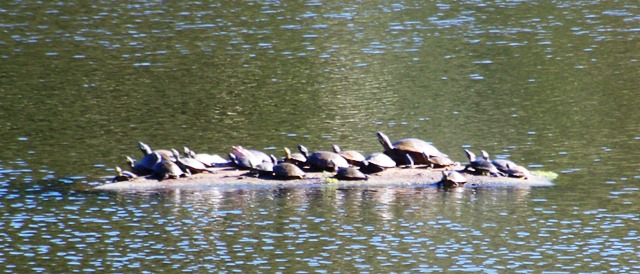
Turtle Row is especially populous on this bright fall morning with all sizes welcome. Snowy egrets walk water’s edge, sampling the bounty of the pond. As I cross the bridge, the falling leaves crackle as they catch a crisp, momentary breeze.

In every direction is awe for the seeing, and I gawk. After some time I realize I have assumed Mountain Pose or Tadasana: spine straight, knees together with toes pointed in slightly to even my stance, head lifted in full appreciation of just being at Waverly.
Snowy Egret in fall 1013

Among the many gifts of yoga is learning to move mindfully, neither straining nor restraining the body but moving according to its level of flexibility.  Yoga is my dialogue with my physical self; each movement opens my body to response. I have come to recognize the sensation of the flow of my own energy, my own Waverly.

In the real Waverly, my steps are deliberate—once I would have characterized them as slow—sinew connects muscle to bone in simultaneous stride, a mind-body connection. There is a light awareness of sensation with every breath, with every step.
Turtle Row in fall 1013

It is a familiar, meditative energy that I have come to appreciate for it is present in a moment of monkey mind or one of being with nature. Such a meditative state always serves, highlighting the sensation of the physical self as the mind drops in thought after thought.

Walking Waverly, I open to its energy, swinging my arms and flexing my fingers just because I can. Images of past yoga sessions drop in and out of my walk, as if to remind me of the first time I felt warmth coursing up and down my legs. It is the energy of life.

I remember that I have not always acknowledged the energy of my life. Just because I was able to walk did not mean I was mindful of my body movement in any regard. It is possible I am receiving another chance despite decades of inattention to my physical self other than to constantly demand of it.

So on this morning as I walk Waverly again, I am mindful of the wonder in every step.
Waverly shade 1013

Why Confine Peace to a Dream?

There is no peace in dreams
only the drama of nightly wandering.
Fractured images, salvaged glimpses
of what might have been….

Some twenty years ago–maybe even longer than that–these lines opened an untitled poem I never completed. The lines have stayed around, although it is not as if they are always with me.

It is the nature of the unfinished to reappear and so it did when October’s Bloggers for Peace post challenge was announced: describe your dream of peace. These many years later, my mostly Buddhist self believes peace is accessible in every moment so why confine it to a dream?forpeace6

If I have a dream of peace, it is for a day like today, full of the daily drama of the story we live, each moment ripe with possibility. The state of world peace is the reflection of our inner revelations regarding ourselves.

As Mooji said, “You don’t awaken to Truth by analyzing the dream. Find out who the dreamer is.” Our truth is our inner state of peace, an ongoing awakening from one dream after another.
Sands of Truth 1013

Dreams allow us to test our truth in single scenarios, salvaging glimpses of what might have been for no peace, no truth ever stays forever.  It is not the nature of being.

The reason everything looks beautiful is
because it is out of balance,
but its background is always in perfect harmony.

This is how everything exists
in the realm of Buddha nature, losing its balance
against a background of perfect balance….

~Shunryu Suzuki~

Dreams pass into memory where they pop up like lines of a lost poem, an opportunity to reexamine what once was, a momentary imbalance. Such is the undulating weave of existence—the web without a weaver—the constant that holds the chaos of everyday drama. 

Listen closely… the eternal hush of silence goes on and on throughout all this,
and has been going on, and will go on and on.
This is because the world is nothing but a dream and is just thought of
and the everlasting eternity pays no attention to it.

~ Jack Kerouac~

It is the nature of peace and dreams to wander in and out of every moment of existence. The challenge is to remember we are part and parcel of that everlasting eternity, offered one experience after another, day and night.

If we try to hold a dream, to confine it as we wish it to be, it splinters; all we salvage is a glimpse of what might have been. We find it unsettling to view peace and dreams as elusive—it is like trying to touch the wind—but we can breathe the air that is available, seek the peace that is accessible. 

A good traveler has no fixed plans
and has no intent of arriving.

~Lao Tzu~

Footprints 1013
KMHuberImages

Opening to a New Wind, the Sea Oat Nods

Sea Oat 1013Sometimes, it is merely a matter of bending with the breeze, opening up to what is available, allowing a new perspective. As Mark Twain said, “Loyalty to a petrified opinion never yet broke a chain or freed a human soul.” Nor will it ever for “openness is like the wind. If you open your doors and windows, it is bound to come in” (Chogyam Trunpa).

Openness is the stuff of adventure, and if given a choice, some step back from it. It is the unknown, the uncertain, the unproven so unlike all the labels to which we cling. Yet, at one time or another, the air in our lives grows stale, and we open to a new wind.

Every year, fall is my fresh air. It has long been my favorite season. Even when I lived in the West, I preferred fall to spring, which was an infrequent visitor to the high plains desert. Yet, the rare Rocky Mountain springtime meant seemingly endless prairies of wildflowers.

Now living near the Gulf of Mexico, I find fall comes gradually, mostly, a cooling down to allow another crop of vegetables, another round of blooming bedding plants. This year, fall feels as if it arrived over night, perhaps an afterthought of Tropical Storm Karen who managed to puff herself up a bit but was too disorganized to do much other than blow in autumn. Or at least that’s when I first felt fall.

It is my first autumn without Cooper. We enjoyed every season but when fall temperatures became the norm, we took to the road, sometimes every day of the week.  I smile at the flood of memories, ever grateful for each one. They open me to the fall that is, and I am ready for an outing.

Cooper Going on a Bye-Bye

It is easy to see Cooper in my mind’s eye sitting in the passenger seat as I drive to Mashes Sands, one of the few places on the Gulf coast that Cooper and I did not explore, although I cannot think why.

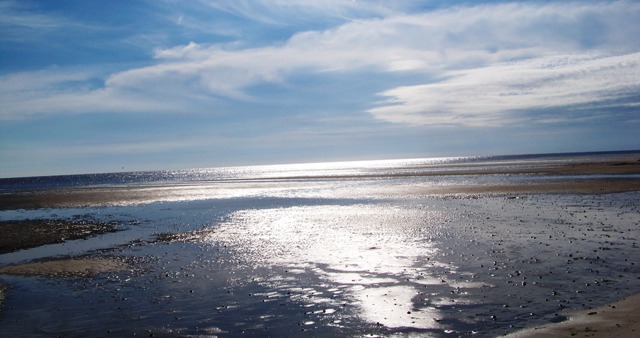
A day of sun and blue, the Gulf sparkles at low tide. The breeze is slight as I admire the sea oats so long absent after previous years of hurricanes as well as some recent tropical storms. Breathing in the salted air, I open to the moment of sun, sea, and me.

Sitting on the sand, I close myself to the openness always available in the gap between thoughts, in the pause that awakens awareness. All around me there is sentient movement, coming and going, ebbing and flowing. The fragile but flexible sea oat nods, finding it not difficult to bend, to open completely to possibility.

I hold sand in the palm of my hand as I squint to “see the world in a grain of sand” for I know it to be true. Thoughts fall left and right, like the sand flowing through my fingers, until each grain of thought mingles with all the others to become one. And that, too, is impermanent.

Before this fall ends, there are more breezes, gusts and maybe even gales to come. It is a matter of throwing open the doors and windows for whatever way the wind may blow, and like the sea oat, nod in acceptance.

KMHuberImages
KMHuberImages

Transformation Requires Refraining

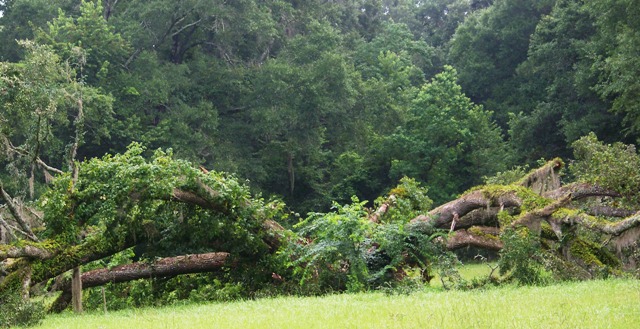
Tree sprawl 0713

Often, we get caught up in transforming our lives. We decide that we will no longer assume an old way of being or an old way of doing. In other words, whether it is New Year’s or not, we make a resolution not only to do better but to be a better person. Just like that.

What we discover is that letting go of a habit or a behavior requires a lot more than filling ourselves with resolve. Letting go is a lifelong practice for we revisit old habits, old behaviors–neuroses we once cherished–often, we recognize them immediately but sometimes, they are disguised as something new and possibly, beneficial.

 The three difficulties (or the three difficult practices) are:

1.   to recognize your neurosis as neurosis,
2. then not to do the habitual thing, but
to do something different to interrupt
the neurotic habit, and
3. to make this practice a way of life

(Pema Chödrön)

Recognizing what we no longer wish to do or be is usually obvious but recognizing all that it has meant to us–how it has disguised itself in order to be an integral part of our every day– is a lifelong practice of recognizing neurosis as neurosis.

For a while, just rising above the neurosis is reward enough. Yet, life is uneven and the rise of the unexpected often dissolves our resolve whether it lasted for minutes or months. Thankfully, life is impermanent, and we get lots of practice in letting go.

What we get to do each time we recognize that once again we have invited in a familiar neurosis is to accept that is exactly what we have done. That is the first step in letting go, accepting what is. Think of it as resolving to refrain rather than resolving to deny.

Refraining comes about spontaneously when you see how your neurotic action works. You may say to yourself, `It would still feel good; it still looks like it would be fun,’ but you refrain because you already know the chain reaction of misery that it sets off.

 (Pema Chödrön)

Even if we have begun to set off the chain reaction, we accept that we have and refrain from going any further. We set our resolve to refrain because we accept where we are. Refraining allows us to halt and not go where we have gone before and unhook from the neurosis.

Resolve serves us as long as it is to accept that life not only changes but masks itself in new faces and different viewpoints, allowing us to experience familiar habits, recognized behaviors, and old relationships through yet another perspective.

Transformation is not a matter of discarding but an accepting of all that we are and were. Such resolve is the genesis of transformation, a lifetime practice of experiencing, letting go, and when we are ready, refraining.

heart of tree 0713
KMHuberImages