On Not Becoming a Buddha

Above all, don’t wish to become a future Buddha;

Your only concern should be,

As thought follows thought,

To avoid clinging to any of them.

~Dogen~

Hawk looking down 0614I do not think I have ever wanted to be a Buddha. I do not remember that thought at all. I do focus on trying not to cling to my thoughts but my lifelong practice of hairsplitting has been a sanctuary as well as a war.

My fondness for making excessive distinctions in reasoning allows me to dress up old behavior as new. I may not have expressed a wish to become a Buddha, but I have desired acquiring inner peace for the rest of my life.

Quite often it feels as if I am stomping through myriad thoughts, trying to shake off first one and then the other. I am amazed at the substance I give to a thought–I walk around in it–giving it a life it does not have.

Usually, it is a thought I know well but until I have examined it thoroughly, I am not able to let it go. I like to think that hairsplitting serves me here, much like Ajahn Chah’s distinction between holding and clinging:

We pick up [a flashlight], look at it and see, `Oh, it’s a flashlight,’ then we put it down. This is called holding but not clinging, we let go. We know and then we let go. To put it simply we say just this, `Know, then let go.’

~Ajahn Chah~

For me, knowing to let go requires trust, and when I do, the named thought floats by, a mere reminder of what is. However, knowing an object, a thing, is easier than meeting a familiar emotion.  Yet, the practice is the same.Hawk looking up 0614

In fact, the practice of looking and letting go is what the mind learns to trust; Chah says that in “constancy of mind, wisdom arises.”

That constancy of mind is what I need most when emotion pulls at me, when I face patterns of a lifetime. Hairsplitting allows me to breathe between thoughts but it also makes for interesting detours.

As I began my regimen of healthy eating, meditation and yoga, I defined and redefined my practice of each as well as the union and intersection of all three. That is neither bad nor good but my initial focus was on results and now, it is to live.

In the beginning we practise with some desire in mind; we practise on and on, but we don’t attain our desire. So we practise until we reach a point where we’re practising for no return, we’re practising in order to let go.”

~Ajahn Chah~

“Practicing for no return” would not have been what I needed to know as I began my practice. I would not have trusted it. My wishing to become a Buddha was disguised as various emotional and physical health goals. In order to change my physical and emotional being, I had to let go of trying to become a future Buddha.

Life as a Juggler

The act of living, breath by breath, is our practice, unique to each one of us and universal to all. Our practice is what we do with the life we have. In some form or another, this idea has always framed the way I live.

where now 0425

There were the decades that I brandished about the label of 19th century romantic, comfortable in believing that life is in the striving and the arriving is secondary. It was my variation of Emerson’s “life is a journey not a destination.”

For me, however, arriving was important. It meant goal accomplished, an item checked off my list. Age has shown me that the value of a list is in its items. If the items reflect our practice, every day is a fresh read of our life list.

These days, my list is limited to four: compassion, loving-kindness, joy, and equanimity for all in all things. This universal list is inherent in every major spiritual tradition, eastern or western. They are not items to check off but to practice in every experience I have.

What we give to the world is our daily practice; it reveals how we are doing.  At the age of 90, cellist Pablo Casals said he continued to practice, “’because I think I am making progress.’” Practice is personal first and public second.

 To be disciplined is to follow in a good way. To be self-disciplined is to follow in a better way.
Corita Kent

I came late to practice and its heart, discipline, but I arrived.  My daily practice of meditation and yoga bring me to my list of compassion, joy, love, and gratitude every morning. Some days, I can see progress but there are many days of practice for its discipline.

In the thick of it 0425

Discipline helps me as a writer and as a chronically ill person, as my life not only constantly changes but expands in ways I never imagined. Yet, the list that guides my life stays the same. No longer interested in striving or arriving, I perceive my life through perspectives new and bold. My discipline is not manipulating my state of being but being in my life as it unfolds.

My life and my list differ from yours yet it is the practice of our lives that connects us. Together, we are coloring existence for every other form of life.

In my life practice, meditation is more than a matter of sitting in stillness. It really is a matter of “changing postures,” as Ajahn Chah called it, bringing stillness into the chaos of every day as life unfolds, moment by moment, nanosecond by nanosecond.

I am learning to juggle rather than to struggle, no matter how many balls are in the air. I need only watch one at a time to keep all the rest in the air, allowing attention to each in its turn. It is my practice of the list that is my life.

Juggling for space 0414

A Way I No Longer Am

Bloom is off 0414Let me begin with a question: what of the moment when the cocoon is no more? All is new, unknown for this form of life. It is a moment of dramatic tension as well as one of wonder. Life is crisp, clear, completely in focus; there is just so much of it to explore.

One life has ended and another begins.

I had never considered the falling away of the cocoon. In not doing so, I missed the ending of one way of life and thus, the beginning of the next. Life cycles and while a cocoon is only a stage, each stage must have its moment—from beginning to end–so that the next may emerge. No matter how many times the cycle repeats each stage is unique.

It is not easy to let go of a way of life, especially the nurturing stage of a cocoon. Yet, in order to experience life through another perspective, the cocoon must fall away for the new form to live.

Five years ago I retired, believing I would regain my health by modifying my life. From a Buddhist perspective, I stayed stuck in samsara (the cycle of suffering), trying to live a way I no longer am.

I did not know then what I know now. The cocoon has fallen away, and the way of life that is emerging is familiar but its form is unique. It is one of less movement and more being.

In Buddhism, one develops the practice of loving-kindness and compassion as well as joy and equanimity for all in all things. I like to think of these “four sublime states” developing in stages as my practice of them grows. Some days, there is no growth but always, there is practice.

In these last two months, my practice has undergone such a dramatic change that my life feels new. I am curious and excited about this new form of being and what I will discover.Not a cocoon but a bud 0414

No longer trying to live a way I no longer am, I open to life turning on a dime. In a moment, it will turn again. Never has impermanence seemed so full of possibility. Once again, chronic illness opens me to another perspective, another way to be. I am not lupus or any of the labels that I have accumulated over the decades for as the Buddha taught, there is “no fixed or unchanged self.”

However, there is a body and a mind that cycle through my lifetime. For over half of that life, my mind and body experience has included autoimmune disease. Now, in this new stage of life, my mind and body are adjusting to the consequences of living with decades of disease. There is a wearing away of the old as the new comes into being.

In order to discover all this new stage offers, I must be more mindful than I have ever been. That much is clear. More rest for the body, more tolerance for the thought chatter.

I am neither my body nor my mind but I am experiencing a lifetime through them. For me, the challenge is and has been to be. Perhaps it is for most, as change excludes no one and no thing.

Stage after stage, the cocoon falls away.

Perhaps a Glimpse of Buddha Nature

Every once in a while I think I catch a glimpse of Buddha nature. Actually, it is more of a feeling than an actual sighting. In other words, any “aha-moment” vanishes the moment the recognition is mine. I suspect that is how it always is with Buddha nature.

Budda Nature glimpse 0414

Even the term, Buddha nature, is known by many other names. For me, it is the eternal aspect of existence–energy vibrating in infinite dimensions and form as matter and anti-matter—creating a background of immutable harmony so that we are able to live our lives with choice.

The reason everything looks beautiful is because it is out of balance, but its background is always in perfect harmony.

This is how everything exists in the realm of Buddha nature, losing its balance against a background of perfect balance.

~Shunryu Suzuki~

Suzuki’s description is a familiar one on this blog, as I have cited it many times. For me, it is the essence of the feeling I get whenever I sense Buddha nature. No matter the definition or description, the idea of a balanced background against the days of our lives means we always have options.

For me, Buddha nature is what I am and have been from my inception, the blank canvas that was me at birth. If I look closely at this painting that is my life, its background is in perfect balance, allowing me to lose and regain myself moment after moment.

New growth 0414

Dates and years frame the triptych of my past, present, and future. I am the artist’s brush, swirling with the color of every choice, stroke after stroke on the canvas that is my moment in Buddha nature. Its balanced background—the context of my life—absorbs the outcome of each moment that is my life.

Buddha nature does not allow me to slide through my life unaware or it does. The choice is mine. In any given moment it is up to me how aware I am of my own brush stroke. In mindful moments is when I glimpse Buddha nature.

The moment is hazy at first, floating in and out like any other, yet its rhythm is different, like an undercurrent that absorbs rather than pulls. Maybe this is what synchronicity is; regardless, I am immersed in it. In such a moment, the ending is as uncertain as is the beginning but I am bothered by neither.

Rather, it is like a story that begins with “once upon a time” and ends with ever after and forever. I am confident there is a bridge between the beginning and the end and indifferent to the outcome. Buddha nature has the essence of a rainbow, a bridge to and from and back again.

Only life is in flux, neither ending nor beginning but always being, not a snapping of photographs or a study in stillness but a series of scene changes as the stroke of the artist aligns with change against the constancy of Buddha nature. The painting that is my life is only one scene in the tapestry of existence yet mine mirrors all others in that it is lived.

As I say, every once in a while I think I get a glimpse.

When Spring Occurs Inside and Out

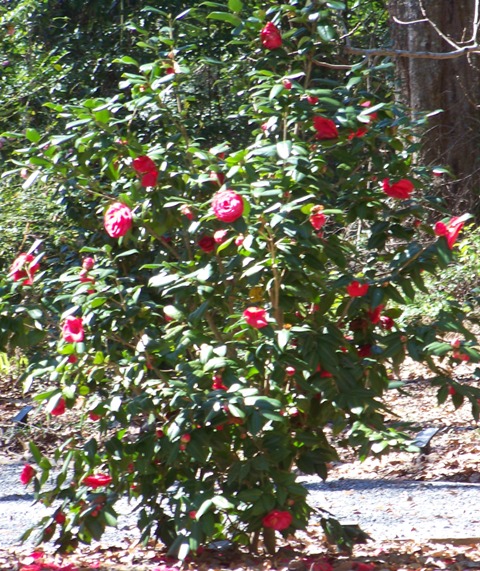
Waverly Bush 0314Every moment is the best time to begin. Beginnings are never out of season no matter what the weather is in your heart or outside your door.  Every once in a while, spring is the season inside and out.

No matter the season, we welcome its beginning for in opening ourselves to any season, we stand at its threshold new, and the possibilities are infinite.

Ten thousand flowers in spring, the moon in autumn, a cool breeze in

summer, snow in winter.  If your mind isn’t clouded by unnecessary things,

this is the best season of your life.

Wu-men (as quoted on Zen Flash)

In each moment of every season, we thrill to the unfolding of what we do not yet know. All together, these are the years of our lives, each with its own spring, summer, fall, and winter.

Sometimes the spring of a year, both within and without, is sporadic in its blossoming but nonetheless, in spring all comes alive again, anticipating the produce of summer, the harvest of fall, and the sleep of winter.

Of course, each season has its days of clouds but on the clear days of spring, eternity seems within our reach for the bursting forth of life is the promise of forever.

A wonderful fact to reflect upon, that every human creature 

is constituted to be that profound secret

and mystery to every other. 

Charles Dickens (A Tale of Two Cities)

Weather in weather 0314

In any beginning of any season is the promise of life’s renewal for every sentient being. There is birdsong, the greening of grass blades; there is the flight of the insect, dazzled in its moment of life.

It is in a moment’s beginning that all seasons start. Beginnings are for poets and painters capturing forever a moment in a blossom’s life, the uncovering of what was once winter stilled. A season begins the life cycle.

In the moment that is spring the world awakens because we, too, awaken, stretching for the infinite possibilities inherent in every beginning. There is spring in such a moment, and we wrap our arms around life.

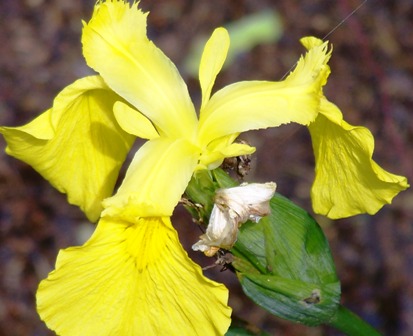
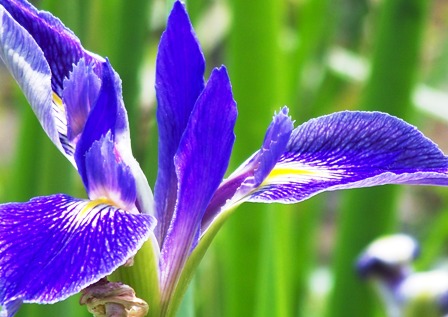
Iris in spring 0314

All winter long, underground roots have embraced one another in frost or warmth, sharing nutrients through the stillness in anticipation of the moment of movement that is a thaw or a breaking of the surface. Life begins again, unpredictable but renewed.

Where I live, it is the season of beginning all around me as well as inside me.  I am reminded that I am in constant relationship with life no matter where I am, inside or out. It is the season of my life, rich in bursting forth, magnificent in blossom, resplendent in fall foliage, and sated in winter.

In every beginning of every moment I stretch my arms to the sky in appreciation that I see the sky, whether or not there is weather in it. I am in a moment’s beginning and all that it may be.

It may be the moment that I look into the face of an iris and discover a shade of purple not ever known to me for the light in this moment is new, unlike it has ever been. Together, the iris and I, wild in our ways and settled in others, share in the sentience of being.

Always, we are in relationship with life whether it is an insect, a blade of grass, or a plant in a pot on a bedroom windowsill. We engage constantly in the cycle that is life and from time to time, we burst forth as an iris bloom or as a human, both grateful for another spring inside and out.

Facing the Past Tense

Do not stand at my grave and weep,

I am not there; I do not sleep.

I am a thousand winds that blow,

I am the diamond glints on snow,

I am the sunlight on ripened grain,

I am the gentle autumn rain.

When you awaken in the morning’s hush

I am the swift uplifting rush

Of quiet birds in circled flight.

I am the soft stars that shine at night.

Do not stand at my grave and cry,

I am not there; I did not die. (Mary Frye)

Fifty years of friendship feels like only a moment yet it has been a lifetime.  It cannot be over. Not yet. I want Laziness 010514the conversation to continue but mostly, I want the past tense to be the present.

In death, the past tense looms. My mostly Buddhist self believes the past tense is a series of images always available for viewing but never again for experiencing.

I am not used to the past tense. I am not ready to live with my friend as mere memory.

If I think of my friend as dead, there is a hole in the sky that is my heart. I want to tell her how that feels, how that hole is now my world. The telephone that connected us as we aged from teenagers to sexagenarians is no longer in service. It is past tense.

In the last couple years, this blog provided yet another connection for us.  Sometimes, my posts sparked conversations, and other times, our conversations created posts. On this blog, my friend is eternally present.

Discussion was our way for five decades, not a daily occurrence or even monthly, but whenever there was a hole in the sky for either one of us we seemed to sense it. There would be a phone call or an email when least expected and most needed.

My friend was not one who labeled but one who listened. Her innate compassion and loving-kindness opened her to the world wherever she was. And the world responded to her light.

KMHuberImages

Along the wend and way of our lives, we each explored Buddhism and over the decades offered our experiences to one another. In these last three years when illness once again marked my life and then for the first time hers, we found ourselves less concerned with outcome and more with exploring the energy of raw emotion.

We were less interested in questions so we had little use for any answer that might appear for we recognized all outcome as temporary. It kept us curious, this being in the moment. We explored eternity as a web without a weaver, its vibrations animating humans, blades of grass–lifetime after lifetime–perfect in its impermanence, forever coming and going.

She is gone in a way I knew and exists in a way I am yet to know.  She is in every breeze, blossom, and glint of light in a night sky. She is. The past tense is no more.

My thanks to Diana J. Hale for her recent post, In Memoriam, as it led me to Mary Frye’s poem, which I could not seem to locate.  Also, thanks to all of you who have sent personal messages. I will respond to each one.

The Eternal Now of All Seasons

The holiday season and I have an ambivalent history. Some years, I was unable to let the season go, and other years, I never quite showed up for it. Yet, there is one seasonal constant: tradition says we harvest in fall and give thanks; as winter begins, we give gifts, goodwill among them.

All that is left

to us by tradition

is mere words. It is up to us

to find out what they mean.

~ ibn al-`Arabi~

In the Midst of 112113

Each holiday season, I reconsider its traditions in words well-worn as well as new ones:  “…to be detached from both the past and future [is] to live in the Eternal Now.  For in truth neither past nor future have any existence apart from this Now; by themselves they are illusions” (Alan Watts).

The promise of the Eternal Now is life as a seamless season, gifts available in every moment of eternity. If we embrace this holiday season as the Eternal Now, we open ourselves to a way of life that extends goodwill this day and every day.

Yet, any moment of the holiday season offers us experiences that unwrap us raw. These are gifts that cannot pass quickly enough–or so we think–whether it is the first holiday of loss or just another year that we mark a loss. We remember, as we should.

Like the holiday season, the Eternal Now is not a matter of endurance but a matter of meeting each moment just as we are. We may only manage a breath but that is enough to take us into the next moment. Emptying ourselves into loss opens us to gratitude for having loved at all. In love, we let loss go.

Strolling along 112113
KMHuberImages

For those holidays I could not let go, I was clinging to the bright and shiny rather than experiencing them. I never really opened their gifts. In those years I completely avoided the holidays, I was surrounded by sparkling gifts not only unopened but unnoticed.

In trying to hold onto a moment and make it stay, we cause ourselves to suffer; if we refuse to show up, we are still seeking what is not and we suffer.  Yet, the field of infinite possibilities is always available to us as long as we breathe for we are never out of sync with the Eternal Now, no matter what.

“You may believe yourself out of harmony with life and its Eternal Now; but you cannot be, for you are life and exist Now—otherwise you would not be here” (Alan Watts). We can celebrate our entire lives with the warmth of the holidays if we remember that existence— the Eternal Now — is always in perfect harmony.

My gift to you, and thus to me, is a life lived in the Eternal Now in all seasons.

Regular blog posts will resume December 8, 2013.

Walking the Walk of Friendship With Pema Chödrön

Recently, I “Walked the Walk” with Pema Chödrön at an online seminar offered by the Omega Institute. Chödrön has the ability to make you feel that she is speaking only with you; I have found the same in reading her books. In my mind, she and I converse frequently.

Chödrön is anything but pretentious—no transcendental soaring with Emerson’s oversoul or escaping into the ether—she is often pithy, adept with any koan, softening much of what she says with anecdote. Frequently, humor is the connection with her audience.

Warning us to beware of “spiritual people” dressed in special clothes to draw attention to their spirituality, she directed our gaze to her own Buddhist nun clothing of burgundy and yellow. Then, she looked up and smiled, eyes twinkling. Laughter filled the room. When all was quiet, the two-day retreat began.
Road Awaits 072813

In walking with Chödrön we explored “making friends with ourselves” unconditionally. Kindness, compassion, and a deep love are what true friendship offers. Why not become friends with the one we know best?

Being friends with ourselves does not mean that we will not know disappointment or concern for in all relationships there are times of confusion. Yet, at some fundamental level we trust the confusion will pass for deep friendship is worthy of unconditional reflection.

Reflection—specifically self-reflection—is found in all of the great spiritual traditions for it is in reflection that there is transformation. In making friends with ourselves, we learn who we are. The transformation comes with accepting who we are unconditionally. As our biggest supporter and ally, we show up for life.
Path in Mic 0713

“Don’t speak, don’t act” is what Chödrön offers as a way of meeting the moments of every day. It means we embrace the feelings we have about what is occurring—we receive what we are given–without the reaction of a label, judgment or opinion. We experience the rawness of the moment.

In embracing the emotion of each experience without acting or speaking, we are practicing what Chogyam Trungpa Rinpoche calls the “reference points of nowness,” gaps between experiences that allow us to strengthen our minds as we meet the moments of life.

The reference points are the practice, and the attitude is one of developing an unconditional friendship with ourselves. With gentleness and kindness we become fully aware of all of our traits. The key is to accept them–give ourselves a break— for that is what we do for friends.
A Closer Look 081913

Chödrön suggests dissecting F-E-A-R as a specific way to examine those darker characteristics that are in all of us. In revealing them, awareness begins and transformation is possible.

F— find it in your body

E— embrace it

A—allow the thoughts to dissolve; abide with the feeling

R–remember or recall that other people are also feeling it (Pema Chödrön , “Walk the Walk” seminar).

Pulling apart fear creates an atmosphere of kindness and compassion. Unconditional means that no matter what we are there for ourselves.  It is not a matter of condoning behavior but viewing it with an open heart. We see and feel with our heart; we listen and experience with our head. It is our heart that leads.

We make choices to cease our suffering. We remember that temporary gratification is unconscious thought, a repetition of old behaviors, following old patterns with the same results. “We do not have to bite that hook” (Pema Chödrön).

It takes courage to be vigilant, to live with an open heart, but the reward is a life of compassion and kindness with ourselves and thus, with the world. It is experiencing life as friends. “Show up for life as it is and drop your preconceptions of how it should be” (Pema Chödrön).

KMHuberImages
KMHuberImages

Life Churns for Everyone so Why Swirl With the I?

As Pema Chodron says, “there is no way to make a dreadful situation pretty.” Often, I find myself searching for language that removes the dualistic labels of good or bad, happy or sad. For me, writing makes this somewhat easier for it affords a pause, whereas in conversation, I tend to forget the gap between thoughts and even my breathing is shallow.

These past few weeks have been full of opportunities for me to “make a big deal” out of situations or to remember that the underlying emotion of my experience is what every other human being feels at one time or another. Remembering that we are all in this together reminds me of what I have in common with all sentient beings.

My specific moments are unique to me yet woven into the undulating life “web that has no weaver.”* One week it was a car mishap and the next moment it was a family member facing a life-threatening situation. The illness was not entirely unexpected, unlike the car incident, yet both provided a life-changing moment. Life churned.

Life Churns 100413

The car is repaired but the loved one’s recovery remains uncertain. The human body, our personal vehicle, endures a life of dents, and occasionally, broken parts. We heal or get replacements but I suspect the heart and mind–and in that order–have more to do with longevity than repairs to the physical body.

Regardless of the wearing out/replacing of parts, all are allowed a life, a length of time known to none but allotted to each. The not knowing churns the emotional pool within each of us. Whether we choose to immerse ourselves in the eddies of emotion or await the stillness that comes with reflection is the ongoing dilemma.

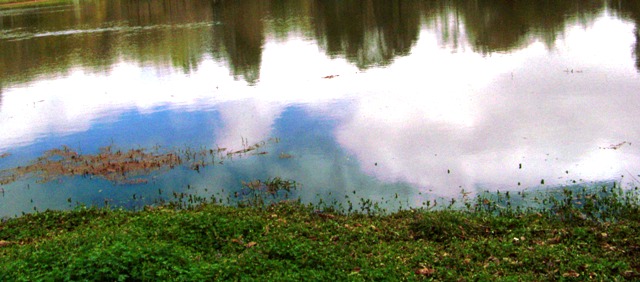
“Like water which can clearly mirror the sky and the trees only so long as its surface is undisturbed, the mind can only reflect the true image of the Self when it is tranquil and wholly relaxed” (Indira Devi).

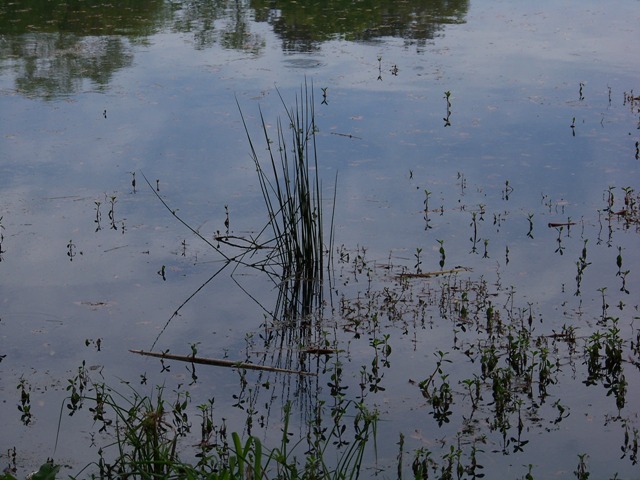
Reflecting Pool 100413
KMHuberImages

Initially, I swirl within the emotional eddies more than I sit in reflective pause yet I know it is the motion that separates me from everyone else. The swirling, downward spiral isolates me in my own pain, unaware that my pain is what connects me to humanity.

“Shantideva said that since all sentient beings suffer from strong, conflicting emotions, and all sentient beings get what they don’t want and can’t hold on to what they do want, and all sentient beings have physical distress, why am I making such a big deal about just me? Since we’re all in this together, why am I making such a big deal about myself?” (Pema Chodron).**

Until we see in ourselves those emotions that we so readily assign to everyone else, we cannot pull ourselves out of our own pain to reflect on the pain that connects us all. In recognizing the human bond, we come to reflect on what is common to all.

We must dive deep to sit at the still waters of our own existence to reflect upon the life force that binds us all.

A personal note: As of this writing, my family member’s recovery continues to be remarkable as well as inspirational.

Text Notes:

*This phrase is from the title of Ted Kaptchuk’s thorough book, The Web That Has No Weaver: Understanding Chinese Medicine. I highly recommend it.

**Omega Institute is offering another online workshop with Pema Chodron on October 25-27 with early bird pricing. The event is sold out for anyone wishing to attend in person. Click here for more information.

Thursday Tidbits: Ever Evolving Peace

Peace quote pic 091913 with text
KMHuberImage

Although Thursday Tidbits posts remain irregular, the Bloggers for Peace movement stays the course in its challenge to bloggers. For September, participants are to post a single quote for peace, a single statement that each one of us might remember the next time disagreement seems inevitable.
forpeace6

Not surprisingly, I turn to the words of the Buddha so frequently offered on the ever-wonderful blog, Zen Flash. For me, this past week has been one of discovering the broader dimensions of compassion—in more than one moment I was found lacking–all will be revealed on Sunday in a regular blog post. Between now and then, I hope you visit some other Bloggers for Peace posts:

Spunky Wayfarer

Bishop Eddie Tatro’s Study

Becoming a Writer

Indira’s Blog

Card Castles in the Sky