Flare or Fog, It Matters Not

“Don’t pursue your passion. Be it” was Anita Moorjani’s response to a Hay House interviewer’s request for one bit of advice for everyone. The interview was months ago but the words stayed with me, like distant notes of a tune I almost recognized.

The words dropped in and out of my attention, showing up when I least suspected them. About ten days ago, the lupus flare I thought was on the wane gained new life, joined by the light of Sjogren’s syndrome.

It has been four years, maybe even five, since I have known the light of a Sjogren’s flare so it took me a while to recognize it. Sjogren’s attacks the body’s moisture glands–the exocrine system that produces tears and saliva—the primary symptoms are dry eyes, dry mouth, and fatigue. Even with the use of prescription medication, my salivary glands were destroyed years ago.

For me, Sjogren’s has always meant debilitating fatigue but in tandem with lupus, the brain fog and joint pain are in high evidence. I have to be careful not to give them too much credit because they will take it and more. They can seem insatiable.

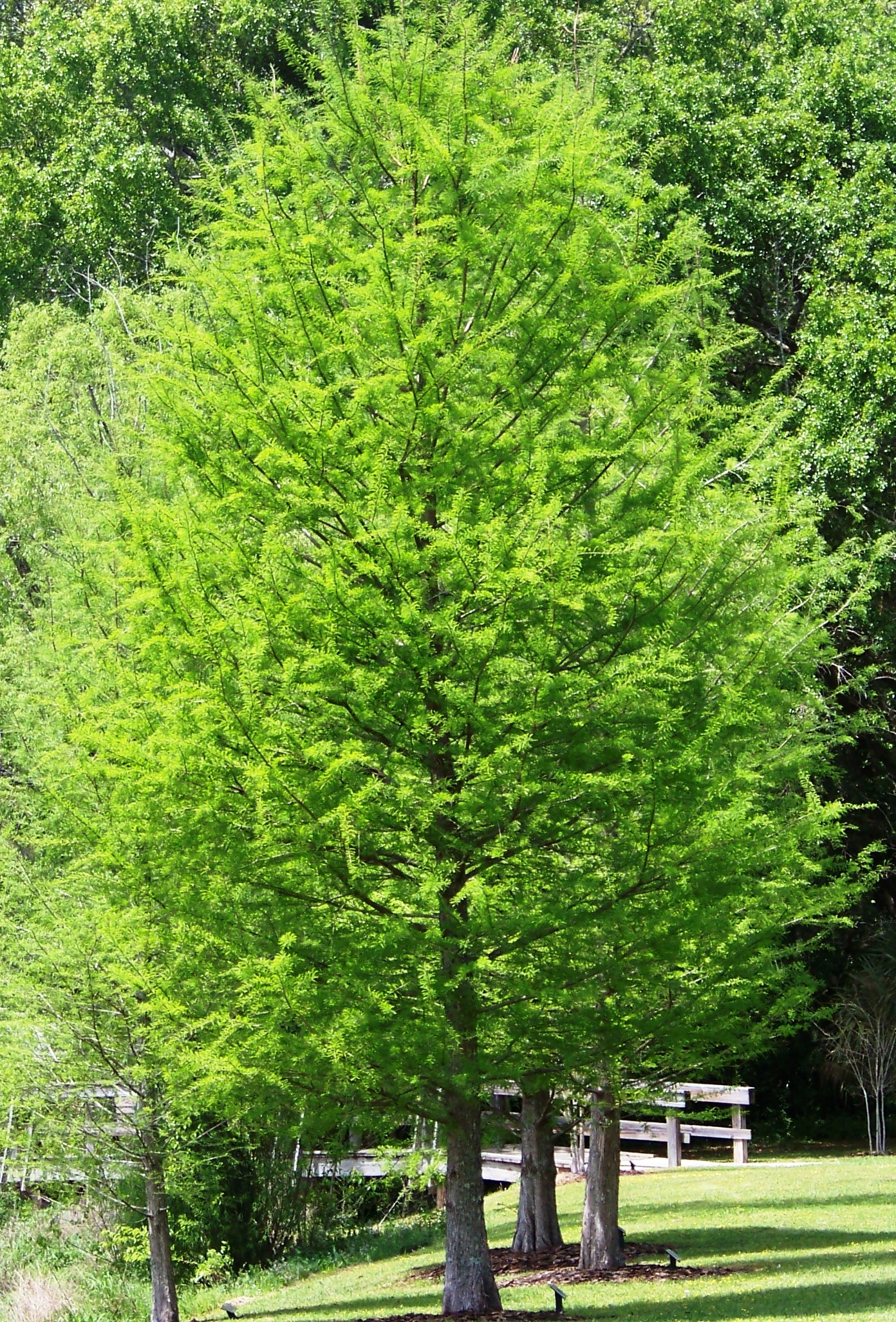
Foliage Waverly 0713

For me, any kind of flare is a flash of light within a fog for the brighter the flare, the thicker the fog. I sense the energy of the flare but the fog is just as intense; for the past ten days, it has been flare and fog, quite fatiguing.

Still, Anita Moorjani’s words wandered in and out of my days for passion is the energy of this flaring duo. As the fog began to lift and the energy of the flare remained, the question emerged: what if I stop pursuing my passion? There is still sufficient fog but the question is clear enough to be considered.

I am not given to labeling passion, not in my later years anyway, but the gift of such flares is to be in life fully, letting one moment go for the next. Each moment presents its infinite possibilities, if we will allow it to reveal itself.

“To access the state of allowing, the only thing I had to do was be myself. I realize that all those years, all I ever had to do was be myself, without judgment or feeling that I was flawed” (Anita Moorjani, Dying to be Me).

KMHuberImages
KMHuberImages

Perhaps, being one’s passion is a mere matter of showing up for every moment mindfully, whether in fog or in flare matters not. It is a thought that enters my mind but I push it away in favor of sleep. It revisits me in my next morning’s meditation; I am tired and take a while before sitting meditation but I sit for my usual hour.

The morning is as it has been for over two weeks–overcast, humid, and rain seems imminent–but as my morning meditation ends, there is not yet rain and as often happens, I have more energy after meditation.

I decide to go in search of Lake Miccosukee, something that has crossed my mind from time to time but the moment never seemed to suit. The morning is still early, hazy with humidity, and I am a bit foggy myself so we are a perfect fit.

Driving down canopy roads of Live Oaks, crape myrtles bloom beneath the oak boughs as does the delicate mimosa. Many consider the mimosa a weed for it grows quickly anywhere, offering feathery blossoms in a fan like wave. I admire the mimosa’s tenacity to bloom, to return time and again, only to be chopped down. Nature is perpetually passionate.

Arriving at Lake Miccosukee, I have the boat dock all to myself for a moment, unbelievably good fortune and an omen for the rest of my day. Miccosukee is a prairie lake. Sometimes, it’s a prairie and other times it’s a lake, too, but always aquatic plants are abundant.

Prairie Lake 0713

I have grown used to lakes controlled by sinkholes, coming or going, either way works. In this moment, Lake Miccosukee is a floating prairie, and it occurs to me that here is yet another version of the island of vegetation from The Life of Pi. Imagine that.

I am already tired but it has been another marvelous hour. Would that all mornings were just like this one but if they were, this one would not be what it was, its own. I am learning the practice of being one’s passion, allowing the day to unfold, be it in flare or fog. It matters not.

“When coming out of sitting, don’t think that you’re coming out of meditation, but that you are only changing postures. If you reflect in this way, you will have peace. Wherever you are, you will have this attitude of practice with you constantly. You will have a steady awareness within yourself. The heart of the path is quite easy. There’s no need to explain anything at length. Let go of like and dislike and let things be. That’s all that I do in my own practice.

~Ajahn Chah~ 

Again, thanks for all of your warm wishes and kind words as I sit within the flare of this fog. My plan is to post weekly, whether it is a Sunday Something or a Thursday Tidbit but I am letting nature be my guide.
Sitting With the Wolf in Stillness

Every morning, I spend an hour in meditation followed by an hour that includes exercise, shower, and breakfast preparation. It is this mind-body connection that begins my day. While I will revisit physical exercise and food preparation, no day opens without meditation.

Empty yourself of everything. Let the mind become still. The ten thousand things rise and fall, while the Self watches their return. They grow and flourish and then Return to the Source. Returning to the Source is stillness, which is the Way of Nature.”
~ Lao Tsu ~
Tao Te Ching

During my recent lupus flare, it was meditation that allowed me to empty and renew myself for the rise and fall of the ten thousand things. It was meditation that allowed me to explore the energy underlying every form of discomfort, the internal investigation as Devaji refers to it.

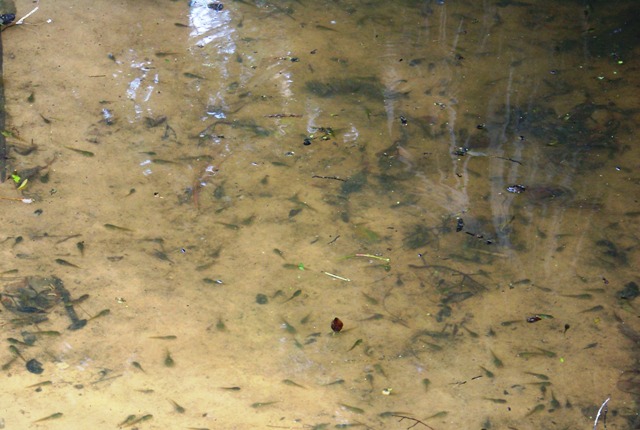
Tadpoles Waverly 0613

When there is internal investigation as opposed to following the external movement,
it is possible to recognize that every form of
discomfort, every problem that is experienced, is happening inside of you.
If you do not have a problem inside, you do not have a problem. The mind will say that it is due to something out there, but where you experience the problem is inside
.”
~Devaji~

It is a familiar pattern of mine this looking to the outside for what may only be discovered on the inside. I have done it for almost all of my life but this past year of daily meditation has been a discovery of stillness, which is not to say the mind is ever quiet.

In meditation, which many teachers referred to as “taming of the mind,” there is no effort to reshape or redefine any of our thoughts. In meditation, we observe our thoughts, allowing them to bubble up and away from us without interference, without creating yet another thought.

Rather, we go into the stillness, to the energy producing our thoughts. Always, in meditation there is “light emphasis” on the breath (Chögyam Trungpa Rinpoche) to sustain us as we sit in the stillness of our internal investigation, emptying ourselves.

As I understand mindfulness, it is bringing this technique to our day-to-day lives as they play out among the ten thousand things. For me, that means letting one storyline after another blow right past for I am interested in the energy supporting those thoughts. I am seeking the source.

Tadpole Free 0613

In this lupus flare, rather than pursuing my usual cause-effect-solution approach—another way of describing this is replacing one storyline with another, albeit a new and untried solution—I sought the source, the stillness, with my breath.

Stillness or “nowness” is placing our awareness on our breath as the thoughts bubble up. The breath is no more manipulated than are the thoughts. The more the breath and mind are observed, the more there is just being, no judgment, just stillness.

Internally investigating my lupus flare allowed me to sit in the energy of the ten thousand things of which my life is just one.  Rather than trying to starve or manipulate the lupus–the wolf–that is also of the ten thousand things, I just sat down with it in relationship.

Flares are never without their gifts nor is it surprising that those flares that burn brightest are always the most generous. This time, the gift of sitting meditation with the wolf has opened the door to a lifetime exploration of the rise and fall of the ten thousand things from the inside out.

Thanks to all of you for your generosity and kindness during this recent flare.

In a Free Fall Flare

My regular Thursday and Sunday posts have been rather irregular for I remain in a free fall flare or the state of still falling apart, which is not to say it is not enlightening for it is.

As a dear friend pointed out, a flare is a flash of light, and this recent lupus flare is full of light for me. It is not so much a matter of physical or emotional discomfort but more a matter of “nowness” as Chögyam Trungpa Rinpoche calls it:

“The way to relax, or rest the mind in nowness, is through the practice of meditation.

“In meditation you take an unbiased approach.

You let things be as they are, without judgment, and in that way you yourself learn to be.”
Chögyam Trungpa Rinpoche

nowness 0513

I, myself, learning to be is what this flare feels like, if not quite a true free fall at least in constant motion. Sometimes, the flare feels like a game of pinball, silver-steeled balls bumping up against this teaching only to zip over to that tradition and back up to yet another healing alternative–all disappearing only to re-emerge.

No doubt that sounds rather scattered and perhaps unpleasant but it does not feel that way. Frankly, it feels like heightened awareness for unlike the game of pinball, I am allowed to sit in the energy of each moment and explore it through the practice of meditation.

“Sitting meditation opens us to each and every moment of our life. Each moment is totally unique and unknown….

“This very moment, free of conceptual overlay, is completely unique. It is absolutely unknown.

“We’ve never experienced this very moment before, and the next moment will not be the same as the one we are in now.

“Meditation teaches us how to relate to life directly, so that we can truly experience the present moment, free from conceptual overlay.”
(Pema Chödrön, How to Meditate: A Practical Guide)

Eyes Open 0513

In the eyes open meditation that Pema Chödrön is describing, we separate the storyline or thoughts–the conceptual overlay– from the energy of the emotion or sensation we are feeling. In essence, we are open to it.

I am new to the eyes open meditation that Pema Chödrön advocates and first tried it during the online retreat offered by the Omega Institute. In eyes open meditation, the gaze is downward but the head is erect and one is constantly aware of what is occurring in the present moment.

“Open the eyes, because it furthers this idea of wakefulness. We are not meditating in hopes of going further into sleep, so to speak.

“We are not internalizing. This isn’t a transcendental type of meditation where you’re trying to go to special states of consciousness.

“Rather, we meditate to become completely open to life— and to all the qualities of life or anything that might come along”
(Pema Chödrön, How to Medicate: A Practical Guide).

Relating to life directly 0513

Meditating with my eyes open was not as difficult as I thought it might be, even the first time, but then, I have the advantage of being in a flare, of being in a flash of light. In a flare, it is obvious that the gift of any moment of discomfort is present moment awareness.

Beyond the flare, practicing this wakeful kind of meditation at the start of my day prepares me for the post-meditation moments. Sitting meditation isn’t always comfortable and neither is life but meditation helps us sit down into the shifting emotional energy that flows through our daily lives.

We learn to go deep, beneath the conceptual overlay or storyline, to the energy of our emotions, of our pain. When we sit within the energy of our pain, we see into the state of us. There, we begin to heal—to suffer less—for we accept the alternating pain and pleasure that is the nature of our human condition, part and parcel. We, ourselves, learn to be.

Thank you for reading my blog. It matters a great deal to me that you do.

Being Present in Healing

My recent trip to the American West was, among other things, a test of the holistic approach to disease that I have followed for the last 33 months. My approach is perhaps best described within Deepak Chopra’s definition of quantum healing:

“…the ability of one mode of consciousness (the mind) to spontaneously correct the mistakes in another mode of consciousness (the body). It is a completely self-enclosed process” (Quantum Healing).

Essentially, this mind-body consciousness is a type of “intelligence” (Chopra’s term) attempting to restore balance in a body that is diseased. It was this “intelligence” that made sense to me when I first read Chopra’s book in the early 1990s and again in 2010 when I removed myself from medical care.

KMHuberImage
KMHuberImage

Undoubtedly, it takes a certain amount of desperation and frustration to walk away from medical science, which is not a route that Chopra, a medical physician, advocates. Rather, he argues that medical science can be a viable partner in working with the innate intelligence of the mind-body connection, with the following caveat:

A man-made drug is a stranger in a land where everyone else is blood kin. It can never share the knowledge that everyone else was born with” (Quantum Healing). In other words, every cell in our body has a kind of intelligence with specific tasks and abilities. All cells in the body work together, ever adjusting to what is occurring.

The inherent intelligence within the mind-body connection is one that medical science has yet to duplicate but it does not mean that medical science cannot assist us in our healing. It can and does–for many. Regardless, awareness of the mind-body intelligence can change our lives just as being aware that every decision we make and every thought we attach to affects our physical body directly and immediately.

That is where stress starts, and with increased stress comes imbalance, and when the imbalance is great enough, there is disease and yes, sometimes irreparable damage. The state of disease for anyone is unique but also may be integral to the individual’s purpose as Anita Moorjani suggests:

The reasons for…illness lie in [our] personal journey and are probably related to [our] individual purpose. I can now see that my disease was part of why I’m here, and whether I chose to live or die, I wouldn’t be any less magnificent” (Dying to be Me).

KMHuberImage
KMHuberImage

Disease as a state of health is how one has lived and continues to live. Just as lupus is not cancer—although in both the body is under attack and in both the autoimmune system plays a major role—directing disease is as unique to the individual as is the optimal level of health outcome.

What that outcome is and how long it may take is just as individualistic as is the degree of recovery. At the very least, an awareness of the inherent intelligence of the mind-body connection provides an alternative to  dealing with disease. At the very most, it can change drastically the course of a disease.

The reason why not everyone manages to take the healing process as far as they can go is that we differ drastically in our ability to mobilize it” (Chopra).

KMHuberImage
KMHuberImage

My experience with “incurable” disease is limited to lupus and Sjogren’s Syndrome, the current names for the disease that has been present in my body for at least 35 years. Some medical experts have told me autoimmune disease has been present since childhood. As I am now a sexagenarian, that’s a long time.

My last rheumatologist told me, “There’s just so much wrong with you and it’s been going on for so long.” That is probably still true for that rheumatologist and the entourage of doctors “on my case” but it was not true for me.

I was seriously ill, and I knew it, but I believe “when we get in touch with that infinite place within us–where we are Whole–then illness can’t remain in the body” (Dying to be Me). My intention is not to be smug or simplistic–nor am I speaking of mere positive thinking–my awareness of the inherent intelligence within my body-mind connection opened me to how I live as well as how I have lived. It gave me a place to begin some 33 months ago, and for me, it has meant drastic changes.

My life does not resemble the life I once knew, nor will it ever. It is not a life free of disease—not yet and maybe never will be–but it is a life aware of the possibilities in each moment I have. It is a life lived from within, and only now do I see the world as it really is, moment by moment, the only reality I ever have.

Thursday Tidbits: Digging Deep for “Meraki”

This week’s Thursday Tidbits considers meraki, a modern Greek word for that “extra something” we add to whatever we’re doing, no matter the task. Usually intangible and often inexplicable, meraki helps us immerse ourselves into whatever is at hand. We dig deep for meraki.

Over the last few weeks, I have had to reinvent my diet, in fact my entire daily way of being. Thanks to Prompts for the Promptless, I now have a word for it, meraki, which actually is often associated with cooking, that hard to identify ingredient or quality so essential to adapting to life.

Although I thought I was on a Slow Boat to Fitness, it seems it was not my boat at all. Last November, I began supplementing Meraki Momentmy diet with a few legumes, bread made from brown rice, and a few fruits. I was able to tolerate the extra carbohydrates but steadily the inflammation increased as did the discomfort. Only apples are still allowed.

At first, I thought it was the yoga so I modified my practice yet eventually, I had to stop. I continued with my walking but as the inflammation and discomfort increased, my distance lessened. Yet, after five months, I finally had a meraki moment.

Did I gain weight? Yes one day and no the next and then yes again, the usual roller coaster that has been my experience with the inflammation from degenerative arthritis and lupus. Overall, my weight did not change, which I attribute to the doshas of Ayurveda, of which I am kapha, mostly. Ayurveda eased me into my meraki moment regarding my food.

The ancient art of Ayurveda is not concerned with classifying carbohydrates, proteins, and fats but concentrates on the six tastes found in food: the hot tastes of pungent, sour, and salty; the cold tastes of bitter, astringent, and sweet. Those tastes carry different messages to the body and it reacts accordingly. Ayurveda is so much more than that but I am just beginning.

For me, Ayurveda provides a way to practice my meraki with maitri or loving-kindness as I let go of a diet that I enjoyed but did not provide my body the fuel it must have to fight inflammation and support my joints. I was looking outside myself for answers that were always within me:

If you look for the truth outside yourself,
It gets farther and farther away.
Today walking alone, I meet it everywhere I step.
It is the same as me, yet I am not it.
Only if you understand it in this way
Will you merge with the way things are.” ~ Tung-Shan ~

Meraki helps me listen to my body rather than sending it commands to which it cannot comply because it does not have the energy. A return to yoga is actually relieving some of the discomfort in my joints, and the walking is easier.

With meraki, which always involves one’s enthusiasm for life, I have added daily trips to the delightful blog, Zen flash, an online temple offering daily posts of solitary images and transcendent lines.  It is a part of my morning meditation practice but I also visit at other times to remember:

“Everyday life

is not divorced from

the Eternal State.

~~Sri Ramana Maharshi

In the spirit of Zen flash, this week’s video offers Schumann’s Opus 15 as a moment of merkai from me to you.

Thursday Tidbits are weekly posts that offer choice bits of information to celebrate our oneness with one another through our unique perspectives. It is how we connect, how we have always connected but in the 21st century, the connection is a global one.

On a Slow Boat to Fitness

“You may be a wonderful doodlekit” is the phrase that opened a February blog post a year ago, almost to the day. It was, of course, an unsolicited statement. In the year that has passed, I have not pursued whether or not I am or have ever been wonderful, a doodlekit or any combination of the two.

In that same February post, I considered my True Self versus my False Self (Mark Nepo) in light of having to cancel family travel plans and wondered whether I would ever be able physically to travel again. It remains a question but because of my progress this past year, there is a trip in the making. Whether it’s the first of many or the last, there is a trip.

KMHuberImage
KMHuberImage

In preparation, I have been increasing my physical activity, which is not to say the trip will require any rigorous hiking or extended walking. That is for most people it will not. For me, just being in airports will be an outing. Although I have made significant progress in mitigating my lupus and Sjogren’s syndrome symptoms, one of the reasons for my success is limited physical activity.

It is no exaggeration to say my exercise program began with walking around one room and then another, eventually graduating to short walks in a park with Cooper. My current recovery is in its third year, and now, my personal best is a thirty-minute walk, with most of my walks right at twenty minutes. Frankly, I’m delighted.

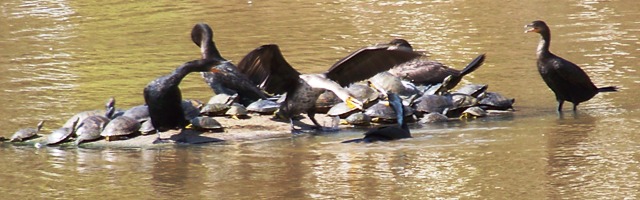
Heron on Turtle Row 0213
KMHuberImage

It may not seem like much but on my way to a level of health that is realistic after decades of disease, I appreciate progress in inches. As I have mentioned many times on this blog, the biggest advantage to chronic illness is that it keeps one physically in the moment, for no matter what occurs on one day, the next day dawns as if the previous day never existed. Frankly, I suspect that is true with or without disease but chronic illness provides a 24/7 mirror.

Having achieved a daily 15-20 minute walk for a month without any significant increase in inflammation or stress on my joints has me giddy with success. Now, I am attempting yoga. My introduction is through Peggy Cappy’s Yoga for People with Arthritis DVD. I highly recommend it.

While I have become accustomed to the fact that the line in the sand is in a different place every day, in my eagerness to begin every day anew, I have a tendency to be idealistic, my mantra in almost every project I attempt. Yoga is no different.

What I appreciate about the Cappy DVD is that it is divided into sections of different poses as well as warm-up exercises. In addition, there are great exercises for hands and fingers, perfect for anyone who uses any kind of electronic device. In the short time I have been doing these exercises, there has been a marked increase in my flexibility, so much so that I ignored the line in the sand.

Wood Stork at Waverly 0213
KMHuberImage

Rather than allow my body to adjust to the sitting poses and warm-up exercises, I went on to try the standing and sun salutation poses–Warrior One, Warrior Two and even Sitting Dog–within a few days my inflammation increased to a level I had not known in over a year. Not the fault of the DVD or any of the yoga poses just the False Self ignoring the True Self and each day’s line in the sand.

My bones and joints have taken a pounding for decades, first with one disease and then another, yet there is still an optimum level of health available to me. As Deepak Chopra says in Quantum Healing, chronic illness and aging have an effect on what that level of health will be. I see it as progress in inches but it is progress, nonetheless.

As I mark this first year of contemplating my True and False Selves, I have made enough progress to begin yoga, one pose at a time, and to attempt a cross-country trip as an avowed Uni-Tasker–one task, one moment. Maybe someday, a doodlekit….

A Change of Habit

Autumn is my favorite time of year, in particular the week before Thanksgiving. For some years now, this is the time I assess the current year in preparation for its final toast on December 31. I love the season; it’s such a time of good feeling. There were years that I watched all the holiday programming television could provide. This year, I’m marking the season by not subscribing to any television programming for one year, perhaps forever. It’s a habit I’ve wanted to change for decades, and it seems the season to do so.

For me, most television programming is noisier than any form of social media on its worst day. And my limited engagement with social media is more free than not. Frankly, I can “click out” of either one quite easily but the television has held sway over me–admittedly, attachment–that social media does not have, yet. Television provides hours of images, day and night, and all I have to do is watch, mindlessly.

Cooper’s TV Reaction

Yet, for all of 2012, I have been exploring consciousness–being aware of being aware–by studying various ancient traditions, including the practice of meditation. Since July, I have been meditating daily, having missed only a handful of days in five months. Meditation is yet another change of habit that is a long time in coming.

In the posts I have written about meditation, specifically about being “in the gap,” I acknowledge my difficulty in learning to accept what is. Yet, it is that acceptance, the moving away from duality–not labeling a moment as this or that—that has allowed me to connect to consciousness, producing changes in my physiology as well.

The benefit of any habit is its consistency; in fact, that is the power of habit. Nowhere is this more apparent than in meditation. My daily connection to “the gap between thoughts”—where stillness or consciousness resides—always provides moments of calm, even relaxation. The more that I practice meditation, the less attention I pay to the constant chatter of my mind. Without attention, my thoughts do not attach.

Early on in my meditation practice, there were days the chatter was almost nonstop but there was always some point where I connected with the stillness.  And every connection affected my physiology. Frankly, when I was in the gap, I was not aware of any discomfort. In five months, I believe my discomfort level is significantly less, and while I do not yet fully understand all that may mean, I know it to be true.

There are other reasons for my improved physiology, including a healthy diet and exercise, but if I had to single out one aspect in the last two years it would be a change in consciousness. In other words, my reality has changed because my consciousness has changed, not my attitude but my awareness. It is not a matter of positive thinking for a change in consciousness has nothing to do with thinking and everything to do with being aware of being aware in every moment.

Autodidact that I am, I have sought out the ancient traditions and continue to do so but when I began my meditation practice is when I noticed the shift in my consciousness that affected my physiology. There is no doubt that the cumulative effect of the change in so many of my habits over the past two years is finally being realized–recently, I added a few fruits and legumes to my diet as well as sweet potatoes–but beyond the increased energy I receive from extra carbohydrates there is a hardened resilience born of acceptance.

I assure you that nothing in television programming can compare with all the realms I have yet to explore.

“In one atom are found all the elements of the earth; in one motion of the mind are found all the motions of existence; in one drop of water are found all the secrets of the endless oceans; in one aspect of you are found all the aspects of life.”–Khalil Gibran


Getting Physical

Sjogren’s Syndrome has had my attention these last few days. Sjogren’s affects gland secretion, which means there is a general dryness throughout the body. It is often in the company of lupus so it’s been a joint effort. However, I’m happy to report that I have remained more in the moment than not and am simply working through my symptoms—dry eyes, dry mouth, fatigue–as they make themselves available. It is intriguing.

In examining these two autoimmune issues, I focus on what is occurring throughout my physiology rather than considering cause and effect. This began two years ago when I walked away from traditional medicine, and with a little knowledge of quantum healing, I began creating a diet for myself that would not make me sicker. I needed a distraction and food, which had been such a comfort, seemed the logical choice.

It was a no-brainer to eat whole foods and eliminate processed/refined products but I discovered I could not tolerate all whole foods, especially carbohydrates. Ultimately, I stopped eating yeast, gluten, dairy, and soy but mostly, I stopped eating almost all sugars, including fruit. I ate meat and still do, infrequently, but I receive more than my required protein amount from almond butter, plain goat’s milk yogurt, eggs, broccoli and even almond cheese, just to name a few sources. I quickly discovered that getting enough protein is not an issue.

Mostly, I found myself engaged in an experiment for health and not a diagnosis for disease. My physiology became my laboratory. As my sugar and high carbohydrate intake dropped, my joint pain began to decrease. Yet, not all sugars are equal. For example, I tolerate apple cider vinegar but no other. When I discovered that apple cider vinegar is a main ingredient in Eden’s Organic Brown Mustard, I finally found my condiment. This mustard is a marvelous addition to any sandwich.

Bread proved elusive until I learned of Paleo Bread—almond and coconut are my preferences—yet another source of protein for me. While the bread is expensive,  a local health food store is providing me a great discount. The bread is a significant source of fiber, contains no refined starch and is extremely low in carbohydrates. Yes, it is an acquired taste but like my ever-changing physiology, my taste buds are not what they were.

I discovered that change at my 60th birthday dinner. The waiter brought a complimentary birthday chocolate sundae, which I ate because it was my birthday and because I wanted to see what reaction I would have. Immediately, I was overwhelmed by the taste–too sweet, too much. For the next few days, that taste stayed with me, mostly in the form of carbohydrate cravings. No one is immune to the physiology of them.

In response, I ate more almond butter and drank more chamomile tea (with Stevia) until my physiological system evened itself out. By the way, the only natural Stevia that I know of is SweetLeaf; all the others have either sugar or a sugar substitute in them. Every time I meet up with sugar, intentionally or no, my physiology alters significantly. This may have been true all my life or not. Doesn’t matter.  I discovered a connection.

In quantum healing, perfect health is an ideal, of course, but its heart is “…the junction point between mind and matter, the point where consciousness actually starts to have an effect” (Deepak Chopra). That junction point is when “…quantum healing moves away from external, high-technology methods toward the deepest core of the mind-body system. This core is where healing begins” (Chopra).

My experimenting with nutrition is only the beginning of my understanding quantum healing. Mine is an undertaking that many question to which I can only respond that for the first time in 30+ years I have a connection to my body that is not external or chemical. It is right for me. I still have Sjogren’s and lupus symptoms–no worse and perhaps no better–I haven’t paid attention to degree of discomfort for I have been busy in my physiology laboratory.

“The healing mechanism resides somewhere in this overall complexity, but it is elusive. There is no one organ of healing. How does the body know what to do when it is damaged, then? Medicine has no simple answer….A man-made drug is a stranger in a land where everyone else is blood kin. It can never share the knowledge that everyone else was born with” (Chopra).

Yet, I am not unrealistic, either. I do not believe I will attain the health of a sexagenarian who has generally taken good care of her emotional and physical needs. I was not that person for 58 of my 60 years; I am only that person now. Thus, whatever healing emerges is from an awareness born of the mind-body connection. For me, it is about appreciating the incredible complexity that is my physiology and doing everything I can to support my body in its never-ending quest to provide me health. I am much more careful in how I live.

Our physiology communicates mainly through pain or discomfort but it is in the examining of the communication that we gain a broader perspective of our physical self. Physically or emotionally, we do not operate well on deprivation. No living organism does. Quantum healing is going beyond physiology—cells, tissues, organs, and systems–to that mysterious “junction point between mind and matter” where healing begins.  It is intriguing.

(All Deepak Chopra quotes excerpted from Quantum Healing: Exploring the Frontiers of Mind/Body Medicine, New York: 1990, Bantam Books)

Final Days of 59

“… Transformation always involves the falling away of things we have relied on, and we are left with the feeling that the world as we know it is coming to an end, because it is” (Mark Nepo, The Book of Awakening).

This past February, I wrote a post about some unexpected milestones at age 59 ½. At the time, I was struck by the synchronicity. Still am. As this is my final week at age 59, I decided to revisit those milestones before I step into my sixth decade, one that promises even more transformation.

KM Huber Image

I have continued to lose weight beyond the 59 ½ pounds of February; I am down 69 pounds with another fifteen-twenty to lose but no more than that. My eating habits have not changed in the past six months but my taste buds have adjusted to other options, and I enjoy eating again. I found millet-buckwheat bread made with chicory root and without refined starch, absolutely critical for me.  Almond butter sandwiches are now a staple. While my future remains gluten, yeast, sugar, dairy and soy free, my grocery list items are crisp and fresh.

In my last week as a fifty-nine-year-old, I am in better health than I was at 58, sans an arsenal of allopathic medicine. I remain convinced that Eastern medicine– Ayurveda and Chinese–has a better understanding of autoimmune disease. Ted J. Kaptchuk’s The Web That Has No Weaver is an excellent overview of traditional Chinese medicine, and I am searching for a similar Ayurveda text. Until I find it, I am enjoying Deepak Chopra’s Perfect Health, an informative volume regarding Ayurveda traditions.  This Tuesday, I have my first meeting with a practitioner of Eastern medicine.

KM Huber Image

But in these final days of my 59th year, it is my writing that is undergoing the greatest transformation. My numbers alone are major personal milestones.  I no longer publish blog posts twice a week as I did in February but on June 2, I began writing the initial draft of a nonfiction manuscript. Currently, I am producing over 9200 words per week on this manuscript alone. At my 59 ½ milestone, my word count was 9800 words for the entire month of February.

While I do not write for a specific word or page count, numbers gauge a manuscript’s size so I knew the end of the nonfiction manuscript was close: currently, it is 330 pages or just over 91,000 words. But even before I tallied the numbers, synchronicity had come to call; what Deepak Chopra calls “a quantum leap of creativity…a relinquishing of the known for the unknown.” And like milestones, coincidence comes wrapped in the ordinary.

In February, I included my participation in ROW 80 as part of my regular blog posts.  Frequently, I discussed the initial draft of a novel that I wrote seventeen years ago; in some blog posts I’d opt for rewriting the novel and in other posts I’d refer to the novel as a life once lived. Rather than letting go, I was very like the speaker in Linda Pastan’s poem, “Ethics,” unable to decide whether to save the old woman or the painting.

So, I signed up for an online workshop, Conflict and Idea with Bob Mayer, and learned about “kernel idea.” I have not been the same since so I consider it my toehold in the unknown, a piece of a milestone.

Bob says that the kernel idea is what initially inspires the writing of a novel–it is the Alpha and Omega of a book–it starts and completes the creative process but here is the key point: the story that you write may and probably does change but the kernel idea of a book does not, ever.

KM Huber Image

During the course of the workshop, I came to understand that the “kernel idea” for my novel was not the story I had written. The kernel idea had not changed but the story I wrote moved away from the idea within the first 100 pages. Finally, I realized what I was hanging onto for seventeen years—my kernel idea and 100 pages—yet, it took me a while to understand just what that might mean but when I did, it felt like a “quantum leap of creativity.” Still does.

Thus, as I started writing a new nonfiction book—my current manuscript–I discovered the way to tell the story of my original kernel idea. Maybe the years sorted themselves, maybe I was letting go of what no longer serves but with transformation there is also revelation. In letting  go of a seventeen-year-old-story that no longer served, I discovered the kernel idea for a new nonfiction book.

“When faced with great change—in self, in relationship, in our sense of calling–we somehow must take in all that has enclosed, nurtured and incubated us so when the new life is upon us, the old is within us” (Nepo).

In the Gap

It is not exaggeration that for almost 60 years I have been a woman who lived outside of herself, meaning whatever I could not “fix” I suppressed, as if a reckoning would never come but, of course, it did.  Fiscally, physically, and spiritually bankrupt, life as I had known it ended, which really was a good thing.

It did mean I had to “go wild into my life” but as freeing as that is, it is not without its pitfalls. The discovery of my story revealed a raw power but knowing my story is only freeing if I am not attached to its outcome. If I am, I am doomed to repeat my own history. I am not without my moments of reliving past behavior but they are fewer.

Two weeks ago, I began accessing what Deepak Chopra calls the “gap between our thoughts” through meditation. Chopra says that in meditation, we access our baseline state of consciousness, in essence where we began. For years, I have touted meditation while my actual practice of it was not an actuality. When the Chopra Center offered a free, 21 day meditation challenge, I was not without my skepticism yet I knew I was ready to begin meditation.

No doubt that makes a difference but I am amazed at what meditation has provided me over these past two weeks. They have not been easy weeks for my lupus has been quite active but meditation has provided me another way to be with lupus. In accessing the gap between my thoughts, I am in the stillness, where my physical body connects with my consciousness.

“In the gap” is a tempting place to stay but the pull of physical existence is stronger. For me, meditation is not a ‘60s “trip” nor am I in some sort of trance. I am, however, in a place where my physical presence is lighter. Upon my return–and this happens every time–there is a physiological change in me, a release of tension that pervades my life more and more. Whatever physical discomfort I have been feeling, it is less.

Here’s what I think is happening: my pain is less because more and more I accept it as a part of my physical presence. I do not know that I have ever accepted lupus or any of the other names my dis-ease has accumulated. While it is taking me some time to realize fully that acceptance, the coincidence of reading Cheryl Strayed’s book as I began meditating with the Chopra Center is not lost on me. Both are tools for releasing the past and accepting what is by choosing to be present in each moment. When I am, there is a physiological change in me.

After 35 years of chronic illness, I am surprised but I also know that when I went knocking on the doors of the ancient traditions this time, I surrendered. That is an admission I never thought I would make much less post on the Internet but in accepting all of my story, lupus included, I surrendered to all I have been and all I have done, freeing me from the responses I have always made.

When I am present, the physiology of my body responds differently. I am not pulling from the past or tugging from the future for a response. My moment is not attached to any past baggage or any future “what ifs.” Situations are not free but my response to any of them, including lupus, is.

Being present is to reside in the unknown, “where the wild things are,” where creativity connects with consciousness. It takes practice, requires patience, its paths are many yet the moment is all we ever have, and it is enough.

Len Huber image