A Matter of Voice


When is a voice not a voice or why does the voice inside my head not resemble the voice in the movie, Field of Dreams? Beyond the obvious answer of “it’s only a movie,” there is also the reality of building a baseball field, which I could never do. That’s the kind of voice I hear.

Perhaps chatter is a better term but regardless of word choice, the voice is not reality, incessant as it is. The voice is so pervasive that it filters the reality of living for us, if we allow it. Why is that?

Michael Singer says that “…reality is just too real for most of us, so we temper it with the mind… As long as that’s what you want, you’ll be forced to constantly use your mind to buffer yourself from life, instead of living it…. In the name of attempting to hold the world together, you really are just trying to hold yourself together”(The Untethered Soul).

I admit I have relied on this voice for almost all my life. As a writer, I’ve considered voice essential for I do hear the word as I type or I did. Now that I use voice recognition software, I am not aware of hearing words before I speak them. Inadvertently, voice recognition software has helped me be more present in life.

In short, I am no longer interested in listening to the voice in my head “… [take] both sides of the conversation, [not caring]… which side it takes, just as long as it gets to keep on talking” (Singer).

As I understand space-time, past, present, and future are all occurring simultaneously. All we ever have is the moment, which is completely free for it is attached to neither past nor future but is simply occurring.
The present is not a comfortable setting for the voice, as it is attached to past and future outcomes. The voice builds on situations that exist in either the past or the future. Situation is the foundation for the voice; it is the known. When we listen to the voice, our focus (and thus our perspective) narrows so rather than exploring the infinite field of possibilities, we explore only what we have known for that is all the voice knows.

Vividly, the voice narrates image after image stored within our memory archives. When it reaches the end of that file, it creates one future scenario after another. The voice is like a pendulum, swinging toward what has been and then all the way to the edge of what might be, with nary a pause at what is.

When we are still, we are in the moment, where the voice does not reside. “There is nothing more important to true growth than realizing that you are not the voice of the mind–you are the one who hears it. If you don’t understand this, you will try to figure out which of the many things the voice says is really you.” And we are none of those things for consciousness—being aware that we are aware—is observing the voice we hear without engaging it. In being aware, our focus broadens.

We experience life as it is and only for what it is. “If you’re willing to be objective and watch all your thoughts, you will see that the vast majority of them have no relevance” (Singer). Rather than defining ourselves as past or future events—what has happened or what may happen–we immerse ourselves in the infinite field of possibilities that is the moment, free from past or future outcomes.

When we are in the moment, we are completely involved in all that is. There is nothing for the voice to attach to. We do not focus on the outcome of that moment, which is not to say that we are passive, not at all. It is to say that we do not react; we do not reach for what we have always known.

Rather, we “…decide not to narrate and, instead, just consciously observe the world, [feeling] more open and exposed” (Singer). Consciously observing the world is experiencing all that life is. It means that our every action is one that encompasses compassion, gratitude, love, and joy—maybe even simultaneously– for these are the emotions that are never felt in the presence of the voice, the ego of the known.

These four emotions reverberate throughout our physiology as it connects to our consciousness. In the moment, we are all that we are completely.  This possibility always exists if we forgo the pendulum swing of the voice of the known. Yet, it is not as if the voice will be still but we are not the voice. We are the oneness that observes the voice, for we have more to observe than we have ever known.

I consider it quite a challenge not to engage the voice but the unknown has always intrigued me. As a writer, the role of the witness is certainly not new to me but once again, my switch to voice recognition software provided yet another unanticipated benefit.

Obviously, using the software is a physical change in how I write but while adjusting to speaking my writing as opposed to typing my writing, I became aware of another voice. In speaking my words, there is an immediacy that does not exist with my typing. At times, the words are a pure surprise. Sometimes that is the software doing its best to communicate what it thinks I said while other times, I do surprise myself in the words I say.

Regardless, the thought is rough, meaning there is no longer any thinking through a sentence before I speak it. I wasn’t aware that I had been a writer who edited as I created but my voice recognition software revealed otherwise. Now, I am no longer aware of that voice even when I do edit finished drafts.

And there is this about writing: no matter how or what I write, it is story. In story, there is always a voice–as there should be–just as there is a conclusion–the outcome of the story–as there should be. In story, voice frees us from clinging to outcome, releasing us into the moment, perhaps into a field of dreams.

(All Michael Singer quotes excerpted from The Untethered Soul, Kindle Edition, 2007: New Harbinger Publications)

Getting Physical

Sjogren’s Syndrome has had my attention these last few days. Sjogren’s affects gland secretion, which means there is a general dryness throughout the body. It is often in the company of lupus so it’s been a joint effort. However, I’m happy to report that I have remained more in the moment than not and am simply working through my symptoms—dry eyes, dry mouth, fatigue–as they make themselves available. It is intriguing.

In examining these two autoimmune issues, I focus on what is occurring throughout my physiology rather than considering cause and effect. This began two years ago when I walked away from traditional medicine, and with a little knowledge of quantum healing, I began creating a diet for myself that would not make me sicker. I needed a distraction and food, which had been such a comfort, seemed the logical choice.

It was a no-brainer to eat whole foods and eliminate processed/refined products but I discovered I could not tolerate all whole foods, especially carbohydrates. Ultimately, I stopped eating yeast, gluten, dairy, and soy but mostly, I stopped eating almost all sugars, including fruit. I ate meat and still do, infrequently, but I receive more than my required protein amount from almond butter, plain goat’s milk yogurt, eggs, broccoli and even almond cheese, just to name a few sources. I quickly discovered that getting enough protein is not an issue.

Mostly, I found myself engaged in an experiment for health and not a diagnosis for disease. My physiology became my laboratory. As my sugar and high carbohydrate intake dropped, my joint pain began to decrease. Yet, not all sugars are equal. For example, I tolerate apple cider vinegar but no other. When I discovered that apple cider vinegar is a main ingredient in Eden’s Organic Brown Mustard, I finally found my condiment. This mustard is a marvelous addition to any sandwich.

Bread proved elusive until I learned of Paleo Bread—almond and coconut are my preferences—yet another source of protein for me. While the bread is expensive,  a local health food store is providing me a great discount. The bread is a significant source of fiber, contains no refined starch and is extremely low in carbohydrates. Yes, it is an acquired taste but like my ever-changing physiology, my taste buds are not what they were.

I discovered that change at my 60th birthday dinner. The waiter brought a complimentary birthday chocolate sundae, which I ate because it was my birthday and because I wanted to see what reaction I would have. Immediately, I was overwhelmed by the taste–too sweet, too much. For the next few days, that taste stayed with me, mostly in the form of carbohydrate cravings. No one is immune to the physiology of them.

In response, I ate more almond butter and drank more chamomile tea (with Stevia) until my physiological system evened itself out. By the way, the only natural Stevia that I know of is SweetLeaf; all the others have either sugar or a sugar substitute in them. Every time I meet up with sugar, intentionally or no, my physiology alters significantly. This may have been true all my life or not. Doesn’t matter.  I discovered a connection.

In quantum healing, perfect health is an ideal, of course, but its heart is “…the junction point between mind and matter, the point where consciousness actually starts to have an effect” (Deepak Chopra). That junction point is when “…quantum healing moves away from external, high-technology methods toward the deepest core of the mind-body system. This core is where healing begins” (Chopra).

My experimenting with nutrition is only the beginning of my understanding quantum healing. Mine is an undertaking that many question to which I can only respond that for the first time in 30+ years I have a connection to my body that is not external or chemical. It is right for me. I still have Sjogren’s and lupus symptoms–no worse and perhaps no better–I haven’t paid attention to degree of discomfort for I have been busy in my physiology laboratory.

“The healing mechanism resides somewhere in this overall complexity, but it is elusive. There is no one organ of healing. How does the body know what to do when it is damaged, then? Medicine has no simple answer….A man-made drug is a stranger in a land where everyone else is blood kin. It can never share the knowledge that everyone else was born with” (Chopra).

Yet, I am not unrealistic, either. I do not believe I will attain the health of a sexagenarian who has generally taken good care of her emotional and physical needs. I was not that person for 58 of my 60 years; I am only that person now. Thus, whatever healing emerges is from an awareness born of the mind-body connection. For me, it is about appreciating the incredible complexity that is my physiology and doing everything I can to support my body in its never-ending quest to provide me health. I am much more careful in how I live.

Our physiology communicates mainly through pain or discomfort but it is in the examining of the communication that we gain a broader perspective of our physical self. Physically or emotionally, we do not operate well on deprivation. No living organism does. Quantum healing is going beyond physiology—cells, tissues, organs, and systems–to that mysterious “junction point between mind and matter” where healing begins.  It is intriguing.

(All Deepak Chopra quotes excerpted from Quantum Healing: Exploring the Frontiers of Mind/Body Medicine, New York: 1990, Bantam Books)

Inner Energy of You

My last two posts have explored freedom through the pause we all experience in every breath–if not in every deed–and through the unknown, where the risk of hope resides. To write of freedom is to explore the oneness of humanity for it is the freedom that connects us all.

When I began publishing this blog in January, I created a homepage of oneness to frame the concept for my blog posts: quantum entanglement, my favorite term for the pure energy of the consciousness connection. Within a few months, I began a study of ancient traditions, primarily Taoism, Hinduism and early Christianity (pre Saint Augustine of Hippo), having previously studied Buddhism, Zen in particular. I sought a synthesis and considered it the rest of my life’s work. Still do.

I have discovered writers, ancient and contemporary, who have written most thoughtfully, and some beautifully, of the inner and external worlds of humanity. Then, I read the “elegant simplicity” of Michael A. Singer in The Untethered Soul. Yet again, I have Oprah Winfrey’s Super Soul Sunday program to thank for this discovery; currently, her website is offering a full episode replay of her interview with Singer.  Oh, that middle initial is important if you are going to search for Singer on Google.

Singer’s graceful prose is stunning. Quietly, he lays down one sentence after another, orchestrating a synthesis of thought, word by word. He  allows the reader to rediscover the spiritual energy within, as if it were the first time. “This flow of energy comes from the depths of your being. It’s been called by many names. In ancient Chinese medicine, it is called Chi. In yoga, it is called Shakti. In the West, it is called spirit.… All the great spiritual traditions talk about your spiritual energy; they just give it different names.” (The Untethered Soul).

We do seem to insist on labels for our innate consciousness and thus, the connection to one another. We identify with one label over another to preserve, and possibly to protect, the nuances within each of the spiritual traditions. It has been like this for over 5000 years, for one reason after another, both East and West.

“Consciousness is the highest word you will ever utter. There is nothing higher or deeper than consciousness. Consciousness is pure awareness…the ability to become more aware of one thing and less aware of something else…” (The Untethered Soul).

Singer removes any mystique regarding consciousness and leads the reader into “the seat of self,” the center of consciousness [where] you are aware there are thoughts, emotions, and a world coming in through your senses. But now you are aware that you’re aware. That is the seat of the Buddhist self, the Hindu Atman and the Judeo Christian soul. The great mystery begins once you take that seat deep within” (The Untethered Soul).

It was Deepak Chopra who described Singer’s writing as “elegant simplicity.” If you watch the interview with Oprah, you will see it is an apt description for the man as well. Singer’s book is not about one set of beliefs or any religion. It is a book about consciousness: “The more you are willing to just let the world be something you’re aware of, the more it will let you be who you are–the awareness, the self, the Atman, the soul.”

For me, Singer’s book offers an unanticipated foundation for my  synthesis of the ancient traditions and thus, an added dimension to this blog. Abraham Heschel wrote that to live a spiritual life is not a gathering of information but it is “facing sacred moments,” the rediscovery of what has always been, one open door after another.

The Power of Pause

Emily Dickinson wrote, “To live is so startling it leaves but little room for other occupations” yet how easy it is to be more startled by our occupations than living our lives. We slide into the demand of our daily requirements, although all of the ancient traditions advise observation–the power of pause—in order to act rather than react.

Dave R Farmer Image
WANA Commons

The power of pause allows us to trust the skies to clear, the fog to dissipate. It is the quiet courage of the heart resonating throughout our bodies while our heads consider whether or not to act. The power of pause requires us to listen as if we were hearing for the first time. It is that crisp, that charged.

The power of pause resides not in analysis but in awareness, a reach into the unknown. It requires us to empty our minds much like Randall Jarrell’s bored, sick child who entreats existence, “all that I’ve never thought of think of me.” It is a trusted leap from comfort to change, embarking on the voyage in to all that we are.

Within in each one of us, there is a unique, natural rhythm to living our lives. Only we can discover our own flow, our tributary that connects us to all life. It is a “startling” discovery, not lending itself to a life of daily lists or to the inertia of self-absorption but to commitment without being attached to its outcome. We take a breath, go “all in” and we’re in the moment.

Rather than outcome, we focus on the emotions not ruled by ego–compassion, gratitude, love, and joy–for they emerge from the thoughtfulness requisite to the power of pause. We go within ourselves to discover the best we have for the world outside of us and then deliver.

The power of pause requires us to quiet ourselves, to allow the storm of the world to swirl round the calm eye of our lives. In the stillness, we discover who we are beyond the business of the world of to-do lists. In the moment that it takes to breathe, we feel the spark of us–our own light–reveal our way.

There is a well-known story regarding two scientists who travel halfway around the world to meet with a Hindu Sage, eager to hear the Sage’s thoughts on their theories. They meet in the Sage’s garden. He pours tea and continues pouring although the cups overflow with the tea.

Finally, one of the scientists says, “‘Your holiness, the cups can hold no more.’  The Sage stops pouring and says, ‘Your minds are like the cups. You know too much. Empty your minds and come back. Then we’ll talk'”(Leroy Little Bear in The Book of Awakening).

No matter how frequently we revisit various versions of the two scientists and the Sage, the light of awareness flashes: empty our minds so we may live our life aware of our breath, as we begin yet again.

so much depends
upon

a red wheel
barrow

glazed with rain
water

beside the white
chickens. (“The Red Wheelbarrow,” William Carlos Williams)

Freedom in the Unknown

For a while I have been residing with two, well-worn nemeses, the past and the future.  I am deliberate in my use of the terms future and past rather than a specific moment, incident, or person for what keeps the past and future ever present is what Deepak Chopra calls “the conditioned response” or the known.

Each one of us has a myriad of conditioned responses for every situation that arises. Regardless of whether or not there is a replica of a particular situation, the mind enthusiastically emits a thought barrage of past experience and future possibility. Both future and past are attached to what happened or what might happen but not to the moment that is. Living in the moment is the unknown, free from past or future.

Essentially, every moment is free. We choose between the known and the unknown, between what we have always been and what we have never been. It is that basic. What is not free is the situation surrounding each and every moment.

Situations reside in the past or in the future–they have strings–and where there is attachment, there is ego, a constant chatter of what you already know. Only when we practice what Chopra calls “choice less awareness” (Moksha), are we in the unknown of the moment and truly free. It takes a lifetime of practice and ceaseless awareness.

For without awareness, we get comfortable and our practice becomes what we know and not what is. Increasingly, my enthusiasm was on the wane, whether for the revision of my novel or for my nonfiction manuscript on consciousness. While I love what I am doing, I could not deny a familiar tug of weariness. Briefly, even the malaise of lupus loomed as I turned more and more to the known of the past.

Mindless television is a tried-and-true response of mine to whenever “the world is too much with us” (William Wordsworth). Some would argue that I could not have picked a better time than the broadcasting of the two major political conventions in the United States. There may be something to that. For completely opposite reasons, both conventions made me weep but as I reached my saturation point for both weeping and politics, I discovered my enthusiasm for republic and democracy.  Both are messy, completely life-like, wherein lies the sliver that is hope.

No matter the moment of life, hope is always the light of the unknown and may be the heart of risk as well. In hope lies enthusiasm, the total immersion into life, “the ripple that follows the stone…[as] we are each faced with the endless and repeatable task of discovering or uncovering our enthusiasm, which means in essence being at one with the energy of God or the divine” (Mark Nepo). Not surprisingly, God and the divine are within the political whirlwind of the United States while the world watches.

Regardless of how we perceive our relationship to one another–Einstein’s “spooky action at a distance,” the Tao, the Universe, the Source or quantum physics–we are all connected to consciousness, which is so much more than a mere pinprick of light. Consciousness connects us to existence, transcending all we have ever known; it moves our heads under our hearts so we may hear one another. When we listen, we observe. We make a response within the moment.

In observing the political conventions I listened, dropping my decades-long conditioned response of ranting and raving. Rather, I was grateful for living in a republic brave enough to reveal the messiness of its democracy to the world, at considerable risk perhaps.  I immersed myself into the enthusiasm that is the noise of life, the unpredictable but eternal moment.

It is such a small step from the known to the unknown. In the unknown resides the “choice less” awareness that is the freedom inherent in risk, the heartbeat of hope. It is neither the past nor the future but only the moment, which is all we ever have yet is always more than enough as long as we are aware. “Despite our endless limitations, it seems that the qualities of attention, risk, and compassion allow us to be at one with the energy of the whole and the result is enthusiasm, that deep sensation of oneness” (Nepo).

(All Mark Nepo citations appear in The Book of Awakening)

The Long Goodbye

This past week has been one of goodbyes. As one goodbye piled upon another, I began to pay attention. I was reminded of a piece I wrote with another writer years ago called, “The Long Goodbye,” a wife’s farewell to her husband who lived more in the realm of Alzheimer’s and less in their sixty year marriage. For me, “The Long Goodbye” was always more about living than moving into another realm of existence.

Dudley

Nowhere is that truer than at an animal sanctuary where I’ve been a volunteer for the last four years. Mostly, I send out monthly updates to animal sponsors–it’s easy and fun–I relay stories and pictures of animal antics, always a welcome email. As the sanctuary is for elderly and medically needy animals, goodbye is often on the horizon. At times, goodbye is said so often it is hard to catch one’s breath.

In the past two days, three sanctuary residents crossed the Rainbow Bridge, one goodbye after another. Two of the residents were elderly canines, Snapper and Rocky, and the other was a very human-friendly rabbit, Dudley. For the remainder of their lives, the sanctuary provided them the security of home, a daily routine they came to trust. Lives regained. No matter how long or short their stay at the sanctuary, each of their lives ended in arms of love. Would that every one of us lived a life with such a long goodbye.

Cooper

As I have learned from Dr. Mac and the residents of the sanctuary, the long goodbye is unique to each and every being. On the very morning the long goodbyes played out at the sanctuary, Cooper reminded me the  moment looms for us as well.  Like his friends at the sanctuary, Cooper lives in the moment, devoted to routine. For now, he is still willing to accommodate the physical changes his body is undergoing but he will let me know when the end of the long goodbye is here. There won’t be much notice, just enough. Until then, we go on as if life has always been this way, and after a while, we believe what we tell ourselves.

For some time, Cooper and I have been witnessing a long goodbye between a woman and a canine that live in our apartment complex. Alice has Alzheimer’s and her hair is white just like Buddy’s, her West Highland Terrier. In the two years we’ve known them, the two have been the best of friends but for a while now, Alice hasn’t been able to remember their routine. While Buddy does his best to remind Alice, Alice remembers routines with other Westies. Buddy does his best to keep up.

Snapper

We learned that Alice and Buddy are moving, and while we know it’s a fact, the actual date is never mentioned. At first, Alice told us that all of her sons were moving as well and the whole family would be living in the same state. First it was Colorado and then it was Connecticut but now the most frequent moving destination is an assisted living center in a small Florida town not too far away from us.

Of course, none of these moves involve Buddy living with Alice anymore. Alice’s sons have dogs of their own, and they seem genuinely fond of Buddy and he of them. He is a fairly young dog, smart, but he has had to fend for himself a lot lately, and he is not as trusting as he once was. Buddy and Alice have done the best they can for each other but the change they face may not involve a long goodbye, at least with one another.

Rocky

I am reminded that the long goodbye is not a guarantee but a gift as I re-read the sponsor updates of Snapper with her tennis balls, of Rocky’s kiddie pool antics and his chomping at the hose water trying to fill his pool. Even little Dudley felt safe again after what seemed a hopeless situation. I cannot know what will be for Alice and Buddy but the long goodbye is often the reward of a life regained.

(AWARDS: Recently, this blog received some awards exchanged among bloggers, and I am humbled. Thank you, fellow bloggers. It is a true honor to have one’s work appreciated by one’s peers.)

The Quiet Teachers

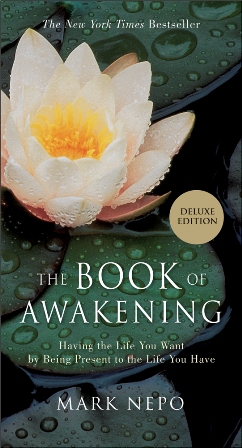
As I have mentioned more than once, I’m spending this year with Mark Nepo’s Book of Awakening, meaning that I begin my daily meditation by reading one of his 365 observations. More often than not, a series of readings—one day after another—will seem an awakening designed only for me. This past week, Nepo introduced me to the quiet teachers.

The quiet teachers are often ignored but are everywhere and are as solid as the ground upon which we walk. We know these quiet teachers by their “lessons [that] dissolve as accidents or coincidence…offering us direction that can only be heard in the roots of how we feel and think” (Nepo).

For me, the lessons have been clear but somewhat noisy for I am in the process of completely restructuring a novel I wrote seventeen years ago. What that means is the destruction of a weakly structured novel in order to salvage a stubborn story that has waited a long time to be told. It has required me to immerse myself into an old world, awakening characters long silent and provoking images fraught with memories. There has been much shattering of ideals but the shards of those ideals proved to be quiet teachers, the first of others that I met this week.

Nepo also introduced me to an observation from Megan Scribner: “‘I’m only lost if I’m going someplace in particular.'” I could not have described my own first attempt at writing a novel more succinctly. For over 80,000 words and seventeen years, I stayed with a story I no longer believed rather than facing the story that was trying to emerge. Once I began stripping away the façade, I heard the heart of the story and found myself at journey’s beginning: “Practice letting go of your plan and discover the path of interest that waits beneath your plan” (Nepo).

Not being attached to outcome or plan reveals the story waiting to be written. It is only when I have the courage to face failure do I heed the lessons of the quiet teachers. Accident and coincidence dissolve into the direction of the story. I am struck by the synchronicity of my own life’s direction with that of my writing life. Not for the last time, I am in awe at the oneness that is all.

“‘Be serene in the oneness of things and erroneous views will disappear by themselves'” (Seng-Ts’an) became clearer and clearer to me as I separated the heart of the story from the remnants of what was once a novel. All of the tearing apart and leaving of words is less difficult than I imagine. There are thorny moments but eventually, they give way to the relief of no longer having to hold up the façade of novel.

While the shininess of a new structure of a novel is a gift, the fear of idolizing structure at the cost of story, wherever it may wend, is a battle that will wage until structure and story support one another as a whole. I am confident in the lessons of the quiet teachers but mostly, I am vigilant for like life, writing is fraught with accident and coincidence as is the beating of my heart.

“As you enter your day, try not to reach for life. Try not to leave or arrive. Try to let life into you” (Nepo).

Gifts at 60

On this first day of my being 60, I am not writing the blog post I had planned; living in the moment is like that or so I am learning. Certainly, I thought about this particular post much more than I usually do—I kept considering it my first blog post of my next decade–but by mid-week, that ego balloon went airless.

The last week of my fifth decade proved to be a week of surprises, mostly in the form of sugar, but not entirely in the obvious way. For the most part, my system no longer tolerates sugar in any form other than what it produces itself. Generally, this is not a statement I have to consider but in my last post, I mentioned that I had an appointment with a practitioner of Eastern medicine. Not so surprisingly, she and I had different interpretations regarding Eastern medicine–and sugar–but rather surprisingly, I agreed to try two different remedies at least one time, which proved to be more than enough.

Buoyed by the possibilities presented by the practitioner, I decided to have one (1) glass of red wine, my first in three years.  Although my glass of wine and my dose of “remedies” were days apart, literally, my week collapsed before Wednesday noon. I am more recovered than not and leaning toward awareness.

KM Huber Image

I suspect I was caught up in birthday bliss for it has been a week of gifts beyond remembering the lesson of sugar.  Once again, I discovered that I really can, and should, trust my instincts and not my ego. It was not my instincts that chose the remedies or the wine but my ego filled with the idea of birthday, a balloon born to burst. I am reminded of Georgia O’Keeffe–“To see takes time”–a sentence for the rest of my life, yet another gift.

KM Huber Image

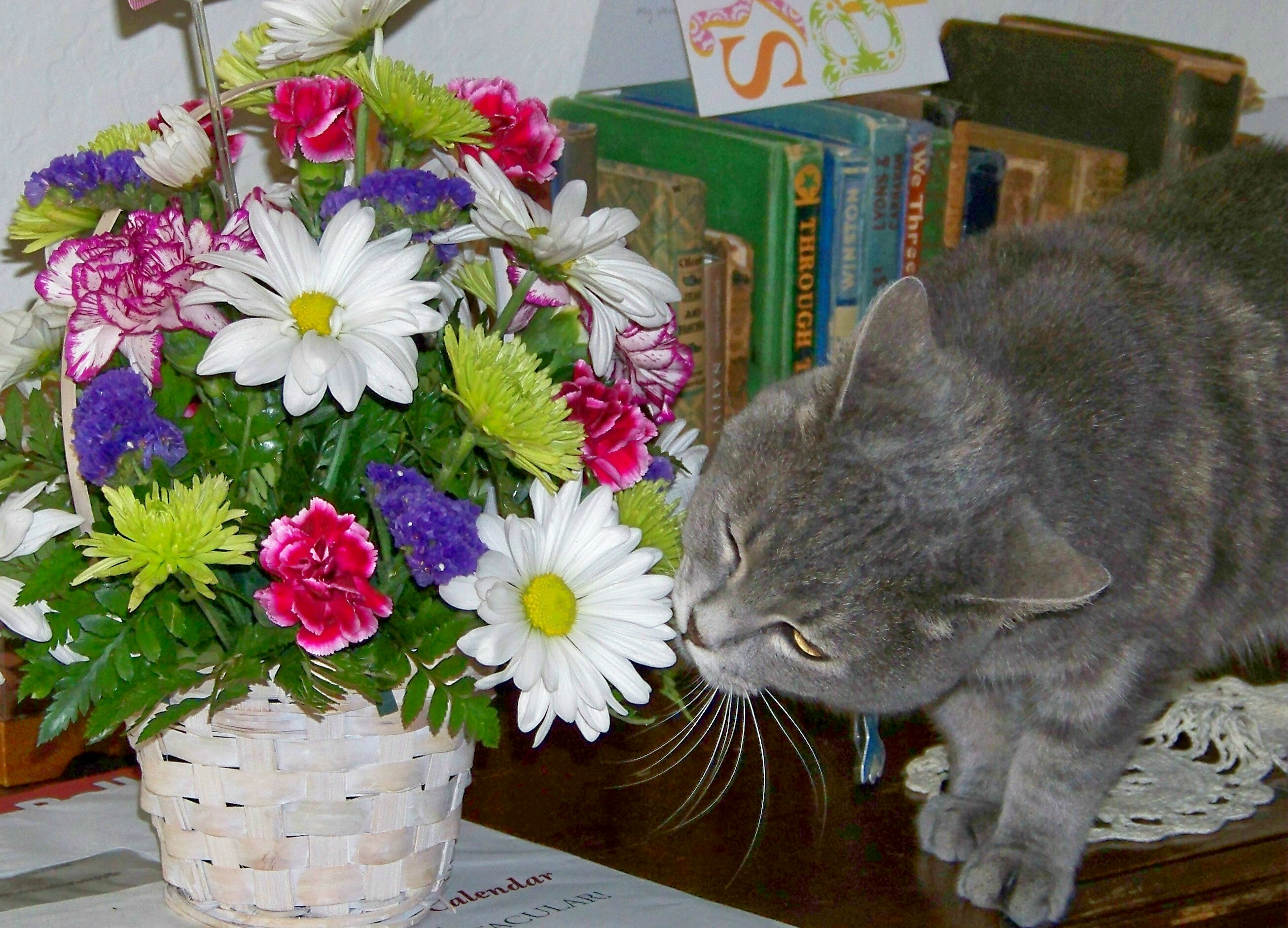
I was pleasantly surprised by lovely flowers from  Dr. Mac and all of the sanctuary “critters” at  secondchancefarms.org. As you can see, EmmaRose wasted no time in her inspection, and yes, all are “kitty safe” petals.

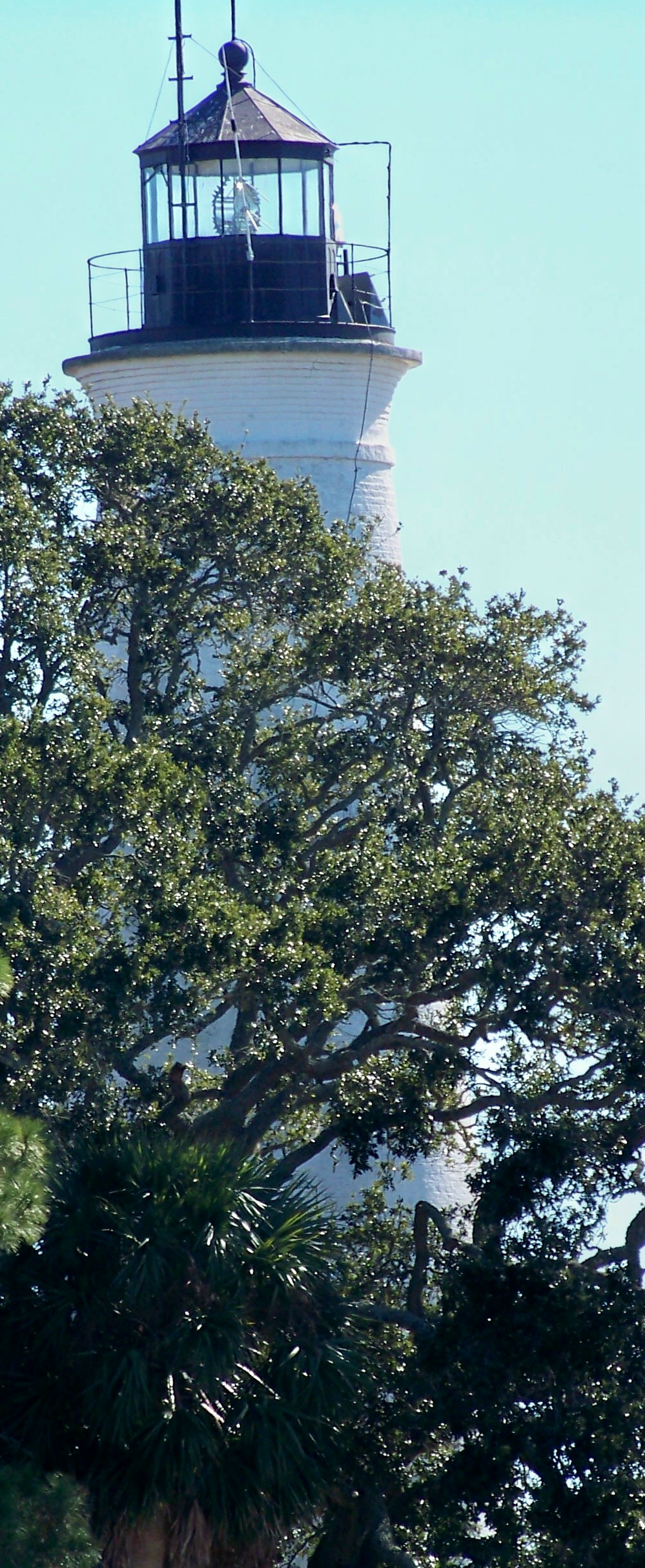
Cooper and I began our morning on the Gulf of Mexico, near this palm tree at St. Mark’s Wildlife Refuge but here is where we will both end our day.

Almost always, Cooper takes command of the remote. Like me, he is a bit ambivalent about television but he has a preference for the remote.

Thank you, Dear Reader, for stopping by to read my posts and to chat, from time to time. It is such a gift you give, and I am most grateful, always.

“Once during the day, think of who you are as living energy and not as a goal to be achieved or obstacle to be overcome. Feel yourself without inventory” (Mark Nepo, The Book of Awakening).

Final Days of 59

“… Transformation always involves the falling away of things we have relied on, and we are left with the feeling that the world as we know it is coming to an end, because it is” (Mark Nepo, The Book of Awakening).

This past February, I wrote a post about some unexpected milestones at age 59 ½. At the time, I was struck by the synchronicity. Still am. As this is my final week at age 59, I decided to revisit those milestones before I step into my sixth decade, one that promises even more transformation.

KM Huber Image

I have continued to lose weight beyond the 59 ½ pounds of February; I am down 69 pounds with another fifteen-twenty to lose but no more than that. My eating habits have not changed in the past six months but my taste buds have adjusted to other options, and I enjoy eating again. I found millet-buckwheat bread made with chicory root and without refined starch, absolutely critical for me.  Almond butter sandwiches are now a staple. While my future remains gluten, yeast, sugar, dairy and soy free, my grocery list items are crisp and fresh.

In my last week as a fifty-nine-year-old, I am in better health than I was at 58, sans an arsenal of allopathic medicine. I remain convinced that Eastern medicine– Ayurveda and Chinese–has a better understanding of autoimmune disease. Ted J. Kaptchuk’s The Web That Has No Weaver is an excellent overview of traditional Chinese medicine, and I am searching for a similar Ayurveda text. Until I find it, I am enjoying Deepak Chopra’s Perfect Health, an informative volume regarding Ayurveda traditions.  This Tuesday, I have my first meeting with a practitioner of Eastern medicine.

KM Huber Image

But in these final days of my 59th year, it is my writing that is undergoing the greatest transformation. My numbers alone are major personal milestones.  I no longer publish blog posts twice a week as I did in February but on June 2, I began writing the initial draft of a nonfiction manuscript. Currently, I am producing over 9200 words per week on this manuscript alone. At my 59 ½ milestone, my word count was 9800 words for the entire month of February.

While I do not write for a specific word or page count, numbers gauge a manuscript’s size so I knew the end of the nonfiction manuscript was close: currently, it is 330 pages or just over 91,000 words. But even before I tallied the numbers, synchronicity had come to call; what Deepak Chopra calls “a quantum leap of creativity…a relinquishing of the known for the unknown.” And like milestones, coincidence comes wrapped in the ordinary.

In February, I included my participation in ROW 80 as part of my regular blog posts.  Frequently, I discussed the initial draft of a novel that I wrote seventeen years ago; in some blog posts I’d opt for rewriting the novel and in other posts I’d refer to the novel as a life once lived. Rather than letting go, I was very like the speaker in Linda Pastan’s poem, “Ethics,” unable to decide whether to save the old woman or the painting.

So, I signed up for an online workshop, Conflict and Idea with Bob Mayer, and learned about “kernel idea.” I have not been the same since so I consider it my toehold in the unknown, a piece of a milestone.

Bob says that the kernel idea is what initially inspires the writing of a novel–it is the Alpha and Omega of a book–it starts and completes the creative process but here is the key point: the story that you write may and probably does change but the kernel idea of a book does not, ever.

KM Huber Image

During the course of the workshop, I came to understand that the “kernel idea” for my novel was not the story I had written. The kernel idea had not changed but the story I wrote moved away from the idea within the first 100 pages. Finally, I realized what I was hanging onto for seventeen years—my kernel idea and 100 pages—yet, it took me a while to understand just what that might mean but when I did, it felt like a “quantum leap of creativity.” Still does.

Thus, as I started writing a new nonfiction book—my current manuscript–I discovered the way to tell the story of my original kernel idea. Maybe the years sorted themselves, maybe I was letting go of what no longer serves but with transformation there is also revelation. In letting  go of a seventeen-year-old-story that no longer served, I discovered the kernel idea for a new nonfiction book.

“When faced with great change—in self, in relationship, in our sense of calling–we somehow must take in all that has enclosed, nurtured and incubated us so when the new life is upon us, the old is within us” (Nepo).

Waverly Mornings

Since early spring of this year, Cooper and I have been spending mornings at Waverly Park. Almost as soon as we started, Cooper needed a ramp for our just-after-sunrise strolls. We settled into the ramp and Waverly mornings as the way we began our days.

Summer has seemed nearly perfect for us or maybe it just seems that way because of Waverly. The thick carpet of grass, rich with dew, anticipates the heat of the day while the still waters of Waverly Pond mirror the day’s possibilities, an idyllic frame for every summer’s day.

We don’t have a usual path through the park that surrounds Waverly Pond, although we are partial to an initial stroll among the pines and dogwood. We weave in and out and among the mosaic mulch of pine straw and leaves long fallen. Shoots of coarse grass serve as sentinels for the forest bed.

Almost every morning we follow the arc of shade to a ring of crape myrtles–white and watermelon when in bloom—they are the gateway to a canopy of live oaks, primeval in their presence. The circular, gray-gravel path beneath the canopy of limbs winds round magnolia trees too young to know their first blossom. Who knows their promise?

Some mornings, we cross the bridge that holds the world away from Waverly.  I watch the waters for turtles and fish–they  surface more often than not–always, I wave in friendship. Cooper explores the bridge for the scent of those who have come before. He has taught me that no two crossings are ever the same. 

On those mornings that we cross the bridge, we never sit at the gazebo for there is much to explore. These are mornings when Cooper’s legs are working as we both remember them, without one wobble.  We admire the scent of the rose bushes but Cooper keeps his nose much closer to the ground, examining the gazebo full circle. Soon, I am given to looking out on the pond.

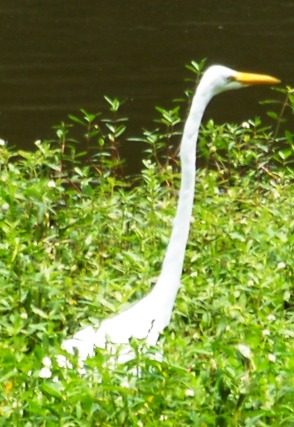
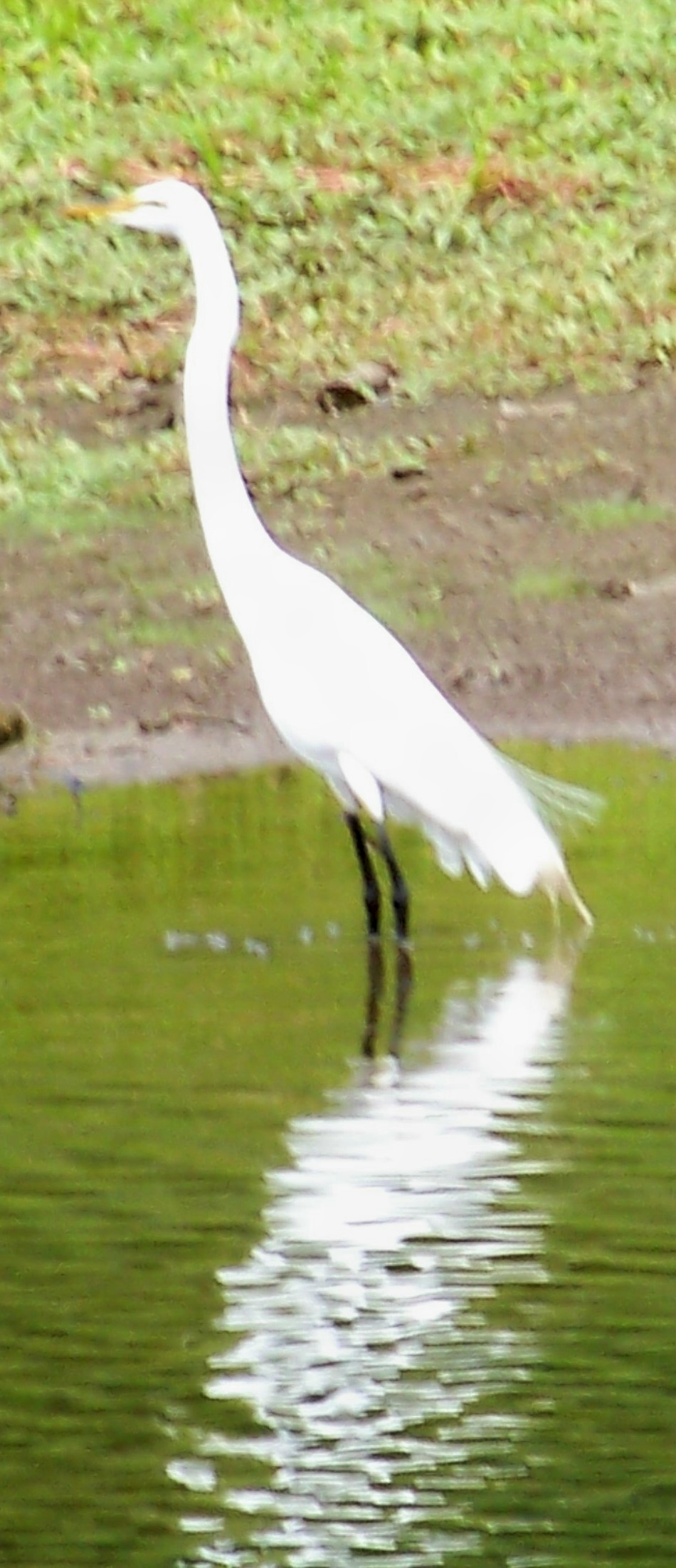
The turtle row launch is generally busy, negotiating space for incoming and outgoing, big or small. On less crowded mornings, a lone egret will land but the concrete of the launch is not as inviting as the verdant growth along the shores of Waverly pond, even in August. There is much to be discovered as the day begins.

I am grateful to Cooper for these Waverly mornings for it is his heart that holds us fast to our ritual. He has taught me the forever joy of “bye-bye in the car.” It is a lifetime gift, of course. Already there are times that we must settle for the memory of Waverly but for every day we are able, we have a Waverly morning.