Sitting With the Wolf in Stillness

Every morning, I spend an hour in meditation followed by an hour that includes exercise, shower, and breakfast preparation. It is this mind-body connection that begins my day. While I will revisit physical exercise and food preparation, no day opens without meditation.

Empty yourself of everything. Let the mind become still. The ten thousand things rise and fall, while the Self watches their return. They grow and flourish and then Return to the Source. Returning to the Source is stillness, which is the Way of Nature.”
~ Lao Tsu ~
Tao Te Ching

During my recent lupus flare, it was meditation that allowed me to empty and renew myself for the rise and fall of the ten thousand things. It was meditation that allowed me to explore the energy underlying every form of discomfort, the internal investigation as Devaji refers to it.
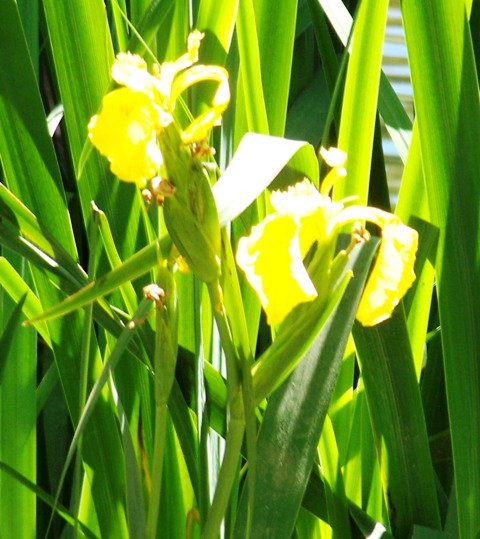
Tadpoles Waverly 0613

When there is internal investigation as opposed to following the external movement,
it is possible to recognize that every form of
discomfort, every problem that is experienced, is happening inside of you.
If you do not have a problem inside, you do not have a problem. The mind will say that it is due to something out there, but where you experience the problem is inside
.”
~Devaji~

It is a familiar pattern of mine this looking to the outside for what may only be discovered on the inside. I have done it for almost all of my life but this past year of daily meditation has been a discovery of stillness, which is not to say the mind is ever quiet.

In meditation, which many teachers referred to as “taming of the mind,” there is no effort to reshape or redefine any of our thoughts. In meditation, we observe our thoughts, allowing them to bubble up and away from us without interference, without creating yet another thought.

Rather, we go into the stillness, to the energy producing our thoughts. Always, in meditation there is “light emphasis” on the breath (Chögyam Trungpa Rinpoche) to sustain us as we sit in the stillness of our internal investigation, emptying ourselves.

As I understand mindfulness, it is bringing this technique to our day-to-day lives as they play out among the ten thousand things. For me, that means letting one storyline after another blow right past for I am interested in the energy supporting those thoughts. I am seeking the source.

Tadpole Free 0613

In this lupus flare, rather than pursuing my usual cause-effect-solution approach—another way of describing this is replacing one storyline with another, albeit a new and untried solution—I sought the source, the stillness, with my breath.

Stillness or “nowness” is placing our awareness on our breath as the thoughts bubble up. The breath is no more manipulated than are the thoughts. The more the breath and mind are observed, the more there is just being, no judgment, just stillness.

Internally investigating my lupus flare allowed me to sit in the energy of the ten thousand things of which my life is just one.  Rather than trying to starve or manipulate the lupus–the wolf–that is also of the ten thousand things, I just sat down with it in relationship.

Flares are never without their gifts nor is it surprising that those flares that burn brightest are always the most generous. This time, the gift of sitting meditation with the wolf has opened the door to a lifetime exploration of the rise and fall of the ten thousand things from the inside out.

Thanks to all of you for your generosity and kindness during this recent flare.

Ringing the Bell of Uncertainty

“Suffering is a meditation bell, not an enemy” appeared in a recent update on Jeff Foster’s Facebook page.  The context of the quote is that in suffering, we identify ourselves as a single thing, image, or sensation, thereby confining ourselves to that single identity. It is only when we remember that we are “no-thing” do we discover our true nature, “which is everything” (Foster).

Suffering grabs our attention as a signal that our “okayness” is about to change. It is the ringing of the bell of uncertainty. We can resist and suffer or we can accept and “allow” as Anita Moorjani calls it.

Allowing or accepting is not passive in any regard but rather, an open-arms welcome to the uncertainty inherent in each of our lives. In allowing, we transcend duality, forgoing the labels that make us this or that. Allowing is discovering our true nature, and it is a lifelong trip.

KMHuberImage
KMHuberImage

“To access the state of allowing, the only thing I had to do was be myself. I realize that all those years, all I ever had to do was be myself, without judgment or feeling that I was flawed. At the same time, I understood that at the core, our essence is made of pure love” (Anita Moorjani).

Moorjani’s book, Dying to be Me, is a fresh approach to accepting ourselves as we are. It is also an accounting of her recovery from physical illness that includes a near death experience, which is not the focus of the book, at least not for me.

Quite specifically, she writes that her story is just that–her story—of recovery from cancer that led her inward to her true  nature, which is entirely unique to her. Likewise, what her story may or may not mean to any of us is just as unique.

Clarity in the wild 0413
KMHuberImage

“I don’t advocate that if we ‘believe’ a certain way, it will eliminate disease or create an ideal life…. Having awareness, on the other hand, just means realizing what exists and what’s possible—without judgment. Awareness doesn’t need defending” (Moorjani).

Moorjani does refer to a kind of “clarity” that she had as she lay dying.  In a coma, she considers where she was as a state and not a place.  There are no conversations with God or with any other being just awareness:

“…I instinctively understood that I was dying because of all my fears. I wasn’t expressing my true self because my worries were preventing me from doing so.

“I understood that the cancer wasn’t a punishment or anything like that. It was just my own energy, manifesting as cancer because my fears weren’t allowing me to express myself as the magnificent force I was meant to be” (Moorjani).

Moorjani’s book focuses on present moment awareness of the self– the exploration of one’s true nature— and within that journey the necessity of loving ourselves unconditionally in this realm that is here and now. Repeatedly, she indicates her healing was not positive thinking or mind over matter but consciousness, which she calls “magnificence…a state of being…the part of me that’s eternal, infinite, and encompasses the Whole.”

KMHuberImage
KMHuberImage

Moorjani is well-versed in all of the Eastern traditions as well as Christianity. She is not a physician or a scientist but a woman who nearly died of cancer seven years ago and is completely recovered.

In previous posts, I have mentioned Deepak Chopra’s Quantum Healing and Perfect Health regarding the role of consciousness in one’s health, specifically the “intelligence” inherent in the physical body. I have read other medical and scientific works as well. In the 21st century, there is a growing body of work in neuroscience—and to some extent, physics–that is exploring the role consciousness may or may not play in our health. I find it fascinating, all of it.

To me, it is increasingly evident that our level of health is inextricably tied to our true nature. Our physical and emotional health reveals our level of awareness of our true nature, in essence whether we resist or accept our lives. Who knows? Attaining our optimal health may begin with our response to the meditation bell of suffering.

In the coming months, I plan to explore optimal health and consciousness. As always, I appreciate your thoughtful comments and that you take time to read my blog. Thank you, dear reader.

Time for a break; regular posts will resume in May.

Staying and Straying: The Tension of Two

KMHunerImage; McCord Park; Tallahassee
KMHuberImage

The fear of letting go makes staying hard and straying easy. As Mark Nepo says, it is “so hard to feel the stone and not the ripple.” It is the tension of trying to be in two places at once, resisting what is for what might be.

“The moment we stray from where we are…we [block] the sensation of being fully alive because being split in our attention prevents us from being authentic” (Mark Nepo).

When we stray to a past moment that gives us pain or joy or both–how we label it really doesn’t matter–the memory provides us with what it has always provided us, a moment that was reality but no longer exists. Yet, that memory appears in the present moment.

KMHuberImage
KMHuberImage

In staying with what each moment offers, memories bubble up—memory is the context of our mind–it is one thing to witness our memories and another to engage them. When we stray to them, we divide our attention and are no longer authentic but somewhere in between.

We can’t help but remember, yet if we allow our memories to stay as bubbles, floating up and through us, we let them go as they are, untouched and whole. As Pema Chödrön teaches, it is the energy beneath memory that is worth our attention for it is the source of the bubbles.

For each moment that we practice being present—neither running from nor holding onto—we feel the stone and not the ripple for we are not attaching or resisting. There is no tension of straying or staying. These moments seem few.

The difficult and the joyous moments we always revisit for those are bubbles we want to forget or we want to remember always. Regardless, we stray. In remembering, sometimes we try to change the outcome by daydreaming new scenarios or we just simply want to relive the moment, maybe embellishing it just a bit. Once we stray, there are no limitations.

Regardless, the memory bubbles will return and keep returning until we practice staying in each moment we have. Our practice begins with our inner resources, the “four limitless qualities [of] loving-kindness, compassion, joy, and equanimity” (Pema Chödrön). We begin with whatever quantity there is of each, no matter how shallow the pool.

We go to what we are because it is what we genuinely and completely feel. We may aspire but we begin right where we are. A well can fill, a pool can become a lake but always, there is the first drop.  For us, always there is the present.

KMHuberImage; McCord Park; Tallahassee; Florida
KMHuberImage

What we actually are–a limitless pool of inner resources–spills into our actions in everyday life. It is a pool to which we may return again and again, staying with what is genuine rather than straying into what was or might be. There is no resistance, just the feel of the stone.

“That we stray from the moment is not surprising. The more crucial thing is that we return” (Nepo).

The Mirror That is You

Love reflecting upon itself—seeing others in ourselves and ourselves in others—or Tat Tvam Asi, Sanskrit for “you are that, that you are.” All individuals comprise the connection that is oneness.

Yet in order to connect, we must detach, free ourselves from clinging to one way or another. We detach when we look into the mirror of our oneness so that we see each other.

KMHuber Image; St. Mark's Refuge, FL; mirror
KMHuberImage

Detachment is not giving up anyone or anything but rather, it is attaining freedom. My own experience tells me that when I am completely present, my life is free of past conditions and future “what ifs,” wide open to the field of infinite possibilities.

When we are completely present, we are giving the moment our full attention. Attention energizes the moment, keeping it free from the past, the future or any current situation. When we energize the moment, we set our intention, the direction we wish to travel within the field of infinite possibilities.

Intention transforms or changes the moment but intention does not attach to any one solution, any one goal. There is no clinging, no controlling how it all works out. Rather, with intention, we set our course, remaining open to the outcome as it reveals itself.

I do not find detachment easy but I find it attractive for it is staying with what is, not what was, what might be or even the outcome I think best. I cannot possibly know what is best but I can focus on a direction.

Deepak Chopra writes that in detachment, there is wisdom in uncertainty. Likewise, attachment to anything results in fear and insecurity:  “In order to acquire anything in the physical universe, you have to relinquish your attachment to it” (Seven Spiritual Laws of Success).

It seems to me detachment offers us the mirror of oneness, the reflection of what connects us to one another. Perhaps it provides us a way through our separateness.

KMHuberImage; oneness; St. Mark's Refuge FL
KMHuberImage

In detachment, our perspective broadens as do our perceptions for we are not attached only to one way or the other but are engaged only in what is. We recognize traits in one another because we know them as our own. In our oneness, we are mirrors, reflecting the world to one another.

Oneness never diminishes the individual but celebrates it–Tat Tvam Asi—you are that, that you are. All are part of the whole. In celebrating our connection to one another, our attention is on what connects us, not what separates us. The energy of attention—our connection–sparks the intention of reaching critical mass awareness.

For the first time in the history of humanity, we have the technology to create global consciousness one person at a time– the only way change is ever truly affected–as we reflect ourselves to one another through the mirror of oneness, a celebration of each and every one of us.

When we are open to what is—the infinite field of possibilities–we are not attached to value, judgment or labels but to “the dream of constant okayness” as Pema Chödrön named it. The infinite field of possibilities abounds in the state of okayness in every moment for every one of us.

The gift of oneness is that the uniqueness of every individual is what connects us, is what allows us to mirror the world for one another. It is how we recognize ourselves.

We live in a fractious and fearful world; we live in a moment unlike any other. As with all who have come before us, we have the opportunity to create a planet of thoughtfulness, mindfulness but unlike previous generations, we have the technology to criss-cross the globe, connection upon connection.

The world grows smaller as we grow closer. “It is only by risking ourselves from one hour to another that we live at all” (William James). It is up to us as it has always been.

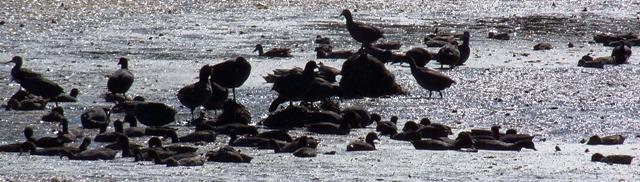
KMHuberImage; Mud hens; St. Mark's Refuge FL
KMHuberImage

And Then Death Returned

Cooper Birthday 12; KMHuberImageAs I write this final post about Cooper James, there are more tears of joy than of loss for he and I did a pretty fine job of making the most of the time we had, which really was not that long but to be honest, it would never have been long enough for me. Yet, the fact that we were together is what comforts. Gratitude always sustains.

Cooper died on New Year’s Eve, and I have not been able to write this post until now for with his passing, a chapter ends but also, a chapter begins. Right now, I’m straddling the pages but as the days pass, the new chapter will begin to write itself. It always does.

Publishing a final post to sum up Cooper’s life just didn’t seem to suit. I seemed to recognize that early on so I began publishing occasional posts about our life together. I wanted to capture as many moments as I could, for Cooper was truly curious about his world. All dogs are completely present all the time but Cooper’s curiosity seemed to enrich his experience on the physical plane.

Cooper was not a dog that everyone loved nor did people see him as a perfect kind of dog. He was handsome, and he knew it, and he was a charmer, albeit a quirky one. Originally named Snoop, he lived up to his name. In Day of Freedom, I relay how he and his cat friend, EmmaRose, came to live with me. Then, I did not know that freedom resides in every moment, if only we are aware.

In Trailblazing, I wrote of Cooper’s intervertebral disc disease and further explained the consequences of a lifelong love of Cooper, EmmaRose; KMHuberImagesnooping:  Cooper has enjoyed reasonably good health, other than taking a daily Pepcid for most of this last year. Essentially, Cooper views the world in terms of how edible it is, often deciding to take a chance. This lifelong habit seems to have caught up with him. Cooper never missed taking a chance, and I began to understand how limiting hesitation is.

Shedding, which proved to be my most popular post for 2012, recounts our first visit to Waverly park. Spring was just starting. Everywhere, everything is coming to life as Cooper snores….There is a lifetime in this moment, as always.

In What Abundance Knows, Cooper, EmmaRose, and I, once separate, were now together enjoying abundance. How we lived before does not define us nor does it measure who we are.

KMHuberImage; Cooper JamesThe first sign of real decline was apparent In the Moment: Even with disk disease and deteriorating joints, Cooper strives for the handsome gait that has all but left him. In seeing his ramp with his car for the first time, he took that in stride as well—allowing me to guide him in—bearing the grace of the being he is. Once in the car, I buckled us into our seats. With hand and paw on the gear shift, we moved into yet another moment.

By summer, we were celebrating Waverly Mornings as an idyllic frame for every day’s possibilities. I am grateful to Cooper for these Waverly mornings for it is his heart that holds us fast to our ritual. He has taught me the forever joy of “bye-bye in the car.” It is a lifetime gift, of course. Already there are times that we must settle for the memory of Waverly but for every day we are able, we have a Waverly morning. 

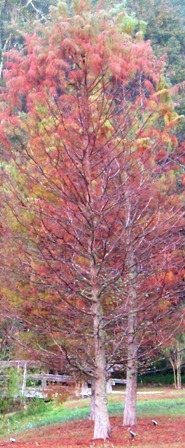
However, as the winter solstice approached, Waverly in Winter was one of our last visits: I watch him more than he realizes. KMHuberimage; larch in autumnEvery time, I am glad that we are at Waverly on this day and that he is engaging with every scent he can find and even in winter, there are many. I do my best to stay as present as Cooper for far too easily my mind wanders to spring and whether or not Cooper will be with me at Waverly, gazebo or no. On the afternoon of the winter solstice, he had his first seizure.

The day that As Death Brushed By posted was Cooper’s last full day on the physical plane. What a visit we had at Waverly that day. The humidity was non-existent, and Cooper walked the circle that is Waverly pond. For the last time, he made his stiff, little legs trot just a bit in celebration of the day dawning. That evening, he suffered another seizure more severe than the first.

Once again, I watched over him through the night, and in the morning, he went for his last “bye-bye in the car,” a 2.5 hour ride, his last trip to Gainesville where he would cross the Rainbow Bridge. I thanked Cooper James for all that he gave me as he drifted into sleep, his last, and for me, the last time I would watch over him.

Regular blog posts will resume January 10, 2013.

Finding Story Anew

My last two blog posts have been an examination of my current mind-body consciousness, specifically my meditation practice and eating habits. I share Deepak Chopra’s belief that a change in one’s consciousness or awareness affects a change in one’s physiology at the cellular level.

I don’t remember when I did not believe in the mind-body connection but I know that reading Chopra’s Quantum Healing helped me consider what quantum healing may mean for me. I first read the book in the early 1990s and again just recently.

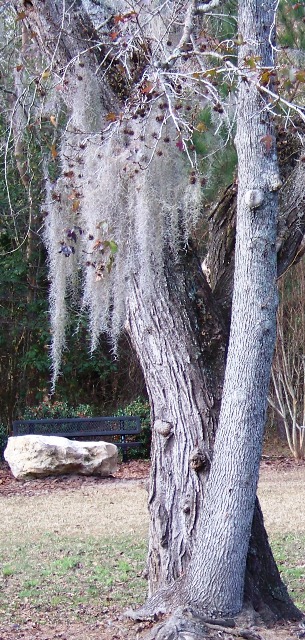
Old Woman Tree; KMHuberImage; Tallahassee Park in Winter

Of course, my current level of awareness is quite different these twenty years later. Then, I was completely attached to outcome—clinging the Buddhists call it—meaning my attention was always focused on the end result. Mostly, I was on a pendulum, swinging back to the past and then to the future without a thought to the moment. No wonder I never felt free.

Becoming aware that the moment is where freedom resides broke me open to Chopra’s “field of infinite possibilities” both physically and spiritually. Now, every facet of my life is fluid as I focus on what is and not what might be, which takes a lot more energy but in every moment, there is more energy.

Nowhere is this more evident than in my writing. When I began blogging, my writing focus was entirely outcome based: I set myself a certain number of words per day, I joined various writing challenges, and I troubled my readers with my angst over whether to plot out a novel scene by scene or just write it out by the seat of my pants. In nine months, I produced 220,000+ words in what I have come to regard as my daily writing practice. It is as valuable as my daily meditation practice, and  I don’t regret a word.

I was so attached to the outcome of writing– was it a novel, was it a memoir, was it a compilation of essays–that I abandoned story in search of format or genre. I could not free myself of what my words might become until I settled into the moment to write. One word after another, each sentence emerged from life rather than artifice. I re-discovered how I write.

In writing from the field of infinite possibilities, format/genre didn’t matter nor did structure, which is not to say that format and structure do not matter. They do and are critical to a successful outcome but like story, they have their moments for each writer to discover. For me, that meant having to know my story first, and I wrote in a way I have never written.

Having always appreciated a good story, I was well aware that I did not know the structure of story so I found out from those who did. I read, I watched movies, I discovered scene, and I wrote every day. I began to see snatches of story and I was reminded of John Irving’s response to the question of how he writes: “I start writing my autobiography and then I begin to lie.”

Pond in Winter; KMHuberImage; Tallahasse Park in Winter

I am writing an old woman story, and I am an old woman. If one can come of age at age 60, this woman does it. I cannot say that she is sympathetic or even likable—yet—but she exists in more faces and more places than is comfortable for any of us. Age or aging is still a thorny subject, and we have many clichés and euphemisms to avoid the word old.

But what can a woman make of a life at 60, if she has just awakened? That does sound rather autobiographical but I was lying before the end of the first paragraph–such is the way of story. For all I know, the old woman story—for lack of a better title–will remain part of my writing practice, as publication is not the outcome it once was for me. It’s too soon to tell.

For now, I go to the writing every day just to see what happens  with the old woman for I have not lived her life, although an old woman myself.

A Change of Habit

Autumn is my favorite time of year, in particular the week before Thanksgiving. For some years now, this is the time I assess the current year in preparation for its final toast on December 31. I love the season; it’s such a time of good feeling. There were years that I watched all the holiday programming television could provide. This year, I’m marking the season by not subscribing to any television programming for one year, perhaps forever. It’s a habit I’ve wanted to change for decades, and it seems the season to do so.

For me, most television programming is noisier than any form of social media on its worst day. And my limited engagement with social media is more free than not. Frankly, I can “click out” of either one quite easily but the television has held sway over me–admittedly, attachment–that social media does not have, yet. Television provides hours of images, day and night, and all I have to do is watch, mindlessly.

Cooper’s TV Reaction

Yet, for all of 2012, I have been exploring consciousness–being aware of being aware–by studying various ancient traditions, including the practice of meditation. Since July, I have been meditating daily, having missed only a handful of days in five months. Meditation is yet another change of habit that is a long time in coming.

In the posts I have written about meditation, specifically about being “in the gap,” I acknowledge my difficulty in learning to accept what is. Yet, it is that acceptance, the moving away from duality–not labeling a moment as this or that—that has allowed me to connect to consciousness, producing changes in my physiology as well.

The benefit of any habit is its consistency; in fact, that is the power of habit. Nowhere is this more apparent than in meditation. My daily connection to “the gap between thoughts”—where stillness or consciousness resides—always provides moments of calm, even relaxation. The more that I practice meditation, the less attention I pay to the constant chatter of my mind. Without attention, my thoughts do not attach.

Early on in my meditation practice, there were days the chatter was almost nonstop but there was always some point where I connected with the stillness.  And every connection affected my physiology. Frankly, when I was in the gap, I was not aware of any discomfort. In five months, I believe my discomfort level is significantly less, and while I do not yet fully understand all that may mean, I know it to be true.

There are other reasons for my improved physiology, including a healthy diet and exercise, but if I had to single out one aspect in the last two years it would be a change in consciousness. In other words, my reality has changed because my consciousness has changed, not my attitude but my awareness. It is not a matter of positive thinking for a change in consciousness has nothing to do with thinking and everything to do with being aware of being aware in every moment.

Autodidact that I am, I have sought out the ancient traditions and continue to do so but when I began my meditation practice is when I noticed the shift in my consciousness that affected my physiology. There is no doubt that the cumulative effect of the change in so many of my habits over the past two years is finally being realized–recently, I added a few fruits and legumes to my diet as well as sweet potatoes–but beyond the increased energy I receive from extra carbohydrates there is a hardened resilience born of acceptance.

I assure you that nothing in television programming can compare with all the realms I have yet to explore.

“In one atom are found all the elements of the earth; in one motion of the mind are found all the motions of existence; in one drop of water are found all the secrets of the endless oceans; in one aspect of you are found all the aspects of life.”–Khalil Gibran


Considering Critical Mass

Imagine what critical mass consciousness might mean for our planet. That’s what I have been considering this past week. In this context, I am referring to critical mass as “a threshold value of the number of people needed to trigger a phenomenon by exchange of ideas” (Wikipedia).

In a recent Super Soul Sunday interview with Oprah Winfrey, Deepak Chopra suggested the possibility of critical mass consciousness because of the advances we have made in technology.  Imagine all of us aware of being aware.

The idea of awareness or wholeness reaching such a threshold does seem more than plausible as we are able to communicate globally on a daily basis, if we are so inclined. Whatever technology may or may not be, it is bringing us together face by face, word by word, video by video, an ongoing parade of points of view. It seems there are few places or events that we cannot access.

The recent US presidential election is a good example of such an event. The reelection of President Obama revealed much about us as Americans, not the least of which is that we, too, are moving toward that segment of the planet where white is just another color. In revealing ourselves, warts and all, we relied on the risk that is hope, on the spark that is genius.

“Genius is a crisis that joins the buried self, for certain moments, to our daily mind” (William Butler Yeats). Whenever we are jarred into genius, we have the opportunity to become whole–once again aware—to perceive yet another perspective on what it is to be human. Through crisis, we absorb all that we have been so that we may be yet again anew and maybe, just maybe not as attached.

“The purpose in crisis, if there is one, is not to break us as much as to break us open” (Mark Nepo). Letting go is a lifelong lesson. To be broken open is to detach from the outcome of crisis, no matter how difficult it is or how long it takes. To become aware of all around us requires us to love enough to let go. As the Buddhists say, “to be a fisherman you must detach yourself from the dream of the fish. This makes whatever is caught or found a treasure” (Nepo).*

Perhaps that is what takes us to crisis, our ever narrowing inability to let go of the dream. We attach our lives to a candidate, to a belief, to a fish, and we close ourselves to any and all outcome outside of our narrowly defined dream. No such dream could ever come true for our attachment to its outcome is beyond the dream.

St. Francis told us that “[we] are what [we] are seeking.” As seekers, we break open, teetering on the edge of ourselves, where awareness begins. Extending all that we are to all that surrounds us is consciousness, motivated only by compassion, love, gratitude, and joy. Just consider that we have the technology to reach such critical mass consciousness.

*(All Mark Nepo quotations are from The Book of Awakening, Kindle version).

Life: A Chronic Condition

Life as a condition generally denotes the state of being human but when health is implied, the meaning involves a defective state. Thus, considering life as chronic implies a wearing away, a wearing down.

Often, I use “chronic illness” to describe my health, although it makes me wince. I am no more an illness than I am a writer, a family member, a friend or a neighbor, although I have met each of these conditions with joy and sorrow, success and failure, the usual mixed bag that is life.

Life with conditions resembles what the Buddhists call clinging, attaching ourselves to this or that. We rarely regard reliving a fond memory as clinging but it is; Michael Singer describes this fondness as “I don’t want this one to go away… I want to keep reliving that moment” forever attached, completely embedded.

Just as chronically, we eschew those memories that are less than fond, even though they are always readily available. From those moments we cannot run fast or far enough, unaware we are on a treadmill of attachment incapable of escaping what we know.

Ironically, a shift in our attention from the known to the unknown of awareness frees us. Being in the moment switches off that treadmill, shuts down that memory to experience what always is, the freedom that is in every moment we ever have. Conditions result from experience but in the moment—the state of being– there are no conditions only creations. Chronically, life is; only we attach.

The ancient traditions teach us that everlasting joy is inevitable when we stop pushing away or holding onto life. The freedom integral to peace and contentment is available in every moment. In truth, freedom requires risk and risk resides in the unknown, not exactly comfortable conditions, or has our chronic response to risk become comfortable.

Embracing risk feels as if we are opening ourselves to each and every moment changing us—we are–as if risk were a mere matter of inhaling and exhaling—it is, if we focus. In a mere matter of a breath, consider the strength of a sigh, an exhaling of what is no longer necessary.

Almost any form of meditation considers the breath. In learning to meditate, I focused on inhaling and exhaling and discovered the pause in between. As basic as the pause is, I had never considered it. Only recently did I realize my daily meditation practice has immersed itself into my daily life: inhaling and exhaling, I release all-too-familiar conditions, as if I were sweeping 10,000 rooms daily, which I do.

For me, it was chronically easy to cling to conditions in the belief they secure one’s life. Labels–gender, occupation, health, neighborhood location–categorize life, as if the familiar confines could stay the constancy of change. I spent a lot of my life that way but I admit to a fascination with risk, which has always served me.

It has taken most of my lifetime to realize that joy, love, compassion, and gratitude are chronically inherent in the risk that is life. These emotions eschew the ego and all of its conditions; these emotions launch us out of ourselves into all of life. They are worth every moment of risk.

Taking a Full Breath

I usually mention “being present” or “being in the moment” in my posts but until I read Elizabeth Mitchell’s inspirational post, I did not realize how often I am my own obstacle. When I read Elizabeth’s words of “get out of your own way,” it occurred to me that I am only in the moment when I am not standing in my own way.

Here is another way to consider it: I am my greatest obstacle when I am least aware that I am aware, the opposite of Michael Singer’s definition of consciousness, “being aware of being aware…the seat of Self.”

When we are in “the seat of Self,” we immerse ourselves in each moment for the experience of it, allowing all of it to pass through us completely, not holding onto a single breath. It is as basic as inhaling and exhaling, the essence of living.

Breathing/living completely requires constant awareness and attention; if we get sidetracked, we attach first to this, then to that and we find ourselves short of breath. Our physiology constricts; our head is over our heart. We need to get out of our own way.

Currently, I am participating in Kristen Lamb’s two-month, online blogging course, which I highly recommend for all bloggers; I am about to engage in writing the initial draft of a second novel; I have a nonfiction manuscript that requires revision; the response to my blog pleases me more and more every day. Every one of these is an opportunity if I breathe fully and do not attach.

Fortunately, I have the luxury of being older as well as being chronically ill, and I’m serious in my application of the word luxury to both advantages.

Aging provides me a considerable archive of experience—albeit one of attachment—yet I pause, mainly because I’ve been there, done that, which is not being present. I catch myself relying on the known, which does not fit as it once did. So, I am considering the class, my writing, and this blog–each for what it is–through perspectives unknown to me. It is taking some time but in understanding that the moment is all I ever have, time is yet another luxury for me.

As I have written numerous times, chronic illness keeps me more in the moment than any resource in my life and as such, I  discovered worlds I would never have known, and there are so many more! Every day, I meet people with the most extraordinary stories, constant sources of inspiration and information.

Always, I am grateful for  my readers and for the incredible insight that so many of you reveal in your comments as well as in your correspondence with me. Frankly, your response is humbling and energizing. It keeps me on the search for blog post topics. Truly, I thank you.

As I reorganize and reconstruct, I am taking a break from blogging, returning on October 28.  As usual, Mark Nepo succinctly describes the coming and going that is living:

“Being human, there are endless times we need to be still and as many times that we need to move. But much of our confusion as modern citizens comes from trying to have the one we are more comfortable with substitute for the other.”