All Posts

In a Free Fall Flare

My regular Thursday and Sunday posts have been rather irregular for I remain in a free fall flare or the state of still falling apart, which is not to say it is not enlightening for it is.

As a dear friend pointed out, a flare is a flash of light, and this recent lupus flare is full of light for me. It is not so much a matter of physical or emotional discomfort but more a matter of “nowness” as Chögyam Trungpa Rinpoche calls it:

“The way to relax, or rest the mind in nowness, is through the practice of meditation.

“In meditation you take an unbiased approach.

You let things be as they are, without judgment, and in that way you yourself learn to be.”
Chögyam Trungpa Rinpoche

nowness 0513

I, myself, learning to be is what this flare feels like, if not quite a true free fall at least in constant motion. Sometimes, the flare feels like a game of pinball, silver-steeled balls bumping up against this teaching only to zip over to that tradition and back up to yet another healing alternative–all disappearing only to re-emerge.

No doubt that sounds rather scattered and perhaps unpleasant but it does not feel that way. Frankly, it feels like heightened awareness for unlike the game of pinball, I am allowed to sit in the energy of each moment and explore it through the practice of meditation.

“Sitting meditation opens us to each and every moment of our life. Each moment is totally unique and unknown….

“This very moment, free of conceptual overlay, is completely unique. It is absolutely unknown.

“We’ve never experienced this very moment before, and the next moment will not be the same as the one we are in now.

“Meditation teaches us how to relate to life directly, so that we can truly experience the present moment, free from conceptual overlay.”
(Pema Chödrön, How to Meditate: A Practical Guide)
Eyes Open 0513

In the eyes open meditation that Pema Chödrön is describing, we separate the storyline or thoughts–the conceptual overlay– from the energy of the emotion or sensation we are feeling. In essence, we are open to it.

I am new to the eyes open meditation that Pema Chödrön advocates and first tried it during the online retreat offered by the Omega Institute. In eyes open meditation, the gaze is downward but the head is erect and one is constantly aware of what is occurring in the present moment.

“Open the eyes, because it furthers this idea of wakefulness. We are not meditating in hopes of going further into sleep, so to speak.

“We are not internalizing. This isn’t a transcendental type of meditation where you’re trying to go to special states of consciousness.

“Rather, we meditate to become completely open to life— and to all the qualities of life or anything that might come along”
(Pema Chödrön, How to Medicate: A Practical Guide).

Relating to life directly 0513

Meditating with my eyes open was not as difficult as I thought it might be, even the first time, but then, I have the advantage of being in a flare, of being in a flash of light. In a flare, it is obvious that the gift of any moment of discomfort is present moment awareness.

Beyond the flare, practicing this wakeful kind of meditation at the start of my day prepares me for the post-meditation moments. Sitting meditation isn’t always comfortable and neither is life but meditation helps us sit down into the shifting emotional energy that flows through our daily lives.

We learn to go deep, beneath the conceptual overlay or storyline, to the energy of our emotions, of our pain. When we sit within the energy of our pain, we see into the state of us. There, we begin to heal—to suffer less—for we accept the alternating pain and pleasure that is the nature of our human condition, part and parcel. We, ourselves, learn to be.

Thank you for reading my blog. It matters a great deal to me that you do.

Right Down the Middle

KMHuberImage; St. Mark's Wildlife Refuge; Florida; USA

I often think of present moment awareness as a matter of balance, and whenever I think of balance, I think of Buddha nature: “The reason everything looks beautiful is because it is out of balance, but its background is always in perfect harmony” (Shunryu Suzuki).

The background balance of Buddha nature is the source of the infinite possibilities available to us in every moment we have. Our lives are up-and-down, in and out, and all the while, the balance of Buddha nature holds it together while we try this and that.

There are many names for Buddha nature— the web that has no weaver, God, Allah, the Tao— and underlying them all is impermanence, the pain and pleasure of existence. All the great traditions offer ways to accept impermanence, for if we can wrap ourselves around the idea that change is what offers us opportunities, we can live in the moment for all that we are.

There is no one way to present moment awareness but all the great traditions encourage living life fully present.  They offer prayer and meditation as tools but only we can find our middle way for balance is uniquely personal.

Thick of it 0313

Yet, the nature of impermanence is that balance requires constant adjustment. Just when we think we have found balance, a way to live that accounts for most possibilities, something changes. Sometimes, everything changes or at least seems that way.

Those are the moments of greatest opportunity but they often require everything of us. Our emotions rage. These are not moments to be passed off in positive platitudes or repressed in any way. These are moments to explore the energy beneath the emotion. Present moment awareness plunges us into the energy without the thought.

Many of the traditions define emotion as raw energy with thought or a story attached to it. Usually, many stories emerge with our emotions. It is the stories that bubble up and we attach to them. Before we know it, our thoughts have removed us from the rawness of what is occurring.

The result is we either stuff the emotion away or devise a strategy to control what we are feeling but regardless, we do not immerse ourselves in the rawness but impermanence is the nature of existence, so we will get another opportunity. What present moment awareness offers is a way to wake up and be in the rawness.

Single Path 0313

It is not surprising that we are resistant to being in the moment for it means accepting the unknown, yet we do not doubt that life is unpredictable.  We want a certain amount of unpredictability in our lives but we do not want to be uncomfortable.

When something outside our regular routine occurs, we get unsettled, and we struggle for balance. Whether the occurrence is as minor as not being able to get a cup of coffee or if it is life-changing, accepting impermanence as the nature of our lives gives us the power to deal with change. It is not approval of any event but acceptance of impermanence.

“So this place of meeting our edge, of accepting the present moment and the unknown, is a very powerful place for the person who wishes to awaken and open their heart and mind…it is what propels us toward transformation…the present moment is the fuel for your personal journey” (Pema Chödrön).

Meditation and prayer are two, sustainable fuel resources and always available. We begin within so that we may be all we want to be to the world. In finding our unique middle way, we awaken our hearts and minds to the ways of the world, able to adjust to its constant flux.

Thursday Tidbits: The Way to Fall Apart

This week’s Thursday Tidbits post considers retreat as a meditative withdrawal and as the idea of falling apart. As Pema Chödrön says, “Everything that comes together at some time falls apart.” Ours is to experience pain and pleasure–usually alternating but not always–for the nature of existence is impermanence.

Recently, I attended an online retreat offered by the Omega Institute, featuring Pema Chödrön. The retreat covered the four marks of existence–impermanence, egolessness, suffering, and peace–during the first minutes of the retreat, Chodron referred to the four as the facts of life. I felt a familiar stirring.

KMHuberimage
KMHuberimage

I had been drawn to the retreat from the moment the invitation arrived in my email box, about 72 hours prior to the event’s first session. I was not aware of having any connection to the Omega Institute, which is not to say I did not but is to say I do not remember a connection. Still don’t.

Serendipitous email or no, the retreat affirmed my suspicion that I was, indeed, falling apart again–health, writing, life–but the initial session on impermanence revealed how adept I had become at avoiding falling apart. That was an unexpected moment yet it was obvious I had been creating various bubbles of escape for some time. No wonder they felt so familiar, so comfortable.

You might think all my posts about allowing bubbles to float up and through us while remaining in present moment awareness might have had some effect on me other than escaping with the bubbles. They did, ultimately.

A few months ago when I started reading Pema Chödrön’s books, I chose The Places That Scare You over When Things Fall Apart. I felt a familiar stirring of avoidance when I made my selection but convinced myself I needed to read the former title–for what reason now escapes me.

Not surprisingly, the phrase that I kept hearing in the online retreat was “when things fall apart,” more by participants than by Pema Chödrön. That was not surprising, either.

“Things falling apart is a kind of testing and also a kind of healing. We think that the point is to pass the test or to overcome the problem, but the truth is that things don’t really get solved. They come together and they fall apart. And they come together again and fall apart again. It’s just like that. The healing comes from letting there be room for all of this to happen: room for grief, for relief, for misery, for joy” (When Things Fall Apart).

The words falling apart have always been difficult for me. I eschew vulnerability in the same breath that I advocate an open mind and open heart; however, I do know “strength does not come from a bubble of safety” (Chödrön).

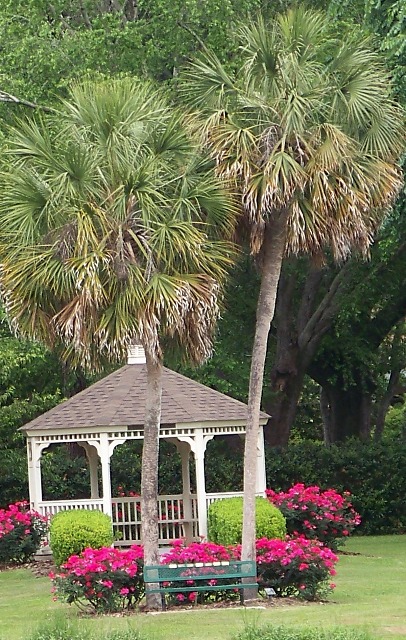
Waverly gazebo 0513
KMHuberImage

My bubble burst within the first few minutes of listening to Pema Chödrön, and my tears streamed right along with the video; Chödrön is quite a wit so my tears were from laughter as well as from the pain of recognition. It was a great way to fall apart, actually.

Nothing has changed and everything has changed. I am still dealing with a significant lupus flare and adjusting my life accordingly; as always, diet, meditation, and yoga figure prominently. For me, it is not a matter of being less but a matter of being more, just as I am, which is new.

If I avoid the discomfort that is part of being alive, I am living in a bubble. Bubbles burst; it is their nature. If I open to both the pleasure and the pain of life, I am vulnerable but strength resides in accepting that things fall apart and come together. It is the nature of existence.

*****

Thursday Tidbits are weekly posts that offer choice bits of information to celebrate our oneness with one another through our unique perspectives. It is how we connect, how we have always connected but in the 21st century, the connection is a global one.

Thursday Tidbits: Like Water Through Rock

This week’s Thursday Tidbits post considers the open mind, essential to mindfulness and perhaps “the gentlest thing in the whole world” as Byron Katie maintains.  Not surprisingly, that which is gentle may also be the most powerful for the open mind, in its awareness, accepts what is.

Acceptance may be the power behind the gentleness of the open mind: “Ultimately the truth flows into it and through it, like water through rock” (A Thousand Names for Joy: Living in Harmony With the Way Things Are, Byron Katie). Undoubtedly, accepting some truths may seem like water flowing through rock yet imagine the power of that possibility.
Obstacle 0413 C

The power of the open mind seems similar to Tonglen, a Buddhist teaching often translated as “sending and taking.” Tonglen “refers to being willing to take in the pain and suffering of ourselves and others and to send out happiness to us all” (Pema Chödrön, The Places That Scare You).

What we take in, we send out in a gentle flow if “…we drop the storyline that goes along with the pain and feel the underlying energy” (Pema Chödrön). In many ways, the open mind is “the bottom line” stripped of judgments and labels, the stuff of storylines.

It is not easy to drop storylines, not easy to resist being pulled in one direction or the other– it is much easier to react–but in the open mind of Tonglen, we stay with the energy that is stirring us. No matter how long or short our stay, in choosing response over reaction, we keep our options open.

In remaining open, we find the way for any truth to flow through us–some consider this courage—we appreciate the gentle persistence of water flowing through rock for it is not how long it may take but that it is undertaken at all. That is the power of being gentle.

The open mind is where paradoxes thrive and similes “like water through rock” describe the world of infinite possibilities for what has never been a moment’s thought may be the next moment’s reality.

KMHuberImage
KMHuberImage

On a personal note, beginning tomorrow I am attending a three-day, online Pema Chödrön retreat as an accompaniment to a lupus flare that is worthy of water flowing through rock.

The Chödrön retreat is “The Marks of Existence,” exploring impermanence, egolessness, suffering, and peace. More information is available from the Omega Institute.

Also, this past week I found three other blogs that seemed related to what this post considers the open mind. I enjoyed each post for entirely different reasons.

Functional Wellness: The Body-Mind Connection is written by a medical doctor and is a thorough, practical discussion of our mind-body’s “one bidirectional system.”  This is one of the most succinct, mind-body articles I have found and includes excellent resources.

Things I have been thinking about lately offers Theodore Roethke’s poem, “The Waking,” a poem of paradox and as the analysis excerpts reveal, a great deal more.

Daily Dose of Vitamin S opens us to an everyday possibility often overlooked and a vitamin well-worth a daily dose, at least.

Finally, this week’s video features excerpts from author David Foster Wallace’s 2005 commencement speech at Kenyon University. It is called “This is Water: Reimagining Everyday Life.” It is nine minutes long but just may help you get through the next nine minutes you find yourself stuck in the everyday.

Video from KarmaTube

Thursday Tidbits are weekly posts that offer choice bits of information to celebrate our oneness with one another through our unique perspectives. It is how we connect, how we have always connected but in the 21st century, the connection is a global one.

The Color of Water

KMHuberImage
KMHuberImage

Ever wonder about the color of water? Water “…takes on the image of the entire world without ever losing its essential clearness,” whether it is a drop in an ocean, a mountain stream, or a rain puddle. (Mark Nepo).

In any given moment, the color of water is steel-gray, sky-blue, moss-green or dirt-brown for water easily embraces the colors of any obstacle anywhere, as the nature of water is movement, while its essence remains ever clear.

Washing over stones, roaring over a cliff to drop thousands of feet, or raining in torrents, it is the nature of water to take on any landscape for as long as necessary, even eons to fill a desert basin as a great salt lake. The nature of water is transparency for no one color ever stays, and no one outcome is preferred.

Like the nature of water we must “…embrace everything clearly without imposing who we are and without losing who we are” (Mark Nepo). It is the nature of human compassion to take on any event completely, no matter its color, but only for as long as necessary.

The highest good is like water.
Water gives life to the ten thousand
things and does not strive
.”

~Lao Tsu~

It is not so easy for us to take on the color of any experience for our nature is not the nature of water, even if our bodies are more water than tissue and bone.
Obstacle 0413 C

We are concerned with the image we present to the world—it may or may not reflect our true nature—often, it is an image thoughtfully prepared so it is somewhat opaque, designed to reflect certain colors in certain situations. It is how we survive in the larger current of human nature.

It is easier to remain within the current of human nature, whether or not that is who we actually are, for we are not water changing the landscape, unaffected by changes, yet the nature of water is a compassionate one.

The nature of water, its constancy to the flow that is all life—regardless of change–reveals we are more than any image we reflect or action that we take. In each moment there is the opportunity not to strive but to seek the essence of our heart, the source of our compassion.

Unlike the nature of water, we are not always aware or completely present in our lives. We are not free from extraordinary or ordinary obstacles but the color of water teaches us not to stay the color of those obstacles but ultimately, to run true and clear to who we are in the current of human nature.

Beneath the clouds, water desires only to flow, and beneath our tensions and problems, the human spirit wants only to embrace and soften” (Mark Nepo).

Perhaps the color of water is compassion reflecting as the colors of the day.

Thursday Tidbits: The Art of Peace

This week’s Thursday Tidbits is the Bloggers for Peace monthly post, specifically the art of peace.  The art of peace begins within ourselves and radiates outward into every relationship we have, in particular those relationships that for one reason or another are askew or gone awry.forpeace6

To renew a relationship begins with intention, although to re-open our heart is often difficult. That is why the art of peace begins within, for when we are at peace with ourselves is when we re-connect to serve all.

In order to start, Pema Chödrön maintains it is not such a great effort to once again establish a relationship that serves, if we will just consider that a commitment we once made is now broken.

KMHuberImage
KMHuberImage

It means we have to let go of the story we’ve been telling ourselves–the why, the what, the how, or who– and just acknowledge “…that we hardened our heart and closed our mind, that we shut someone out. And then we can retake our vow. On the spot—or as a daily practice—we can reaffirm our intention to keep the door open to all sentient beings for the rest of our life” (Pema Chödrön).

Everyday life, no matter how we approach it, is a practice that requires patience, especially when we do not seem to notice any progress within ourselves or within the world.

There are four emotions that never involve the ego—compassion, gratitude, joy, and love—these four ways have many other names including the four agreements of Don Miguel Ruiz that ask us to be “impeccable” in our speech, not to take whatever occurs personally, to be present in all we do so we are not assuming anything about anyone for when we are present, we are doing the best we can.

The art of peace is available to us in every moment we have for each moment is free from any attachment to what has been or what might be. That we affirm our intention to be the best we can be and live with true compassion for ourselves and others in every moment is what keeps peace always within our grasp. It begins with being present.

KMHuberImage
KMHuberImage

“That’s the training of the spiritual warrior, the training of cultivating courage and empathy, the training of cultivating love. It would be impossible to count the number of beings in the world who are hurting, but still we aspire to not give up on any of them and to do whatever we can to alleviate their pain” (Pema Chödrön).

In alleviating that pain we must remember the key to the art of peace: the idea of serving rather than helping or fixing anyone or anything. It is only in serving that we view ourselves and our connection to all life as whole, not broken or weak.

When we are clear in our intention of serving, we are open to what is available for all of us. The art of peace is a celebration of the diversity that makes up the whole, an acknowledgment that uniqueness is necessary for completeness.

Here are links to other Bloggers for Peace and their consideration of the art of peace:

Kozo Hattori: Art Thou Peaceful 

Bodhisattva In Training: The Art of Peace

Grandma Lin: May Post for Peace

The Seeker: Peace is Like a River

Caron Dann: Recreationist Theory

Card Castles in the Sky: Float Upward

One of my favorite combinations of the art of lyrics, music, and painting is this well-known video featuring the music and lyrics of Don McLean and Vincent Van Gogh’s paintings.

Thursday Tidbits are weekly posts that offer choice bits of information to celebrate our oneness with one another through our unique perspectives. It is how we connect, how we have always connected but in the 21st century, the connection is a global one.

Being Present in Healing

My recent trip to the American West was, among other things, a test of the holistic approach to disease that I have followed for the last 33 months. My approach is perhaps best described within Deepak Chopra’s definition of quantum healing:

“…the ability of one mode of consciousness (the mind) to spontaneously correct the mistakes in another mode of consciousness (the body). It is a completely self-enclosed process” (Quantum Healing).

Essentially, this mind-body consciousness is a type of “intelligence” (Chopra’s term) attempting to restore balance in a body that is diseased. It was this “intelligence” that made sense to me when I first read Chopra’s book in the early 1990s and again in 2010 when I removed myself from medical care.

KMHuberImage
KMHuberImage

Undoubtedly, it takes a certain amount of desperation and frustration to walk away from medical science, which is not a route that Chopra, a medical physician, advocates. Rather, he argues that medical science can be a viable partner in working with the innate intelligence of the mind-body connection, with the following caveat:

A man-made drug is a stranger in a land where everyone else is blood kin. It can never share the knowledge that everyone else was born with” (Quantum Healing). In other words, every cell in our body has a kind of intelligence with specific tasks and abilities. All cells in the body work together, ever adjusting to what is occurring.

The inherent intelligence within the mind-body connection is one that medical science has yet to duplicate but it does not mean that medical science cannot assist us in our healing. It can and does–for many. Regardless, awareness of the mind-body intelligence can change our lives just as being aware that every decision we make and every thought we attach to affects our physical body directly and immediately.

That is where stress starts, and with increased stress comes imbalance, and when the imbalance is great enough, there is disease and yes, sometimes irreparable damage. The state of disease for anyone is unique but also may be integral to the individual’s purpose as Anita Moorjani suggests:

The reasons for…illness lie in [our] personal journey and are probably related to [our] individual purpose. I can now see that my disease was part of why I’m here, and whether I chose to live or die, I wouldn’t be any less magnificent” (Dying to be Me).

KMHuberImage
KMHuberImage

Disease as a state of health is how one has lived and continues to live. Just as lupus is not cancer—although in both the body is under attack and in both the autoimmune system plays a major role—directing disease is as unique to the individual as is the optimal level of health outcome.

What that outcome is and how long it may take is just as individualistic as is the degree of recovery. At the very least, an awareness of the inherent intelligence of the mind-body connection provides an alternative to  dealing with disease. At the very most, it can change drastically the course of a disease.

The reason why not everyone manages to take the healing process as far as they can go is that we differ drastically in our ability to mobilize it” (Chopra).

KMHuberImage
KMHuberImage

My experience with “incurable” disease is limited to lupus and Sjogren’s Syndrome, the current names for the disease that has been present in my body for at least 35 years. Some medical experts have told me autoimmune disease has been present since childhood. As I am now a sexagenarian, that’s a long time.

My last rheumatologist told me, “There’s just so much wrong with you and it’s been going on for so long.” That is probably still true for that rheumatologist and the entourage of doctors “on my case” but it was not true for me.

I was seriously ill, and I knew it, but I believe “when we get in touch with that infinite place within us–where we are Whole–then illness can’t remain in the body” (Dying to be Me). My intention is not to be smug or simplistic–nor am I speaking of mere positive thinking–my awareness of the inherent intelligence within my body-mind connection opened me to how I live as well as how I have lived. It gave me a place to begin some 33 months ago, and for me, it has meant drastic changes.

My life does not resemble the life I once knew, nor will it ever. It is not a life free of disease—not yet and maybe never will be–but it is a life aware of the possibilities in each moment I have. It is a life lived from within, and only now do I see the world as it really is, moment by moment, the only reality I ever have.

Thursday Tidbits: The Whole World That is Home

This week’s Thursday Tidbits considers home, in particular the miles and years that make up the distance between what was home and what is home. It is surprising how far one will travel only to discover that one was always home.

Just recently, I made such a trek, a physical distance of over 2000 miles, and a trip in the making for many years. Some months ago, I finally made the plane reservations and as much as possible, I went into training by increasing my daily exercise and experimenting with different foods.

There was never a doubt the trip would require much more of me than the everyday life I have come to know.

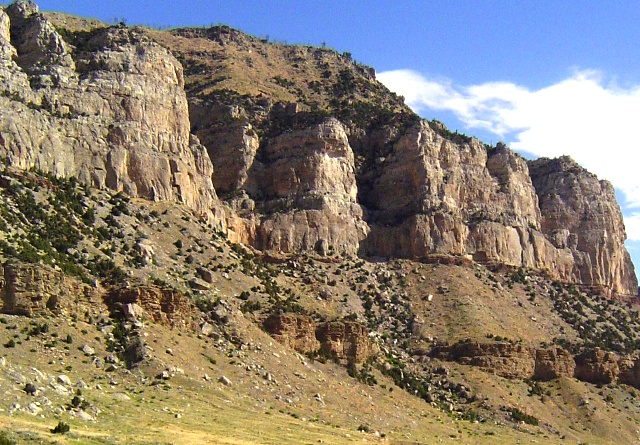
I flew across the United States, leaving the subtropical climate of the American South for the high plains desert of the American West. It is no exaggeration to say that I went from sea level to a mile high in a matter of hours. My body is still recovering.

KMHuberImage
KMHuberImage

Of course, there is no way to prepare for such a trip home, even one without such altitude extremes for what was home is now another place entirely with a life and tempo all its own. It is, essentially, no longer home.

“lift the veil
that obscures the heart
and there
you will find
what you are looking for”
Kabir (India, 15th century)

A visit to a location that was home requires us to open our eyes to what that hometown is now, a place we no longer call home and a place that no longer calls to us, save in memory. That is the veil we lift if we are to experience home at all.

There are streets not much changed and others completely new but already familiar to those who now make this town their home. There are new houses with new lives, making memories, and old houses no longer in evidence, not even a brick or board, but in memory they remain home.

The hours I spent in my former hometown— long enough to see the sun set and rise—was a constant barrage of sixties moments competing with the growth that marks us all, the march of time. The torrent of memories rained into the next few days, as we drove across one state into another, all familiar roads like the town that once was home.

For over four decades, the wide-open, windy vistas of the American West defined me–birth, youth, adulthood, and most of middle age—place was prominent in my life that was, often the only anchor in tempest-tossed seas.

KMHuberImage
KMHuberImage

It is not lost on me that I mix the imagery of that past life–so arid and wild–with the life I have now, not as wild nor arid at all.

The place that I call home has changed from desolate, vast plains and mountain slopes of snow to the verdant green carpet surrounding Waverly pond as well as the Gulf of Mexico, blue beneath towering palms. And I have changed with it.

Now a sexagenarian, home is among the live Oaks draped with moss, creating one canopy road after another. In every season, something blooms or yet another color emerges in the ever-changing foliage. There is lushness in my later years and for me, that is as it should be.

I came late to the realization of “If you look for the Truth outside yourself, it gets farther and farther away” (Tung Shan). Yet, without those early years of traversing the high plains desert that held my heart, I might never have realized that what I sought was always within me.

KM Huber Image
KM Huber Image

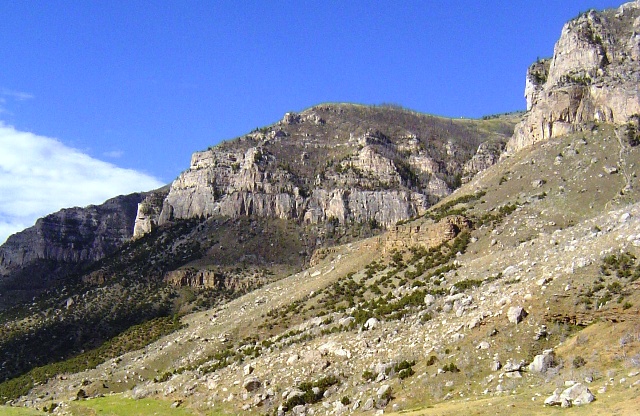
My trip home, these many years later, confirmed a life lived is just that, which is a lot. Driving across the desert plains in spring, I saw that old life in every sagebrush stock, rock outcropping, or hogback hill that whisked by my window. It all passed so quickly—just as it had when I lived it–vast and sweeping but complete in itself.

The whole world is you,
yet you keep thinking
there is something else.”
~ Hsueh Feng

For years, I thought there was something else but as I have shared on this blog many times, what is inside each one of us is the whole world that is each one of us. What is inside us colors the way we are in the world, for our everyday lives are a mere reflection of what is in our hearts.

The two regions I have called home are worlds apart geographically and geologically, and I am grateful for the gifts of each, for only now is home no longer a location but the whole world that I am in any place, in any moment.

Thursday Tidbits are weekly posts that offer choice bits of information to celebrate our oneness with one another through our unique perspectives. It is how we connect, how we have always connected but in the 21st century, the connection is a global one.

Ringing the Bell of Uncertainty

“Suffering is a meditation bell, not an enemy” appeared in a recent update on Jeff Foster’s Facebook page.  The context of the quote is that in suffering, we identify ourselves as a single thing, image, or sensation, thereby confining ourselves to that single identity. It is only when we remember that we are “no-thing” do we discover our true nature, “which is everything” (Foster).

Suffering grabs our attention as a signal that our “okayness” is about to change. It is the ringing of the bell of uncertainty. We can resist and suffer or we can accept and “allow” as Anita Moorjani calls it.

Allowing or accepting is not passive in any regard but rather, an open-arms welcome to the uncertainty inherent in each of our lives. In allowing, we transcend duality, forgoing the labels that make us this or that. Allowing is discovering our true nature, and it is a lifelong trip.

KMHuberImage
KMHuberImage

“To access the state of allowing, the only thing I had to do was be myself. I realize that all those years, all I ever had to do was be myself, without judgment or feeling that I was flawed. At the same time, I understood that at the core, our essence is made of pure love” (Anita Moorjani).

Moorjani’s book, Dying to be Me, is a fresh approach to accepting ourselves as we are. It is also an accounting of her recovery from physical illness that includes a near death experience, which is not the focus of the book, at least not for me.

Quite specifically, she writes that her story is just that–her story—of recovery from cancer that led her inward to her true  nature, which is entirely unique to her. Likewise, what her story may or may not mean to any of us is just as unique.

Clarity in the wild 0413
KMHuberImage

“I don’t advocate that if we ‘believe’ a certain way, it will eliminate disease or create an ideal life…. Having awareness, on the other hand, just means realizing what exists and what’s possible—without judgment. Awareness doesn’t need defending” (Moorjani).

Moorjani does refer to a kind of “clarity” that she had as she lay dying.  In a coma, she considers where she was as a state and not a place.  There are no conversations with God or with any other being just awareness:

“…I instinctively understood that I was dying because of all my fears. I wasn’t expressing my true self because my worries were preventing me from doing so.

“I understood that the cancer wasn’t a punishment or anything like that. It was just my own energy, manifesting as cancer because my fears weren’t allowing me to express myself as the magnificent force I was meant to be” (Moorjani).

Moorjani’s book focuses on present moment awareness of the self– the exploration of one’s true nature— and within that journey the necessity of loving ourselves unconditionally in this realm that is here and now. Repeatedly, she indicates her healing was not positive thinking or mind over matter but consciousness, which she calls “magnificence…a state of being…the part of me that’s eternal, infinite, and encompasses the Whole.”

KMHuberImage
KMHuberImage

Moorjani is well-versed in all of the Eastern traditions as well as Christianity. She is not a physician or a scientist but a woman who nearly died of cancer seven years ago and is completely recovered.

In previous posts, I have mentioned Deepak Chopra’s Quantum Healing and Perfect Health regarding the role of consciousness in one’s health, specifically the “intelligence” inherent in the physical body. I have read other medical and scientific works as well. In the 21st century, there is a growing body of work in neuroscience—and to some extent, physics–that is exploring the role consciousness may or may not play in our health. I find it fascinating, all of it.

To me, it is increasingly evident that our level of health is inextricably tied to our true nature. Our physical and emotional health reveals our level of awareness of our true nature, in essence whether we resist or accept our lives. Who knows? Attaining our optimal health may begin with our response to the meditation bell of suffering.

In the coming months, I plan to explore optimal health and consciousness. As always, I appreciate your thoughtful comments and that you take time to read my blog. Thank you, dear reader.

Time for a break; regular posts will resume in May.

Thursday Tidbits: Unhooking the Pain

This week’s Thursday Tidbits considers “shenpa…the all-worked-up feeling of…getting hooked on a negative emotion” such as pain (Pema Chödrön).  In order to unhook ourselves from shenpa, we must give our full attention to our pain and that includes physical discomfort as well. We must immerse ourselves in our pain in order to release it.

KMHuberImage; oneness; St. Mark's Refuge FL
KMHuberImage

In giving our full attention to our pain, we open up to the experience of it and not the drama or storyline we have told ourselves about our pain. Our storyline is what hooks us until we sit down in the middle of what is hurting us, forsaking its interpretation for its reality.

Anyone who has ever experienced chronic pain—physical, emotional or both–knows that this kind of shenpa can easily become the only story we ever live. Yet, when we give chronic pain our full attention, we change the idea of our pain. We are no longer content to live its story.

Unhooking ourselves from shenpa does not mean that we will be completely pain-free but it does mean we give our full attention to living the lives we have as the beings we are. Being in our pain completely is where all healing begins.

KMHunerImage; McCord Park; Tallahassee
KMHuberImage

Essential to all life is water, and it has more than one form, yet it is either flowing or frozen. Mark Nepo suggests that how we deal with our pain resembles the form water takes. “For when trees fall into the ice, the river shatters. But when a large limb falls into the flowing water, the river embraces the weight and floats around it” (Book of Awakening).

If we view our pain as ice, jagged and hard, we risk living shattered lives of fear and worry, holding our shenpa close. But if we give our pain our full attention and release it branch by branch into the river of life, it becomes a burden we can bear.

We release the idea of our pain and experience it as is, moment by moment, within our flow in our own time. “Once given full attention, you will come back—one drop at a time— into the tide of the living” (Nepo).

Like the river’s path, our lives wend in ways we never imagine. It is life’s way, and pain is only one part, although it can last a lifetime. It is up to us whether pain remains sharp or a bubble in our daily flow.

KMHuberImage; McCord Park; Tallahassee; Florida
KMHuberImage

We have to show up for every moment of our lives, pain or no, giving our full attention to life, trusting that we will absorb our pain and not be shattered by it.

For the people of Boston and the Commonwealth of Massachusetts, for the people of West and the state of Texas, we open ourselves to each and every one of you—victims and family members—for as long as it takes to absorb the pain. There is no limit on your courage or on our love.

Thursday Tidbits are weekly posts that offer choice bits of information to celebrate our oneness with one another through our unique perspectives. It is how we connect, how we have always connected but in the 21st century, the connection is a global one.