A Matter of Voice


When is a voice not a voice or why does the voice inside my head not resemble the voice in the movie, Field of Dreams? Beyond the obvious answer of “it’s only a movie,” there is also the reality of building a baseball field, which I could never do. That’s the kind of voice I hear.

Perhaps chatter is a better term but regardless of word choice, the voice is not reality, incessant as it is. The voice is so pervasive that it filters the reality of living for us, if we allow it. Why is that?

Michael Singer says that “…reality is just too real for most of us, so we temper it with the mind… As long as that’s what you want, you’ll be forced to constantly use your mind to buffer yourself from life, instead of living it…. In the name of attempting to hold the world together, you really are just trying to hold yourself together”(The Untethered Soul).

I admit I have relied on this voice for almost all my life. As a writer, I’ve considered voice essential for I do hear the word as I type or I did. Now that I use voice recognition software, I am not aware of hearing words before I speak them. Inadvertently, voice recognition software has helped me be more present in life.

In short, I am no longer interested in listening to the voice in my head “… [take] both sides of the conversation, [not caring]… which side it takes, just as long as it gets to keep on talking” (Singer).

As I understand space-time, past, present, and future are all occurring simultaneously. All we ever have is the moment, which is completely free for it is attached to neither past nor future but is simply occurring.
The present is not a comfortable setting for the voice, as it is attached to past and future outcomes. The voice builds on situations that exist in either the past or the future. Situation is the foundation for the voice; it is the known. When we listen to the voice, our focus (and thus our perspective) narrows so rather than exploring the infinite field of possibilities, we explore only what we have known for that is all the voice knows.

Vividly, the voice narrates image after image stored within our memory archives. When it reaches the end of that file, it creates one future scenario after another. The voice is like a pendulum, swinging toward what has been and then all the way to the edge of what might be, with nary a pause at what is.

When we are still, we are in the moment, where the voice does not reside. “There is nothing more important to true growth than realizing that you are not the voice of the mind–you are the one who hears it. If you don’t understand this, you will try to figure out which of the many things the voice says is really you.” And we are none of those things for consciousness—being aware that we are aware—is observing the voice we hear without engaging it. In being aware, our focus broadens.

We experience life as it is and only for what it is. “If you’re willing to be objective and watch all your thoughts, you will see that the vast majority of them have no relevance” (Singer). Rather than defining ourselves as past or future events—what has happened or what may happen–we immerse ourselves in the infinite field of possibilities that is the moment, free from past or future outcomes.

When we are in the moment, we are completely involved in all that is. There is nothing for the voice to attach to. We do not focus on the outcome of that moment, which is not to say that we are passive, not at all. It is to say that we do not react; we do not reach for what we have always known.

Rather, we “…decide not to narrate and, instead, just consciously observe the world, [feeling] more open and exposed” (Singer). Consciously observing the world is experiencing all that life is. It means that our every action is one that encompasses compassion, gratitude, love, and joy—maybe even simultaneously– for these are the emotions that are never felt in the presence of the voice, the ego of the known.

These four emotions reverberate throughout our physiology as it connects to our consciousness. In the moment, we are all that we are completely.  This possibility always exists if we forgo the pendulum swing of the voice of the known. Yet, it is not as if the voice will be still but we are not the voice. We are the oneness that observes the voice, for we have more to observe than we have ever known.

I consider it quite a challenge not to engage the voice but the unknown has always intrigued me. As a writer, the role of the witness is certainly not new to me but once again, my switch to voice recognition software provided yet another unanticipated benefit.

Obviously, using the software is a physical change in how I write but while adjusting to speaking my writing as opposed to typing my writing, I became aware of another voice. In speaking my words, there is an immediacy that does not exist with my typing. At times, the words are a pure surprise. Sometimes that is the software doing its best to communicate what it thinks I said while other times, I do surprise myself in the words I say.

Regardless, the thought is rough, meaning there is no longer any thinking through a sentence before I speak it. I wasn’t aware that I had been a writer who edited as I created but my voice recognition software revealed otherwise. Now, I am no longer aware of that voice even when I do edit finished drafts.

And there is this about writing: no matter how or what I write, it is story. In story, there is always a voice–as there should be–just as there is a conclusion–the outcome of the story–as there should be. In story, voice frees us from clinging to outcome, releasing us into the moment, perhaps into a field of dreams.

(All Michael Singer quotes excerpted from The Untethered Soul, Kindle Edition, 2007: New Harbinger Publications)

The Quiet Teachers

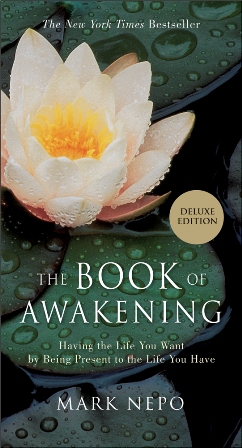
As I have mentioned more than once, I’m spending this year with Mark Nepo’s Book of Awakening, meaning that I begin my daily meditation by reading one of his 365 observations. More often than not, a series of readings—one day after another—will seem an awakening designed only for me. This past week, Nepo introduced me to the quiet teachers.

The quiet teachers are often ignored but are everywhere and are as solid as the ground upon which we walk. We know these quiet teachers by their “lessons [that] dissolve as accidents or coincidence…offering us direction that can only be heard in the roots of how we feel and think” (Nepo).

For me, the lessons have been clear but somewhat noisy for I am in the process of completely restructuring a novel I wrote seventeen years ago. What that means is the destruction of a weakly structured novel in order to salvage a stubborn story that has waited a long time to be told. It has required me to immerse myself into an old world, awakening characters long silent and provoking images fraught with memories. There has been much shattering of ideals but the shards of those ideals proved to be quiet teachers, the first of others that I met this week.

Nepo also introduced me to an observation from Megan Scribner: “‘I’m only lost if I’m going someplace in particular.'” I could not have described my own first attempt at writing a novel more succinctly. For over 80,000 words and seventeen years, I stayed with a story I no longer believed rather than facing the story that was trying to emerge. Once I began stripping away the façade, I heard the heart of the story and found myself at journey’s beginning: “Practice letting go of your plan and discover the path of interest that waits beneath your plan” (Nepo).

Not being attached to outcome or plan reveals the story waiting to be written. It is only when I have the courage to face failure do I heed the lessons of the quiet teachers. Accident and coincidence dissolve into the direction of the story. I am struck by the synchronicity of my own life’s direction with that of my writing life. Not for the last time, I am in awe at the oneness that is all.

“‘Be serene in the oneness of things and erroneous views will disappear by themselves'” (Seng-Ts’an) became clearer and clearer to me as I separated the heart of the story from the remnants of what was once a novel. All of the tearing apart and leaving of words is less difficult than I imagine. There are thorny moments but eventually, they give way to the relief of no longer having to hold up the façade of novel.

While the shininess of a new structure of a novel is a gift, the fear of idolizing structure at the cost of story, wherever it may wend, is a battle that will wage until structure and story support one another as a whole. I am confident in the lessons of the quiet teachers but mostly, I am vigilant for like life, writing is fraught with accident and coincidence as is the beating of my heart.

“As you enter your day, try not to reach for life. Try not to leave or arrive. Try to let life into you” (Nepo).

Final Days of 59

“… Transformation always involves the falling away of things we have relied on, and we are left with the feeling that the world as we know it is coming to an end, because it is” (Mark Nepo, The Book of Awakening).

This past February, I wrote a post about some unexpected milestones at age 59 ½. At the time, I was struck by the synchronicity. Still am. As this is my final week at age 59, I decided to revisit those milestones before I step into my sixth decade, one that promises even more transformation.

KM Huber Image

I have continued to lose weight beyond the 59 ½ pounds of February; I am down 69 pounds with another fifteen-twenty to lose but no more than that. My eating habits have not changed in the past six months but my taste buds have adjusted to other options, and I enjoy eating again. I found millet-buckwheat bread made with chicory root and without refined starch, absolutely critical for me.  Almond butter sandwiches are now a staple. While my future remains gluten, yeast, sugar, dairy and soy free, my grocery list items are crisp and fresh.

In my last week as a fifty-nine-year-old, I am in better health than I was at 58, sans an arsenal of allopathic medicine. I remain convinced that Eastern medicine– Ayurveda and Chinese–has a better understanding of autoimmune disease. Ted J. Kaptchuk’s The Web That Has No Weaver is an excellent overview of traditional Chinese medicine, and I am searching for a similar Ayurveda text. Until I find it, I am enjoying Deepak Chopra’s Perfect Health, an informative volume regarding Ayurveda traditions.  This Tuesday, I have my first meeting with a practitioner of Eastern medicine.

KM Huber Image

But in these final days of my 59th year, it is my writing that is undergoing the greatest transformation. My numbers alone are major personal milestones.  I no longer publish blog posts twice a week as I did in February but on June 2, I began writing the initial draft of a nonfiction manuscript. Currently, I am producing over 9200 words per week on this manuscript alone. At my 59 ½ milestone, my word count was 9800 words for the entire month of February.

While I do not write for a specific word or page count, numbers gauge a manuscript’s size so I knew the end of the nonfiction manuscript was close: currently, it is 330 pages or just over 91,000 words. But even before I tallied the numbers, synchronicity had come to call; what Deepak Chopra calls “a quantum leap of creativity…a relinquishing of the known for the unknown.” And like milestones, coincidence comes wrapped in the ordinary.

In February, I included my participation in ROW 80 as part of my regular blog posts.  Frequently, I discussed the initial draft of a novel that I wrote seventeen years ago; in some blog posts I’d opt for rewriting the novel and in other posts I’d refer to the novel as a life once lived. Rather than letting go, I was very like the speaker in Linda Pastan’s poem, “Ethics,” unable to decide whether to save the old woman or the painting.

So, I signed up for an online workshop, Conflict and Idea with Bob Mayer, and learned about “kernel idea.” I have not been the same since so I consider it my toehold in the unknown, a piece of a milestone.

Bob says that the kernel idea is what initially inspires the writing of a novel–it is the Alpha and Omega of a book–it starts and completes the creative process but here is the key point: the story that you write may and probably does change but the kernel idea of a book does not, ever.

KM Huber Image

During the course of the workshop, I came to understand that the “kernel idea” for my novel was not the story I had written. The kernel idea had not changed but the story I wrote moved away from the idea within the first 100 pages. Finally, I realized what I was hanging onto for seventeen years—my kernel idea and 100 pages—yet, it took me a while to understand just what that might mean but when I did, it felt like a “quantum leap of creativity.” Still does.

Thus, as I started writing a new nonfiction book—my current manuscript–I discovered the way to tell the story of my original kernel idea. Maybe the years sorted themselves, maybe I was letting go of what no longer serves but with transformation there is also revelation. In letting  go of a seventeen-year-old-story that no longer served, I discovered the kernel idea for a new nonfiction book.

“When faced with great change—in self, in relationship, in our sense of calling–we somehow must take in all that has enclosed, nurtured and incubated us so when the new life is upon us, the old is within us” (Nepo).

Another Stray

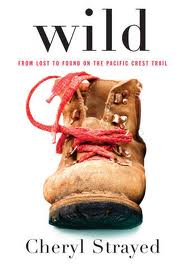
What if going into the wild is the way home? What if a wilderness journey awaits each one of us? The wilderness is the unknown, rarely appreciated and while sometimes faced, the wilderness is flush with fear. Yet, where “the wild things are” is where the infinite possibilities are for in the wilderness we bear what we believe we cannot bear.

When Cheryl Strayed hiked the Pacific Crest Trail in 1995, she was “on a spiritual quest but what [she] got was a physical test.”* Before her 1100 mile trek, Strayed was not even a novice backpacker–she had never carried a backpack—thus, she seriously compromised herself in her selection of equipment and gear, especially her boots. She was not physically prepared or emotionally fit, and beyond her food supplies, she had almost no money. What she did have was unfailing support from her fear of failing. In other words, the wilderness provided—perhaps only as it can—for “the physical realm kept delivering the spirit to [her].”

Strayed’s writing is raw in the revealing of herself at twenty-two years old. Through Strayed, we see what masters we are at masking our fears, and how the wilderness will break us open if we are willing to replay the stories that are our lives. For 1100 miles, Cheryl Strayed revisits her life, comforted only by the constant pain of surviving each day, sometimes only step by step. She says, she “went wild into [her] life.”

Wild is a call to our own wilderness, a call to exploration of all that we are. For Strayed, it was an arduous trek through the high country of California and Oregon but Wild is more than that. If we go “wild” into our lives, we discover the rawness in our past not to relive but to observe the stories that are no more. What was then is not now, and it is a crucial distinction for once we discover it, we have found our own Pacific Crest Trail, a walk that will not be painless.

In the wilderness, we are not what we have been; what we are is in the moment. Physical existence in the wilderness depends on being completely present every moment. Each wilderness has its own miles, its own beasts, and no two journeys are the same, although paths do cross.

We come to recognize that we do want to know what is around the bend and over the mountain. Climbing rocks, stomping through snow, and trying to find water–literally or figuratively– may bring us to the edge of our existence but if we lean into each experience, we see through the fear and accept the pain. We may find places within the wilderness to stay forever but until we’ve walked our wilderness, we can only stop for a while.

We nudge ourselves along until we hit our stride—we just notice it one day–we recognize how our physical being strives to meet our spirit.  In facing fear, we clear a path through our wilderness because “being fearless is not being unafraid.”

Unknown is the nature of the wild–we are not tomorrow what we are today–such are the fields of possibilities in the wilderness. If we immerse ourselves in those fields—in as many possibilities as we can—we will travel less in what used to be and live more in what is.

That is what Cheryl Strayed’s book has given me, my own wild. For the last two years, I have been on a voyage in but until I read Wild, I did not lean into the pain as acceptance. Like Strayed, I am ill-equipped and utterly naïve in my quest; like Strayed, I am the cause of my own physical and emotional pain; like Strayed, I insist on learning the hard way.

Unlike Strayed, I was 58 years old when I began and have not yet walked all the miles of my wilderness but I have hit my stride. For the rest of my journey, the pages of Wild burn in my memory.

*All Cheryl Strayed quotes are from the Super Soul Sunday Interview with Oprah Winfrey, July 22, 2012.

Life at Sixty

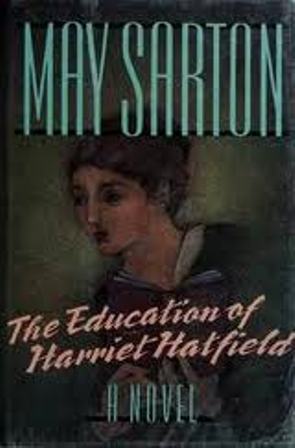
I had been dreading the evening when I would no longer have May Sarton’s The Education of Harriet Hatfield to read. Yet, as is often true with the really fine writers, Sarton pushed me along, knowing it was time for another book, another story.

I want to tell you about Harriet Hatfield.

The novel opens at the death of Harriet’s partner. It is the late 1980s in an exclusive, upper-class neighborhood in Boston—Chestnut Hill–where Harriet and her partner had lived for thirty years. It is not a novel in which a great deal happens but, of course, a great deal does happen to a sixty-year-old lesbian who has an opportunity to begin life completely anew. With the money she inherits from her partner’s estate, Harriet moves from Chestnut Hill to a working-class neighborhood where she opens a feminist bookstore that also serves as  her residence.

Harriet soon learns that hatred and prejudice run roughshod over any sense of security she may have once had. The anonymous but ominous threats Harriet receives do not weaken her resolve but strengthen her determination to stay in a neighborhood that does not want a “lady” lesbian or her feminist–and therefore must be pornographic–bookstore, Hatfield House.

Harriet Hatfield’s feminism is a belief in equality for all in all things–jobs, housing, existence–and is a constant source of tension throughout the novel. Hatfield House, with its overstuffed chairs and afternoon teas, is “‘the equivalent these days of men’s clubs…places where women can talk to each other, find sustenance, and come to some idea of who they really are.'” Yet, Hatfield House is much more. It is, perhaps, a “bridge” to and for all in Harriet’s neighborhood–including hate and prejudice–but as Harriet says of metaphor, “‘if you run it into the ground… it suddenly doesn’t quite work.'”

I was introduced to The Education of Harriet Hatfield on Cynthia Newberry Martin’s blog . While I am familiar with most of Sarton’s work, I was not aware of this novel but I was aware of a bit of a coincidence, being a sixty-year-old lesbian myself. Like Harriet, I, too, believe that at sixty I have been given a rare opportunity to live a life I have never lived. Unlike Harriet, I am anything but financially secure–her complete opposite financially–but I am rich in ways that continue to surprise me every day, which is so very like Harriet. One of the greatest perks of growing old is finally appreciating all that one is and how little, how very little is necessary to live a life fulfilled.

“‘I have just three things to teach: simplicity, patience, compassion.
These are your greatest treasures.
Patient with both friends and enemies, you accord with the way things are.'”
–Lao-Tzu (Translation provided in The Book of Awakening, Mark Nepo)

Above all, Harriet Hatfield has patience. She does not believe that all of her neighbors will accept her or her bookstore even eventually–she knows she will not outlive prejudice–the temporary truce in the neighborhood is indirectly provided by her dog, Patapouf: “‘there is a residue of compassion… that suddenly comes into view where an animal is concerned, as though the only pure thing left in this corrupt, hate filled world is the love of animals.'” The neighborhood belief that animals are beyond prejudice provides a brief respite as well as some consideration for what another human being may or may not be, even a lesbian.

This is a novel in which not a lot happens and in which everything happens. It is not a novel about understanding one side or the other much less taking sides. It is a novel about living one’s life fully and completely every day–whatever is presented–even if it is a new life at sixty.

“…Given enough time, most of our enemies cease to be enemies, because waiting allows us to see ourselves in them. Patience devastates us with the truth that, in essence, when we fear another, we fear ourselves; when we distrust another, we distrust ourselves; when we kill another, we kill ourselves”
(The Book of Awakening).

(All quotations from May Sarton’s The Education of Harriet Hatfield are from the 1989 Norton edition.)

Spending My Days

Consider the essence of magic as the enchantment of the unknown, a paradox that in the words of the Tao is the “named and the nameless.” Magic appears throughout this blog so similarly to its appearance in my life or to borrow from Annie Dillard:  “How we spend our days is, of course, how we spend our lives.”

What if we spend our days creating and re-creating our lives as works of art rather than scheduling our lives by the hour, defining ourselves by the number of tasks we accomplish. Only late in my life did I come to this magic, this nuance of routine. Now, I spend my days in the experience of each moment where every minute is a way of life and not a moment on a timepiece or a task on a list.

I am not without day-to-day demands—mine is chronic illness—nor am I without the gifts that life’s demands provide, and chronic illness has its gifts, too. Of course, it took me more than thirty years to notice there were any gifts from any demands. We just don’t look for these gifts. We focus our attention only on the demands, maybe even calling attention to ourselves. Mark Nepo says “the threshold to all that’s extraordinary in life is when we devote ourselves to giving attention, not getting it. [That’s when] things come alive for us…[we] find our place in the beauty of things by the attention we can give.”

Perhaps the best measure of giving attention is how we live the routine of our days. Of late, I’ve been experimenting with routine in the larger context of creating a resilient life, which is, among other attributes, a work of art according to Dr. Symeon Rodger in The Five Pillars of Life. The process is a simple one. I record the moments of my day as they occur and not as a schedule of what must occur. There are requirements for each day—some specific tasks must be done–but there is not a plan. Within a week, I discovered a natural flow to how I spend my days as I watched them unfold, regardless of the interruptions and the unexpected. Most important, I discovered resilience and flow reside in the creative unknown.

Here is how that translates in my everyday life. The day-to-day unpredictability of my dis-ease as well as Cooper’s does not change nor does it require any more attention than juggling finances, doing the laundry, grocery shopping, writing—all requirements of my days. In focusing on each moment, I not only accomplish what is required but I complete tasks and chores that have been waiting for months. Furthermore, there is energy in everything I do as I immerse myself into each task and only that task. There is no multi-tasking for each moment belongs to itself completely. Not one day is like another nor is any day exhausting. I schedule nothing and record everything.

Melissa Bowersock Image
WANA Commons

I am quick “to soar with the oversoul”—Louisa May Alcott’s phrase regarding her father and the transcendentalists—and like Thoreau, I have built my “castles in the air” but few times in my life have I put “foundations beneath them” that did not crumble. Yet, in living a routine as a work of art and embracing the enchantment of the everyday, I have a foundation for my current castle in the recording of how I spend my days.

The role of voice recognition software  in my routine is nothing short of finding a new energy source.  Once I began using Dragon NaturallySpeaking, I realized how much physical energy I was expending in typing, a necessity for a writer but  one I had overlooked. Ironically, I had spent considerable time, money, and thought in creating a comfortable work space. I work from an adjustable bed that supports my entire body, and my laptop rests on a spacious tray designed for use with adjustable beds. I believed I had a comfortable way to continue writing, and it was just a matter of settling into a writing schedule but those were days devoid of enchantment and full of design.

There never was a consistent writing schedule, and increasingly, neuropathy limited the length of time that I could use a  keyboard. Finally, I took a three-week hiatus from blogging and from scheduling my days. I knew I would no longer write as I had–I didn’t know whether I would write–yet, I knew I would continue to create and re-create, and that was enough as I explored the moments of my days. Then, I discovered Dragon NaturallySpeaking, and in the initial moments of using the software, I knew life was about to change even more, and so it has. Within two days, there was also a marked decrease in my physical discomfort.

Dave R Farmer Image
WANA Commons

For me, dictating my thoughts is quite different from typing thoughts on a screen using keys on a keyboard. Dictating is sending thoughts through speech; typing is the tactile sensation of selecting keys to produce words. The awareness involved  in each process is completely different, and I am allowed another perspective on creating. I find the combination quite freeing. I focus on the writing before I bring it to the screen through my voice. Then, with my fingers on the keyboard, I edit and shape the words on the screen, creating and re-creating yet another perspective on the story of how I spend my days.

The Night Circus: A Review

amazon.com image

In The Night Circus, Erin Morgenstern spins a tale that is magical in its prose and practical in its illusions. To me, it is as fine a debut novel as can be found.

Morgenstern’s prose is poetry mostly and not without wit. Her novel’s structure is a marvel, perhaps a study in magic itself for Le Cirque des Reves—the Circus of Dreams—arrives and departs without notice, opening only at midnight and closing at dawn.

The dream circus is a world of black and white with wafts of caramel weaving in and out of striped tents that offer moments of awe and acts unknown, swirling round an extraordinary love story, truly a circus for any rêveur.

There is the Wishing Tree where every wish is a light always lit; there is the illusionist who appears and disappears as if she were born to it;  there is the Labyrinth that will take you up and down, sideways, or to the top of your world.

If you are fortunate, perhaps chosen is a better word, you may receive a silver pass to the Circus of Dreams for the rest of your life. It is a tempting way to live for every tent tells a story within a story as “there are many kinds of magic,” seemingly unending.

The Night Circus opens in 1885, near the midnight of the 19th century and closes in 1903, just after the dawn of the 20th century. Anything and everything seems possible, as the planet is still more dream than reality so there are stories yet to tell, and what is more magical than a story in which so much seems to happen all on its own.

If you read The Night Circus, do pay attention to time and its relationship to permanence or endurance but if you lose track of time— and you probably will but you won’t mind—remember this:

“The whole of Le Cirque des Reves is formed by series of circles. Perhaps it is a tribute to the origin of the word “circus,” deriving from the Greek kirkos meaning circle, or ring. There are many such nods to the phenomenon of the circus in a historical sense, though it is hardly a traditional circus. Rather than a single tent with rings enclosed within, this circus contains clusters of tents like pyramids, some large and others quite small. They are set within circular paths, contained within a circular fence. Looping and continuous.”

As I have mentioned previously, Stephanie Carmichael, a fine writer, wrote a review of The Night Circus that captures its essence completely, and I hope you take a moment to read Stephanie’s review found here.

(All excerpts are from Erin Morgenstern’s The Night Circus, Thorndike ME: Center Point Large Print edition by arrangement with Doubleday, 2011.)


ROW80 Wednesday Words

This ROW80 round is one of continuous goal revision for me yet challenge is growth, even if my vision is a bit cloudy at the moment. However, I am considering not writing fiction for I suspect I am a better reader and editor than a storyteller when it comes to fiction.

As for nonfiction, I do have a lifelong love affair with the essay and seem to pursue that form more than storytelling. It is not the first time I have met this issue but I do believe it is the first time I may have to choose. Yet, I write, which is what is important to me. My revised goals are:

Write 500 words per day, write a regular blog at least once a week, and complete the ROW80 check-ins on Sunday and Wednesday.

So far, the revision feels comfortable.

The Power of Story

Lupus is a creation of mine, its own story really, not one of which I am proud, as its writer, but I have been its source of life for the last 35 to 40 years, maybe even longer.

It is not possible to note the day my lupus gene switched to on nor is it possible to know why I have the gene or what activated it, if anything. It simply is. That part of the story has never mattered to me, even before I knew about the Tao or Zen.

It took me most of my life to understand I am not my lupus and that autoimmune disease is its own story, one steeped in imitation and deceit, usually disguised as flexibility and malleability. Separating what is the lupus story from all I am has been delicate and sometimes, seemingly impossible.

Through the Tao and Zen, I have come to believe my body is my soul having a physical experience, which gives me, a writer, the luxury of viewing lupus as story, a structure I do understand. In all the ways I have viewed lupus, it never occurred to me to view it as a story until very recently.

Lupus really does have plot points, conflict, a protagonist and an antagonist, all tools of my trade on my turf. I just may have the advantage here for the very first time.

In some ways, I have had a long life with lupus, if knowing lupus by other names counts. Lupus’ ability to mimic so many other illnesses along with my gullibility in believing one misdiagnosis after another are extraneous chapters but there is this: my heart never believed any of those labels.

In the lupus story, my heart is the protagonist and my brain or ego is the antagonist, the one that drives the conflict in every story, and all stories have an antagonist and a protagonist locked in a conflict box.

http://www.niams.nih.gov
Image Credit

As the lupus story opens, my immune system produces antinuclear antibodies to fight infection and viruses, just as it should, until we reach the first plot point: a normal immune system turns on itself and begins to attack the very body it defended for years, for no apparent reason.

This relentless war for the body continues for years under various guises–multiple sclerosis, migraines, mixed connective tissue disorder–until Sjogren’s wipes out the salivary glands to pave the way for lupus.

As we reach the midpoint of the lupus story, the brain discovers that it, too, is under attack and turns to the last bastion of hope, the open heart, the remaining connection to the spirit that animates the soul’s body.

I do know that in any story there is one more major plot point before the conclusion, and the lupus story is no different. I don’t know the last plot point nor do I know the conclusion but I have this: the structure of story has given me some of my first moments truly away from the physical battle, and I know I am so much more than the lupus story.

ROW80 Sunday Scheduling 

I finished reading The Night Circus by Erin Morgenstern and may write a review for an upcoming blog post; however a very fine writer, Stephanie Carmichael, wrote an excellent review that you may read here.  I cannot imagine what I could add to this review. The Night Circus is one of the best novels I have ever read and am considering purchasing it (I borrowed it from the library) as it is a book to read and re-read.

I continue to write at least 500 words a day, mostly nonfiction, and I reached my goal of scheduling blog posts so I am not writing to deadline on Sundays and Wednesdays. This next week will be the dismantling of my novel’s first draft, which I plan to have finished by April 22, 2012 as well as a rough outline of its scenes so I may begin “plotting” the novel’s major points. Unlike the lupus story, I actually do know how this story ends.

For the rest of this round, my goal is a weekly total of 2500 words, as I do not know how long it will take to plot the novel so I do not know when I will start the actual writing of the second draft. You may read more about my second Round of Words in 80 Days here.


Go for the Metaphor

Eleven days ago, I stopped blogging regularly on Wednesdays and Sundays and my mind shutdown, leaving me alone with my ego.  It had been years since that had happened, and I did not want to go there, again.

And so I begin my second Round of Words in 80 days, the writing challenge that knows I have a life and probably has similar suspicions about my ego. Wayne Dyer refers to ego as “Edging God Out,” and when it comes to God, I’m with Joseph Campbell:

Joseph Campbell
newworldlibrary.com image

 “God is a metaphor for that which transcends all levels of intellectual thought. It’s as simple as that” (PBS Power of Myth Series with Bill Moyers).

It is always advantageous to define one’s terms succinctly, if possible, and if not, find others who can and do.

Our fearless ROW80 leader, Kait Nolan, provided an initial inspirational post for her ROW80 ranks of writers.  In particular, Kait dispelled a popular fallacy for many writers: if writing were their full-time job, writers would write as many as three or four novels a year, at the very least.

Once again,  ego spins falsely into fantasy.

Before I retired to writing, I, had that fantasy, which faded–frankly, on my first day– with full-time watching of Turner Classic Movies, then PBS, then British television, simply seductive. While some movie/television gazing can be considered studying the craft of scene and dialogue, reading and actual writing are closer to the grindstone.

As a writer and a human being—at times, known to be one and the same—my ego chatters constantly but I want the metaphor, aware  that I cannot know what transcends all intellectual thought but I can contemplate.

Frankly, ROW80 is what got me pursuing metaphor, in a most practical way. When I began round one in January, I was determined to publish a Sunday and Wednesday blog post for the entire round.

I did.

However, success has consequences, often overlooked in the glow of self-satisfaction, but for every action, there is a reaction.

The amount of time I spent writing blog posts, thinking about blog posts, and trying to have a week’s worth of posts written so I would not be always writing to deadline took on a life of its own, admittedly, a life bigger than screen gazing but it was not the metaphor.

So, here I am writing this post on the afternoon of April 2, the deadline for my first post of the second round of ROW80, battling my ego that says, “Post a couple goals. By Wednesday, you’ll be organized.”

No, I’m following fearless leader Kait Nolan:

“I want to help you develop that discipline and establish those good habits in your everyday life.  I want to help you take YOURSELF seriously as a writer, treat YOURSELF as a professional, so that bracket of time you can devote to writing, be it an hour or a day, becomes set in your mind as Writing Time–something you protect with the fierceness of a honey badger.”

See what happens when you go for the metaphor?

ROW80 Goal Posting

I have a separate blog page for the precise accounting of my R0W80 goals and updates, although I will probably  include a summary on main blog posts. Frankly, I can decide that later but for now, here we go:

Writing and Reading

Writing: Beginning April 4, 2012, write 500 words five days a week on my current manuscript. Word counts will be updated every Wednesday starting April 11, 2012.

Reading: Beginning April 4, 2012, read at least 50 pages every night to re-establish my reading routine. Am currently reading The Night Circus by Erin Morgenstern. Beginning Sunday, April 8, 2012, I will comment on my reading progress each Sunday.

Blog Posts

By Sunday, April 15, 2012, I will have at least one week’s posts written and scheduled so I am not writing to deadline. 

Honey badger, honey badger….

Stirring the Pot

“To let knowledge produce troubles, and then use knowledge to prepare against them, is like stirring water in hopes of making it clear.” Lao-Tzu
(Tao, Verse 87 as quoted in Mark Nepo’s Book of Awakening)

So very like “stirring the pot” was my initial reaction to this verse of the Tao as memories of harsh words—felt and returned—stirred one unkind pot after another. Never once did I think to take it off the stove nor did I imagine knowledge in any way other than as a glorious fount, effervescent, pure, dependable.

How sure I was of so much and so many–then.

Now, I appreciate knowledge within the context of creativity—the act of imagining—one of the greatest gifts life offers, requiring only an open heart.

As I begin my third act, words remain a major force in my life; I am so curious about so much. More than ever, I write, something I never quite accomplished with all the pot stirring although writing was my constant goal.

“Feeling unworthy or insecure, we create a goal, in hopes that achieving this will make us feel good about ourselves. Then we’re off scheming for success, preparing against failure, stirring the water, hoping it will go clear” (Nepo, Book of Awakening).

Seventeen years ago, my goal was to write a novel, which I managed amid much pot stirring. Always, I spoke of the experience with false fondness. I wrote 80,000+ words, allowing myself to tread water in any current of thought.

Natasha Hanova Image
WANA Commons

Frankly, I felt quite good about myself, proud even, for accomplishing my goal. To be honest, every year since writing that original draft, I tried one writing goal after another, stirring and stirring.

One of my favorite far afield attempts was to collaborate on an inspirational book of vignettes with the actual working title of Rising to the Occasion When You Can’t. Outside of considerable pot stirring for three years, our hearts were not open to a word we wrote.

From time to time, I returned to the goal of revising the 380+ page manuscript word by word—certainly a worthwhile goal within the first year of its writing—but at seventeen years later, it was time to take the pot off the stove.

“The mind is a spider that, if allowed, will tangle everything and then blame the things it clings to for the web it wants to be free of. I have done this with dreams of greatness and hopes of love, wanting so badly to see myself clearly in the water, while I kept stirring and stirring” (Nepo, Book of Awakening).

As I mentioned in my last few blog posts, I am yet again working with this first novel draft. Pursuing knowledge within experience, I stirred myself into a month-long, writing workshop. After so many years of empty goal-gazing, it took most of the workshop for the waters to still.

Truly, I did not recognize the actual moment the waters cleared. It was a gradual realization that I no longer was “scheming for success” or weaving any web. Frankly, my sediment sunk.

It was clear that I “don’t have to be finished in order to be whole” (Nepo) as a writer or as a human being. So, for the first time in seventeen long years, I saw the draft of my novel for what it is: the story of a moment passed, completely. Its worth is immeasurable.

With waters clear, I write.

Note: I am publishing only one post this week but will resume publishing two posts per week beginning Monday. As always, feel free to comment or Email me! your comments.