Compassion Totters on Friday the 13th

Simplicity, patience, compassion.
These three are your greatest treasures.
Simple in actions and thoughts, you return to the source of being.
Patient with both friends and enemies,
you accord with the way things are.
Compassionate toward yourself,
you reconcile all beings in the world.

~The Tao~

A car accident allowed me a “real-life” opportunity to practice the three treasures of the Tao—simplicity, patience, compassion. The Friday the 13th mishap found my compassion tottering, like an amphora (vase) too close to the edge.

Frankly, my patience held, even when my tone of voice betrayed me, as I temporarily strayed into the tentacles of story so very far from the simplicity that is “the source of being.” As far as I know, the story strands still abound outside my being.
Compassion Crash 091313

At the core of the story is an uninsured driver, momentarily distracted by a text message, hitting one parked car and sliding it into another (mine) in the parking lot of the apartment complex where all involved live. The driver left a phone number, unable to remain at the scene. That is the source of every story that followed.

Thoughtful neighbors who witnessed parts of the accident notified me. My initial thought on seeing the two cars together was I am very fortunate. The car that slid into my white Scion was severely damaged on both sides. After more than one call to the police, an officer did arrive to assist with details and separate the two vehicles.

My compassion vase moved ever closer to the edge as the hours ticked by, bringing no response to a voice mail I left for the driver. His late night call to me with strands of story unconnected to the accident wrapped round me, and my emotions swirled to the surface. My compassion went into free fall.
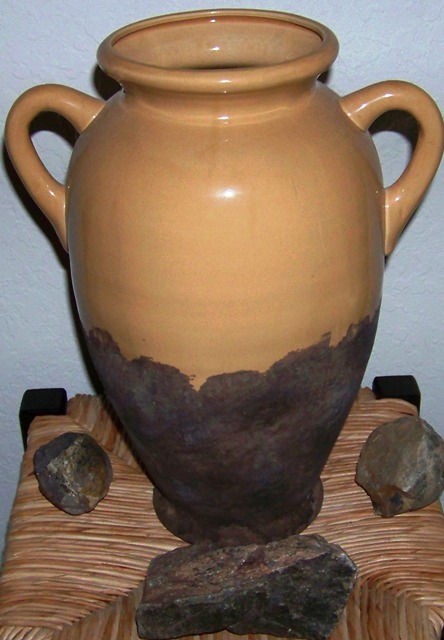
Compassion Jug 092113

Over the next 72 hours, the driver’s story would emerge in various versions, sometimes tangentially connected to the incident but often not. In a face-to-face meeting of all three car owners, I peppered the driver with questions in a cold, staccato tone devoid of compassion, a tone I once used far too frequently.

However, that realization was not what returned me to compassion but this thought: I really have to stop reading/watching so many murder mysteries. I am not a chief inspector solving a crime. I smiled, stopped my questions, and leaned back in my chair, finally listening to the driver’s story. Then, I let it go.

Securing my amphora of compassion—returning to my source of being—meant more to me than staying in a never-ending story. Once, I had lived that way, for most of my life, actually. Those years pale to how I live now.

Of course, I still have moments when my compassion totters, and there will be others, no doubt, but such is the human experience. My vase is secure for now. As for the final reconciliation, the driver and I have entered into a payment arrangement. After all was agreed and signed, he said he had not expected me to be kind. I responded that he and I had one bad moment but we need not have another.

Thursday Tidbits: Ever Evolving Peace

Peace quote pic 091913 with text
KMHuberImage

Although Thursday Tidbits posts remain irregular, the Bloggers for Peace movement stays the course in its challenge to bloggers. For September, participants are to post a single quote for peace, a single statement that each one of us might remember the next time disagreement seems inevitable.
forpeace6

Not surprisingly, I turn to the words of the Buddha so frequently offered on the ever-wonderful blog, Zen Flash. For me, this past week has been one of discovering the broader dimensions of compassion—in more than one moment I was found lacking–all will be revealed on Sunday in a regular blog post. Between now and then, I hope you visit some other Bloggers for Peace posts:

Spunky Wayfarer

Bishop Eddie Tatro’s Study

Becoming a Writer

Indira’s Blog

Card Castles in the Sky

The Wisdom in Compassion, a Matter of Nuance

Living with All Beings 081913

The practice of compassion requires considerable courage, for the way of compassion is living an active life amongst all beings. Practicing compassion means we trust ourselves enough to connect to life completely, making ourselves vulnerable, a daring in its own right.  Such is the wisdom of compassion.

Compassion (Late Latin: com=”together” + pati “to suffer”) offers us a perspective on suffering. Its etymology—the peeling back of the layers of its life—reveals its nuance, allowing us a peek into its past. Much of the mystery of life lies in such nuance.

The practice of compassion is a commitment to connect with the suffering of all beings, including those we do not like. Connecting is not condoning but rather a revealing of the nuance inherent in every being. “It involves learning to relax in allowing ourselves to move gently toward what scares us” (Chodron).

A Closer Look 081913

Moving toward what scares us allows us to soften rather than harden, to open to options previously hidden from view. In acknowledging that all suffer, we recognize that all know pain in its various guises. Suffering reveals our connection to all beings.

In practicing compassion, especially when to do so challenges us to our core, we appreciate the pain of other people. The nuance is in recognizing the suffering without judging the behavior. In this coming together with those who suffer— the etymology of compassion—we glean the wisdom inherent in living such a life.

Dr. Grace Damman terms this as the aligning of compassion with wisdom: “What I mean is that when I am served by other people who are driven by their own standards of excellence, and not by the demands of my ‘whiny self,’ then I am best served by them.” It is what she discovered in her recovery from a serious car accident, a truly vulnerable state.

In reaching for the wisdom within compassion, our perspective broadens, leaving us less susceptible to shenpa or getting hooked by our emotions. When we are hooked, we soar with our neuroses, oblivious to objectivity. We sever our connection with all beings, hearing only our own demands, our own needs.

Storm Clouds 081913

The churning of our emotions slips us into solitary confinement with our suffering, devoid of compassion. We sharpen our selves, harden our hearts to resist what scares us–creating the classic boomerang effect—the life of the infinite loop.

When we finally stop and peel back the layers of our pain, we open up to compassion, softening into the realization that all suffer. We connect to the nuance of life. The practice of compassion is not for the faint of heart but for warriors—bodhisattvas—who trust their vulnerability, for they know it is their connection to the wisdom of existence.

“We cultivate bravery through making aspirations. We make the wish that all beings, including ourselves and those we dislike, be free of suffering and the root of suffering” (Chodron).

Such is the way of a life of compassion.

After Silence, Music Expresses it Best

The power of music was the Bloggers for Peace challenge for August. It brought to mind Aldous Huxley: “After silence, that which comes nearest to expressing the inexpressible is music.”
forpeace6
Throughout the history of humanity, music has permeated barriers often considered impenetrable. Music unites continents, as the deeds of humanity are recounted in song. Human existence is the song of the ages written across bars of hope and measures of peace.

From Paleolithic time onward, every major tradition—Islam, Christianity, Judaism, Buddhism, Taoism Tao, Hinduism—embraced song as one way to reveal the stories of human existence. Combining music and story, each of the major traditions expressed compassion for all in the community as a way of daily living. Similarly, each tradition warned of the pitfalls of hoarding riches and extolled the virtues of giving to the least among us.
Heron on Turtle Row 0213

In each verse of the song of community, all give and all receive, the song of the ages expressing the inexpressible.

For many in my generation, “We Shall Overcome” was the song for civil rights for every American as well as every citizen of the world. We are still singing this song, still committed to overcoming what divides us in order to live with what unites us–peace. Globally, it is the melody of the human heart, expressing the inexpressible. Within its coda is the constant vigilance required for compassion and thus, for coexistence.

Peace is not passive but like compassion it is alive, an aria to overcome what we have yet to accomplish in twenty-one centuries: to live with one another in the harmony of acceptance sans the labels of race, creed, color or any dissonance that divides rather than unites.

Since we began composing the story of human existence, there have always been notes of hope. Perhaps the power of music and its ability to express what we cannot will one day lead us to a vigilant, vibrant life of peace and compassion.

It is and always has been to our great credit that we sing.

If memory serves, the video clip of Joan Baez singing “We Shall Overcome” is from the 1969 movie, Woodstock.  There was a time I would have recognized it immediately. Well, I still know all the words.

Other Bloggers for Peace Posts:

Grandmalin: The August Post for Peace

Rarasaur: One Little Candle Burning Bright

The Seeker:  Music That Will Make You Smile

Rohan Healy:  Alien Eyes

Electronic Bag Lady: Music and the Brain