Inner Energy of You

My last two posts have explored freedom through the pause we all experience in every breath–if not in every deed–and through the unknown, where the risk of hope resides. To write of freedom is to explore the oneness of humanity for it is the freedom that connects us all.

When I began publishing this blog in January, I created a homepage of oneness to frame the concept for my blog posts: quantum entanglement, my favorite term for the pure energy of the consciousness connection. Within a few months, I began a study of ancient traditions, primarily Taoism, Hinduism and early Christianity (pre Saint Augustine of Hippo), having previously studied Buddhism, Zen in particular. I sought a synthesis and considered it the rest of my life’s work. Still do.

I have discovered writers, ancient and contemporary, who have written most thoughtfully, and some beautifully, of the inner and external worlds of humanity. Then, I read the “elegant simplicity” of Michael A. Singer in The Untethered Soul. Yet again, I have Oprah Winfrey’s Super Soul Sunday program to thank for this discovery; currently, her website is offering a full episode replay of her interview with Singer.  Oh, that middle initial is important if you are going to search for Singer on Google.

Singer’s graceful prose is stunning. Quietly, he lays down one sentence after another, orchestrating a synthesis of thought, word by word. He  allows the reader to rediscover the spiritual energy within, as if it were the first time. “This flow of energy comes from the depths of your being. It’s been called by many names. In ancient Chinese medicine, it is called Chi. In yoga, it is called Shakti. In the West, it is called spirit.… All the great spiritual traditions talk about your spiritual energy; they just give it different names.” (The Untethered Soul).

We do seem to insist on labels for our innate consciousness and thus, the connection to one another. We identify with one label over another to preserve, and possibly to protect, the nuances within each of the spiritual traditions. It has been like this for over 5000 years, for one reason after another, both East and West.

“Consciousness is the highest word you will ever utter. There is nothing higher or deeper than consciousness. Consciousness is pure awareness…the ability to become more aware of one thing and less aware of something else…” (The Untethered Soul).

Singer removes any mystique regarding consciousness and leads the reader into “the seat of self,” the center of consciousness [where] you are aware there are thoughts, emotions, and a world coming in through your senses. But now you are aware that you’re aware. That is the seat of the Buddhist self, the Hindu Atman and the Judeo Christian soul. The great mystery begins once you take that seat deep within” (The Untethered Soul).

It was Deepak Chopra who described Singer’s writing as “elegant simplicity.” If you watch the interview with Oprah, you will see it is an apt description for the man as well. Singer’s book is not about one set of beliefs or any religion. It is a book about consciousness: “The more you are willing to just let the world be something you’re aware of, the more it will let you be who you are–the awareness, the self, the Atman, the soul.”

For me, Singer’s book offers an unanticipated foundation for my  synthesis of the ancient traditions and thus, an added dimension to this blog. Abraham Heschel wrote that to live a spiritual life is not a gathering of information but it is “facing sacred moments,” the rediscovery of what has always been, one open door after another.
Freedom in the Unknown

For a while I have been residing with two, well-worn nemeses, the past and the future.  I am deliberate in my use of the terms future and past rather than a specific moment, incident, or person for what keeps the past and future ever present is what Deepak Chopra calls “the conditioned response” or the known.

Each one of us has a myriad of conditioned responses for every situation that arises. Regardless of whether or not there is a replica of a particular situation, the mind enthusiastically emits a thought barrage of past experience and future possibility. Both future and past are attached to what happened or what might happen but not to the moment that is. Living in the moment is the unknown, free from past or future.

Essentially, every moment is free. We choose between the known and the unknown, between what we have always been and what we have never been. It is that basic. What is not free is the situation surrounding each and every moment.

Situations reside in the past or in the future–they have strings–and where there is attachment, there is ego, a constant chatter of what you already know. Only when we practice what Chopra calls “choice less awareness” (Moksha), are we in the unknown of the moment and truly free. It takes a lifetime of practice and ceaseless awareness.

For without awareness, we get comfortable and our practice becomes what we know and not what is. Increasingly, my enthusiasm was on the wane, whether for the revision of my novel or for my nonfiction manuscript on consciousness. While I love what I am doing, I could not deny a familiar tug of weariness. Briefly, even the malaise of lupus loomed as I turned more and more to the known of the past.

Mindless television is a tried-and-true response of mine to whenever “the world is too much with us” (William Wordsworth). Some would argue that I could not have picked a better time than the broadcasting of the two major political conventions in the United States. There may be something to that. For completely opposite reasons, both conventions made me weep but as I reached my saturation point for both weeping and politics, I discovered my enthusiasm for republic and democracy.  Both are messy, completely life-like, wherein lies the sliver that is hope.

No matter the moment of life, hope is always the light of the unknown and may be the heart of risk as well. In hope lies enthusiasm, the total immersion into life, “the ripple that follows the stone…[as] we are each faced with the endless and repeatable task of discovering or uncovering our enthusiasm, which means in essence being at one with the energy of God or the divine” (Mark Nepo). Not surprisingly, God and the divine are within the political whirlwind of the United States while the world watches.

Regardless of how we perceive our relationship to one another–Einstein’s “spooky action at a distance,” the Tao, the Universe, the Source or quantum physics–we are all connected to consciousness, which is so much more than a mere pinprick of light. Consciousness connects us to existence, transcending all we have ever known; it moves our heads under our hearts so we may hear one another. When we listen, we observe. We make a response within the moment.

In observing the political conventions I listened, dropping my decades-long conditioned response of ranting and raving. Rather, I was grateful for living in a republic brave enough to reveal the messiness of its democracy to the world, at considerable risk perhaps.  I immersed myself into the enthusiasm that is the noise of life, the unpredictable but eternal moment.

It is such a small step from the known to the unknown. In the unknown resides the “choice less” awareness that is the freedom inherent in risk, the heartbeat of hope. It is neither the past nor the future but only the moment, which is all we ever have yet is always more than enough as long as we are aware. “Despite our endless limitations, it seems that the qualities of attention, risk, and compassion allow us to be at one with the energy of the whole and the result is enthusiasm, that deep sensation of oneness” (Nepo).

(All Mark Nepo citations appear in The Book of Awakening)

“Do you Believe in Magic?”

These days, I find myself wrapped round story, magic, being—in any and every order—an entangled trio so reminiscent of a quantum entanglement known as “spooky action at a distance.”

It seems entanglement is the heart of this blog.

Becca Pugilsi Image
WANA Commons

The story I pursue is layered in the oneness of the 10,000 things of “the Way” (the Tao) that connects the consciousness of all always and simultaneously. That is the story of the human plane, I believe.

It is a story I want to know.

I have enrolled in a sixteen month course that offers a synthesis of the ancient traditions of the last 25 centuries including Buddhism, Taoism, and Christianity in its “original state,” meaning not according to St. Augustine of Hippo, a prospect much more exciting than it may seem. I may write a post on that but we are not there yet.

Dave R Farmer Image
WANA Commons

Perhaps a more practical way to consider the course is this: the predominant Western belief of “you are your rational mind” is lacking in magic and story, at the very least, and at its very worst, it is unsustainable dogma.

That is how I see the course, and while it is early in my study, I am impressed with its evidence-based emphasis, specifically that hypothesis is not fact.

The irony of my beginning this study as my lupus moves into its own story is not lost on me; I suspect irony is frequent when one leads with the heart and not with the head. Yet, to live with an open heart and to discover what that truly means–for there is not agreement upon it or about it—is to dive deep into the head-heart connection.

Mark Nepo writes that “with your head beneath your heart, you must stop doing….Time and time again, the head must be brought beneath the heart or the ego swells” (The Book of Awakening).

Consider the entanglement of placing the head under the heart, thereby creating the “voice” of the gut. Nepo calls it, “a truth of being for a truth of being.” The resonance of the gut is like a messenger rushing through every system of our being proclaiming a resilient, “I get it!”

And resilience is rather magical but it is not magical thinking. To me, resilience lies in remembering the distinction between believing and knowing. While believing is akin to knowing, what we believe often lies in faith but not always in fact. For fact, experience provides us evidence of all we come to know.

“By opening fully to our own experience, we can feel and see the resilience of life around us” (Nepo).

Amber N West Image
WANA Commons

Being completely within the experience of our life–being fully present—we experience what every other life form knows: living fully means denying nothing. Being present in every moment is to experience all the moment offers, a pure opportunity to be.

Being is the magical story that the natural world celebrates completely and constantly every moment. It is a story that plays out moment by moment, a real page turner.

For those of you who want to follow my ROW80 progress, you may view it here.

What Abundance Knows

How do we live with our hearts open? How do we use what is within us to bring together all that divides us? How do we, like the fifth verse of the Tao Te Ching suggests, “…offer our treasures to everyone”?

And the Tao means everyone, not just those we love/like, for living with an open heart is all-encompassing. It is difficult to open ourselves to what a person feels when that person’s beliefs are so separate from ours yet abundance knows no separateness only wholeness.

Unconditional Love Experts

It requires a larger vision whose origin may be right in front of us.

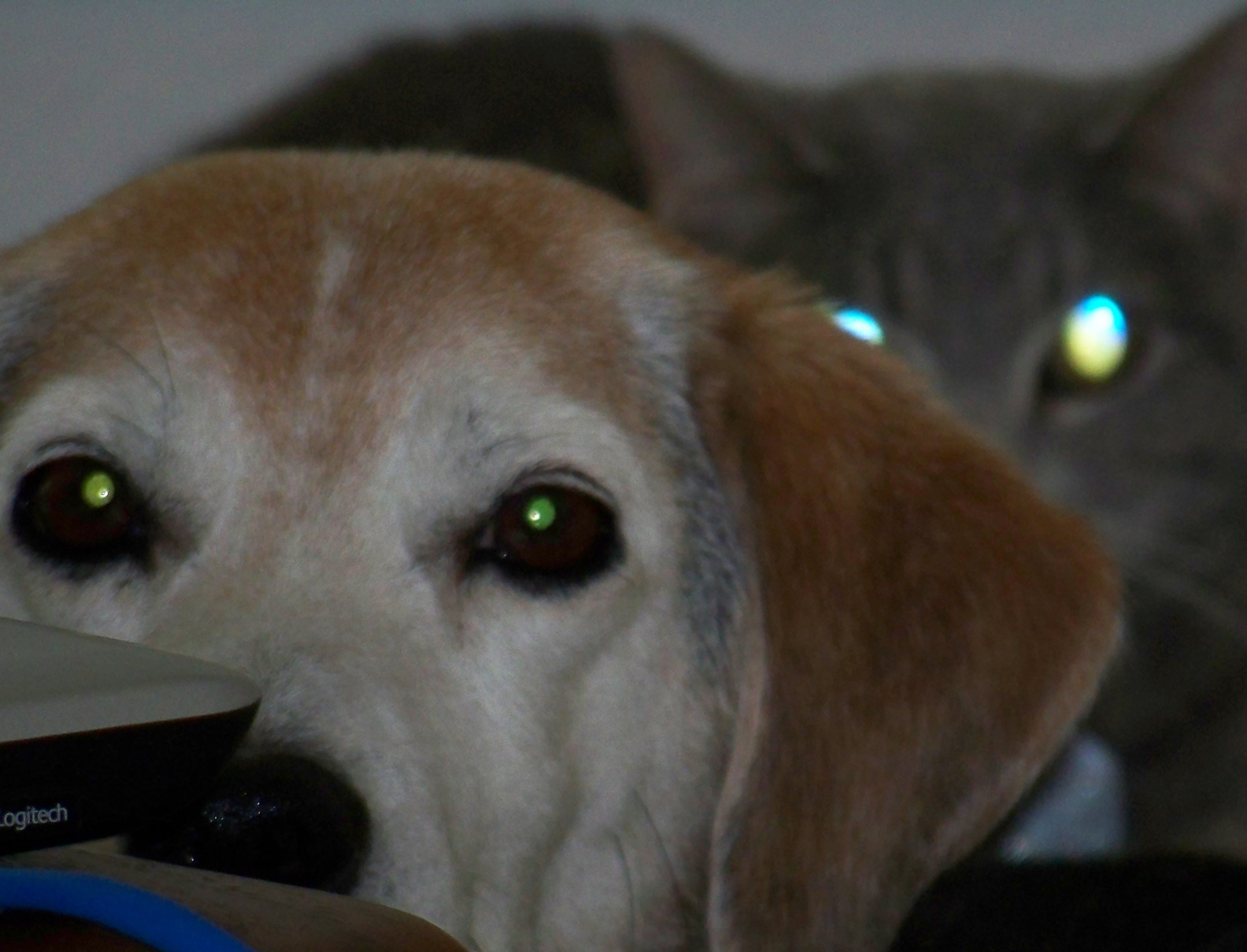
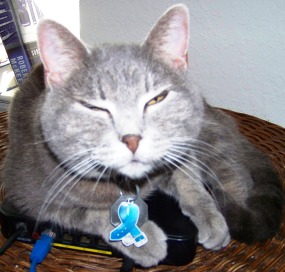
Often I offer the thoughts of Mark Nepo and Wayne Dyer but honestly, when it comes to abundance and unconditional love, I turn to beagle Cooper James and EmmaRose, a grey-blue dilute kitty of 5.5 pounds whose one word name was decided by a paw-press on the “Enter” key.

The three of us are an illustration of what was separate that is now whole.

How we lived before does not define us nor does it measure who we are. Those are years separate from us, now. As a feline, EmmaRose is 44, canine Cooper is 57, and as the human, I am sixty; what we measure is what we are together, and in that, our differences are minute.

Blanket Mountains

Our one-bedroom apartment is all we need and in some ways, more than we ever had. EmmaRose moves about the apartment most, rearranging throw rugs, curling up in what have become known as the Blanket Mountains of the living room, playing pine cone shuffle with cones Cooper and I brought her from one of our fall outings. EmmaRose is not a traveler outside the apartment–she enjoys her solitude–Cooper and I provide her her time on a daily basis.

"Why now?"

We all share the bedroom—the adjustable, queen-sized bed supports canine and human arthritic joints—EmmaRose’s preferred spot is on the computer modem that rests on the round, wicker bedside table, darkening with age. The table provides EmmaRose the perfect distance to meow in my ear—at least a couple of hours before dawn–if she has seen her reflection in the bottom of her food dish in the dark.

"Yes, Dr. Mac?"

Like many canines, Cooper is food-motivated and as a beagle, he is indiscriminate in what he eats, resulting in a daily antacid prescribed by Dr. Mac.

When the three of us could still eat tacos without major digestive upset for the human and the canine, we each had our favorite ingredient: Cooper scarfed cheddar cheese shavings; EmmaRose preferred powdered corn tortilla bits; meat and lettuce were for the human.

EmmaRose has never noted the absence of our taco dinners but it has been hard on Cooper and me. About a month ago, we gave into our cravings and purchased one taco; Cooper wanted more, as always; EmmaRose was not in the mood for tacos that night; as for me, I cannot imagine a time I will want another taco ever.

Having food and shelter is something we have always shared amicably, perhaps because all three of us have been as close to homelessness as we ever want to be. For Cooper and EmmaRose, euthanasia was near; for me, life was a series of question marks for some time.

What if

We learned to re-frame our lives, not looking back at what we no longer have nor looking to what we fear but rather through it, moment by moment—together. Cooper and EmmaRose seem better at facing fear than I but in watching what they give to one another as well as to me, reciprocating is effortless.

Every vision starts somewhere.

I suspect the force that is all life, whether the form is matter or antimatter, sees wholeness not separateness, offers treasure without condition—imagine.

ROW80 Wednesday Word Marking

 I am re-framing my writing goals. This round, I am concentrating on revising the original draft of my novel, based on the kernel idea I developed in a writing workshop. You can view what I have to say about that here.

I did manage to write a little more than a thousand words (1,068) on how the new version of the novel will read, in particular what it will mean for many of the characters. It is a fascinating process, for me.

Center of the Universe

You are not the center of the universe” is a pivotal line in my unpublished novel, written eighteen years ago. Actually, Center of the Universe was the novel’s real working title, which I do not believe I have never told anyone until now but I’m old and every day, my memory is kinder. For most of my novel’s years, I called it Spirit Song or a still favorite phrase, In-Between Dances.

dachsundlove.blogspot.com image

Anti-Spoiler: At no time in this post or any other post will you be subjected to excerpts from any novel or story I may write. This blog may  look at the 10,000 things of the Tao but my novel or story excerpts are excluded.  My writing has its place, which is not my blog.

“Center of the universe” was an unusual concept in the early 1990s  for me and for the small, coal mining community where I lived. Amazingly, I played a pivotal role in that community for a short period of time, if not as the center of the community, it was close enough for me forever. It doesn’t take much in a small community.

Fresh from a university setting, I was teaching the  basic composition course for the community college outreach program. The course was required for anyone pursuing an associate degree but I did not let that hold me back. I launched my (and the community’s) writing life with Natalie Goldberg’s Writing Down the Bones. Zen Buddhism completely captured my heart; I was so in love.

Edgar Allan Poe Wikipedia Image

Everywhere I looked, there was analogy after analogy. In teaching Poe’s “Fall of the House of Usher,” a classic story of sentience, I nearly brought to life the house’s  weeping walls and the Tao of 10,000 things. I was ingenuousness personified. At best, I only knew half of what I thought I knew but I tossed all my sentience out there.

It stuck.

For the next few years, former students liked to introduce me as: “This is (My Name), and she thinks this chair has feelings.” Yes, a chair was offered to a somewhat startled, formerly secure person. It kept people on their feet, and for a moment, made me the center of the universe. Only now do I appreciate how truly amazing those years were.

By the time I began writing my novel in 1994, I had pulled away from the community and in all fairness, it had pulled away from me, too. We had reason to separate—it seems fair to say we had forgotten our sentient selves—it is so long ago who knows whether  there was any reason left in any of us. We just were.

Regardless, my novel was about finding community again; I wanted to discover where we had gone so wrong, all of us. Somewhere after 60,000 words, my protagonist was informed: “You are not the center of the Universe.” Truly, I remember the moment.

As a writer, I recognized the importance of the sentence but as a human being, I sensed enlightenment, albeit briefly. It would take another seventeen years to fully appreciate the center of the universe but there was light, and toward that, I moved.

In 2011, I read Stephen Hawking’s books—Grand Design and A Briefer History of Time—and learned of the multiverse, a considerable blow to my centered universe–momentarily–for I found the joy of quantum entanglement and Oneness. The reality of joy is once you experience it, you move in that direction always. Dark just does not have the same hold in Oneness.

genamason.wordpress.com image

However, Oneness translates hard for a writer, sometimes.

While I had known for a while—sixteen years, eleven months, and twenty days—that I might glean only dribs and drabs from my first attempt at a novel, I always believed I had the center of the universe. Not so. Seems it really was a bit of fiction.  And there was something even worse: my center of the universe was a Little Darling, in writing, a death knell.

True to form, I kept silent about my Little Darling. Perhaps I hoped I would forget there was a multiverse–I promise you there is real merit in this possibility–yet, sentient human or no, once the heart knows, it knows.

Yesterday, my universe imploded, victim of  my first assignment in a writing workshop: write the idea of my novel in one sentence of 25 words or less. Surprisingly, I managed to find a sentence, not a cogent one, but the center of the universe was gone.

Note: For one of the best explanations about Little Darlings and how to get help for this alarmingly prevalent addiction, please read Piper Bayard and Kristen Lamb, proud sponsors of Little Darlings Anonymous.

ROW80 Wednesday Word Marking:

My word total for January was 8250 with my goal of writing at least 250 words per day; in February, I began writing in 30-minute stretches to focus my writing and the word total for the month is 9814;  in March, my current word total is 2118.  My total Round of Words so far is 21,182, which is a raw total, meaning a lot of free writing/brainstorming with a goal of writing consistently, which I have accomplished. I generate an additional 1200 to 2000 words per week as blogs, fiction, and nonfiction.

For the remaining days of this ROW80, I am focusing on scheduling my blogs so I am not on “deadline” ever or always on deadline.  Oneness is confusing in this regard.

Bob Mayer’s Idea and Conflict Workshop  is just incredible, and I mean that sincerely. I can honestly say I have not been this excited about writing in years. There is true joy in my work.

Dear Reader

themacfeed.com image

Today, I came up with a tag line for my blog: A Boomer Being. It’s on the left hand side of the screen, beneath KM Huber’s Blog. My belief in Oneness and my attempts at Being are the basis for this blog but you, Dear Reader, are its heart.

Thank you for visiting my blog—whether it’s your first time and last time or whether you’re a regular—in that moment, we connect in ways we may never realize. That is “spooky action at a distance.”

My blog has been up for less than two months, and your incredible response warms my heart, truly. In fact, you’ve changed my life, and I mean that with all my heart.

If you blog or participate in social media, you know the fear of “pressing” your words into print. Chagrin, terror loom. You really can’t take those words back. Oh, you can delete a published blog page or a comment and never hear about it but here’s a hint: commit the word cache to memory. I promise you at least one pair of eyes found your words, knows what you tried to take back.

Technology just may force us into being thoughtful and patient, qualities we do well when we are them. Magnanimity is a  marvelous  human trait that is not used as frequently as it might be but blogging and writing in the ether give new meaning to being in the moment.

Welcome to the world of the open heart: the 21st century.

impactlab.com image

There is a revolution going on across the globe every minute of every day. We are seeing ourselves as we’ve never seen ourselves, and it’s a bit of a shock, which revelation always is. There seems no place to hide but there never was is what we are discovering.

As an aging feminist and boomer, I was born to revolution; as an aging writer, I know I am living in a golden age of words still being arranged and rearranged but language is within the Oneness that connects us all.

Dave R Farmer
WANA Commons

At almost sixty, I am categorized as a boomer by virtue of my age but I really am a hippie, still. Yet being, really being, is new to me after six decades of a lot of doing–and not always well. Now, living moment by moment, I am not rushing anywhere anymore for anyone. Frankly, it is all I can do to be for the rest of my life—it’s that compelling.

Some label life as spirit being human, and it just may be, but life is an experience that we take in and let go, usually unevenly, especially the letting go part.

But maybe now that we reach round the world any time we want to, we will open our hearts to each other completely. Certainly, it seems we can, Dear Reader, although I did not believe it two months ago.

You, Dear Reader, showed me all is possible, and for you, I blog.

ROW80 Wednesday Word Marking:

From January 2 until February 4, my goal was to write 250 words per day—as blog posts, fiction, or nonfiction–for an approximate total of 8250 words.

Beginning February 4, I started the “30-minute” stretch in which I write for 30 minutes. So far, that has generated just over 9,800 words, almost half of those words will see another format. I generate another 1200 to 2000 words per week as blogs, fiction, and nonfiction.

I achieved my goal of returning to writing regularly.  Now, the 30 minute stretches have found focus as drafts of future blogs, eliminating the time crunch of making the Sunday and Wednesday press deadlines. My goal is to schedule my all my blogs so I am not on “deadline” ever.  For this round of ROW80, I am just over 20, 800 words.  I am so pleased that I am writing regularly.

I signed up for Bob Mayer’s Idea and Conflict Workshop that begins March 3.  With this workshop, I will finally start putting together pieces of  a story I’ve had for sometime–my first write-through of a novel seventeen years ago.  Structurally, I never considered it a novel–it’s always been an exploration of my writing process–I knew there were some strong pieces without a true story. With this workshop, I’ll test my idea, which means I have a novel to write, and I am excited.

Where Risk Resides

Wikipedia photo

When risk is choosing this one or that, I always think of  Linda Pastan’s poem, “Ethics.”

In ethics class so many years ago
our teacher asked this question every fall:
if there were a fire in a museum
which would you save, a Rembrandt painting
or an old woman who hadn’t many
years left anyhow? Restless on hard chairs
caring little for pictures or old age
we’d opt one year for life, the next for art
and always half-heartedly. Sometimes
the woman borrowed my grandmother’s face
leaving her usual kitchen to wander
some drafty, half imagined museum.
One year, feeling clever, I replied
why not let the woman decide herself?
Linda, the teacher would report, eschews
the burdens of responsibility.
This fall in a real museum I stand
before a real Rembrandt, old woman,
or nearly so, myself. The colors
within this frame are darker than autumn,
darker even than winter–the browns of earth,
though earth’s most radiant elements burn
through the canvas. I know now that woman
and painting and season are almost one
and all beyond saving by children.
Linda Pastan, from the collection Waiting for My Life (1981)

The poem sets up an array of caveats—whether the woman is loved or a stranger, whether or not one is mature in experience or just beginning to experience life, whether or not to choose—each requires risking this or that, one or the other, or not at all.

Mark Nepo writes:

“There is no substitute for genuine risk…the very core issues we avoid return, sometimes with different faces, but still, we are brought full circle to them, again and again” (The Book of Awakening).

Avoiding risk, somewhat akin to eschewing responsibility, seems to be a circular choice every time. Yet, in oneness—here and there, this and that–risk is whole, not one or the other, not old or young but the one truth that resides in us:

“It is we who, in our readiness and experience, keep coming back, because the soul knows only one way to fulfill itself, and that is to take in what is true” (Nepo, The Book of Awakening). 

Maybe that’s why the poem puts the annual question to children, who are no strangers to truth.

Rhythm of ROW80 Sunday Scheduling:

On February 3, added a 30-minute writing stretch—free writing that is timed—it helps clear the minutia of the moment so my daily writing is more focused.

Alternating short fiction, novel, and blog posts as daily writing

Doing the Tao with Dyer, still stuck in duality

Nepo morning meditation continues

Two and “Not Two”

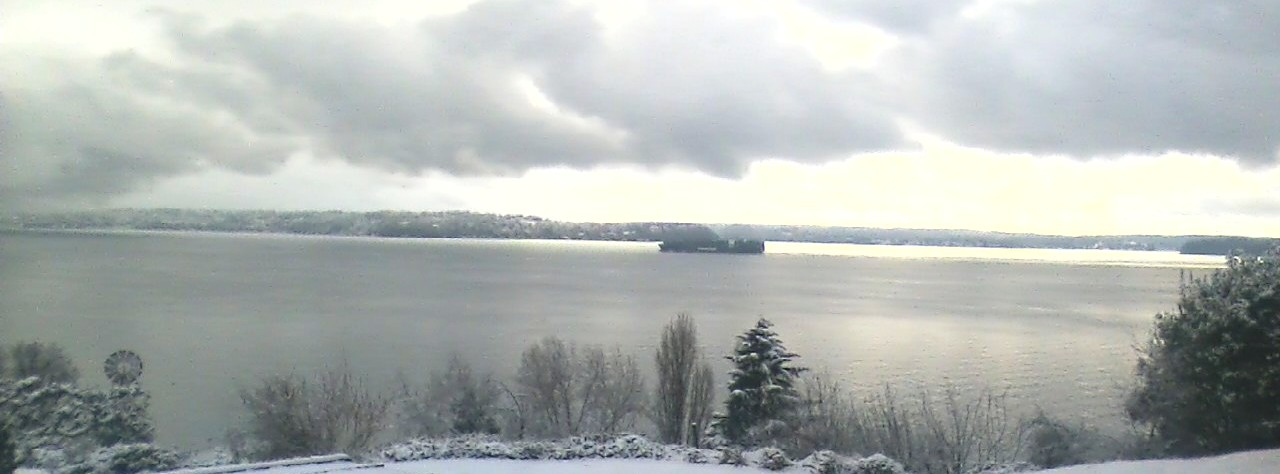
Len Huber, Photographer

A winter’s day in Seattle produces snow-fog all around Puget Sound as the warmth of a cloudless sky bathes St. Mark’s Refuge on the Gulf of Mexico. We categorize them as here or there, as opposites even. What one location has, the other has not, for they are two. Yet, they are “not two” as they are one with the waters that cover the earth.

“Not two” was the constant response of Seng Ts’An–third patriarch of Chan in the seventh century–to all who sought his advice. Perhaps the patriarch’s response is best understood by what he did not say–oneness.

As one, we are both here and there, not completely in one place or the other. There is no separation between what we have and what we lack if we are one, not two. When we identify ourselves as this or that, we deprive ourselves of our joy, the “filling up and spilling over”* of  us.

In oneness, we are infused with the force of life and all of its mystery. Mark Nepo writes that “there are no wrong turns, only unexpected paths.”  If we believe that failure and success are one–not two–then we understand that every choice we make is complete in and of itself, a path of our own accord. Happy trails!

*Cris Williamson lyric in “The Changer and the Changed.”

Rhythm of ROW80 Sunday Scheduling:

  • Submitted bi-weekly Leashed as scheduled
  • Introducing short story revisions to writing schedule this week
    Plan this for afternoons/evenings but have to work in a nap
  • Novel revision consistent but not daily yet
  • Doing the Tao with Dyer on duality
  • Nepo morning meditation continues