On-Again, Off-Again Buddhism

Waiting 0613Dukkha is the first of the Four Noble Truths in Buddhism and is usually translated as suffering, a concept that has always appealed to me about as much as the phrase falling apart, hence my on-again, off-again nearly thirty-year relationship with Buddhism.

Yet, it is to Buddhism that I always return, rather like everywhere I go there I am for as the Buddha said, “I teach only one thing: suffering and the cessation of suffering” (Pema Chödrön, How to Meditate: A Practical Guide).

While dukkha is the word the Buddha is said to have used for suffering, dukkha has more than one level. The first level concerns mostly our physical bodies and ultimately the fact that we die. This kind of suffering involves “outer discomforts” and is considered ordinary.

The second level of suffering pertains more to our stress/anxiety in accepting that nothing stays the same, no matter how hard we might try to make it so. This is the “dukkha produced by change.”
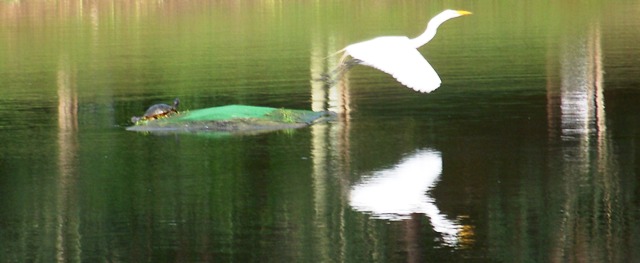
Taking Off 0613

The third level of suffering is often referred to as the “dukkha of conditioned states,” translated as “dissatisfaction” or “never satisfied.” Pema Chödrön explains:

“Dukkha is kept alive by being continually dissatisfied with the reality of the human condition, which means being continually dissatisfied with the fact that pleasant and unpleasant situations are part and parcel of life.”

Over the decades, it has actually become apparent that if I accept each moment as it occurs— the dukkha of conditioned states—the first two levels of suffering fade away, which is not to say accepting impermanence is easy.

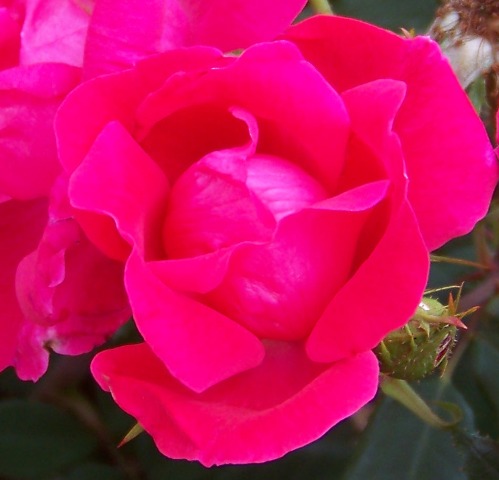
Bloom of Peace 0613
KMHuberImages

For any level of dukkha, meditation helps us strip away our storylines, our drama from any pain or emotion we are feeling. Meditation takes us into the energy of our suffering so whether or not we can do anything about the circumstances, we can decide whether or not to suffer.

If we accept that we fall apart and come together all through our lives, we begin to practice compassion, first with ourselves and later with all those circumstances beyond our control. Because we are human, we are not always compassionate but every time, we have the choice to return to compassion. It is our inner version of war and peace.

In a comment on my initial post on falling apart, Ann E. Michael was kind enough to remind me of these lines from “The Second Coming,” Yeats’ often quoted poem on the aftermath of World War I:

“Things fall apart; the centre cannot hold;
Mere anarchy is loosed upon the world,
The blood-dimmed tide is loosed, and everywhere
The ceremony of innocence is drowned….”
~William Butler Yeats~

Every time I read Yeats or other World War I poets, I am reminded WWI was the war to end all wars, as if any war ever could. When we are at war with ourselves, we must remember that having compassion with ourselves is where peace begins for everyone.

All three levels of dukkha wend their way through our lives: physical pain, decay, and death claim each one; life will not stay the same for anyone; the constant impermanence of life is the human condition.

The Buddha taught, “I teach only one thing: suffering and the cessation of suffering.” Perhaps I always return to Buddhism because it is neither pessimistic nor optimistic but rather, things fall apart and come together again. Dukkha really is up to me.

The Color of Water

KMHuberImage
KMHuberImage

Ever wonder about the color of water? Water “…takes on the image of the entire world without ever losing its essential clearness,” whether it is a drop in an ocean, a mountain stream, or a rain puddle. (Mark Nepo).

In any given moment, the color of water is steel-gray, sky-blue, moss-green or dirt-brown for water easily embraces the colors of any obstacle anywhere, as the nature of water is movement, while its essence remains ever clear.

Washing over stones, roaring over a cliff to drop thousands of feet, or raining in torrents, it is the nature of water to take on any landscape for as long as necessary, even eons to fill a desert basin as a great salt lake. The nature of water is transparency for no one color ever stays, and no one outcome is preferred.

Like the nature of water we must “…embrace everything clearly without imposing who we are and without losing who we are” (Mark Nepo). It is the nature of human compassion to take on any event completely, no matter its color, but only for as long as necessary.

The highest good is like water.
Water gives life to the ten thousand
things and does not strive
.”

~Lao Tsu~

It is not so easy for us to take on the color of any experience for our nature is not the nature of water, even if our bodies are more water than tissue and bone.
Obstacle 0413 C

We are concerned with the image we present to the world—it may or may not reflect our true nature—often, it is an image thoughtfully prepared so it is somewhat opaque, designed to reflect certain colors in certain situations. It is how we survive in the larger current of human nature.

It is easier to remain within the current of human nature, whether or not that is who we actually are, for we are not water changing the landscape, unaffected by changes, yet the nature of water is a compassionate one.

The nature of water, its constancy to the flow that is all life—regardless of change–reveals we are more than any image we reflect or action that we take. In each moment there is the opportunity not to strive but to seek the essence of our heart, the source of our compassion.

Unlike the nature of water, we are not always aware or completely present in our lives. We are not free from extraordinary or ordinary obstacles but the color of water teaches us not to stay the color of those obstacles but ultimately, to run true and clear to who we are in the current of human nature.

Beneath the clouds, water desires only to flow, and beneath our tensions and problems, the human spirit wants only to embrace and soften” (Mark Nepo).

Perhaps the color of water is compassion reflecting as the colors of the day.

Thursday Tidbits: The Art of Peace

This week’s Thursday Tidbits is the Bloggers for Peace monthly post, specifically the art of peace.  The art of peace begins within ourselves and radiates outward into every relationship we have, in particular those relationships that for one reason or another are askew or gone awry.forpeace6

To renew a relationship begins with intention, although to re-open our heart is often difficult. That is why the art of peace begins within, for when we are at peace with ourselves is when we re-connect to serve all.

In order to start, Pema Chödrön maintains it is not such a great effort to once again establish a relationship that serves, if we will just consider that a commitment we once made is now broken.

KMHuberImage
KMHuberImage

It means we have to let go of the story we’ve been telling ourselves–the why, the what, the how, or who– and just acknowledge “…that we hardened our heart and closed our mind, that we shut someone out. And then we can retake our vow. On the spot—or as a daily practice—we can reaffirm our intention to keep the door open to all sentient beings for the rest of our life” (Pema Chödrön).

Everyday life, no matter how we approach it, is a practice that requires patience, especially when we do not seem to notice any progress within ourselves or within the world.

There are four emotions that never involve the ego—compassion, gratitude, joy, and love—these four ways have many other names including the four agreements of Don Miguel Ruiz that ask us to be “impeccable” in our speech, not to take whatever occurs personally, to be present in all we do so we are not assuming anything about anyone for when we are present, we are doing the best we can.

The art of peace is available to us in every moment we have for each moment is free from any attachment to what has been or what might be. That we affirm our intention to be the best we can be and live with true compassion for ourselves and others in every moment is what keeps peace always within our grasp. It begins with being present.

KMHuberImage
KMHuberImage

“That’s the training of the spiritual warrior, the training of cultivating courage and empathy, the training of cultivating love. It would be impossible to count the number of beings in the world who are hurting, but still we aspire to not give up on any of them and to do whatever we can to alleviate their pain” (Pema Chödrön).

In alleviating that pain we must remember the key to the art of peace: the idea of serving rather than helping or fixing anyone or anything. It is only in serving that we view ourselves and our connection to all life as whole, not broken or weak.

When we are clear in our intention of serving, we are open to what is available for all of us. The art of peace is a celebration of the diversity that makes up the whole, an acknowledgment that uniqueness is necessary for completeness.

Here are links to other Bloggers for Peace and their consideration of the art of peace:

Kozo Hattori: Art Thou Peaceful 

Bodhisattva In Training: The Art of Peace

Grandma Lin: May Post for Peace

The Seeker: Peace is Like a River

Caron Dann: Recreationist Theory

Card Castles in the Sky: Float Upward

One of my favorite combinations of the art of lyrics, music, and painting is this well-known video featuring the music and lyrics of Don McLean and Vincent Van Gogh’s paintings.

Thursday Tidbits are weekly posts that offer choice bits of information to celebrate our oneness with one another through our unique perspectives. It is how we connect, how we have always connected but in the 21st century, the connection is a global one.