Stirring the Pot

“To let knowledge produce troubles, and then use knowledge to prepare against them, is like stirring water in hopes of making it clear.” Lao-Tzu
(Tao, Verse 87 as quoted in Mark Nepo’s Book of Awakening)

So very like “stirring the pot” was my initial reaction to this verse of the Tao as memories of harsh words—felt and returned—stirred one unkind pot after another. Never once did I think to take it off the stove nor did I imagine knowledge in any way other than as a glorious fount, effervescent, pure, dependable.

How sure I was of so much and so many–then.

Now, I appreciate knowledge within the context of creativity—the act of imagining—one of the greatest gifts life offers, requiring only an open heart.

As I begin my third act, words remain a major force in my life; I am so curious about so much. More than ever, I write, something I never quite accomplished with all the pot stirring although writing was my constant goal.

“Feeling unworthy or insecure, we create a goal, in hopes that achieving this will make us feel good about ourselves. Then we’re off scheming for success, preparing against failure, stirring the water, hoping it will go clear” (Nepo, Book of Awakening).

Seventeen years ago, my goal was to write a novel, which I managed amid much pot stirring. Always, I spoke of the experience with false fondness. I wrote 80,000+ words, allowing myself to tread water in any current of thought.

Natasha Hanova Image
WANA Commons

Frankly, I felt quite good about myself, proud even, for accomplishing my goal. To be honest, every year since writing that original draft, I tried one writing goal after another, stirring and stirring.

One of my favorite far afield attempts was to collaborate on an inspirational book of vignettes with the actual working title of Rising to the Occasion When You Can’t. Outside of considerable pot stirring for three years, our hearts were not open to a word we wrote.

From time to time, I returned to the goal of revising the 380+ page manuscript word by word—certainly a worthwhile goal within the first year of its writing—but at seventeen years later, it was time to take the pot off the stove.

“The mind is a spider that, if allowed, will tangle everything and then blame the things it clings to for the web it wants to be free of. I have done this with dreams of greatness and hopes of love, wanting so badly to see myself clearly in the water, while I kept stirring and stirring” (Nepo, Book of Awakening).

As I mentioned in my last few blog posts, I am yet again working with this first novel draft. Pursuing knowledge within experience, I stirred myself into a month-long, writing workshop. After so many years of empty goal-gazing, it took most of the workshop for the waters to still.

Truly, I did not recognize the actual moment the waters cleared. It was a gradual realization that I no longer was “scheming for success” or weaving any web. Frankly, my sediment sunk.

It was clear that I “don’t have to be finished in order to be whole” (Nepo) as a writer or as a human being. So, for the first time in seventeen long years, I saw the draft of my novel for what it is: the story of a moment passed, completely. Its worth is immeasurable.

With waters clear, I write.

Note: I am publishing only one post this week but will resume publishing two posts per week beginning Monday. As always, feel free to comment or Email me! your comments.

Comment Choice

Image from themacfeed.com

It seems last Sunday’s blog on silence coincided with the implementation of some “comment updates” from WordPress, the hosting company for this blog. I chose WordPress for its theme diversity and low cost but mainly for its ease in connecting with other social networks.

A blog that deals with Oneness and being is about connecting so hosting my blog with WordPress did and does make sense. It also makes sense that there will be missed connections, from time to time. On Monday, some readers wanting to leave a comment received this message:

That email address is associated with an existing WordPress.com (or Gravatar.com) account. Please click the back button in your browser and then log in to use it.

No one has to register with or log in to my actual blog to comment;  however, my blog has always required an email address (never revealed) and a name to accompany all comments. If I didn’t, anonymous responses could conceivably rival spam contributions so on my blog, one must create an identity to comment.

Identity seems to be at the core of the recent comment update issue, although I do not pretend to understand the technology of it so I may be completely wrong.  However, it does appear that in order to leave a comment on my blog now, readers must sign in with an existing social media account (Facebook, Twitter, Yahoo, etc.) or create an account with WordPress.

Image from playthink.wordpress.com

This is the ether so remember that  updates/changes to what I just wrote are always just a breath away, if that far.

As this blog is also about one boomer being–I have an appreciation for and history of questioning authority so I do “get” why some readers are upset—I support every reader who does not want to sign in with any of their existing accounts or create an account with WordPress in order to comment.

For me, blogging is all about community and finding ways to support each other. Yes, I am nauseatingly optimistic almost all of the time but just the fact that we can have a global conversation about commenting or not commenting is a positive for all of us. Here’s an alternative way to comment on my blog:

Under Contact in the right hand column on my home page (Oneness),  please click on Email me!  to send  your comments.

As I do with all comments, I will review, respond (if appropriate), and I will post your comment just as if you had submitted it in the comment section. Please provide a name that you like as your identity. It may even be your own.

“So rather than giving energy to…perceived misfortunes, [I look to] the Tao…inexhaustible…the ancestor of it all…living infinitely” (Wayne Dyer).

“Wisdom is knowing I am nothing,
love is knowing I am everything,
and between the two my life moves.”

Nisargadatta Maharaj


Round One of Round of Words Final Tally
 

The first round of Round of Words in 80 days ends tomorrow, and round two begins April 2. ROW80 helps writers bring their writing into their real lives, no more goal-gazing or sighing. ROW80 helps writers establish realistic goals that may be revised as many times as any manuscript. All one needs is a blog and a love of writing.

I was skeptical about ROW80 but if nothing else, I launched a blog, the writing of which requires way more than I anticipated. Furthermore, I saw my writing as it really is, which is not exactly how it was playing in my head or through my heart.  Now, I know what is possible so thank you  to the ROW80 community of writers who post their progress on Sundays and Wednesdays.

My beginning goals were modest—write at least 250 words per day, write a blog post twice a week, do something with a 17-year-old manuscript. I made it hard for me to fail, for once.

I progressed from 250 words per day to 30-minute stretches and to a daily average of 900 words. In these last few weeks, I am comfortably writing over 1,000 words per day. The type of writing includes technical, nonfiction, fiction, and blog posts but in this first round, I excluded technical and nonfiction writing from my word count. Total fiction and blog post word count is 23,639. Total technical and nonfiction word count is 14,000-18,000.

As a writer who was not writing except for an occasional spurt, I am more than pleased. What ROW80 reveals is that it does not take a great deal of time to generate words. With words come ideas and better words, clearer thought.

My manuscript is in shreds but its core, kernel idea is intact, which is more than I expected. The story is completely different as am I– seventeen years later–but the story’s idea is as fresh as always.

ROW80 Round Two on deck.

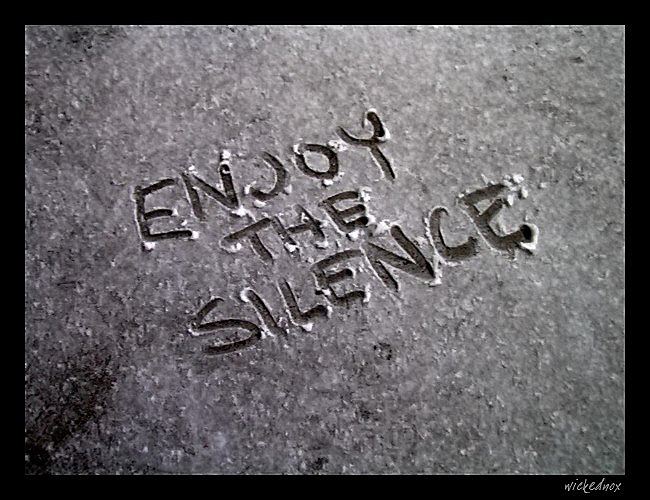
Silence is a Response

Life is loud, the constant chatter of a unified life. The more we connect with each other, the more we learn about ourselves. Yet, there are moments when a silent response may benefit us most.

We live with the daily fallout of nonsense that has been increasing over the last two decades but in the last two years, the social and political climate of the planet has completely changed. Hot spots are everywhere. Frankly, we do not know what to do so we text what we do not know.

In this immediate world, an emoticon or single parentheses with a colon is acceptable but the larger fallacy in all this chatter is oranges become apples and then later, as needed, apples turn into oranges. There isn’t a logical fallacy that is out-of-bounds.

I offer this: silence is a sound response preferable to the chatter of logical fallacies. There is nothing new in the virtue of silence but as we reach across, up, down and around the globe, we are connecting with all we can be, and the possibilities are endless.

mairedubhtx.wordpress.com image

How we connect with one another in the ether seeps into our physical relationships, particularly those conversations of the heavy heart, the ones that thud: conversations we no longer want to have much less start; conversations that reveal a truth we never saw until we realize it was there always. Revelation and resonance are pure, often painful.

In a recent blog post, Sabrina Reber tells us: “Understand that when we resonate ‘strongly’ with the pain and suffering in others, it is a reflection of our own inner pain that has not been healed. STRONG REACTIONS to anything outside ourselves are always a reflection of our own inner turmoil.”

Other people are mirrors for us, even when we look away–keep the chatter on them–as we tweet or text a response to relieve our own discomfort.

“When you find yourself having a strong reaction to an external issue ~ STOP. Turn it around and say ~ ‘this is my stuff.’ This is your place of POWER ~ because you are accepting responsibility for yourself/your emotions/your feelings/your vibration ~ and only then will you be able to tap into the underlying truth of the issue so you can create change” (Reber).

A response is a thoughtful decision including whether or not to respond. There is so much chatter in the outer world  but if we listen silently and allow our egos to chatter, judge or interpret inside our heads, then we’ll know whether or not to respond but even better, we will know what to respond.

Silence is a straightforward action, and the fact that silence is a possibility for each one of us in every moment at a cost we determine is the very power we seek in chatter.

Truly, “it is time for us to stop expecting someone outside of ourselves to make the changes on this planet we so desire to see. Our power for change revolves around the SELF……one person at a time” (Reber).

Rhythm of ROW80 Sunday Scheduling:

This week, we examine conflict in the Idea and Conflict workshop with Bob Mayer.  As he says, it will be a challenge. This past week, I struggled with the kernel idea of my novel, which is clearer but not quite there. The kernel idea exercises require the writer to peel back layer after layer of story. It’s quite rigorous, and I have spent about five hours a day with variations on the exercise. In the process, I am writing a lot of back story.

Beyond my workshop writing, I am generating at least 1,000 words per day  for blog posts as well as some creative nonfiction. In this regard, I have exceeded my original word count of writing 250 words per day in this first round of ROW80.

Shakespeare’s Sister Still

goodreads image

“It would have been impossible, completely and entirely, for any woman to have written the plays of Shakespeare in the age of Shakespeare.” These are Virginia Woolf’s words from a series of lectures she delivered at Cambridge University in October, 1928. They were published In 1929 as  A Room of One’s Own. 

In later decades, “Shakespeare’s Sister” found a life of its own as an excerpted essay* in various anthologies. My own discovery of Woolf’s work was over three decades ago, and I am grateful for her transcendent sentences.

Woolf creates her imaginary Judith Shakespeare within William Shakespeare’s generally accepted circumstances. As is often true, similar circumstances are no guarantee of similar outcomes even when one’s mother is an heiress, as was true for William and the imaginary Judith.

The grammar-schooled William “was, it was well known, a wild boy who poached rabbits, perhaps shot a deer, and had, rather sooner than he should have done, to marry a woman in the neighborhood, who bore him a child rather quicker than was right. That escapade sent him to seek his fortune in London. He had, it seemed, a taste for the theatre” (p. 8).

Daily nebraskan.com image

While William’s stage career began by “holding horses at the stage door,” it wasn’t long before William was center stage, “living at the hub of the universe.” He even managed to meet the queen.

Judith, equally curious and imaginative but not schooled—no  Horace or Virgil for her—did learn to read and even found a book or two, perhaps even one of William’s, until she was found out by her parents.

“They would have spoken sharply but kindly, for they were substantial people who knew the conditions of life for a woman and loved their daughter… [They] told her to mend the stockings or mind the stew and not moon about with books and papers” (p. 8).

Yet, Judith went on reading and started scribbling a line or two as she was near a marriageable age, seventeen. Upon discovering that she was betrothed to a “wool-stapler’s son, [she] cried out that marriage was hateful to her, and for that she was severely beaten by her father,” which did not produce the desired results in Elizabethan England any more than it does in the 21st century.

Father Shakespeare then offered Judith “a chain of beads or a fine petticoat…there were tears in his eyes. How could she disobey him? How could she break his heart?

“The force of [Judith’s] own gift alone drove her to it. [She] let herself down by a rope one summer’s night and took the road to London…she had the quickest fancy, a gift like her brother’s…she had a taste for the theatre” but she was sent away from the stage door (p. 8).

ehow-co-uk image

Actually, Judith was laughed away by the stage manager who told her “no woman…could possibly be an actress. He hinted—you can imagine what. She could get no training in her craft. Could she even seek her dinner in a tavern or roam the streets at midnight?

“[Judith’s] genius was for fiction and [she] lusted to feed abundantly upon the lives of men and women and the study of their ways…for she was very young, oddly like Shakespeare the poet in her face” (p. 9).

Judith was turned away, time and again, until an “actor-manager” took pity on her and her dreams of theatre. Soon, Judith was with child and without marriage.

Sadly, Judith killed herself “one winter’s night and lies buried at some cross-roads…that, more or less is how the story would run…if a woman in Shakespeare’s day had had Shakespeare’s genius” Woolf conjectured, almost a century ago (p. 9).

In 2012, we are still asking: “…who shall measure the heat and violence of the poet’s heart when caught and tangled in a woman’s body.”
*All excerpts from “Shakespeare’s Sister,” by Virginia Woolf are from Eight Modern Essayists, 5th edition, St. Martin’s Press, 1990.

ROW80 Wednesday Word Marking:

My word total for January is 8250 with my goal of writing at least 250 words per day; in February, I began writing in 30-minute stretches to focus my writing and the word total for the month is 9814;  in March, my current word total is 3838.  My total Round of Words so far is 21,902, which is a raw total, meaning a lot of free writing/brainstorming yet meeting my goal of writing consistently. I generate an additional 1200 to 2000 words per week as blogs, fiction, and nonfiction.

Bob Mayer’s Idea and Conflict Workshop is life-changing, and I mean that sincerely. I can honestly say I have not been this excited about writing in years. There is true joy in my work.

A Unified Life

It is not frequently the “world is too much” with me but too much always means a matter of words.

These are days of careless and thoughtless words thrown around the world in a nanosecond and forgotten just as immediately, as if a word once released is never more.

KM Huber Image

Every word reveals its writer, as Wayne Dyer demonstrates in his work with the Tao: “Live a unified life” and forego the “mind game” of duality, that “propensity to compartmentalize everything as good or bad, right or wrong.” Ah, the slippery slope of duality.

I take this viewpoint or that one, keeping each in its box, opposites, while I allow myself the luxury of weighing right vs. left, considering women vs.  men, contemplating yin-yang.

I name it balance but my heart knows it as judgment unexpressed but held. I am a lifelong hair-splitter within myself as well as with the world. At times, both are too much with me.

I am a true believer in finding common ground on any issue—no matter how insignificant that spot of ground may be, I know it exists–often, I am tenacious beyond popularity with left or right, no or yes, yet it keeps me just shy of duality. Dyer offers this: “eliminating opposites paradoxically unifies them.”

Imagine that as a political viewpoint in a discussion of  the role of government for the individual, for an entire country, especially when our planet is so pendulous, left-right, right-left, right-wrong. Words and more words, this word heard, that word ignored, a lie believed, a truth buried.

It’s a squawking sky of words where a good offense is the next day’s defense, and no one remembers to ask whether the sky is falling for the sky is full of flying words.

“…notice an opportunity to defend or explain yourself and choose not to. Instead, turn within and sense the texture of misunderstanding…just be with what is.” 

These Wayne Dyer words clear the sky for me on any day. The moment is all we ever have and it’s more than enough to “just be.” In order to clear the sky, I have to remove “me” from the words so I can see their meaning, their context, how they come together and when. Then, I can hear them.

“The world is too much with us, late and soon,” Mr. Wordsworth, as it always has been.

Amanda Stephan Image
WANA Commons

Rhythm of ROW80 Sunday Scheduling:

This past week, I started a month-long workshop with Bob Mayer on Idea and Conflict. For the rest of this round of ROW80, I will work with the kernel idea and conflict box of  a story that may actually become a novel.

Daily, I write for at least 30 minutes, often longer, generating at least 1,000 words per day  for blog posts as well as some creative nonfiction. In this regard, I have exceeded my word count for this first round of ROW80.

All Wayne Dyer excerpts are from Change Your Thoughts, Change Your Life, second verse of the Tao.

Center of the Universe

You are not the center of the universe” is a pivotal line in my unpublished novel, written eighteen years ago. Actually, Center of the Universe was the novel’s real working title, which I do not believe I have never told anyone until now but I’m old and every day, my memory is kinder. For most of my novel’s years, I called it Spirit Song or a still favorite phrase, In-Between Dances.

dachsundlove.blogspot.com image

Anti-Spoiler: At no time in this post or any other post will you be subjected to excerpts from any novel or story I may write. This blog may  look at the 10,000 things of the Tao but my novel or story excerpts are excluded.  My writing has its place, which is not my blog.

“Center of the universe” was an unusual concept in the early 1990s  for me and for the small, coal mining community where I lived. Amazingly, I played a pivotal role in that community for a short period of time, if not as the center of the community, it was close enough for me forever. It doesn’t take much in a small community.

Fresh from a university setting, I was teaching the  basic composition course for the community college outreach program. The course was required for anyone pursuing an associate degree but I did not let that hold me back. I launched my (and the community’s) writing life with Natalie Goldberg’s Writing Down the Bones. Zen Buddhism completely captured my heart; I was so in love.

Edgar Allan Poe Wikipedia Image

Everywhere I looked, there was analogy after analogy. In teaching Poe’s “Fall of the House of Usher,” a classic story of sentience, I nearly brought to life the house’s  weeping walls and the Tao of 10,000 things. I was ingenuousness personified. At best, I only knew half of what I thought I knew but I tossed all my sentience out there.

It stuck.

For the next few years, former students liked to introduce me as: “This is (My Name), and she thinks this chair has feelings.” Yes, a chair was offered to a somewhat startled, formerly secure person. It kept people on their feet, and for a moment, made me the center of the universe. Only now do I appreciate how truly amazing those years were.

By the time I began writing my novel in 1994, I had pulled away from the community and in all fairness, it had pulled away from me, too. We had reason to separate—it seems fair to say we had forgotten our sentient selves—it is so long ago who knows whether  there was any reason left in any of us. We just were.

Regardless, my novel was about finding community again; I wanted to discover where we had gone so wrong, all of us. Somewhere after 60,000 words, my protagonist was informed: “You are not the center of the Universe.” Truly, I remember the moment.

As a writer, I recognized the importance of the sentence but as a human being, I sensed enlightenment, albeit briefly. It would take another seventeen years to fully appreciate the center of the universe but there was light, and toward that, I moved.

In 2011, I read Stephen Hawking’s books—Grand Design and A Briefer History of Time—and learned of the multiverse, a considerable blow to my centered universe–momentarily–for I found the joy of quantum entanglement and Oneness. The reality of joy is once you experience it, you move in that direction always. Dark just does not have the same hold in Oneness.

genamason.wordpress.com image

However, Oneness translates hard for a writer, sometimes.

While I had known for a while—sixteen years, eleven months, and twenty days—that I might glean only dribs and drabs from my first attempt at a novel, I always believed I had the center of the universe. Not so. Seems it really was a bit of fiction.  And there was something even worse: my center of the universe was a Little Darling, in writing, a death knell.

True to form, I kept silent about my Little Darling. Perhaps I hoped I would forget there was a multiverse–I promise you there is real merit in this possibility–yet, sentient human or no, once the heart knows, it knows.

Yesterday, my universe imploded, victim of  my first assignment in a writing workshop: write the idea of my novel in one sentence of 25 words or less. Surprisingly, I managed to find a sentence, not a cogent one, but the center of the universe was gone.

Note: For one of the best explanations about Little Darlings and how to get help for this alarmingly prevalent addiction, please read Piper Bayard and Kristen Lamb, proud sponsors of Little Darlings Anonymous.

ROW80 Wednesday Word Marking:

My word total for January was 8250 with my goal of writing at least 250 words per day; in February, I began writing in 30-minute stretches to focus my writing and the word total for the month is 9814;  in March, my current word total is 2118.  My total Round of Words so far is 21,182, which is a raw total, meaning a lot of free writing/brainstorming with a goal of writing consistently, which I have accomplished. I generate an additional 1200 to 2000 words per week as blogs, fiction, and nonfiction.

For the remaining days of this ROW80, I am focusing on scheduling my blogs so I am not on “deadline” ever or always on deadline.  Oneness is confusing in this regard.

Bob Mayer’s Idea and Conflict Workshop  is just incredible, and I mean that sincerely. I can honestly say I have not been this excited about writing in years. There is true joy in my work.

Being Lily

“Originally, the word power meant able to be.
In time, it was contracted to mean to be able.
We suffer the difference” (Mark Nepo, Book of Awakening).

In a world weary and wary of power, I doubt the distinction that comes from rearranging words—even contracting them—is noted when we  consider our power, inner or outer, globally or individually. Usually, we find power and ourselves lacking, somehow; “…the wish for more always issues from a sense of lack” (Nepo).

Yet, there are times when lack results in abundance sans want and wishing. I think of Lily, a dog story of joy ever after because with Lily, lack is always more.

A white-muzzled, chocolate lab kind of canine, Lily found herself at a county animal shelter; she was too old to care for, she was too fat, her hips were bad. Lily lacked everything she needed to continue her life as it was so she began a new life, incrementally.

Second Chance Farms Inc. Photo

First, there was Underdog Foundation whose main operations are not in the area Lily lived nor is Underdog usually contacted about dogs like Lily. Underdog provides funds for various rescue operations but it is not involved in any physical rescue nor does it have its own facility so  Lily found her  funding but no place to be.

Yet, home was always near. Lily was in a county shelter that was part of the network of Second Chance Farms’ sanctuary. The sanctuary takes in older animals of almost all species, offering them forever home for the rest of their lives. Lily would live with dogs, cats, a tortoise, ducks, chickens, a horse named River, two goats, a donkey, and at that time, an opossum.

But with Lily, there was still more.

Second Chance Farms Inc. Photo

In under two weeks and entirely unexpectedly, Lily met and fell in love with her permanent foster parents who also care for cats, dogs and horses. At first, Lily slept a lot, as always, but her new life moved fast. With her human mom, Lily learned about her barn, her horses and having all around  romps in the barnyard grass. Her personality perked.

Lily was no longer quiet about life. Eagerly, she showed her humans that she could howl like a wolf, if needed, yet with a little eye contact, she was just as capable of carrying on a conversation, of sorts, with humans.  Lily being Lily, she ascended to alpha dog in her canine pack of three.

Second Chance Farms Inc. Photo

Lily’s family travels quite a bit. In particular, her humans are serious college football fans. In less than six months and in time for her first football season, Lily shed the weight that had been too much for her age and for her hips. She was on her way to a victorious season of football trips, especially the pre-game activities inside and outside the family RV.

When it came time for an extended family wedding, Lily attended, of course, and was included in the official wedding photos. In her first year of so many firsts, Lily’s world of canine and human contact is ever more. Lily no longer lacks for family, for care, for life in any way, a true alpha dog of her canine and human pack.

It’s the kind of story that takes us out of lack into what is best in all of us, canine or human. Lily, lacking all except her ability to be, created a chance for humans to prove they are able, always, to be more.

Christmas, 2011 (SCF photo)

And that is powerful.

Rhythm of ROW80 Sunday Scheduling:

This week, I begin a month-long workshop with Bob Mayer on Idea and Conflict. For the rest of this round of ROW80, I will work with the idea of my current manuscript so I may actually turn the story into a novel.

Daily, I write for at least 30 minutes, often longer, generating at least 1,000 words per day  for blog posts as well as some creative nonfiction.