Gifts and Limitations

In a recent morning meditation from Mark Nepo’s The Book of Awakening, I read of his playing basketball during high school and college. He assessed his performance with this stunning sentence: “My gifts were enough to hide my limitations.”

In immediate response, my mind sorted its archives to a job interview I had in the late ’80s; I interviewed for a library KMHuberImage; librarycataloger position with the library system’s director. Her impression of my resume was, “You’ve had many positions that most people would consider careers.”

Forever naïve, I welcomed her comment as a compliment, freely admitting how wonderful it was to experience as many careers as possible. Not only did I miss her point but I’m not sure that I fully appreciated my own response until I read Nepo’s sentence.

In other words, my gifts were sufficient to let my heart go elsewhere.

The ability to enjoy more than one career seems to be much more accepted in the 21st century. In fact, it may be a necessity. Regardless, there is an emerging awareness that exploring our gifts to their fullest allows us to let go of the dreams that are mere moments of brightness for the one light that is ours alone.

I have been incredibly fortunate in my work as a journalist/editor, a college writing instructor, an administrator and in between, I worked clerical jobs that taught me the immense importance of detail.

For as long as I can remember, writing was in my heart but I never had the courage to experience it. I believed one secured a job to support one’s writing, which wasn’t working out too well for me. Never did I consider “the succession of life’s trials is precisely the unfolding we need to find our bliss and rightful place in the order of things” (Nepo).

Not surprisingly, I did not get the cataloger position but I was later hired as the branch librarian and went on to become the director of the library system. I loved those library years but I could not make them be my dream nor was I the library system’s dream, ultimately. We both looked elsewhere.

It is not that I have not considered my careers from time to time for I have. I am grateful for all that brought me to this moment, for all the unfolding of my gifts that gave me each dream until another dream emerged. I think it kept me curious.KMHuberImage; Library gazer

What I never experienced in any of the dream jobs was the joy I experience every time I write. For me, there is nothing like it, and I am completely serious when I say that I come to the writing to find out what happens next. Whatever happens in the writing, I experience it. No longer clinging to what the writing may or may not be, the words and sentences open into the field of infinite possibilities, where joy resides.

Every career brought me moments of happiness but never joy for I was KMHuberImage; writingclinging, which is very like trying to touch the wind.

“The truth is that what we want to dream of doesn’t always last. It tends to serve its purpose… And then fades away, losing its relevance. And we can do enormous damage to ourselves by insisting on carrying that which has died” (Nepo).

Only in pursuing our gifts do we meet our limitations, which, I suspect, is the stuff of dreams.
Finding Story Anew

My last two blog posts have been an examination of my current mind-body consciousness, specifically my meditation practice and eating habits. I share Deepak Chopra’s belief that a change in one’s consciousness or awareness affects a change in one’s physiology at the cellular level.

I don’t remember when I did not believe in the mind-body connection but I know that reading Chopra’s Quantum Healing helped me consider what quantum healing may mean for me. I first read the book in the early 1990s and again just recently.

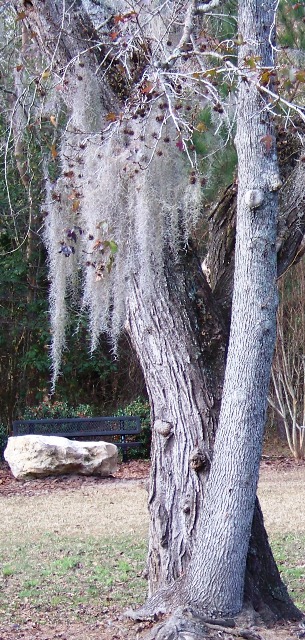
Old Woman Tree; KMHuberImage; Tallahassee Park in Winter

Of course, my current level of awareness is quite different these twenty years later. Then, I was completely attached to outcome—clinging the Buddhists call it—meaning my attention was always focused on the end result. Mostly, I was on a pendulum, swinging back to the past and then to the future without a thought to the moment. No wonder I never felt free.

Becoming aware that the moment is where freedom resides broke me open to Chopra’s “field of infinite possibilities” both physically and spiritually. Now, every facet of my life is fluid as I focus on what is and not what might be, which takes a lot more energy but in every moment, there is more energy.

Nowhere is this more evident than in my writing. When I began blogging, my writing focus was entirely outcome based: I set myself a certain number of words per day, I joined various writing challenges, and I troubled my readers with my angst over whether to plot out a novel scene by scene or just write it out by the seat of my pants. In nine months, I produced 220,000+ words in what I have come to regard as my daily writing practice. It is as valuable as my daily meditation practice, and  I don’t regret a word.

I was so attached to the outcome of writing– was it a novel, was it a memoir, was it a compilation of essays–that I abandoned story in search of format or genre. I could not free myself of what my words might become until I settled into the moment to write. One word after another, each sentence emerged from life rather than artifice. I re-discovered how I write.

In writing from the field of infinite possibilities, format/genre didn’t matter nor did structure, which is not to say that format and structure do not matter. They do and are critical to a successful outcome but like story, they have their moments for each writer to discover. For me, that meant having to know my story first, and I wrote in a way I have never written.

Having always appreciated a good story, I was well aware that I did not know the structure of story so I found out from those who did. I read, I watched movies, I discovered scene, and I wrote every day. I began to see snatches of story and I was reminded of John Irving’s response to the question of how he writes: “I start writing my autobiography and then I begin to lie.”

Pond in Winter; KMHuberImage; Tallahasse Park in Winter

I am writing an old woman story, and I am an old woman. If one can come of age at age 60, this woman does it. I cannot say that she is sympathetic or even likable—yet—but she exists in more faces and more places than is comfortable for any of us. Age or aging is still a thorny subject, and we have many clichés and euphemisms to avoid the word old.

But what can a woman make of a life at 60, if she has just awakened? That does sound rather autobiographical but I was lying before the end of the first paragraph–such is the way of story. For all I know, the old woman story—for lack of a better title–will remain part of my writing practice, as publication is not the outcome it once was for me. It’s too soon to tell.

For now, I go to the writing every day just to see what happens  with the old woman for I have not lived her life, although an old woman myself.

And Then, You’re There

Maybe a milestone is easy for me to miss, which seems contradictory, as I hold it in high regard, a true moment of significant development. Yet, such a moment did occur this past Thursday but it was not until Black Friday that I noticed.

Like many Americans who gave thanks this past week, I have food allergies/sensitivities that require some adjustment to the traditional Thanksgiving turkey meal: stuffing made with gluten/yeast free bread, organic apples and freshly ground sausage; organic sweet potatoes, green beans, and cranberries; no salt, no refined sugar.

When I woke up on Black Friday feeling not only fine but wonderful, I became suspicious. I had been careful with my meal preparation and ingredients yet I anticipated a bit of a reaction to the amount of carbohydrates I had consumed. There was none. 

Thus, it may have dawned as a Black Friday like any other–I am not given to participating in the holiday season gift frenzy—but it became  the day I realized that 26 months of fastidious eating habits had finally returned my digestive system to a state it has not known in decades: harmony.

When I first began eating gluten, yeast, dairy, soy, and sugar-free in August, 2010, I learned as I ate, which I soon discovered meant being precise in my eating and foregoing a lifelong habit of eating to please any particular craving that appeared. On Black Friday, 2012, I reaped the rewards of overcoming carbohydrate cravings, giving myself and my taste buds a new life.

New life is not really an exaggeration for I left behind all I had known—my well-worn, conditioned ways of living–for the freedom of the unknown–shed of past and future in favor of the present—a path that unfolds only moment by moment. Here, I trust my heart over my head–there isn’t room or need for any baggage–an open heart travels light.

In the early days, there are sugar cravings in as many forms as there are thoughts: a very dry, vodka martini shaken so hard that slivers of ice float on its surface evaporates into a cheese-dripping, twice-baked potato melting into a milk chocolate fondue for pound cake and strawberries. They are mirage, part and parcel of the past, ultimately powerless in the realm of the present.

In 26 months, the past has had its way with me. Sometimes, rather than giving into the image, I tried a “substitute,” seeking sugar in all the wrong places, always sorry the next morning and often, sooner. The taste of sugar always seemed just beyond me until I stopped reaching into the past. The last time I ate ice cream, I felt as if I were eating raw sugar from a sugar bowl. For the rest of the day, I could not brush my teeth enough, and the next morning, I had a hangover.


So, being able to eat apples, bread stuffing, cranberries, and sweet potatoes in one meal without an immediate or delayed reaction is a milestone. And, I have continued to enjoy Thanksgiving leftovers without any reaction, without any weight increase. In fact, for over a year, I have maintained a 50+ pound weight loss and for the last six months, my total loss has stayed right at 68-69 pounds.

My constant companion on this path has been steady weight loss, from the first day 26 months ago. Of course, my forays into the dark side of sugar always resulted in some kind of temporary weight gain but for the first time in my life, losing weight was not an effort.

My exercise is modest–mostly walking–although yoga is now playing a more active role. And while I would not have thought it possible, I truly enjoy eating a varied regimen of green, leafy and low carbohydrate vegetables, a few legumes, nuts/nut butters, infrequent fish/poultry, almond milk and now, some fruit.

Most of the digestive system resources are quite imprecise on how long it may take to return to what I call digestive harmony. Occasionally, however, I found this general guideline: it takes one month for every year the digestive system has been out of balance. In my case, 26 years of digestive disharmony is plausible, but more than anything, it is baggage from the past best left leaning against the Black Friday milestone. Soon, none of it will even be a thought.

A Change of Habit

Autumn is my favorite time of year, in particular the week before Thanksgiving. For some years now, this is the time I assess the current year in preparation for its final toast on December 31. I love the season; it’s such a time of good feeling. There were years that I watched all the holiday programming television could provide. This year, I’m marking the season by not subscribing to any television programming for one year, perhaps forever. It’s a habit I’ve wanted to change for decades, and it seems the season to do so.

For me, most television programming is noisier than any form of social media on its worst day. And my limited engagement with social media is more free than not. Frankly, I can “click out” of either one quite easily but the television has held sway over me–admittedly, attachment–that social media does not have, yet. Television provides hours of images, day and night, and all I have to do is watch, mindlessly.

Cooper’s TV Reaction

Yet, for all of 2012, I have been exploring consciousness–being aware of being aware–by studying various ancient traditions, including the practice of meditation. Since July, I have been meditating daily, having missed only a handful of days in five months. Meditation is yet another change of habit that is a long time in coming.

In the posts I have written about meditation, specifically about being “in the gap,” I acknowledge my difficulty in learning to accept what is. Yet, it is that acceptance, the moving away from duality–not labeling a moment as this or that—that has allowed me to connect to consciousness, producing changes in my physiology as well.

The benefit of any habit is its consistency; in fact, that is the power of habit. Nowhere is this more apparent than in meditation. My daily connection to “the gap between thoughts”—where stillness or consciousness resides—always provides moments of calm, even relaxation. The more that I practice meditation, the less attention I pay to the constant chatter of my mind. Without attention, my thoughts do not attach.

Early on in my meditation practice, there were days the chatter was almost nonstop but there was always some point where I connected with the stillness.  And every connection affected my physiology. Frankly, when I was in the gap, I was not aware of any discomfort. In five months, I believe my discomfort level is significantly less, and while I do not yet fully understand all that may mean, I know it to be true.

There are other reasons for my improved physiology, including a healthy diet and exercise, but if I had to single out one aspect in the last two years it would be a change in consciousness. In other words, my reality has changed because my consciousness has changed, not my attitude but my awareness. It is not a matter of positive thinking for a change in consciousness has nothing to do with thinking and everything to do with being aware of being aware in every moment.

Autodidact that I am, I have sought out the ancient traditions and continue to do so but when I began my meditation practice is when I noticed the shift in my consciousness that affected my physiology. There is no doubt that the cumulative effect of the change in so many of my habits over the past two years is finally being realized–recently, I added a few fruits and legumes to my diet as well as sweet potatoes–but beyond the increased energy I receive from extra carbohydrates there is a hardened resilience born of acceptance.

I assure you that nothing in television programming can compare with all the realms I have yet to explore.

“In one atom are found all the elements of the earth; in one motion of the mind are found all the motions of existence; in one drop of water are found all the secrets of the endless oceans; in one aspect of you are found all the aspects of life.”–Khalil Gibran


Considering Critical Mass

Imagine what critical mass consciousness might mean for our planet. That’s what I have been considering this past week. In this context, I am referring to critical mass as “a threshold value of the number of people needed to trigger a phenomenon by exchange of ideas” (Wikipedia).

In a recent Super Soul Sunday interview with Oprah Winfrey, Deepak Chopra suggested the possibility of critical mass consciousness because of the advances we have made in technology.  Imagine all of us aware of being aware.

The idea of awareness or wholeness reaching such a threshold does seem more than plausible as we are able to communicate globally on a daily basis, if we are so inclined. Whatever technology may or may not be, it is bringing us together face by face, word by word, video by video, an ongoing parade of points of view. It seems there are few places or events that we cannot access.

The recent US presidential election is a good example of such an event. The reelection of President Obama revealed much about us as Americans, not the least of which is that we, too, are moving toward that segment of the planet where white is just another color. In revealing ourselves, warts and all, we relied on the risk that is hope, on the spark that is genius.

“Genius is a crisis that joins the buried self, for certain moments, to our daily mind” (William Butler Yeats). Whenever we are jarred into genius, we have the opportunity to become whole–once again aware—to perceive yet another perspective on what it is to be human. Through crisis, we absorb all that we have been so that we may be yet again anew and maybe, just maybe not as attached.

“The purpose in crisis, if there is one, is not to break us as much as to break us open” (Mark Nepo). Letting go is a lifelong lesson. To be broken open is to detach from the outcome of crisis, no matter how difficult it is or how long it takes. To become aware of all around us requires us to love enough to let go. As the Buddhists say, “to be a fisherman you must detach yourself from the dream of the fish. This makes whatever is caught or found a treasure” (Nepo).*

Perhaps that is what takes us to crisis, our ever narrowing inability to let go of the dream. We attach our lives to a candidate, to a belief, to a fish, and we close ourselves to any and all outcome outside of our narrowly defined dream. No such dream could ever come true for our attachment to its outcome is beyond the dream.

St. Francis told us that “[we] are what [we] are seeking.” As seekers, we break open, teetering on the edge of ourselves, where awareness begins. Extending all that we are to all that surrounds us is consciousness, motivated only by compassion, love, gratitude, and joy. Just consider that we have the technology to reach such critical mass consciousness.

*(All Mark Nepo quotations are from The Book of Awakening, Kindle version).

When Reality Calls

Perfect storm Sandy arrived as predicted, forever changing millions of lives, a staggering reality. Three bloggers that I read regularly have written about their new reality–thanks for making the effort to publish your posts–as usual, each of you inspires, making all of us a bit more grateful for you as well as the lives we have.

Poet Anne Michael’s reflective post: “Weather like this is refreshing, my sister says, even if frightening, because people need to be reminded that technology cannot control everything. The hurricane interrupted cell phone use, communication systems, transport networks, traffic, electrical grids. We ended up wet and cold and we needed to take shelter with friends and to share supplies and stories, to wait awhile before we hurry on our way.” Read more….

Bottledworder provides his usual thoughtfulness regarding his reality:  “In situations of such magnitude, you’re lucky if you can manage some description with integrity and so I decided to just record what I saw and provide my tiny bit of detail in the great picture of what happened. So here it is.” Read more…. 

Layla from Cat Wisdom 101 is candid: “I’m not used to being restricted with Wi-Fi but the past few days have taught me not to take anything for granted. Being a hardy Canadian, I’m used to harsh weather but nothing could have prepared me for Sandy. We’ve weathered Nor’easters, power outages, flooding, major trees uprooted but I’ve never wrestled one on one with a force like Sandy.” Read more….

Another blogger is not yet able to get online—Stephanie and her family may be without power for another fifteen days is the latest word—we have been able to communicate via Twitter, on almost a daily basis.  True to her generous and kind nature, Stephanie’s last “tweet” of the day is a “shout out” regarding other blogs. She’s like that.

While I am not a fan of Twitter, I have seen remarkable exchanges not only during Super Storm Sandy but during storms/disasters not so perfect or super. The reality of any storm, especially a perfect one, is that its seemingly omnipotence does end, leaving an aftermath of stories, lives forever changed as they rise in resilience.

Not in the path of this super storm, I watched and wondered. I began to consider all of the blogs that I follow and read regularly. Each is an invitation into a world I would have missed if it were not for that blogger. In myriad ways, their perspectives add new dimensions to my reality. I had not considered the world of the blogger in this regard.

And because I, too, respect all the forces that exist beyond humanity’s grasp, I do not want to wait a moment more before acknowledging some of the blogs that expand the universe on a regular basis.

Here are some other blogs that rock my reality:

Adrian Fogelin’s Slow Dance Journal: “I am both wonderful and a genuine waste of skin. Like water I assume the shape of the vessel into which I am poured. And that vessel is your opinion. I can’t be alone in this.” Read more….

August McLaughlin: “Blogs grow along with us. It only makes sense that they’d change as we do.” Read more….

Diana J. Hale: “Their dystopian vision of a world surviving on salvaging rubbish is not such a fantasy as might be thought.” Read more….

Matthew J. Wright: “The only real way to do it was abstract the whole thing – take the shapes out of the context and turn them into something else. A trick that writers use too.” Read more….

Sigrun: “What really impresses me is how Oliver manages to capture the mystery of the world, its vastness and beauty, in very simple, ordinary, everyday words. She makes it sound so easy, but of course we all know that nothing is more difficult than simplicity.” Read moreLinks….

Let’s all go out and rock a little reality.

Life: A Chronic Condition

Life as a condition generally denotes the state of being human but when health is implied, the meaning involves a defective state. Thus, considering life as chronic implies a wearing away, a wearing down.

Often, I use “chronic illness” to describe my health, although it makes me wince. I am no more an illness than I am a writer, a family member, a friend or a neighbor, although I have met each of these conditions with joy and sorrow, success and failure, the usual mixed bag that is life.

Life with conditions resembles what the Buddhists call clinging, attaching ourselves to this or that. We rarely regard reliving a fond memory as clinging but it is; Michael Singer describes this fondness as “I don’t want this one to go away… I want to keep reliving that moment” forever attached, completely embedded.

Just as chronically, we eschew those memories that are less than fond, even though they are always readily available. From those moments we cannot run fast or far enough, unaware we are on a treadmill of attachment incapable of escaping what we know.

Ironically, a shift in our attention from the known to the unknown of awareness frees us. Being in the moment switches off that treadmill, shuts down that memory to experience what always is, the freedom that is in every moment we ever have. Conditions result from experience but in the moment—the state of being– there are no conditions only creations. Chronically, life is; only we attach.

The ancient traditions teach us that everlasting joy is inevitable when we stop pushing away or holding onto life. The freedom integral to peace and contentment is available in every moment. In truth, freedom requires risk and risk resides in the unknown, not exactly comfortable conditions, or has our chronic response to risk become comfortable.

Embracing risk feels as if we are opening ourselves to each and every moment changing us—we are–as if risk were a mere matter of inhaling and exhaling—it is, if we focus. In a mere matter of a breath, consider the strength of a sigh, an exhaling of what is no longer necessary.

Almost any form of meditation considers the breath. In learning to meditate, I focused on inhaling and exhaling and discovered the pause in between. As basic as the pause is, I had never considered it. Only recently did I realize my daily meditation practice has immersed itself into my daily life: inhaling and exhaling, I release all-too-familiar conditions, as if I were sweeping 10,000 rooms daily, which I do.

For me, it was chronically easy to cling to conditions in the belief they secure one’s life. Labels–gender, occupation, health, neighborhood location–categorize life, as if the familiar confines could stay the constancy of change. I spent a lot of my life that way but I admit to a fascination with risk, which has always served me.

It has taken most of my lifetime to realize that joy, love, compassion, and gratitude are chronically inherent in the risk that is life. These emotions eschew the ego and all of its conditions; these emotions launch us out of ourselves into all of life. They are worth every moment of risk.

Taking a Full Breath

I usually mention “being present” or “being in the moment” in my posts but until I read Elizabeth Mitchell’s inspirational post, I did not realize how often I am my own obstacle. When I read Elizabeth’s words of “get out of your own way,” it occurred to me that I am only in the moment when I am not standing in my own way.

Here is another way to consider it: I am my greatest obstacle when I am least aware that I am aware, the opposite of Michael Singer’s definition of consciousness, “being aware of being aware…the seat of Self.”

When we are in “the seat of Self,” we immerse ourselves in each moment for the experience of it, allowing all of it to pass through us completely, not holding onto a single breath. It is as basic as inhaling and exhaling, the essence of living.

Breathing/living completely requires constant awareness and attention; if we get sidetracked, we attach first to this, then to that and we find ourselves short of breath. Our physiology constricts; our head is over our heart. We need to get out of our own way.

Currently, I am participating in Kristen Lamb’s two-month, online blogging course, which I highly recommend for all bloggers; I am about to engage in writing the initial draft of a second novel; I have a nonfiction manuscript that requires revision; the response to my blog pleases me more and more every day. Every one of these is an opportunity if I breathe fully and do not attach.

Fortunately, I have the luxury of being older as well as being chronically ill, and I’m serious in my application of the word luxury to both advantages.

Aging provides me a considerable archive of experience—albeit one of attachment—yet I pause, mainly because I’ve been there, done that, which is not being present. I catch myself relying on the known, which does not fit as it once did. So, I am considering the class, my writing, and this blog–each for what it is–through perspectives unknown to me. It is taking some time but in understanding that the moment is all I ever have, time is yet another luxury for me.

As I have written numerous times, chronic illness keeps me more in the moment than any resource in my life and as such, I  discovered worlds I would never have known, and there are so many more! Every day, I meet people with the most extraordinary stories, constant sources of inspiration and information.

Always, I am grateful for  my readers and for the incredible insight that so many of you reveal in your comments as well as in your correspondence with me. Frankly, your response is humbling and energizing. It keeps me on the search for blog post topics. Truly, I thank you.

As I reorganize and reconstruct, I am taking a break from blogging, returning on October 28.  As usual, Mark Nepo succinctly describes the coming and going that is living:

“Being human, there are endless times we need to be still and as many times that we need to move. But much of our confusion as modern citizens comes from trying to have the one we are more comfortable with substitute for the other.”

A Matter of Voice


When is a voice not a voice or why does the voice inside my head not resemble the voice in the movie, Field of Dreams? Beyond the obvious answer of “it’s only a movie,” there is also the reality of building a baseball field, which I could never do. That’s the kind of voice I hear.

Perhaps chatter is a better term but regardless of word choice, the voice is not reality, incessant as it is. The voice is so pervasive that it filters the reality of living for us, if we allow it. Why is that?

Michael Singer says that “…reality is just too real for most of us, so we temper it with the mind… As long as that’s what you want, you’ll be forced to constantly use your mind to buffer yourself from life, instead of living it…. In the name of attempting to hold the world together, you really are just trying to hold yourself together”(The Untethered Soul).

I admit I have relied on this voice for almost all my life. As a writer, I’ve considered voice essential for I do hear the word as I type or I did. Now that I use voice recognition software, I am not aware of hearing words before I speak them. Inadvertently, voice recognition software has helped me be more present in life.

In short, I am no longer interested in listening to the voice in my head “… [take] both sides of the conversation, [not caring]… which side it takes, just as long as it gets to keep on talking” (Singer).

As I understand space-time, past, present, and future are all occurring simultaneously. All we ever have is the moment, which is completely free for it is attached to neither past nor future but is simply occurring.

The present is not a comfortable setting for the voice, as it is attached to past and future outcomes. The voice builds on situations that exist in either the past or the future. Situation is the foundation for the voice; it is the known. When we listen to the voice, our focus (and thus our perspective) narrows so rather than exploring the infinite field of possibilities, we explore only what we have known for that is all the voice knows.

Vividly, the voice narrates image after image stored within our memory archives. When it reaches the end of that file, it creates one future scenario after another. The voice is like a pendulum, swinging toward what has been and then all the way to the edge of what might be, with nary a pause at what is.

When we are still, we are in the moment, where the voice does not reside. “There is nothing more important to true growth than realizing that you are not the voice of the mind–you are the one who hears it. If you don’t understand this, you will try to figure out which of the many things the voice says is really you.” And we are none of those things for consciousness—being aware that we are aware—is observing the voice we hear without engaging it. In being aware, our focus broadens.

We experience life as it is and only for what it is. “If you’re willing to be objective and watch all your thoughts, you will see that the vast majority of them have no relevance” (Singer). Rather than defining ourselves as past or future events—what has happened or what may happen–we immerse ourselves in the infinite field of possibilities that is the moment, free from past or future outcomes.

When we are in the moment, we are completely involved in all that is. There is nothing for the voice to attach to. We do not focus on the outcome of that moment, which is not to say that we are passive, not at all. It is to say that we do not react; we do not reach for what we have always known.

Rather, we “…decide not to narrate and, instead, just consciously observe the world, [feeling] more open and exposed” (Singer). Consciously observing the world is experiencing all that life is. It means that our every action is one that encompasses compassion, gratitude, love, and joy—maybe even simultaneously– for these are the emotions that are never felt in the presence of the voice, the ego of the known.

These four emotions reverberate throughout our physiology as it connects to our consciousness. In the moment, we are all that we are completely.  This possibility always exists if we forgo the pendulum swing of the voice of the known. Yet, it is not as if the voice will be still but we are not the voice. We are the oneness that observes the voice, for we have more to observe than we have ever known.

I consider it quite a challenge not to engage the voice but the unknown has always intrigued me. As a writer, the role of the witness is certainly not new to me but once again, my switch to voice recognition software provided yet another unanticipated benefit.

Obviously, using the software is a physical change in how I write but while adjusting to speaking my writing as opposed to typing my writing, I became aware of another voice. In speaking my words, there is an immediacy that does not exist with my typing. At times, the words are a pure surprise. Sometimes that is the software doing its best to communicate what it thinks I said while other times, I do surprise myself in the words I say.

Regardless, the thought is rough, meaning there is no longer any thinking through a sentence before I speak it. I wasn’t aware that I had been a writer who edited as I created but my voice recognition software revealed otherwise. Now, I am no longer aware of that voice even when I do edit finished drafts.

And there is this about writing: no matter how or what I write, it is story. In story, there is always a voice–as there should be–just as there is a conclusion–the outcome of the story–as there should be. In story, voice frees us from clinging to outcome, releasing us into the moment, perhaps into a field of dreams.

(All Michael Singer quotes excerpted from The Untethered Soul, Kindle Edition, 2007: New Harbinger Publications)

Getting Physical

Sjogren’s Syndrome has had my attention these last few days. Sjogren’s affects gland secretion, which means there is a general dryness throughout the body. It is often in the company of lupus so it’s been a joint effort. However, I’m happy to report that I have remained more in the moment than not and am simply working through my symptoms—dry eyes, dry mouth, fatigue–as they make themselves available. It is intriguing.

In examining these two autoimmune issues, I focus on what is occurring throughout my physiology rather than considering cause and effect. This began two years ago when I walked away from traditional medicine, and with a little knowledge of quantum healing, I began creating a diet for myself that would not make me sicker. I needed a distraction and food, which had been such a comfort, seemed the logical choice.

It was a no-brainer to eat whole foods and eliminate processed/refined products but I discovered I could not tolerate all whole foods, especially carbohydrates. Ultimately, I stopped eating yeast, gluten, dairy, and soy but mostly, I stopped eating almost all sugars, including fruit. I ate meat and still do, infrequently, but I receive more than my required protein amount from almond butter, plain goat’s milk yogurt, eggs, broccoli and even almond cheese, just to name a few sources. I quickly discovered that getting enough protein is not an issue.

Mostly, I found myself engaged in an experiment for health and not a diagnosis for disease. My physiology became my laboratory. As my sugar and high carbohydrate intake dropped, my joint pain began to decrease. Yet, not all sugars are equal. For example, I tolerate apple cider vinegar but no other. When I discovered that apple cider vinegar is a main ingredient in Eden’s Organic Brown Mustard, I finally found my condiment. This mustard is a marvelous addition to any sandwich.

Bread proved elusive until I learned of Paleo Bread—almond and coconut are my preferences—yet another source of protein for me. While the bread is expensive,  a local health food store is providing me a great discount. The bread is a significant source of fiber, contains no refined starch and is extremely low in carbohydrates. Yes, it is an acquired taste but like my ever-changing physiology, my taste buds are not what they were.

I discovered that change at my 60th birthday dinner. The waiter brought a complimentary birthday chocolate sundae, which I ate because it was my birthday and because I wanted to see what reaction I would have. Immediately, I was overwhelmed by the taste–too sweet, too much. For the next few days, that taste stayed with me, mostly in the form of carbohydrate cravings. No one is immune to the physiology of them.

In response, I ate more almond butter and drank more chamomile tea (with Stevia) until my physiological system evened itself out. By the way, the only natural Stevia that I know of is SweetLeaf; all the others have either sugar or a sugar substitute in them. Every time I meet up with sugar, intentionally or no, my physiology alters significantly. This may have been true all my life or not. Doesn’t matter.  I discovered a connection.

In quantum healing, perfect health is an ideal, of course, but its heart is “…the junction point between mind and matter, the point where consciousness actually starts to have an effect” (Deepak Chopra). That junction point is when “…quantum healing moves away from external, high-technology methods toward the deepest core of the mind-body system. This core is where healing begins” (Chopra).

My experimenting with nutrition is only the beginning of my understanding quantum healing. Mine is an undertaking that many question to which I can only respond that for the first time in 30+ years I have a connection to my body that is not external or chemical. It is right for me. I still have Sjogren’s and lupus symptoms–no worse and perhaps no better–I haven’t paid attention to degree of discomfort for I have been busy in my physiology laboratory.

“The healing mechanism resides somewhere in this overall complexity, but it is elusive. There is no one organ of healing. How does the body know what to do when it is damaged, then? Medicine has no simple answer….A man-made drug is a stranger in a land where everyone else is blood kin. It can never share the knowledge that everyone else was born with” (Chopra).

Yet, I am not unrealistic, either. I do not believe I will attain the health of a sexagenarian who has generally taken good care of her emotional and physical needs. I was not that person for 58 of my 60 years; I am only that person now. Thus, whatever healing emerges is from an awareness born of the mind-body connection. For me, it is about appreciating the incredible complexity that is my physiology and doing everything I can to support my body in its never-ending quest to provide me health. I am much more careful in how I live.

Our physiology communicates mainly through pain or discomfort but it is in the examining of the communication that we gain a broader perspective of our physical self. Physically or emotionally, we do not operate well on deprivation. No living organism does. Quantum healing is going beyond physiology—cells, tissues, organs, and systems–to that mysterious “junction point between mind and matter” where healing begins.  It is intriguing.

(All Deepak Chopra quotes excerpted from Quantum Healing: Exploring the Frontiers of Mind/Body Medicine, New York: 1990, Bantam Books)