True or False Self

You may be a wonderful doodlekit…,” a possibility I had not considered, ever. I was, however, considering what Mark Nepo calls the “never-ending task of deciding to whom we entrust our life: our True or False Self.”
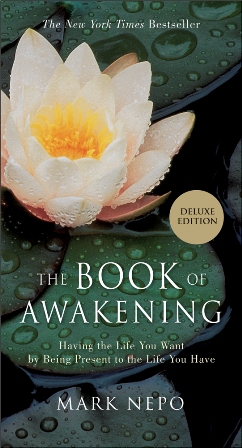
But before I deliberated on “doodlekit”—whatever or whoever that might be—Cooper provided a possibility for my current struggle with my two selves, True or False.

Mark Nepo and Mira threeintentions.com

Like any sensible being—canine or otherwise—Cooper is omnipresent to life in the now. In my last post, Trailblazing, I wrote about Cooper being ill and my glimpse of the road to the Rainbow Bridge or my False Self interjecting what may be but not what is.

In this moment in northern Florida, the humidity has dropped to 38% from over 90% and temperatures are high 40s with wind. It’s a cold, dry day, the kind that favors Cooper’s health, and he’s for it.

Dog ramp in tow, out the door we go for our ride. I open the hatch of my Toyota Scion. Cooper waits for me to stretch out the ramp and put it into place before he completely clears the ramp, as if he were a pup again, soaring  into the back of the Scion. With wide open grin, he turns and walks down the ramp. He is still Cooper; his dream still is “going bye-bye in the car” as we always have.

We take our usual front seats–I drive–before I can put the key into the ignition, Cooper licks my face for more than a few minutes. Once we settle into driving, Cooper places his paw on my hand, a dog having his day. Being human, I can only think of how hard my False Self works to prevent what may be.

We arrive at Guyte McCord Park for our daily stroll.

Again, I remember my morning’s meditation with Nepo and Carl Jung. In a dream, Jung works ceaselessly to clear a path to nowhere and to no purpose, it seems, until he reaches a cabin in a clearing, whereupon he drops his tools, and enters through its open door. He sees a being kneeling in front of a simple altar. Soon, he realizes he is seeing himself and “…that his life of cutting a path was this being’s dream.”  He has cleared the path to his True Self, his soul.

Cooper and I stop to sit awhile in a favorite area. He checks out scent. I stay with my two selves, True or False; I think we’re onto something.

Other than these daily park outings, I am no longer able to travel. This has been true for the last three years, not bad after more than thirty years of living with lupus.  Honestly, I’m still discovering what an extraordinary gift my life is but I seem to explore it only within my soul.

Dave R Farmer Image
WANA Commons

My False Self—the one that works so hard at fixing/preventing what may be—recently agreed to extensive family travel plans, relying once again on a way of life that no longer is but may be????

For two months, I thrashed through one form of fear or another over this trip: worry, stress, irritability, stress, sadness, stress—seeking any way it might be, any way except facing my True Self.

Not content with a Cooper leap of faith or a Jungian dream, my False Self screamed, stomped and swore until my online Scrabble partner (everyone should have a Scrabble partner of such equanimity) suggested I consider a drink or two, wondering whether it “would hurt that much?” Oh, out of the Chat wisdom of Scrabble partners….

KM Huber Image

I met myself not with drink but with an open heart for what is and no longer for what was. It hurt, all, but the air is clear, now.

A cold, canine muzzle nudges the limp leash handle loosely hanging from my fingers. Cooper is ready to go “bye-bye in the car,” as always.

A wonderful doodlekit? Who knows?

Rhythm of ROW80 Sunday Scheduling:

The 30-minute writing stretches have improved the overall quality of the “words I keep.” The exercise provides a way to think through material for blog posts as well as novel scenes.

As Gene Lempp mentioned in his blog today, none of this writing happens without patience. In that spirit, this week I am establishing a writing routine specific to my blog posts. I’m finding that it’s too much of a Sunday-Wednesday “time crunch” to produce quality posts. So, beginning this week, I will have two blog posts in final draft form by each Sunday.

I continue to work on my novel, using Larry Brooks’ Story Engineering and Kristen Lamb’s concept critique.  Last Saturday, I submitted an overview of the novel to my concept critique group and received excellent comments. I will work some with scenes and plots points as possible this week. This is the first substantial writing progress I’ve made in the last four years.

Dimensions of Creativity

“Creativity may be our Last Line of Defense” is the title of Gary Gauthier’s intriguing and well-written post that appeared on Sonia Medeiros’ blog this past Friday. For me, Gauthier’s consideration of creativity as our last defense in an increasingly technological world of  decreasing human tasks was not only sobering but a bit of a surprise. I realized I had only considered creativity from the human perspective. What about other dimensions?

Gizmodo.com image

Like Gauthier, I was quite taken with the performance of Watson, the IBM computer, on Jeopardy!  last Valentine’s Day. While some of Watson’s responses proved that human nuance is still a bit beyond a computer’s creativity, Watson won the knowledge rounds speedily and decisively.

I do not fear human or literary Watsons, I believe in them.

Gauthier also cited technology capable of creating journalism articles once “the facts” are provided. There are software programs for creating screenplays, novels, and probably just about any kind of writing for there is nothing new under the sun, which we’ve known at least since Ecclesiastes, probably before.

Time is relative and maybe so is creativity.

Until the 21stcentury, creativity has been a human component; truthfully, we don’t completely comprehend any dimension–yet. We’re not even completely convinced how our own human parts work but we know the sum of us is quite amazing. So, when it comes to creativity in technology, are we trying to simulate/emulate being human or are we vying for being perfect, which some would argue we already are.

greggbraden.com

What constitutes creativity? Is it the life force that animates a neutrino or a gnat as easily as a human? There is an argument that the life force in any dimension fights for every possible moment of existence, which seems pretty perfect already, creative even.

As for what creativity may mean for the 21st century, I came across this quote from Gregg Braden, a computer geologist who writes about the relationship between science and spirituality:

“For those who can embrace the learning curve of our past without judgment, the future becomes the palate for new industry, new jobs, new forms of expression, and new communities based upon sustainable ways of thinking, living, and being in our world” (Gregg Braden, Letter to the Community).

Poe Wikipedia Image
Edgar Allan Poe Wikipedia Image

For me, the source of all being is in matter and anti-matter; is in Einstein’s quantum entanglement of “spooky action at a distance”; is in Edgar Allan Poe’s sentient story, “The Fall of the House of Usher.” Maybe creativity is less a line of defense and more a bridge between humanity and all that is not.

Rhythm of ROW80 Sunday Scheduling:

The 30-minute writing stretches have improved the quality and number of  “words I keep.” The exercise provides a way to think through material for blog posts as well as novel scenes. In short, it’s creating much needed distance from the initial excitement of writing.

This week, I start writing the concept of my already drafted novel based upon Larry Brooks’ Story Engineering and Kristen Lamb’s concept critique.

Doing the Tao with Dyer away from duality, perhaps

Nepo morning meditation continues

Paradox Practice

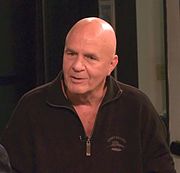
Wayne Dyer (Wikipedia photo)

I didn’t grow up practicing to be a paradox so when Wayne Dyer writes, “practice being a living, breathing paradox every moment of your life”* it seems a tad…paradoxical. Yet, my life of duality brought me only contrasts, opposites, comparisons and yes, judgment—all balancing acts of duality and not of the “paradoxical unity” that is the oneness of the Tao.

This I discover after almost 60 years of living but I do discover it.

More than thirty years of my life have been with lupus, an autoimmune disease that now actively lives with me permanently, unlike its earlier years of extended stays but then it had other names.   Truly, I understand “the name that can be named is not the eternal name.”

Regardless, lupus was made to order for practicing paradoxical unity.

For years, juggling balance, stressing no stress, and unlimiting limitations were my duality, uneven at best. The effort of trying to order my life out of chaos was like touching the wind. Yet, chaos, like every storm, has one, still eye that allows …”apparent duality while seeing the unity that is reality…[an] effortless action without attachment to outcome.”  By no longer focusing on outcome in my life with lupus, I replaced the trying and the effort with what is moment by moment.

Being requires a lot of presence–“duality is a mind game” that is always ready for a match–so I get a lot of paradox practice.

*Attribution: All quotations are excerpted from Wayne Dyer’s book, Change Your Thoughts, Change Your Life, Hay House, Inc., Carlsbad, CA, 2007.

ROW80 Wednesday Word Marking:

From January 2 until February 4, my goal was to write 250 words per day—as blog posts, fiction, or nonfiction–for an approximate total of 8250 words.

On February 4, I started the “30-minute” stretch in which I write for 30 minutes daily. So far, that has generated just over 3700 words, averaging about 900 words a day. It takes care of  a lot of my mind minutia so my other writing is more focused, and I fuss less.

Where Risk Resides

Wikipedia photo

When risk is choosing this one or that, I always think of  Linda Pastan’s poem, “Ethics.”

In ethics class so many years ago
our teacher asked this question every fall:
if there were a fire in a museum
which would you save, a Rembrandt painting
or an old woman who hadn’t many
years left anyhow? Restless on hard chairs
caring little for pictures or old age
we’d opt one year for life, the next for art
and always half-heartedly. Sometimes
the woman borrowed my grandmother’s face
leaving her usual kitchen to wander
some drafty, half imagined museum.
One year, feeling clever, I replied
why not let the woman decide herself?
Linda, the teacher would report, eschews
the burdens of responsibility.
This fall in a real museum I stand
before a real Rembrandt, old woman,
or nearly so, myself. The colors
within this frame are darker than autumn,
darker even than winter–the browns of earth,
though earth’s most radiant elements burn
through the canvas. I know now that woman
and painting and season are almost one
and all beyond saving by children.
Linda Pastan, from the collection Waiting for My Life (1981)

The poem sets up an array of caveats—whether the woman is loved or a stranger, whether or not one is mature in experience or just beginning to experience life, whether or not to choose—each requires risking this or that, one or the other, or not at all.

Mark Nepo writes:

“There is no substitute for genuine risk…the very core issues we avoid return, sometimes with different faces, but still, we are brought full circle to them, again and again” (The Book of Awakening).

Avoiding risk, somewhat akin to eschewing responsibility, seems to be a circular choice every time. Yet, in oneness—here and there, this and that–risk is whole, not one or the other, not old or young but the one truth that resides in us:

“It is we who, in our readiness and experience, keep coming back, because the soul knows only one way to fulfill itself, and that is to take in what is true” (Nepo, The Book of Awakening). 

Maybe that’s why the poem puts the annual question to children, who are no strangers to truth.

Rhythm of ROW80 Sunday Scheduling:

On February 3, added a 30-minute writing stretch—free writing that is timed—it helps clear the minutia of the moment so my daily writing is more focused.

Alternating short fiction, novel, and blog posts as daily writing

Doing the Tao with Dyer, still stuck in duality

Nepo morning meditation continues

“Once More to the Lake”

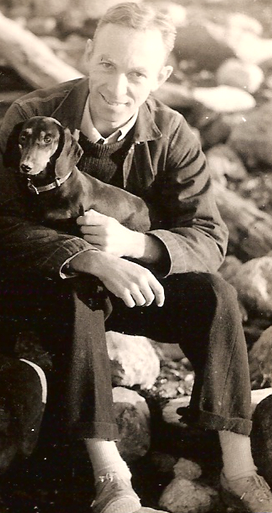
E B White (Wikipedia photo)

“Once More to the Lake” is a 1941 essay by E.B. White in which he returns to a Maine lake, revisiting childhood memories that are “precious and worth saving.” The essay is among the finest ever written; here  is my favorite paragraph in any writing anywhere:

“It seemed to me, as I kept remembering all this, that those times and those summers had been infinitely precious and worth saving. There had been jollity and peace and goodness. The arriving (at the beginning of August) had been so big a business in itself, at the railway station the farm wagon drawn up, the first smell of the pine-laden air, the first glimpse of the smiling farmer, and the great importance of the trunks and your father’s enormous authority in such matters, and the feel of the wagon under you for the long ten-mile haul, and at the top of the last long hill catching the first view of the lake after eleven months of not seeing this cherished body of water. The shouts and cries of the other campers when they saw you, and the trunks to be unpacked, to give up their rich burden…. Peace and goodness and jollity.”*

Always, White’s words return me to the lake that is my life, no matter when or where I am.

This time, it is 1985, on the last day of the last year I taught at the University of Wyoming. Alone, I sit in an empty classroom, with its beige, cracked-plaster walls—the rows of laminated desks stretched into an elongated square—I am 33, giddy in my belief that I am leaving teaching to write,  whatever it may mean. By 1989, it means part-time teaching in a college outreach program for a trio of towns in southwestern Wyoming—less than 3,000 total population—whose “jollity, peace, and goodness” still occupy me. With these students, I write in restaurants, in classes, in homes, returning again and again to White’s lake. It is the richest writing of my life with a Parker fountain pen—the cheapest but best my money can buy—scrawling in spiral notebooks of red covers and silver spines in the low light of a scrawny chandelier until 1991.

Some 21 years later, my writing unpacked, I return with White once more to the lake.

*“Once More to the Lake,” E.B. White in Eight Modern Essayists, 5th Edition, St. Martin’s Press, New York: 1990 (page 83).

ROW80 Wednesday Word Marker:

Since January 2, I aimed for writing 250 daily words that I could keep—as blog posts, fiction, or nonfiction–so far, I have approximately 7500 words.

“It Tells You.”

“You don’t tell it. It tells you.”  I included these two sentences in my reply to a comment on last Wednesday’s post, Goal-Gazing. The discussion was around writing and what it evokes in us, from the slough of despond to joy and every emotion in-between. All agreed writing is worth it.

Joan Didion, nndb.com image

Hours beyond the blog and out of the electronic ether entirely, the sentences return to me, just a tad tenacious. They belong to Joan Didion and are from her 1976 “Why I Write” essay.

“It tells you.”
“You don’t tell it.

I’m used to sorting and shuffling through my mind for “lines I like” but of late, I find my recollection is not always the original order of occurrence. I consult my well-used copy of William Smart’s Eight Modern Essayists, fifth edition, a resident of my writer’s bag until the end of the 20thcentury, now a bookshelf retiree to ease its spine.

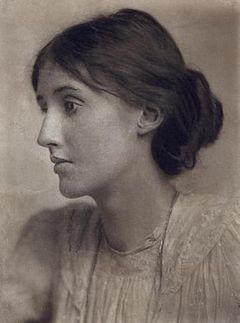
Virginia Woolf, Wikipedia image

I open the book to a heavily underlined passage from Virginia Woolf’s “Professions for Women,” her 1931 speech to The Women’s Service League:

“…for it is a very strange thing that people will give you a motor car if you will tell them a story. It is still a stranger thing that there is nothing so delightful in the world as telling stories…” (Page 12).

I consider finding the part about the Persian cat but I turn pages instead, remembering I may forget what I started. Didion’s one-line paragraphs return, as if on cue, but with the additional phrase of nota bene (note well), and I remember that the phrase precedes the paragraphs. 

“It tells you.
“You don’t tell it.”

At that point, I reach page 241 and read: “the arrangement of the words matters…[it] tells you what is going on in the picture.” I have believed this all my writing life—still do—moreover, Didion’s two, one-line paragraphs were a mantra for me—still are–nota bene to self.

Rhythm of ROW80 Sunday Scheduling:

  • Alternating short fiction, novel, and blog posts as daily writing
  • Doing the Tao with Dyer
  • Nepo morning meditation continues

Grace in the Ether

Grace Beatrice Brown Jenkins (1921-2011)

Although Grace was on this planet 90 years—just ten shy of a century—it was too soon for her to leave. Some lives are like that.

“She believed she would never die and she had the rest of us convinced,” Grace’s eldest daughter tells me.

I’m with Grace on death, just a matter of changing form. Yet, it is hard to let go of Grace even if she is in the ether.

Grace was disposed to kindness, courtesy, generosity. Her legacy overflows with civic and philanthropic works. The people of Casper, Wyoming–past residents and those yet to reside–thrive among Grace’s good works.

Like many Casperites, my introduction to opera came  from Grace.  I try not to miss a Saturday afternoon performance of “Live at the Met.” My classical FM radio station is a 24/7 background to my days, and on my own scale, I am a patron. I can distinguish an oboe from a clarinet in less than three notes; I have yet to hear chamber music that does not reach my essence.

I thought often of Grace before she entered the ether. The day she gave me her chili recipe is a frequent memory replay.

I sit at Grace’s modest, functional kitchen table as she thoughtfully answers my litany of questions, ranging from the distinctions between garlic powder and garlic salt to the indisputable opinion that Kuner’s kidney beans “are just the best.” My notes of the actual ingredient amounts are seriously sketchy–my scoffing at recipes proves to be a permanent trait—yet Grace provides the only phrase I need to hear: “the recipe will not fail.”

My culinary courage is still with me but Grace is in the ether now.

“but World enough and Time….”

On this first day of January, 2012,  here is  Andrew Marvell on love, perhaps the greatest quantum entanglement of all.

To His Coy Mistress

Had we but world enough, and time,
This coyness, lady, were no crime.
We would sit down and think which way
To walk, and pass our long love’s day;
Thou by the Indian Ganges’ side
Shouldst rubies find; I by the tide
Of Humber would complain. I would
Love you ten years before the Flood;
And you should, if you please, refuse
Till the conversion of the Jews.
My vegetable love should grow
Vaster than empires, and more slow.
An hundred years should go to praise
Thine eyes, and on thy forehead gaze;
Two hundred to adore each breast,
But thirty thousand to the rest;
An age at least to every part,
And the last age should show your heart.
For, lady, you deserve this state,
Nor would I love at lower rate.

But at my back I always hear
Time’s winged chariot hurrying near;
And yonder all before us lie
Deserts of vast eternity.
Thy beauty shall no more be found,
Nor, in thy marble vault, shall sound
My echoing song; then worms shall try
That long preserv’d virginity,
And your quaint honour turn to dust,
And into ashes all my lust.
The grave’s a fine and private place,
But none I think do there embrace.

        Now therefore, while the youthful hue
Sits on thy skin like morning dew,
And while thy willing soul transpires
At every pore with instant fires,
Now let us sport us while we may;
And now, like am’rous birds of prey,
Rather at once our time devour,
Than languish in his slow-chapp’d power.
Let us roll all our strength, and all
Our sweetness, up into one ball;
And tear our pleasures with rough strife
Thorough the iron gates of life.
Thus, though we cannot make our sun
Stand still, yet we will make him run.